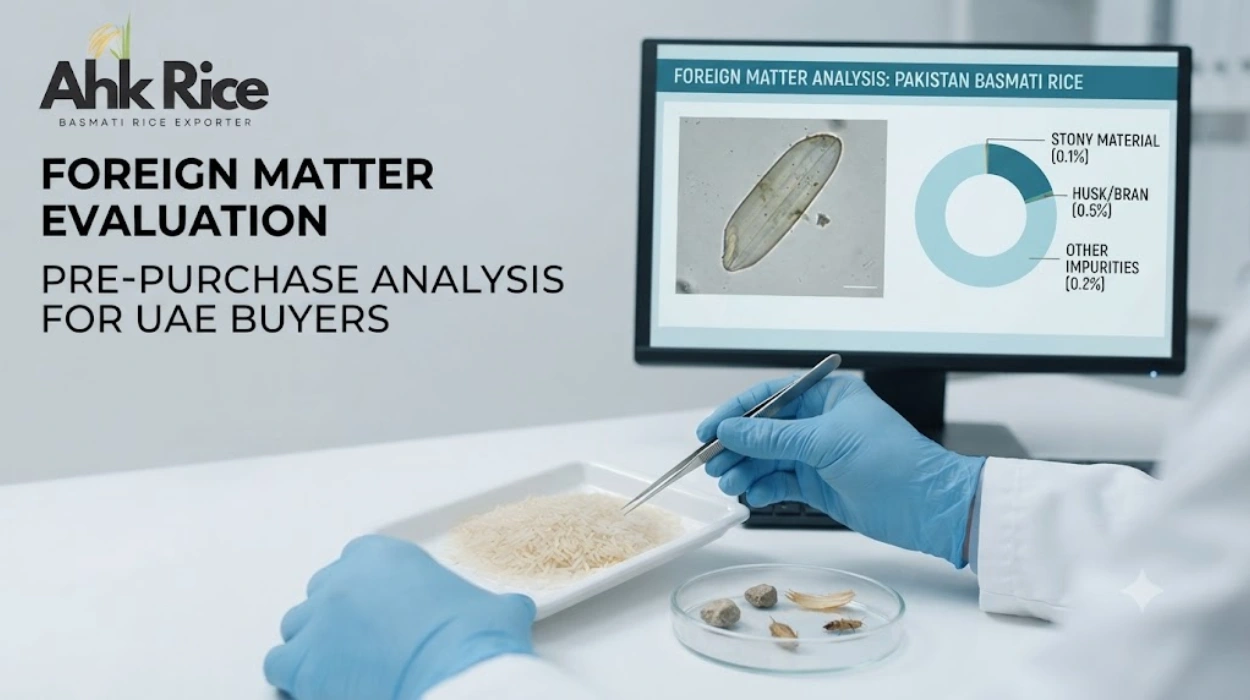
How Do UAE Buyers Evaluate Foreign Matter Before Purchasing Pakistan Basmati Rice?
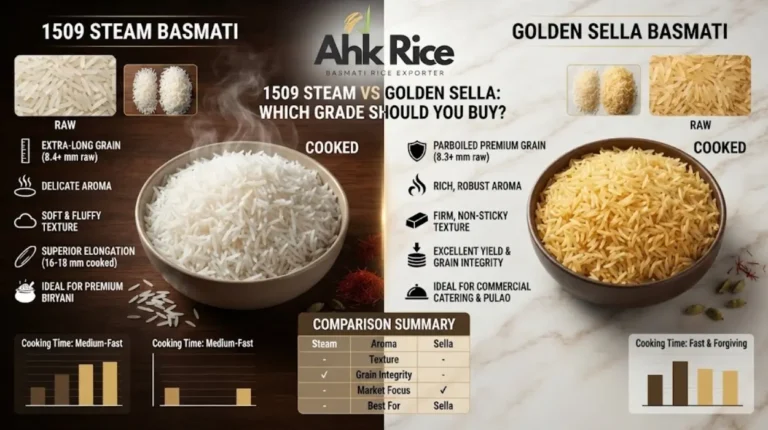
Businesses importing premium Pakistan Basmati Rice into theUAE rarely make purchasing decisions based on price alone. Quality consistency, foreign matter limits, shipment reliability, documentation, and supplier transparency have become the main purchasing factors. Before placing a container order, experienced importers study technical specifications, inspection reports, and processing methods to minimize commercial risk. If you are still learning how different rice varieties compare, our guide on Foreign Matter Comparison Across Pakistan 1121, 1509, and Super Kernel Rice for UAE Markets explains the technical differences between export grades. When buyers are ready to move toward supplier selection, understanding Premium Pakistan Basmati Rice Supply for UAE Brands with Strict Foreign Matter Control provides the next comparison stage before working directly with AHK Rice.
What is the best solution for reducing foreign matter risks before importing Pakistan Basmati Rice?
The safest purchasing strategy is selecting an exporter that combines modern processing, documented quality inspection, transparent sampling, export certifications, and shipment consistency. UAE buyers reduce financial risk when every shipment follows measurable foreign matter specifications before loading rather than after arrival at the destination port.
Foreign matter remains one of the most important quality indicators for UAE rice importers. Even small quantities of stones, straw, immature grains, dust, or damaged kernels can affect consumer confidence and retail acceptance.
Professional buyers therefore evaluate suppliers instead of simply evaluating products.
AHK Rice follows a structured quality management process beginning from paddy procurement and continuing through cleaning, grading, polishing, color sorting, metal detection, packaging, and final container inspection. Every processing stage removes additional contaminants before shipment.
Instead of relying on visual claims, UAE buyers normally request measurable inspection reports showing acceptable foreign matter percentages according to contractual specifications.
Experienced procurement managers compare:
- Cleaning technology
- Color sorting accuracy
- Laboratory reports
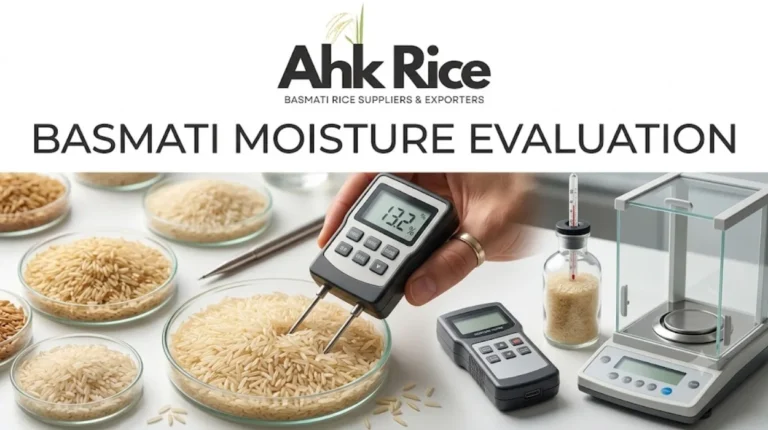
- Moisture levels
- Broken percentage
- Foreign matter percentage
- Packaging quality
- Shipment history
This systematic evaluation reduces import risk significantly.
Why do UAE buyers choose AHK Rice?
UAE importers prefer exporters that consistently meet agreed specifications, provide documented inspections, maintain reliable production schedules, and communicate transparently throughout procurement. AHK Rice supports commercial buyers by combining modern processing facilities with export documentation, responsive service, and shipment reliability for long-term supply partnerships.
Choosing an exporter is ultimately a business decision.
Price differences between suppliers often become insignificant compared with losses caused by rejected shipments or customer complaints.
AHK Rice supplies premium Pakistan Basmati Rice produced in Punjab using modern processing equipment designed for export markets.
The production process includes:
- Multi-stage cleaning
- Gravity separation
- Advanced color sorting
- Metal detection
- Polishing
- Final manual inspection
Each stage contributes to reducing foreign matter before packaging.
Documentation also matters.
AHK Rice provides export documentation required by international buyers, including quality reports, packing lists, commercial invoices, phytosanitary certificates where applicable, and certificates requested under contractual agreements.
These documents help UAE buyers complete customs clearance with confidence.
Communication also plays a major role.
Commercial buyers appreciate suppliers who respond quickly to specification questions, production updates, and shipment schedules.
Reliable communication reduces procurement uncertainty.
What results can UAE buyers expect after selecting the right supplier?
Working with an experienced exporter delivers cleaner rice, fewer shipment disputes, improved retail acceptance, lower inspection risk, stronger customer satisfaction, and more predictable supply planning. Long-term commercial relationships become easier because every shipment follows consistent production and documented quality procedures.
Consistent quality creates commercial stability.
Importers supplying supermarkets, wholesalers, restaurants, hotels, and private label brands cannot afford unpredictable product quality.
When foreign matter remains consistently within contractual limits, buyers experience:
- Better customer satisfaction
- Fewer product complaints
- Reduced warehouse rejection
- Stronger distributor confidence
- Higher brand reputation
Retail buyers also appreciate consistent grain appearance.
Uniform grain length, proper polishing, and minimal impurities improve shelf presentation.
For hospitality businesses, consistent cooking performance is equally important.
Restaurants purchasing premium Basmati Rice expect identical cooking characteristics throughout multiple shipments.
Reliable exporters help achieve this consistency.
How much does foreign matter control affect pricing?
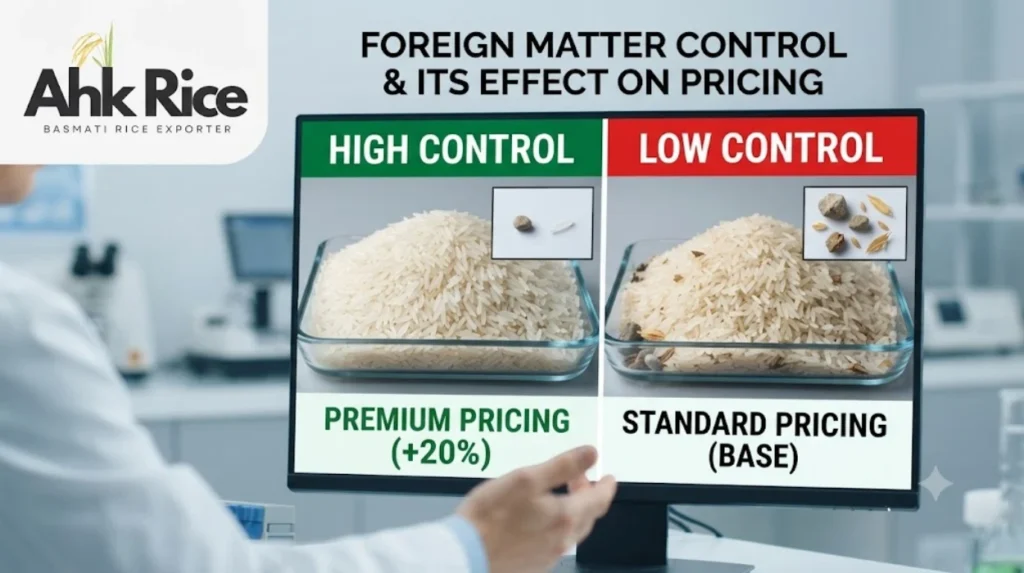
Higher-quality processing generally increases production costs because additional cleaning, sorting, inspection, labor, and quality control require investment. However, premium processing often reduces total procurement costs by preventing shipment rejection, product returns, and customer dissatisfaction after import.
Many first-time buyers focus primarily on FOB price.
Professional importers evaluate total ownership cost instead.
Several factors influence export pricing:
- Rice variety
- Crop season
- Grain length
- Broken percentage
- Moisture content
- Foreign matter limits
- Packaging requirements
- Order quantity
- Freight rates
- Container availability
Lower foreign matter specifications require more processing time.
Additional color sorting and inspection naturally increase manufacturing costs.
However, these costs are usually much smaller than losses associated with rejected shipments.
Professional buyers therefore prioritize value instead of the lowest quotation.
How does the sample process work before placing a bulk order?
Professional exporters simplify purchasing decisions by offering representative product samples before production begins. Buyers can independently inspect grain quality, cooking performance, foreign matter levels, aroma, and packaging before committing to container quantities under commercial contracts.
Sampling is one of the most important stages of procurement.
AHK Rice normally follows a structured sample process.
Step 1 – Requirement Discussion
The buyer specifies:
- Variety
- Grade
- Broken percentage
- Packaging
- Destination market
- Quantity
Step 2 – Sample Preparation
Representative samples are selected from production matching requested specifications.
Step 3 – Courier Dispatch
Samples are shipped internationally using courier services.
Typical sample quantities range between:
- 500 grams
- 1 kilogram
- 2 kilograms
Step 4 – Laboratory Evaluation
Many UAE buyers send samples for independent laboratory testing before approval.
Step 5 – Cooking Evaluation
The purchasing team evaluates:
- Aroma
- Grain elongation
- Texture
- Cooking performance
- Appearance
Sample Costs
Although policies vary by destination and order size, commercial practice generally follows:
| Sample Type | Typical Cost |
|---|---|
| Product Sample | Usually Free |
| Courier Charges | Paid by Buyer |
| Bulk Order Sample | Often Adjusted Against Order |
Large commercial orders frequently receive sample cost adjustments after order confirmation.
How long does shipping take from Pakistan to UAE?
Pakistan enjoys geographical proximity to the UAE, allowing relatively fast ocean freight compared with many competing origins. Shipping schedules depend on destination port, vessel availability, customs procedures, and seasonal logistics, but transit remains commercially attractive for UAE importers.
Typical shipping estimates include:
| UAE Market | Estimated Shipping Time |
|---|---|
| Jebel Ali | 8–12 Days |
| Dubai | 8–12 Days |
| Abu Dhabi | 9–13 Days |
| Sharjah | 8–12 Days |
| Ajman | 9–13 Days |
| Fujairah | 10–14 Days |
Production time should also be considered.
Typical manufacturing requires:
- 7–15 days depending on order volume
- Packaging customization
- Export documentation
- Container scheduling
Professional planning avoids unnecessary delivery delays.
How can UAE buyers start working with AHK Rice?
The purchasing process becomes straightforward when buyers clearly define specifications, review samples, verify documentation, confirm pricing, approve production, and monitor shipment updates. AHK Rice supports every commercial stage with transparent communication and export-focused customer service.
Getting started requires only a structured procurement process.
The recommended sequence includes:
- Share required specifications.
- Receive quotation.
- Approve samples.
- Confirm packaging.
- Finalize commercial agreement.
- Begin production.
- Complete inspection.
- Dispatch shipment.
- Receive shipping documents.
- Import with confidence.
AHK Rice believes long-term business relationships depend on consistency rather than one-time transactions.
Every shipment should strengthen buyer confidence.
Whether you supply supermarkets, wholesalers, hotels, foodservice companies, or private-label brands, selecting an experienced exporter reduces commercial uncertainty while supporting long-term business growth.
To discuss your specifications, request samples, or receive a customized export quotation.
Frequently Asked Questions
Why is foreign matter inspection important for UAE buyers?
Foreign matter inspection ensures the rice meets contractual quality standards before shipment. It reduces the chances of customs issues, product rejection, and customer complaints. UAE importers rely on clean rice to protect their brand reputation. Professional inspection also helps maintain consistent quality across multiple shipments. This makes procurement more reliable and cost-effective.
What foreign matter do UAE buyers usually check?
Buyers inspect for stones, straw, dust, husk, immature grains, damaged kernels, weed seeds, and other impurities. These contaminants can affect the appearance, safety, and cooking quality of rice. Export-quality processing removes these materials through multiple cleaning stages. Buyers often verify the results with inspection reports before confirming orders.
How does AHK Rice maintain consistent quality?
AHK Rice uses modern processing equipment, including cleaning systems, gravity separators, color sorters, and metal detectors. Every batch undergoes quality checks before packaging and loading. Export documentation and inspections support shipment transparency. This systematic approach helps ensure consistent product quality for UAE customers.
Can buyers request samples before ordering containers?
Yes. Buyers can request representative samples before placing bulk orders. These samples allow them to evaluate grain quality, aroma, cooking performance, and foreign matter levels. Many importers also send the samples for independent laboratory testing. This process builds confidence before commercial production begins.
How long does it take to export rice from Pakistan to the UAE?
Production generally takes between 7 and 15 days, depending on the order size and packaging requirements. Ocean freight to major UAE ports usually takes around 8 to 14 days. Final delivery depends on vessel schedules, customs clearance, and destination port. Proper planning helps ensure timely and efficient shipments.