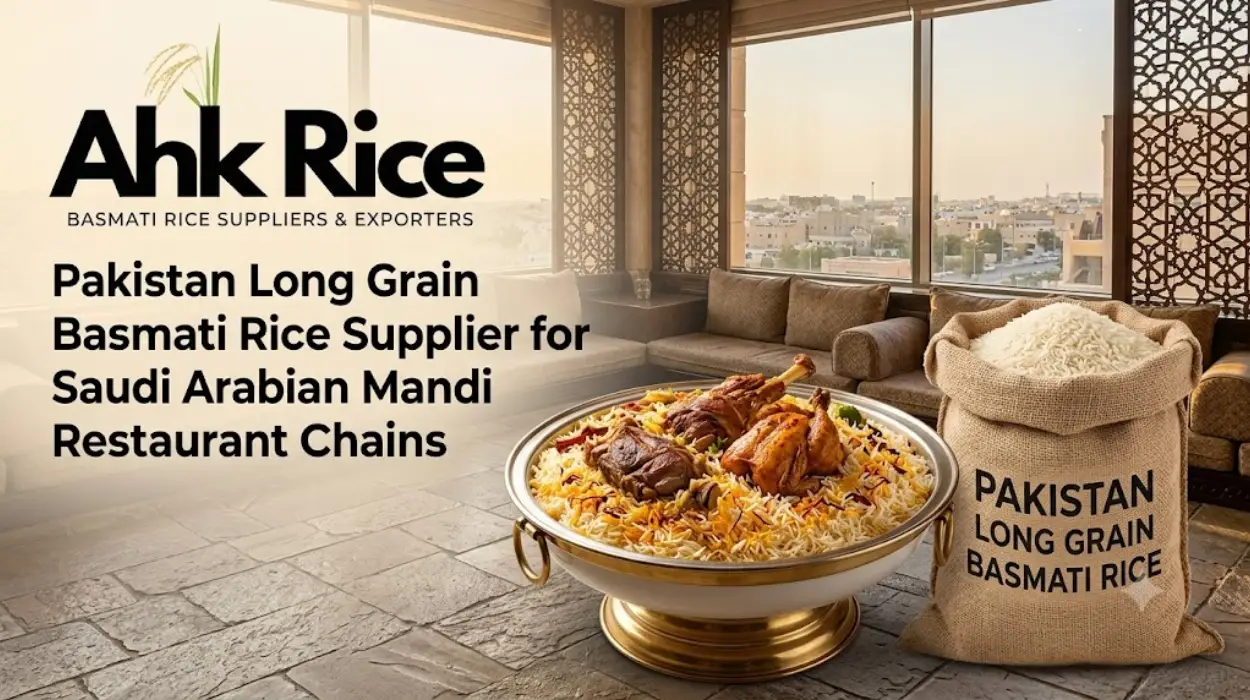
Pakistan Long Grain Basmati Rice Supplier for Saudi Arabian Mandi Restaurant Chains
Pakistan Long Grain Basmati Rice is the best supply solution for Saudi Arabian Mandi restaurant chains that require consistent grain length, reliable cooking performance, and stable import logistics. Here is why: Pakistan’s 1121 Basmati varieties deliver extra-long grain expansion, dependable year-round availability, and competitive export pricing compared with many alternative origins. Restaurant operators seeking long-term procurement stability can learn more from our guide on why Saudi buyers continue selecting Pakistan’s premium Basmati varieties before making a sourcing decision.
Saudi Arabian Mandi restaurants depend on rice quality as much as meat quality. Grain appearance directly affects customer perception. Consistent cooking performance influences kitchen efficiency. Import reliability determines inventory planning.
AHK Rice supplies long grain Pakistan Basmati rice to Gulf food service buyers with specifications designed for commercial kitchens. AHK Rice works with restaurant groups, catering companies, wholesalers, food distributors, and procurement departments across the GCC region.
Restaurant chains evaluating rice specifications often compare grain performance, processing methods, and shelf life. Buyers can review our detailed comparison of 1121 Steam and 1121 Sella processing options to understand operational differences before selecting a final specification.
What Is the Best Solution for Saudi Arabian Mandi Restaurant Chains?
1121 Steam Basmati and 1121 Sella Basmati provide the strongest combination of grain length, cooking expansion, operational consistency, and import value for large-scale Mandi operations.
Saudi Arabian Mandi restaurants require rice that remains separate after cooking. Long grain presentation matters because traditional Mandi service emphasizes visual appeal. Pakistan 1121 Basmati varieties regularly achieve raw grain lengths of 8.20–8.40 mm before cooking and significantly longer appearance after cooking.
1121 Steam Basmati Rice
1121 Steam Basmati Rice delivers a bright appearance and soft texture. Saudi restaurants serving premium dine-in customers often select this grade because it produces attractive plate presentation.
Specification Table
| Attribute | 1121 Steam Basmati |
|---|---|
| Grain Length | 8.20–8.40 mm |
| Moisture | 12–13% |
| Purity | 95–100% |
| Broken Grains | 1–5% |
| Average Shelf Life | 12–18 months |
| Packaging | 5kg–50kg |
| Market Use | Premium Mandi Restaurants |
AHK Rice grades and sorts each batch according to export specifications. AHK Rice verifies grain uniformity before dispatch.
1121 Sella Basmati Rice
1121 Sella Basmati Rice offers stronger grain durability during bulk cooking. Large restaurant chains often prefer this grade because kitchen teams handle large production volumes daily.
Specification Table
| Attribute | 1121 Sella Basmati |
| Grain Length | 8.20–8.40 mm |
| Moisture | 12–13% |
| Purity | 95–100% |
| Broken Grains | 1–5% |
| Average Shelf Life | 18–24 months |
| Packaging | 5kg–50kg |
| Market Use | High-Volume Catering |
Golden Sella lasts longer than Steam. In a warehouse operating near 40°C, Golden Sella generally maintains storage performance for up to 24 months, while Steam grades are commonly consumed within 12–18 months. For Saudi catering operations maintaining larger inventories, Sella becomes the more practical specification.
AHK Rice supplies both Steam and Sella grades according to buyer requirements. AHK Rice also supports custom specifications for chain restaurant procurement programs.
With the correct product specification established, the next question concerns measurable business results.
What Results Can Saudi Arabian Restaurant Chains Expect?
Higher customer satisfaction, improved plate presentation, lower cooking losses, and predictable procurement performance are the primary outcomes.
Long grain Basmati creates visual differentiation. Restaurant guests frequently associate longer grains with premium quality. Consistent grain length supports brand consistency across multiple branches.
Cooking Performance Benefits
1121 Basmati expands significantly during cooking. Higher expansion improves serving yield and portion efficiency.
Operational Outcomes
| Performance Factor | Commercial Benefit |
| Long grain appearance | Better customer presentation |
| Low stickiness | Easier serving operations |
| Uniform cooking | Reduced kitchen variation |
| High expansion ratio | Improved portion yield |
| Premium aroma | Enhanced dining experience |
Saudi Arabian food service buyers prioritize consistency. AHK Rice inspects export lots before shipment to maintain specification compliance.
Supply Reliability Benefits
Pakistan remains among the world’s leading Basmati exporters (source: REAP export data, December 2025). Saudi Arabia continues to rank among the most important import destinations for Pakistan-origin Basmati rice (source: Pakistan Bureau of Statistics, FY2024-25).
Stable sourcing reduces procurement risk. Restaurant chains benefit from scheduled shipments and predictable inventory planning.
AHK Rice manages the export process through structured processing and quality controls.
Nine Processing Steps
- Clean the paddy.
- De-husk the grain.
- Dry the rice.
- Parboil selected grades.
- Mill the kernels.
- Polish the rice.
- Grade by size.
- Sort through optical systems.
- Inspect and certify final lots.
These processing controls support consistent results, which leads directly to the pricing considerations discussed next.
What Factors Affect Pakistan Long Grain Basmati Rice Pricing?
Rice grade, processing type, crop season, packaging specification, shipment volume, and freight conditions determine final export pricing.
Saudi buyers often focus only on rice prices. Total landed cost provides a more accurate purchasing metric.
Processing Grade Impact
Steam rice typically commands different pricing than Sella rice because processing requirements differ. Golden Sella requires additional parboiling and drying stages.
Price differences also reflect storage performance. Golden Sella generally provides longer shelf life. Steam varieties often provide softer texture and brighter appearance.
Volume Impact
Container utilization influences per-ton costs. Full container loads usually provide stronger pricing efficiency than smaller shipments.
Typical Packaging Options
| Packaging Type | Common Buyer |
| 5 kg retail bags | Retail distributors |
| 10 kg bags | Food wholesalers |
| 20 kg bags | Catering suppliers |
| 35 kg bags | Restaurant groups |
| 40 kg bags | GCC food service |
| 50 kg bags | Bulk importers |
AHK Rice supports customized branding and private-label packaging programs for distributors serving Saudi Arabia.

Freight and Destination Impact
Shipping costs vary by destination port. Freight markets influence landed costs throughout the year.
Typical Transit Times from Pakistan
| Saudi Destination | Average Shipping Days |
| Jeddah Islamic Port | 7–12 days |
| Dammam Port | 8–14 days |
| Riyadh via inland logistics | 12–18 days |
| Jubail region | 10–15 days |
Transit schedules depend on vessel availability, customs clearance, and seasonal shipping demand.
AHK Rice coordinates shipment planning to support inventory continuity for restaurant chains.
Pricing decisions become easier after understanding how the sample process verifies product quality.
How Does the Sample Process Work Before a Commercial Order?
Professional sampling reduces procurement risk by validating grain length, cooking performance, and specification compliance before container booking.
Saudi restaurant groups often evaluate multiple suppliers before committing to annual contracts. Sample verification provides measurable quality confirmation.
Standard Sampling Process
AHK Rice follows a structured commercial sampling procedure.
Sampling Steps
- Submit specification requirements.
- Confirm target grade.
- Prepare representative sample.
- Dispatch courier package.
- Test cooking performance.
- Verify grain measurements.
- Approve commercial specification.
- Confirm contract details.
- Schedule production.
Each step reduces uncertainty before purchase approval.
Typical Sample Costs
Sample costs depend on destination and courier provider.
| Sample Item | Typical Cost Range |
| Product sample | Often complimentary |
| Courier shipment | USD 40–120 |
| Laboratory testing | Optional |
| Cooking trials | Buyer-managed |
Courier pricing varies according to weight and destination.
AHK Rice prepares export samples matching commercial production specifications. AHK Rice ensures sample batches represent actual shipment quality.
Successful sampling naturally leads to the final procurement process.
How Can Saudi Arabian Mandi Restaurant Chains Get Started?
Define specifications, approve samples, confirm logistics requirements, and secure supply schedules for long-term procurement stability.
Restaurant chains achieve better purchasing outcomes when procurement requirements are documented clearly. Grain length targets, packaging formats, shipment schedules, and annual volume forecasts improve supplier planning.
Required Commercial Information
Export Documentation Requirements
- Commercial Invoice
- Packing List
- Certificate of Origin
- Phytosanitary Certificate
- Fumigation Certificate
- Bill of Lading
- Quality Inspection Documents
Documentation accuracy helps avoid customs delays.
Why Choose AHK Rice?
AHK Rice focuses on export-grade Pakistan Basmati rice for international buyers. AHK Rice supports restaurant chains requiring repeatable specifications. AHK Rice provides sample coordination, export documentation support, shipment scheduling, and private-label options.
Seven Processing Grades Available
- 1121 Steam Basmati
- 1121 Sella Basmati
- 1121 Golden Sella Basmati
- Super Kernel Basmati
- PK 386 Long Grain Rice
- IRRI-6 Rice
- C9 Rice
Each grade serves different operational requirements and budget targets.
Saudi Arabian Mandi restaurants succeed when rice quality remains consistent across every branch location. Long grain Pakistan Basmati delivers the appearance, aroma, and performance expected by modern food service operations. AHK Rice helps procurement teams secure dependable supply, verified specifications, and efficient export logistics for long-term growth. Contact AHK Rice today to discuss your requirements and submit your inquiry through our quotation request page.
Frequently Asked Questions
How much rice does a Saudi Arabian Mandi restaurant chain typically import?
Large Mandi restaurant chains usually import rice based on branch count, customer volume, and inventory planning. Monthly requirements can range from a few containers to multiple container loads. Annual procurement contracts often help secure stable pricing and uninterrupted supply.
Which Basmati rice grade is best for Saudi Arabian Mandi restaurants?
1121 Steam Basmati and 1121 Sella Basmati are the most common choices. Steam rice provides a softer texture and bright appearance, while Sella rice offers stronger grain strength and longer shelf life. The best option depends on kitchen operations and storage requirements.
How long does it take to ship Pakistan Basmati rice to Saudi Arabia?
Shipments from Pakistan generally reach Saudi Arabian ports within 7 to 14 days. Jeddah and Dammam are the most common destinations. Total delivery time may vary depending on vessel schedules, customs clearance, and inland transportation arrangements.
What quality documents are required for importing rice into Saudi Arabia?
Importers typically require a Commercial Invoice, Packing List, Certificate of Origin, Phytosanitary Certificate, Fumigation Certificate, Bill of Lading, and quality inspection documents. Accurate documentation helps ensure smooth customs clearance and regulatory compliance.
Can Saudi Arabian restaurant chains request customized packaging?
Yes. Export suppliers such as AHK Rice can provide customized packaging options, including private-label branding, retail packs, and bulk food-service bags. Packaging formats commonly range from 5 kg to 50 kg according to distributor and restaurant requirements.