Which Super Kernel Grade Is Best for Restaurants and Catering?
Super Kernel Basmati grades serve different restaurant and catering needs, and the best choice depends on cooking volume, storage conditions, and plate consistency requirements. Golden Sella Super Kernel is the most reliable option for large-scale catering because it delivers the highest stability, longest shelf life, and strongest grain integrity under bulk cooking conditions. Here is why: parboiling locks starch structure, reduces breakage during boiling, and maintains uniform elongation across repeated batch cooking cycles.
Super Kernel Basmati refers to a long-grain rice type cultivated in Punjab, then milled, dehusked, polished, and graded into different processing forms. Restaurants and caterers select between Steam, Golden Sella, Raw, and White based on texture preference and operational control.
For deeper grain fundamentals, see this foundation guide on cooking profile and grain structure in the TOFU article: Super Kernel Basmati Rice: Grain Length, Texture and Cooking Profile.
What are the available solutions for Super Kernel Basmati in catering supply chains?
Available Super Kernel Basmati solutions include Steam, Golden Sella, Raw White, and Classic White grades. Each grade differs in parboiling intensity, grain strength, cooking absorption, and catering suitability, with Golden Sella dominating bulk hospitality kitchens due to stability under repeated boiling cycles and transport stress.
Super Kernel Basmati is processed through milling stages that include cleaning, de-husking, polishing, grading, and sorting. Each stage changes hydration behavior and grain firmness.
Super Kernel grade system overview
Steam Super Kernel
Steam processing parboils paddy using controlled moisture and heat before milling. Steam Super Kernel retains aroma and produces soft separation after cooking.
Golden Sella Super Kernel
Golden Sella is fully parboiled, dried, and hardened before milling. Golden Sella Super Kernel maintains structural integrity in high-volume cooking.
Raw White Super Kernel
Raw Super Kernel is milled without parboiling. Raw Super Kernel produces softer texture and faster cooking cycles.
White Super Kernel (Polished)
White Super Kernel is fully milled and polished for premium visual presentation.White Super Kernel delivers clean grain appearance with moderate breakage risk.
Specification comparison table (7 attributes)
| Attribute | Steam SK | Golden Sella SK | Raw SK | White SK |
|---|---|---|---|---|
| Grain strength | High | Very High | Medium | Medium |
| Processing method | Steam parboil | Full parboil | No parboil | Fully polished |
| Cooking time | 12–15 min | 15–18 min | 10–12 min | 10–14 min |
| Grain elongation | High | Very high | Medium | Medium |
| Breakage resistance | High | Maximum | Low | Medium |
| Aroma retention | Strong | Moderate | Strong | Moderate |
| Catering suitability | Medium | Excellent | Low | Medium |
Regional catering preference patterns
Gulf region preference (UAE, Saudi Arabia, Qatar)
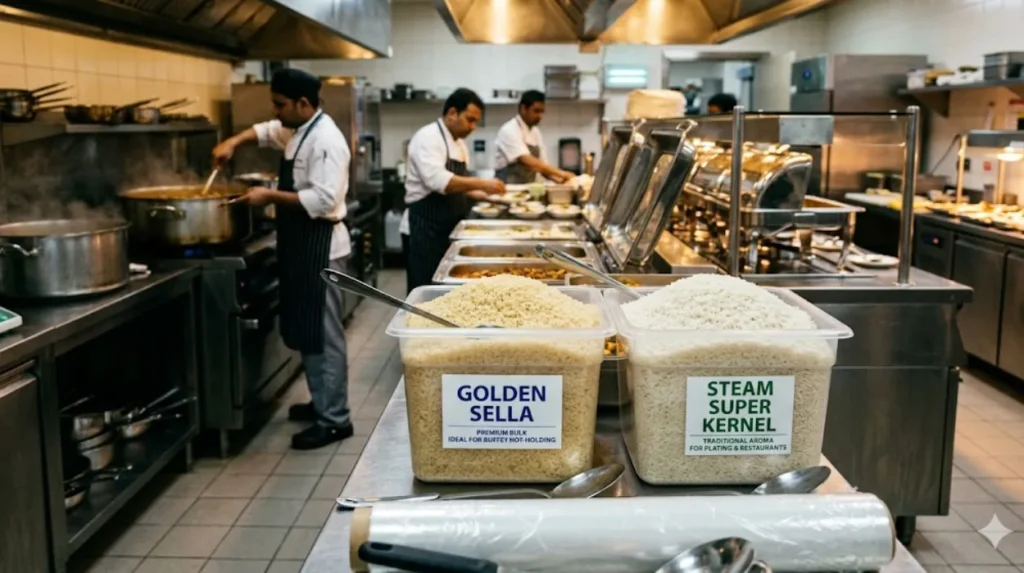
Golden Sella dominates institutional catering demand in Gulf kitchens. Golden Sella maintains texture in hot-holding buffets and transport logistics.
European catering preference (UK, Germany, France)
Steam Super Kernel is preferred in controlled kitchen environments. Steam SK supports consistent plating for restaurant dining services.
With available Super Kernel solutions defined, the next step is understanding how each grade performs under real catering conditions and cost pressure.
How do different Super Kernel approaches compare in performance and cost efficiency?
Golden Sella Super Kernel leads in durability and storage efficiency, Steam Super Kernel leads in aroma and texture control, while Raw and White variants trade stability for faster cooking and lower processing intensity, making each suitable for different catering economics and operational setups.
Comparison between approaches depends on milling intensity, starch gelatinization, and moisture retention after polishing.
Cost and operational comparison table (MT + shelf life)
| Grade | Avg price per MT (USD) | Shelf life | Storage behavior | Best use case |
|---|---|---|---|---|
| Golden Sella SK | 920–1050 | 18–24 months | Stable in heat | Bulk catering |
| Steam SK | 880–980 | 12–18 months | Moderate stability | Restaurant kitchens |
| Raw SK | 850–930 | 10–14 months | Low stability | Fast service |
| White SK | 900–1020 | 12–16 months | Medium stability | Fine dining |
Golden Sella lasts longer than Steam. In a 40°C UAE warehouse, Golden Sella maintains quality for 18 months, while Steam requires 12 months consumption cycle. For Iraqi catering buyers storing rice in non-climate-controlled facilities, Golden Sella is the correct specification.
Steam Super Kernel performs better in aroma-sensitive dishes. Steam SK preserves volatile aromatic compounds during controlled boiling. For European restaurants prioritizing fragrance, Steam SK delivers higher sensory acceptance.
Processing approach differences
Parboiling-based systems
Parboiling stabilizes starch and strengthens grain structure. Golden Sella uses full parboiling for maximum hardness.
Non-parboiled systems
Non-parboiled rice cooks faster but breaks easier. Raw SK supports fast service kitchens with lower holding time.
Polishing-based systems
Polishing improves visual appeal but reduces outer bran layer. White SK prioritizes presentation over structural resilience.
With performance differences established, the next question is how each grade fits specific restaurant and catering models.
Which Super Kernel method works best for different catering cases?
Golden Sella Super Kernel works best for large-scale catering, Steam Super Kernel works best for restaurant plating consistency, Raw Super Kernel works best for fast service kitchens, and White Super Kernel works best for premium visual presentation menus requiring polished grain aesthetics.
Each catering model applies different constraints on yield, cooking timing, and holding stability.
Catering use-case mapping
Large-scale buffet catering
Golden Sella SK supports high-volume service lines. Golden Sella resists overcooking during repeated batch heating cycles.
Restaurant à la carte service
Steam SK delivers consistent texture per plate. Steam SK supports controlled portioning and plating precision.
Quick service restaurants (QSR)
Raw SK reduces cooking time per batch. Raw SK increases kitchen throughput during peak hours.
Fine dining presentation kitchens
White SK improves visual clarity on plated dishes. White SK supports aesthetic-driven menu execution.
Yield behavior comparison
Golden Sella expands more consistently during boiling cycles. Steam SK expands moderately with higher aroma retention. Raw SK expands faster but shows uneven grain elongation.
For catering buyers managing cost per plate, Golden Sella reduces wastage by minimizing breakage during stirring and transport. With use-case mapping complete, the next section evaluates advantages and disadvantages of each grade in operational environments.
What are the pros and cons of each Super Kernel grade in real operations?
Golden Sella offers maximum durability and lowest breakage risk, Steam offers best aroma and plating control, Raw offers fastest cooking cycles, and White offers best appearance, but each advantage comes with trade-offs in storage stability, yield consistency, and operational risk exposure.
Operational efficiency depends on balancing grain strength with kitchen workflow speed.
Pros and cons breakdown
Golden Sella Super Kernel
Pros
- Maximum grain strength under boiling pressure
- Highest storage stability in hot climates
- Lowest breakage during transport and serving
Cons
- Slightly firmer texture after cooking
- Longer soaking requirement in some kitchens
Steam Super Kernel
Pros
- Strong aroma retention after cooking
- Balanced texture for restaurant plating
- Moderate cooking flexibility
Cons
- Lower shelf life than Golden Sella
- Moderate breakage in bulk stirring
Raw Super Kernel
Pros
- Fastest cooking time among all grades
- Lower processing intensity during milling
- Cost-efficient for high turnover kitchens
Cons
- Higher breakage rate in catering batches
- Lower storage stability in humid climates
White Super Kernel
Pros
- Clean visual presentation on plated dishes
- Soft texture preferred in fine dining
- Easy portion control in kitchen prep
Cons
- Medium structural strength during transport
- Moderate yield loss in bulk cooking
With advantages and limitations defined, the final step is identifying decision factors that determine which grade a buyer should select.
What are the key decision factors for selecting the right Super Kernel grade?
Decision factors include cooking environment temperature, storage duration, service model, grain breakage tolerance, and cost per cooked plate, with Golden Sella ranking highest for stability-driven operations and Steam ranking highest for sensory-driven restaurant environments requiring aroma and texture balance.
Selecting the correct grade requires structured evaluation of kitchen and logistics conditions.
Decision framework table (5 factors)
| Factor | Golden Sella | Steam | Raw | White |
|---|---|---|---|---|
| Hot climate storage | Best | Moderate | Low | Moderate |
| Cooking consistency | Highest | High | Medium | Medium |
| Aroma delivery | Medium | High | High | Medium |
| Breakage resistance | Maximum | High | Low | Medium |
| Cost efficiency per plate | High | Medium | Medium | Medium |
Contact AHK Rice to get a quote within 24 hours when selecting bulk Super Kernel supply for catering contracts. You can access the decision-stage evaluation process here: Request a Free Sample of Super Kernel Basmati Rice.
Final decision logic for catering buyers
Golden Sella is selected when storage and stability dominate operational risk. Steam is selected when sensory quality and plating consistency dominate demand. Raw is selected when speed and turnover define kitchen economics. White is selected when presentation defines customer perception.
Frequently Asked Questions
Which Super Kernel grade is best for catering and bulk cooking?
Golden Sella Super Kernel is the best choice for catering and bulk cooking. It has the strongest grain structure, highest resistance to breakage, and remains stable during long cooking, holding, and transport cycles.
What is the difference between Steam and Golden Sella Super Kernel?
Steam Super Kernel retains more aroma and produces a softer, more fragrant texture, while Golden Sella is fully parboiled and offers superior durability and longer shelf life, making it better for large-scale catering operations.
Which Super Kernel grade cooks the fastest?
Raw Super Kernel cooks the fastest because it is not parboiled. However, it is less stable and more prone to grain breakage, making it better suited for quick-service kitchens rather than bulk catering.
Which grade is best for fine dining presentation?
White Super Kernel is best for fine dining presentation. It has a clean, polished appearance and soft texture, making it visually appealing for plated dishes in premium restaurants.
How should restaurants choose the right Super Kernel grade?
Restaurants should choose based on their service model. Golden Sella is best for stability and storage, Steam for aroma and plating consistency, Raw for speed, and White for visual presentation.