Why Is Extra Long Grain Pakistan Basmati Rice Considered Premium in Saudi Arabia?
Extra long grain Pakistan Basmati rice is considered premium in Saudi Arabia because it delivers grain lengths above 8.0 mm, elongation up to 2.5 times after cooking, strong aroma, high visual appeal, and suitability for traditional Saudi rice dishes. Saudi consumers value long, separate grains in dishes such as Kabsa, Mandi, Bukhari Rice, and Madghout. Pakistan Basmati varieties consistently meet these requirements through specialized cultivation, milling, grading, and export standards.
Saudi Arabia remains one of the largest import markets for Pakistan Basmati rice. The country imports significant volumes of premium rice annually to meet household, hospitality, catering, and food service demand (source: REAP export data, December 2025). Pakistan’s Punjab region supplies several premium Basmati varieties that align with Saudi consumer preferences, including 1121 Basmati, Super Kernel Basmati, and 1509 Basmati.
Understanding why Saudi buyers prefer extra long grain Basmati requires examining the grain itself, its cultivation environment, processing methods, grades, certifications, and practical applications.
What Is Extra Long Grain Pakistan Basmati Rice?
Extra long grain Pakistan Basmati rice measures more than 8.0 mm before cooking, develops significant elongation after cooking, and retains a distinctive aromatic profile.
Pakistan Basmati rice is a specialty aromatic rice cultivated primarily in Punjab. Punjab provides fertile alluvial soil, controlled irrigation systems, seasonal temperature variation, and suitable humidity levels for Basmati cultivation.
Extra long grain refers to physical grain length before cooking. Premium export specifications typically begin at 8.0 mm and extend beyond 8.4 mm, depending on the variety and grade.
Saudi consumers associate longer grains with higher quality. Long grains create a more attractive appearance on serving platters. Long grains also remain separate after cooking, which supports traditional Gulf food presentation standards.
Which Pakistan Basmati Varieties Are Considered Premium in Saudi Arabia?
1121 Basmati, Super Kernel Basmati, and 1509 Basmati represent the most recognized premium Pakistan Basmati varieties in Saudi Arabia.
1121 Basmati delivers some of the longest grains available in international rice trade. Raw grain lengths frequently exceed 8.3 mm, while cooked grains can reach more than 20 mm.
Super Kernel Basmati combines aroma, appearance, and traditional heritage. Saudi importers often select this variety for retail packaging and premium household consumption.
1509 Basmati provides long grain performance with competitive pricing. Many distributors position 1509 between standard long grain rice and premium 1121 specifications.
These varieties dominate premium Basmati imports because they satisfy both visual and culinary expectations in Saudi households and food service operations.
With the definition of extra long grain established, the next question is how this premium rice achieves its unique characteristics.
How Does Extra Long Grain Pakistan Basmati Rice Develop Its Premium Characteristics?
Climate, genetics, cultivation practices, harvesting standards, and controlled milling create the premium characteristics Saudi buyers expect.
Basmati genetics determine the grain’s inherent length and aroma potential. Breeding programs have developed varieties such as 1121 and 1509 to maximize grain length while maintaining cooking performance.
Punjab’s growing conditions support grain development. Cool nights during grain filling encourage the formation of longer kernels and stronger aromatic compounds.
Harvest timing directly affects quality. Farmers harvest mature paddy at optimal moisture levels to preserve grain structure and minimize breakage.
Processing then preserves these natural characteristics through controlled handling.
Which Processing Steps Preserve Premium Grain Quality?
Nine critical processing steps preserve grain length, appearance, aroma, and export quality.
The standard export process follows a structured sequence:
- Clean the paddy.
- Dry the paddy.
- De-husk the grain.
- Separate impurities.
- Polish the rice.
- Grade the kernels.
- Sort by length.
- Inspect quality parameters.
- Package for export.
Each step protects grain integrity. Length grading removes shorter kernels. Optical sorting removes discolored grains. Quality inspections verify moisture, purity, and defect levels.
Saudi importers often specify strict tolerances because uniform grain appearance influences consumer purchasing decisions.
Processing quality explains premium appearance. The next question is which specific components define premium Saudi market standards.
What Key Components Define Premium Extra Long Grain Basmati Rice?
Grain length, elongation ratio, aroma, purity, moisture control, aging, and uniform grading determine premium status.
Saudi buyers evaluate rice through measurable specifications rather than marketing descriptions.
Why Is Grain Length Important?
Grain length above 8.0 mm serves as the primary visual indicator of premium Basmati quality.
Long grains create elegant presentation after cooking. Saudi consumers often associate longer grains with authenticity and superior value.
Import specifications frequently define minimum grain lengths. Premium grades generally exceed 8.0 mm, while elite grades often exceed 8.3 mm.
Why Does Grain Elongation Matter?
Cooked grain expansion creates visual volume and enhances presentation quality.
Elongation refers to length increase after cooking. Premium Basmati varieties can expand up to 2.5 times their original length.
Saudi dishes emphasize grain separation and visual presentation. High elongation supports these culinary requirements.
Why Is Aroma a Premium Feature?
Natural aromatic compounds distinguish Basmati from ordinary long grain rice.
Basmati contains naturally occurring aromatic molecules that create its recognizable fragrance.
Saudi consumers often identify premium rice through aroma before cooking and during serving. Aromatic quality contributes significantly to perceived value.
Why Does Uniform Grading Influence Quality?
Uniform kernels cook consistently and create an attractive finished product.
Length sorting removes irregular kernels. Uniform grains absorb water evenly and maintain a consistent appearance.
Premium retail brands frequently emphasize uniformity because consumers notice visible differences immediately.
These components explain quality standards. The next question is why Saudi Arabia specifically values these characteristics.
Why Does Saudi Arabia Prefer Extra Long Grain Pakistan Basmati Rice?
Traditional cuisine, hospitality culture, premium food presentation, and consumer preferences drive demand for extra long grain Basmati rice.
Rice occupies a central role in Saudi food culture. Many traditional dishes rely on rice as the primary component rather than a side item.
Large family gatherings, weddings, corporate events, and hospitality functions require visually appealing rice presentation.
Which Saudi Dishes Benefit Most From Extra Long Grain Rice?
Kabsa, Mandi, Bukhari Rice, Madghout, and catering platters benefit from extra long grain Basmati performance.
Kabsa requires separate grains that remain intact during cooking.
Mandi emphasizes aroma and grain appearance because rice absorbs flavors from meat and spices.
Bukhari Rice depends on attractive presentation and consistent texture.
Large catering platters require grains that remain visually appealing during extended serving periods.
These applications explain consumer demand. The next question is which export grades satisfy different Saudi market segments.
What Grades of Pakistan Basmati Rice Are Exported to Saudi Arabia?
Raw, Steam, White, Golden Sella, and Parboiled grades serve different Saudi retail and food service requirements.
Saudi buyers often compare 1121 Basmati and Super Kernel Basmati before selecting a specification for retail, wholesale, or food service distribution. Both varieties belong to the premium Basmati category, but they differ in grain length, cooked elongation, aroma profile, price positioning, and target market segments. Buyers evaluating procurement decisions can gain a deeper understanding through this detailed comparison of Saudi Arabia’s two most established premium Basmati rice varieties, including their grain specifications, commercial applications, and market demand patterns.
Processing grades affect appearance, shelf life, cooking behavior, and market positioning.
What Is White Basmati Rice?
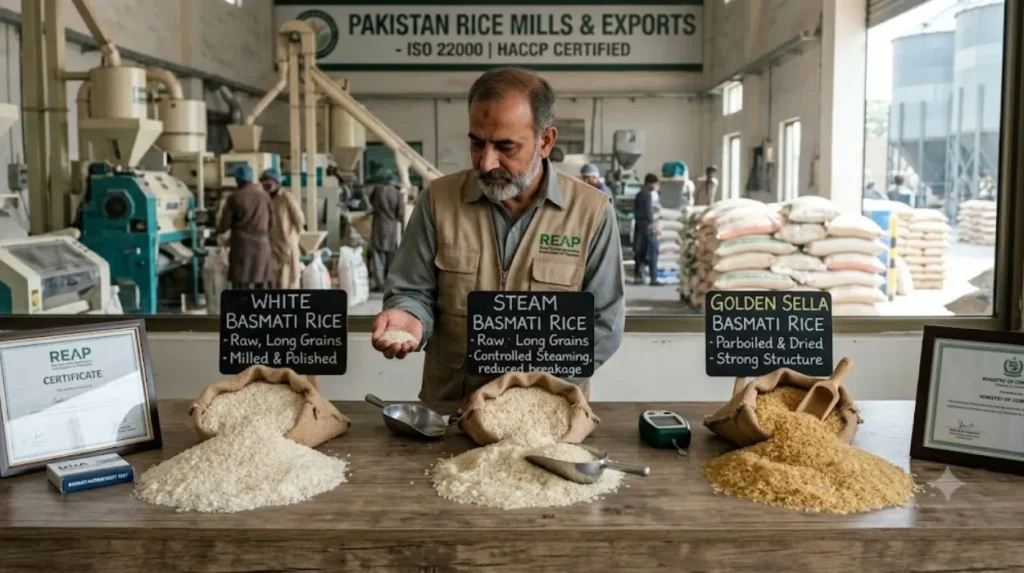
White Basmati undergoes standard milling and polishing to produce a bright appearance and soft texture.
White Basmati targets households and premium retail channels.
Saudi consumers often prefer White Basmati for daily home cooking because it cooks quickly and delivers a delicate texture.
What Is Steam Basmati Rice?
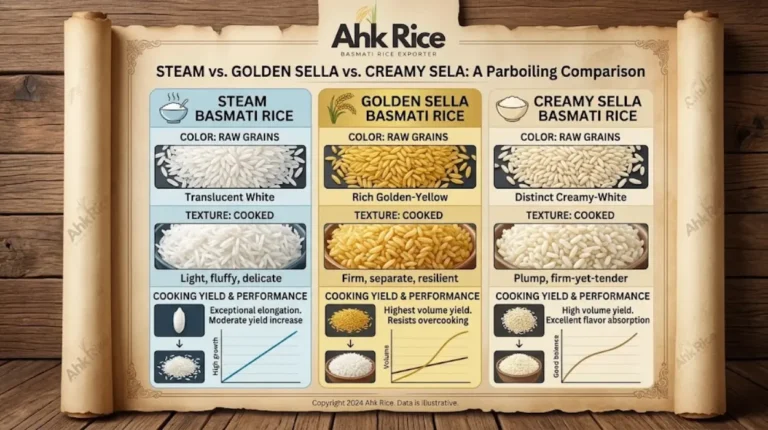
Steam Basmati undergoes controlled steaming before milling to improve grain strength.
Steam processing reduces breakage and improves cooking stability.
Many food service operators select Steam Basmati because it balances quality and operational efficiency.
What Is Golden Sella Basmati Rice?
Golden Sella undergoes parboiling and drying to create stronger grains and extended storage performance.
Golden Sella retains structure during large-scale catering operations.
In a 40°C warehouse environment, Golden Sella maintains quality for approximately 18 months. Steam grades generally perform best within 12 months under similar storage conditions.
Saudi catering companies frequently choose Golden Sella for banquet operations and institutional food service.
What Is Parboiled Basmati Rice?
Parboiled Basmati improves nutritional retention and grain durability through controlled heat treatment.
Parboiling strengthens kernels before milling.
Export markets with large food service sectors frequently prefer parboiled specifications because grains remain separate during high-volume cooking.
These grades address different needs. The next question is which certifications support premium market acceptance.
Which Certifications Apply to Pakistan Basmati Rice Exports?
ISO certifications, HACCP systems, phytosanitary compliance, fumigation requirements, and laboratory testing support international trade.
Saudi importers require documented compliance with food safety and quality standards.
Which Export Documents Support Saudi Imports?
Commercial documentation, quality certificates, and regulatory compliance documents support customs clearance and food safety verification.
Common export documentation includes:
- Commercial Invoice
- Packing List
- Certificate of Origin
- Phytosanitary Certificate
- Fumigation Certificate
- Quality Inspection Report
- Bill of Lading
Laboratory testing verifies moisture content, purity levels, broken percentage, and contaminant limits before shipment.
Saudi food regulations emphasize traceability and documented compliance throughout the supply chain.
Certification explains buyer confidence. The next question is how premium rice benefits different users.
What Benefits Does Extra Long Grain Pakistan Basmati Rice Provide?
Superior presentation, higher consumer acceptance, strong cooking performance, aroma retention, and broad culinary versatility create premium value.
Premium rice creates visible differentiation at retail and food service levels.
Long grains enhance product appearance immediately after cooking.
Aromatic properties improve dining experiences.
Consistent grading improves cooking predictability.
Strong grain structure reduces breakage during handling and preparation.
These benefits explain commercial demand across multiple sectors.
With benefits established, the next question is where premium Basmati is most commonly used.
Where Is Extra Long Grain Pakistan Basmati Rice Commonly Used?
Households, restaurants, catering companies, hotels, supermarkets, and institutional kitchens use premium Basmati rice extensively.
Different sectors prioritize different specifications.
How Do Households Use Premium Basmati?
Households prioritize aroma, taste, appearance, and consistent cooking performance.
Retail consumers often select premium Basmati for family meals, celebrations, and religious gatherings.
Presentation quality remains important because rice frequently serves as the centerpiece of the meal.
How Do Restaurants and Caterers Use Premium Basmati?
Food service operators prioritize grain stability, appearance, and yield after cooking.
Restaurants require consistency across large volumes.
Caterers require grains that remain separate during extended serving periods.
Hotels require premium presentation because rice accompanies high-value menu items.
These applications demonstrate demand. The final question addresses common misconceptions surrounding premium Basmati rice.
What Common Misconceptions Exist About Extra Long Grain Pakistan Basmati Rice?
Length alone does not determine quality, all Basmati is not identical, and premium grades require verified specifications.
Buyers frequently misunderstand quality indicators.
Does Longer Grain Always Mean Better Rice?
Grain length alone does not guarantee premium quality.
Aroma, purity, moisture control, and uniform grading remain essential.
Rice with excellent length but poor sorting performs below premium expectations.
Are All Basmati Varieties the Same?
Different varieties deliver different performance characteristics.
1121 emphasizes maximum grain length.
Super Kernel emphasizes traditional aroma and heritage characteristics.
1509 emphasizes efficiency and value while maintaining premium appearance.
Is Premium Basmati Only for Luxury Consumers?
Premium Basmati serves multiple market segments beyond luxury retail.
Households purchase premium rice for daily consumption.
Restaurants purchase premium rice for operational consistency.
Caterers purchase premium rice for large-scale events.
Demand spans retail, wholesale, hospitality, and institutional sectors.
Premium status results from measurable specifications, cultivation expertise, processing precision, and consumer preference. Saudi Arabia values extra long grain Pakistan Basmati rice because it consistently delivers the appearance, aroma, and cooking performance required by the country’s most important rice-based dishes.
Frequently Asked Questions
Why do Saudi consumers prefer extra long grain Pakistan Basmati rice?
Saudi consumers prefer extra long grain Pakistan Basmati rice because it delivers long, separate grains, strong aroma, and an attractive appearance after cooking. These qualities match the requirements of traditional dishes such as Kabsa, Mandi, and Bukhari Rice.
What is the average grain length of premium Pakistan Basmati rice?
Premium Pakistan Basmati rice usually has a grain length above 8.0 mm before cooking. Varieties such as 1121 Basmati often exceed 8.3 mm and can elongate significantly during cooking, creating a premium presentation.
Which Pakistan Basmati variety is most popular in Saudi Arabia?
1121 Basmati is one of the most popular varieties in Saudi Arabia because of its exceptional grain length and cooking performance. Super Kernel Basmati also maintains strong demand due to its aroma and traditional Basmati characteristics.
What certifications are required for Pakistan Basmati rice exports to Saudi Arabia?
Pakistan Basmati rice exports typically require a Phytosanitary Certificate, Certificate of Origin, Fumigation Certificate, and quality inspection documentation. Exporters also follow food safety systems such as HACCP and ISO standards to meet international requirements.
What is the difference between White, Steam, and Golden Sella Basmati rice?
White Basmati rice is milled and polished for a soft texture and bright appearance. Steam Basmati undergoes controlled steaming to improve grain strength. Golden Sella Basmati is parboiled before milling, which increases grain durability and makes it suitable for large-scale catering and food service operations.