Steam vs Golden Sella vs Creamy Sella: How Parboiling Changes Color, Texture and Cooking Yield
Golden Sella is best for kitchens that prioritize firm grains and holding performance, Creamy Sella suits buyers seeking a lighter parboiled appearance, and Steam works well for white-looking rice with a familiar Basmati profile. The right choice depends on cooking yield, serving style, customer expectations, storage, and purchase cost per metric tonne.
For importers, distributors, restaurant groups, and catering companies, comparing these processing methods helps prevent inconsistent cooking results and unnecessary food waste. Understanding how Basmati rice is processed from paddy to finished grain provides useful context for evaluating parboiling, milling, grading, and finished-rice specifications before choosing a commercial grade.
What are Steam, Golden Sella, and Creamy Sella Basmati rice?
Steam, Golden Sella, and Creamy Sella describe processing styles used for Basmati rice, not separate botanical varieties. Each method affects grain appearance, starch behavior, cooking texture, and commercial applications. The underlying variety, milling quality, moisture, and processing controls also determine the final result.
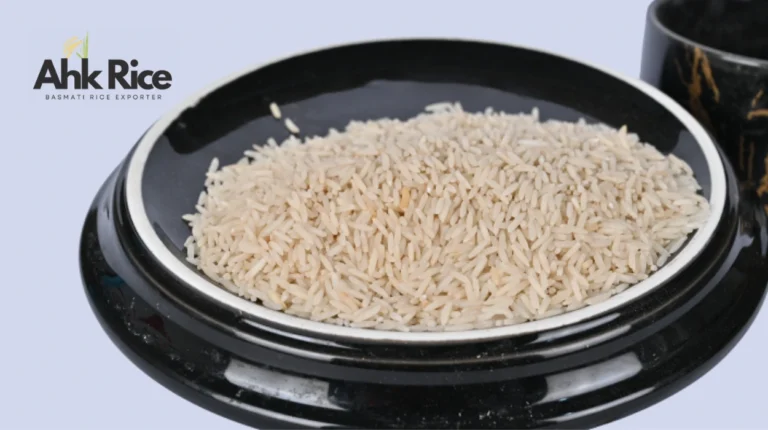
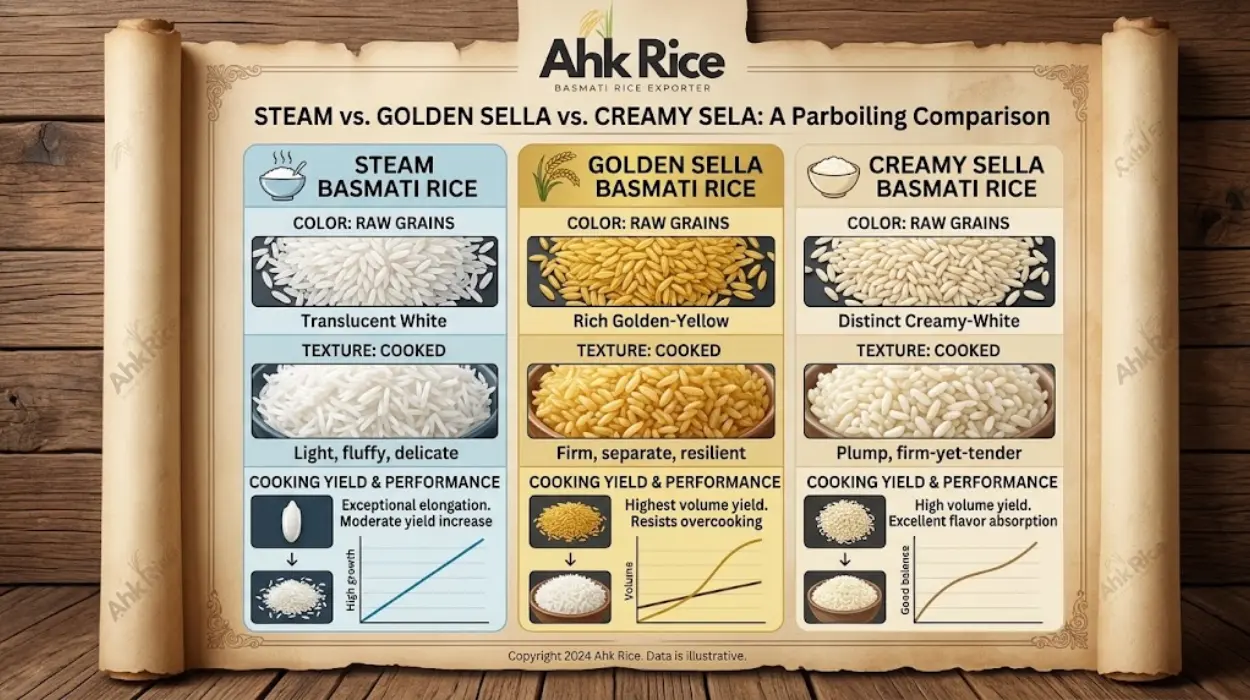
Steam Basmati receives controlled steam treatment during processing, without the full soaking and hydrothermal parboiling sequence associated with Sella rice. The finished grain generally retains a white or pale appearance and provides the familiar texture expected from white Basmati.
Golden Sella is parboiled Basmati processed through soaking, heating, and drying before milling. The hydrothermal treatment changes the grain’s starch structure and produces a golden or yellowish appearance. Properly processed grains retain their shape during cooking and suit applications that require separated rice.
Creamy Sella is also parboiled Basmati, but its finished appearance is generally cream, ivory, or pale yellow rather than deep golden. The exact color depends on paddy characteristics, soaking conditions, temperature, drying, and processing controls. Creamy Sella offers a middle ground for buyers who want parboiled performance without a pronounced golden color.
The three products can use varieties such as 1121, Super Kernel, and 1509 Basmati rice. A buyer must therefore specify both the variety and processing style. Ordering only “Sella Basmati” leaves important quality requirements undefined.
How does parboiling change color, texture, and cooking yield?
Parboiling changes the grain’s internal starch structure through controlled moisture and heat before milling. This treatment generally improves resistance to breakage during processing and helps cooked grains retain their shape. Color, firmness, water absorption, and serving yield still depend on the variety and production parameters.
During conventional parboiling, paddy is soaked, heated or steamed, and dried before the husk and bran are removed. Heat promotes starch gelatinization inside the grain. Subsequent drying stabilizes the processed kernel, although the final outcome depends on time, temperature, moisture, and drying uniformity.
| Attribute | Steam Basmati | Golden Sella Basmati | Creamy Sella Basmati |
|---|---|---|---|
| Processing | Controlled steam treatment | Hydrothermal parboiling | Hydrothermal parboiling with a lighter finished color |
| Typical appearance | White or pale | Golden or yellow | Cream, ivory, or pale yellow |
| Cooked texture | Tender, aromatic, and separate when prepared correctly | Firm, resilient, and separate | Firm but often perceived as milder than Golden Sella |
| Grain integrity | Depends on variety, milling, and cooking | Generally strong when processing is controlled | Generally strong when processing is controlled |
| Water absorption | Varies with variety and preparation | Often supports substantial cooked expansion | Often supports substantial cooked expansion |
| Commercial strengths | White-rice presentation and familiar Basmati character | Large-scale catering and separated-grain dishes | Catering and retail markets preferring a lighter color |
| Main consideration | Can be less forgiving of overcooking | Color and firmness must match customer expectations | Color consistency and cooking performance require verification |
These are general commercial tendencies, not guaranteed laboratory results. A controlled cooking test is necessary to compare actual expansion, moisture absorption, breakage, aroma, and serving yield across supplier samples.
Does Golden Sella always produce a higher cooking yield?
Golden Sella often performs well in bulk cooking because parboiling supports grain integrity and helps maintain separation. However, cooked weight depends on the amount of water retained, the rice-to-water ratio, cooking time, draining, resting, and the variety’s characteristics. A supplier cannot establish a reliable yield figure from color alone.
Buyers should measure both cooked weight and usable portions. For example, a catering kitchen can cook a fixed quantity of each sample using the same recipe, record the final drained weight, and count acceptable servings. This method identifies the grade that delivers the best operational yield rather than simply the largest apparent expansion.
What are the available solutions for different commercial requirements?
The available solutions are white Steam, golden-colored Sella, and lighter Creamy Sella, each matched to a specific cooking and presentation requirement. Buyers should select the processing style alongside grain length, broken percentage, moisture, aroma, packaging, and destination requirements to obtain consistent commercial performance.
Steam is appropriate when customers expect white-looking Basmati, recognizable aroma, and a relatively tender cooked texture. It suits menus where the rice’s natural appearance matters, including pulao, selected biryani recipes, and everyday rice service. Cooking controls remain important because excessive water or agitation can damage grain separation.
Golden Sella is appropriate when kitchens prioritize firm grains, batch consistency, and resistance to handling during large-volume preparation. It is widely associated with biryani, banquet service, and catering operations where cooked rice must retain its structure during portioning and service. Its golden appearance is an important part of the purchase decision.
Creamy Sella serves buyers who need parboiled characteristics but prefer a less golden presentation. It can suit restaurants, wholesalers, and retail brands whose customers expect pale-colored rice. Its commercial value depends on whether the supplier can deliver consistent color, grain length, aroma, and cooking performance across shipments.
AHK Rice supplies Pakistani Basmati varieties including 1121, Super Kernel, and 1509. Buyers can evaluate these varieties against their required processing style, grade, packaging, and destination specifications rather than assuming that one processing method performs identically across all varieties.
How do the three processing styles compare for US and Gulf markets?
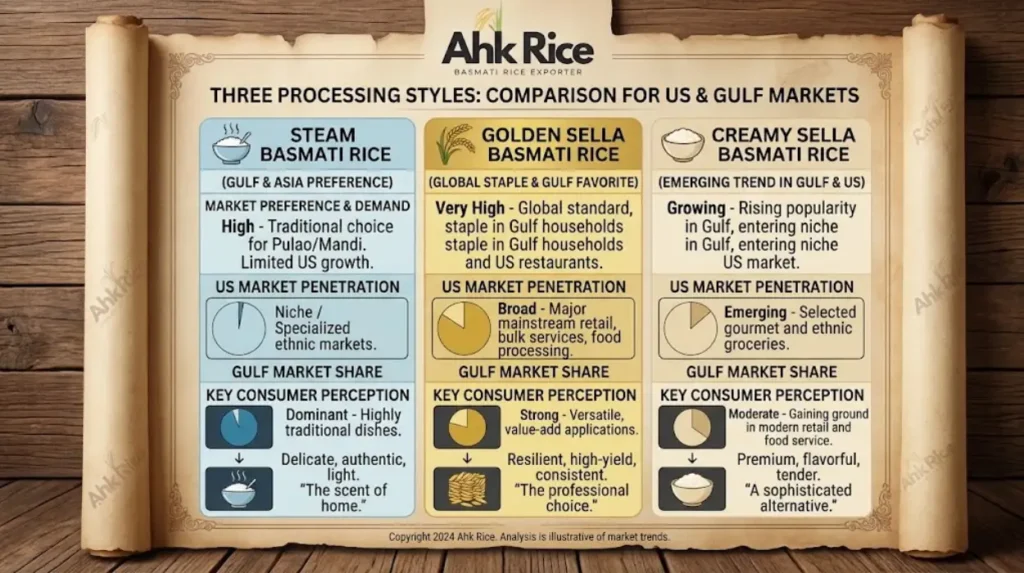
US restaurant and catering buyers should match rice to menu requirements, while Gulf buyers should also account for established preferences for long-grain Basmati and Sella products. In both regions, the correct choice depends on customer expectations, landed cost, cooking performance, regulatory compliance, and the supplier’s ability to maintain consistent specifications.
United States: restaurant, catering, and foodservice requirements
US buyers serving biryani, South Asian cuisine, buffets, and large events often prioritize long, separate grains and predictable batch cooking. Golden Sella is a strong option for operations that need firm rice during preparation and service. Creamy Sella suits buyers who prefer a lighter-colored parboiled product, while Steam fits menus that require a white-rice appearance.
Restaurants should compare 1121 and 1509 Basmati as well as processing style. A 1121 specification can support a premium long-grain presentation, while 1509 may fit procurement strategies focused on long grains and cost control. Actual grain length, broken percentage, cooking expansion, and aroma must be confirmed through samples and the agreed specification.
US importers should also review applicable food safety requirements, importer responsibilities, product labeling, traceability, and shipment documentation. The supplier’s specification and supporting records should match the product actually loaded. Shipping terms, freight, insurance, duties, and port-related charges affect the final landed price per metric tonne.
Gulf markets: wholesale, restaurants, and catering
Gulf markets have established demand for Pakistani Basmati in household retail, restaurants, wholesale distribution, and catering. Golden Sella often fits biryani and large-scale foodservice requirements where grain separation is important. Creamy Sella serves customers who prefer a paler appearance, while Steam fits white-rice applications and selected retail segments.
In the UAE and Saudi Arabia, importers should consider local customer preferences, storage conditions, packaging, Arabic labeling where required, and applicable food registration rules. Buyers distributing across multiple customer segments can compare more than one processing style before committing to a full container.
Neither region has a single grade preference shared by every buyer. Restaurant menus, ethnic retail customers, institutional contracts, and private-label specifications can lead to different purchasing decisions within the same market.
How do price per metric tonne and shelf life compare?
Price per metric tonne reflects variety, grade, processing costs, order volume, packaging, freight, and trade terms, rather than color alone. Shelf life depends on moisture, packaging integrity, storage temperature, humidity, pest control, and the manufacturer’s validated product specification. Buyers should compare documented offers and storage guidance.
Indicative price comparison
The following table is a procurement framework, not a live quotation or a verified market price list. Exact prices require matching specifications, quantities, shipment dates, packaging, and Incoterms.
| Commercial factor | Steam | Golden Sella | Creamy Sella |
|---|---|---|---|
| Relative price position | Depends on variety and grade | Includes soaking, heating, and drying costs | Includes parboiling and color-control requirements |
| Price per MT | Obtain a matched supplier quote | Obtain a matched supplier quote | Obtain a matched supplier quote |
| Main cost drivers | Grain quality, milling, packing | Parboiling, drying, grade, packing | Parboiling, drying, grade, packing |
| Landed-cost effect | Freight, insurance, duty, and clearance | Freight, insurance, duty, and clearance | Freight, insurance, duty, and clearance |
A fair comparison uses the same Basmati variety, grain-length specification, broken percentage, moisture limit, bag size, order volume, and delivery term. A lower FOB price does not necessarily produce a lower landed cost. Buyers should compare CIF or other equivalent delivered costs when assessing alternative offers.
Shelf life and storage
All three processing styles require dry, clean, pest-controlled storage and intact packaging. Parboiling does not remove the need for moisture control or protect rice from poor warehouse conditions. Golden Sella and Creamy Sella should not automatically be assigned longer shelf lives than Steam without product-specific evidence.
Ask suppliers for the declared shelf life, production date, best-before or expiry labeling as applicable, storage instructions, and packaging specification. Warehouses should limit exposure to humidity, direct sunlight, odors, pests, and condensation. The product’s declared shelf life should follow the supplier’s validated specification and the destination market’s requirements.
Which method works best for different cases?
Golden Sella is a practical starting point for high-volume biryani and catering, Creamy Sella suits buyers who want parboiled performance with a lighter color, and Steam suits white-rice presentation. The final selection should follow a cooking test, cost analysis, and confirmation of the buyer’s written specification.
| Decision factor | Choose Steam when… | Choose Golden Sella when… | Choose Creamy Sella when… |
|---|---|---|---|
| Finished color | White or pale rice is expected | Golden color is acceptable or preferred | Cream or ivory appearance is preferred |
| Menu | White Basmati, pulao, or selected rice dishes | Biryani, banquets, and bulk service | Biryani and catering with lighter-colored rice |
| Texture | Tenderness and aroma lead the requirement | Firmness and grain separation are priorities | Firm, separated grains are needed with a pale appearance |
| Kitchen workflow | Batches are cooked with controlled water and timing | Large batches need robust handling | Large batches need parboiled performance and lighter presentation |
| Procurement | A suitable specification and quote are available | The cooking test justifies its total cost | Color consistency and cooking results justify the purchase |
The table narrows the shortlist, but it does not replace testing. The best commercial grade is the one that meets the buyer’s requirements consistently at an acceptable cost per usable serving.
What are the advantages and disadvantages of each method?
Each processing style offers a different balance of appearance, texture, cooking tolerance, and cost. Steam emphasizes white presentation and Basmati character; Golden Sella emphasizes firm grains and bulk-service reliability; Creamy Sella combines parboiled performance with a lighter appearance. Supplier quality and cooking technique determine actual results.
Steam’s advantages include a familiar white appearance and suitability for menus where Basmati aroma and presentation matter. Its disadvantages include greater sensitivity to poor water control or excessive handling in some cooking applications. A restaurant should test it using its actual equipment and recipe before purchasing at scale.
Golden Sella’s advantages include firm grain structure and suitability for large batches of biryani and catering rice. Its disadvantages include a more noticeable golden color that does not match every menu or customer preference. Buyers must also check whether the product’s firmness and aroma meet their desired eating experience.
Creamy Sella’s advantage is the combination of parboiled characteristics and a lighter finished color. It can fit customers who reject a strong golden appearance. Its disadvantage is that the term alone does not guarantee a precise shade or cooking outcome. Importers should define acceptable color, grain dimensions, moisture, broken percentage, and cooked performance in the purchase specification.
How should buyers evaluate samples before placing a bulk order?
Buyers should compare supplier samples under identical cooking conditions and record grain quality, cooked texture, expansion, usable yield, and cost. A standardized test turns subjective preferences into measurable acceptance criteria and helps purchasing teams approve a grade before committing to commercial volumes.
Request representative samples with clear identification of variety, processing style, crop or lot information where available, and grade specifications. Cook each sample with the same rice-to-water ratio, soaking procedure, cooking time, resting period, and serving method. Record raw weight, cooked weight, broken grains, separation, aroma, and appearance.
Next, calculate the cost per usable serving rather than relying only on the price per tonne. A grade that costs more per tonne can still provide better value if it reduces waste and meets portion requirements. The result depends on the actual test, not a general claim about a processing style.
Before shipment, confirm the approved specification, packing format, lot identification, quality documents, shipment terms, and destination requirements in writing. Commercial approval should cover the same product that the supplier will process and load.
Steam, Golden Sella, and Creamy Sella serve different commercial requirements. Steam supports white-rice presentation, Golden Sella suits firm-grain catering applications, and Creamy Sella serves buyers seeking parboiled performance with a lighter appearance. Color alone does not establish quality, cooking yield, price, or shelf life.
Importers and foodservice operators should compare documented specifications, conduct standardized cooking tests, and calculate landed cost per usable serving. A clear specification and approved sample reduce the risk of receiving rice that fails to meet menu, retail, or distribution expectations.
Frequently asked questions
Is Golden Sella better than Steam Basmati?
Golden Sella is generally better for kitchens prioritizing firm, separate grains and bulk cooking. Steam is better when white appearance, aroma, and a familiar white-Basmati texture are more important. The menu and cooking test determine the right choice.
What is the difference between Golden Sella and Creamy Sella?
Both are parboiled Basmati styles. Golden Sella usually has a stronger golden or yellow appearance, while Creamy Sella is generally paler. Their actual color and cooking performance depend on processing conditions and the rice variety.
Which Basmati rice gives the highest cooking yield?
No processing style guarantees the highest yield in every kitchen. Measure cooked weight and usable portions under identical conditions. Water absorption, variety, cooking method, draining, and grain breakage all influence the result.
Does parboiled Basmati have a longer shelf life?
Parboiling does not establish a universal shelf-life advantage. Shelf life depends on moisture, packaging, storage conditions, and the product’s validated specification. Buyers should follow the supplier’s declared shelf life and storage instructions.
How should US restaurants compare prices for bulk parboiled rice?
Compare the same variety, grain length, broken percentage, moisture limit, packaging, quantity, and delivery term. Include freight, insurance, duties, and clearance where relevant. Then compare the cost per usable serving from cooking tests.
Which specification should importers request from a supplier?
Specify the Basmati variety, processing style, grain length, broken percentage, moisture limit, color expectations, packing size, quantity, destination, required documents, and delivery term. Request a representative sample and approve the cooking result before confirming the bulk order.