How Does Saudi Arabia’s Climate Impact Moisture Requirements for Imported Pakistan Rice?
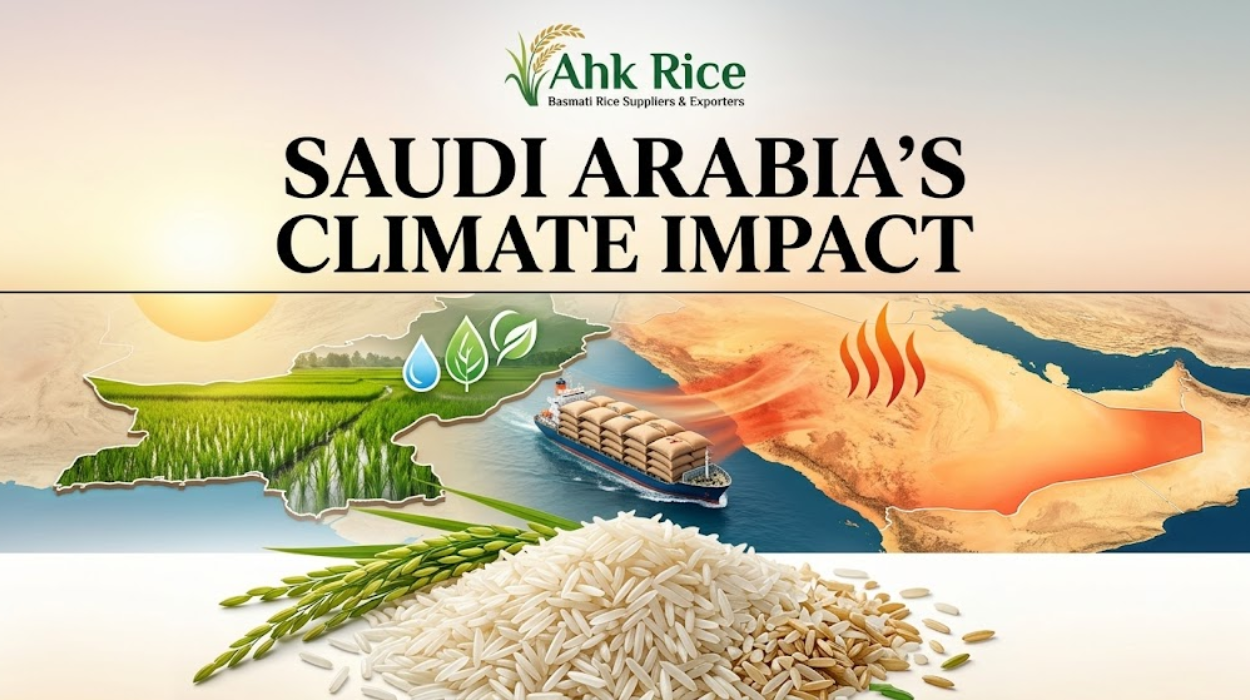
Saudi Arabia’s hot desert climate requires imported Pakistan rice to maintain carefully controlled moisture levels throughout processing, shipping, and storage. The recommended export moisture for premium Pakistani Basmati rice is generally 12% to 13%, allowing the rice to remain stable during long sea transit while preserving grain quality, aroma, cooking performance, and shelf life after arrival.
Pakistan is one of the world’s leading exporters of aromatic Basmati rice. Saudi Arabia remains among its largest import destinations because of strong consumer demand for long-grain premium rice. Since rice travels by sea for several weeks before reaching Saudi ports, moisture management becomes one of the most important quality specifications in the export process.
The relationship between climate and rice quality begins before shipment. Temperature, humidity, packaging, container conditions, and warehouse storage all influence the moisture balance of rice. Exporters therefore measure moisture repeatedly throughout milling, grading, packaging, loading, and final inspection to ensure every shipment meets international quality requirements.
Why does Saudi Arabia’s climate influence the moisture requirements of imported Pakistan rice?
Saudi Arabia’s consistently high temperatures, low annual rainfall, and dry desert environment require imported Pakistani rice to maintain stable export moisture between 12% and 13%. This range protects grain integrity, reduces breakage, preserves aroma, and extends shelf life during international shipping and domestic storage.
Saudi Arabia has one of the hottest climates in the Middle East. Summer temperatures regularly exceed 45°C in many regions, while annual rainfall remains below 100 mm across much of the country. These environmental conditions accelerate moisture loss after rice arrives in local warehouses.
Rice naturally exchanges moisture with the surrounding air until equilibrium is reached. When surrounding air becomes very dry, rice gradually loses internal moisture. Excessive moisture loss increases grain brittleness and raises the percentage of broken kernels during handling and packaging.
Exporters therefore prepare rice according to the climatic conditions of the destination market instead of using identical moisture standards for every country.
What is moisture content in Pakistan rice?
Moisture content represents the percentage of water naturally present inside each rice grain. It directly determines milling quality, cooking performance, storage stability, export durability, and resistance to physical damage throughout the international supply chain.
Moisture is measured using calibrated digital moisture meters during every production stage.
Freshly harvested paddy normally contains 20% to 25% moisture. This level is unsuitable for storage because microorganisms develop rapidly and grain quality deteriorates.
The paddy undergoes controlled drying until moisture reaches safe milling levels. After milling, polishing, grading, and packaging, exporters verify the final moisture before loading containers.
Maintaining this balance prevents both excessive drying and excessive moisture retention.
How is moisture controlled during Pakistan’s rice processing?
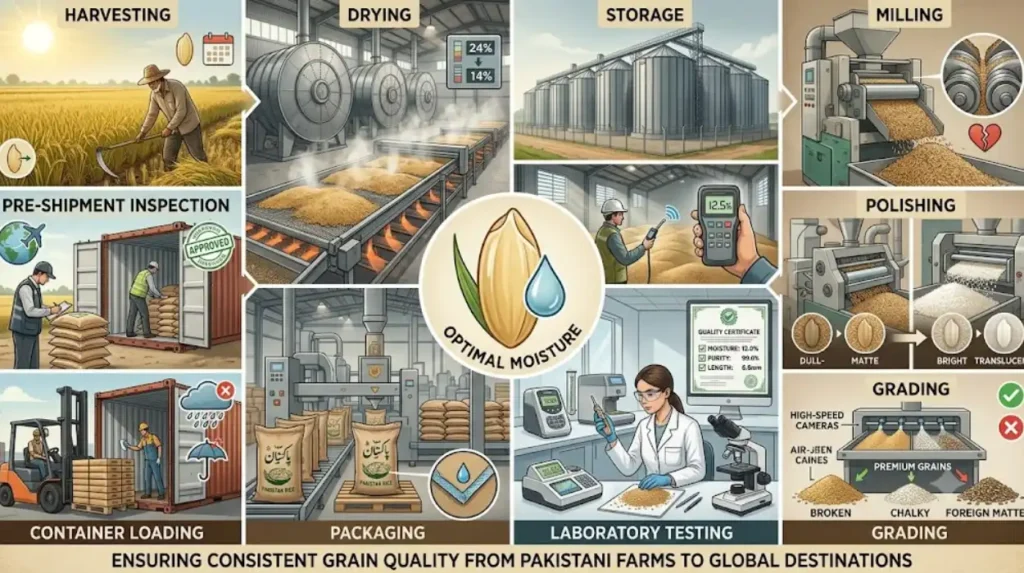
Moisture control follows a step-by-step production process that includes harvesting, drying, storage, milling, polishing, grading, laboratory testing, packaging, container loading, and pre-shipment inspection to maintain consistent grain quality from farm to destination.
Harvesting
Farmers harvest mature rice after the grain reaches physiological maturity. Correct harvesting timing helps achieve uniform moisture reduction during drying.
Drying
Fresh paddy enters drying systems where moisture is gradually reduced to safe storage levels. Controlled drying prevents stress cracks inside the grain.
Storage
Dried paddy remains in ventilated warehouses where temperature and humidity are monitored continuously.
Milling
The husk is removed while preserving kernel length and reducing breakage.
Polishing
Polishing removes bran layers and produces the clean appearance expected by international buyers.
Grading
Rice passes through grading equipment that separates broken grains, immature kernels, chalky grains, stones, and foreign material.
Laboratory Testing
Quality control laboratories verify several specifications, including:
- Moisture percentage
- Grain length
- Broken percentage
- Purity
- Foreign matter
- Colour
- Whiteness
Packaging
Rice is packed into moisture-resistant bags that help preserve its condition during transport.
Container Loading
Containers are cleaned, inspected, and protected from external moisture before shipment.
What moisture percentage is generally recommended for Pakistan Basmati rice exported to Saudi Arabia?
Premium Pakistan Basmati rice exported to Saudi Arabia is generally prepared at approximately 12% to 13% moisture because this level provides excellent transport stability, protects grain structure, and maintains cooking quality throughout long-distance shipping.
Rice exported with moisture above recommended specifications faces higher risks during storage and shipment.
Higher moisture increases the possibility of:
- Quality deterioration
- Reduced shelf life
- Grain discoloration
- Odour development
- Insect activity under poor storage conditions
Rice exported with excessively low moisture develops different problems.
These include:
- Higher breakage during handling
- Reduced head rice recovery
- Lower market value
- Reduced visual appearance
Understanding these export specifications becomes easier after learning the:
Recommended moisture percentage for Pakistan Basmati rice shipped to Saudi Arabia.
Which Pakistani rice varieties are commonly exported to Saudi Arabia?
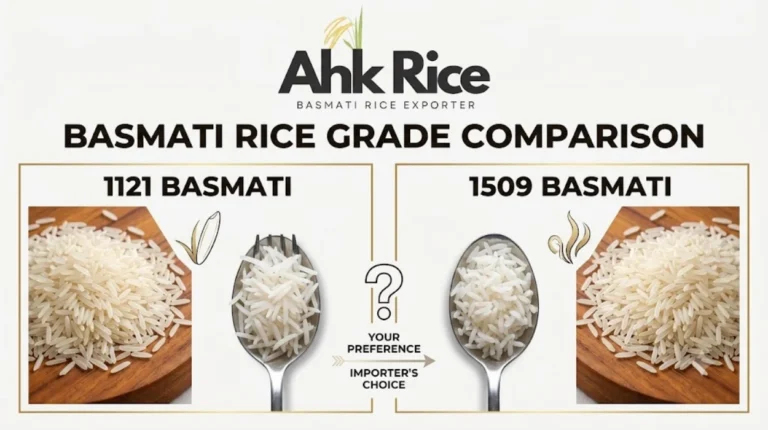
Saudi Arabia imports several premium Pakistani rice varieties, including 1121 Basmati, Super Kernel Basmati, 1509 Basmati, PK-386 Long Grain, and IRRI varieties, each serving different consumer preferences and food service requirements.
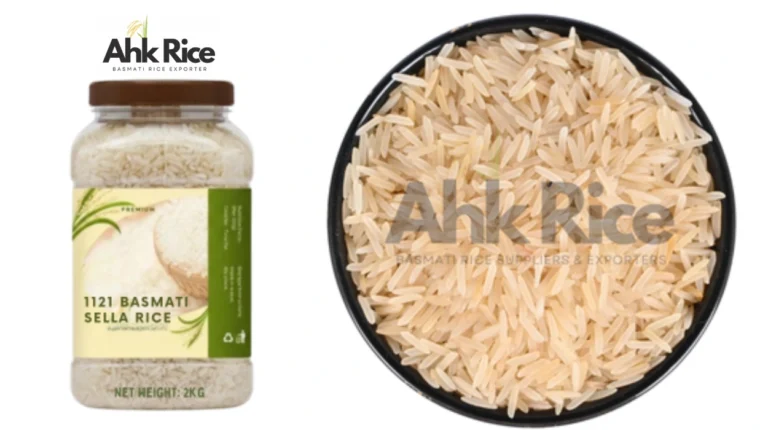
1121 Basmati Rice
Known for its exceptional grain length and elongation after cooking.
Common applications include biryani, mandi, kabsa, and premium hospitality.
Super Kernel Basmati
Recognised for its traditional aroma, slender grain, and balanced cooking characteristics.
Popular among households and retail consumers.
1509 Basmati
Offers high cooking expansion with relatively shorter crop duration compared with traditional Basmati varieties.
Widely used by importers seeking premium quality with competitive pricing.
PK-386 Long Grain
Frequently supplied for commercial catering operations.
IRRI Rice
Suitable for large-scale institutional consumption where cost efficiency receives greater priority.
Which quality certifications support Pakistan rice exports?
International certifications verify food safety, quality management, traceability, hygiene, and export compliance throughout the rice supply chain, increasing buyer confidence in imported Pakistani rice products.
Export facilities commonly maintain internationally recognised management systems.
Examples include:
- ISO 22000 Food Safety Management System
- HACCP
- GMP (Good Manufacturing Practices)
- Halal Certification
- Phytosanitary Certification
- Fumigation Certification
- Certificate of Origin
- Quality Inspection Reports
- Laboratory Analysis Reports
These certifications verify that rice has been processed according to internationally accepted food safety requirements.
How does packaging help preserve moisture during shipment?
Proper packaging protects rice from environmental exposure, limits unnecessary moisture exchange, reduces contamination risks, and preserves product quality from the packing facility until final delivery in Saudi Arabia.
Packaging forms an important barrier between rice and the external environment.
Common export packaging includes:
- PP woven bags
- BOPP laminated bags
- Paper bags
- Vacuum packs
- Retail consumer packs
- Jumbo bulk bags
Inner liners provide additional protection where required.
Proper palletisation also improves airflow and reduces handling damage.
Which countries import Pakistani Basmati rice besides Saudi Arabia?
Pakistani Basmati rice is imported across the Middle East, Europe, North America, Africa, Asia, and Oceania because of its aroma, cooking quality, grain length, and international quality standards.
Major importing markets include:
- Saudi Arabia
- United Arab Emirates
- Qatar
- Kuwait
- Oman
- Bahrain
- Iraq
- United Kingdom
- Germany
- Canada
- United States
- Australia
- Belgium
- Netherlands
- South Africa
Each destination establishes its own purchasing specifications for moisture, broken percentage, grain length, packaging, and labelling.
What benefits result from maintaining correct export moisture?
Maintaining correct export moisture protects rice quality throughout transportation, improves customer satisfaction, preserves aroma, reduces financial losses, and supports long-term storage without compromising grain performance.
Proper moisture management provides measurable advantages.
These include:
- Longer storage stability
- Better cooking consistency
- Higher head rice recovery
- Lower breakage rates
- Improved grain appearance
- Better aroma preservation
- Reduced quality claims
- Stable export specifications
These benefits extend throughout the supply chain from exporter to importer, wholesaler, retailer, restaurant, and final consumer.
What misconceptions exist about moisture requirements for rice exports?
Many people incorrectly assume lower moisture always means better rice quality, while others believe all export markets require identical moisture specifications. Both assumptions ignore the relationship between destination climate, storage conditions, and grain performance.
One misconception states that extremely dry rice lasts longer.
In reality, excessive drying increases kernel brittleness and produces more broken grains during transport.
Another misconception suggests every importing country accepts identical moisture specifications.
Different markets establish purchasing requirements based on climate, logistics, storage infrastructure, and consumer expectations.
A third misconception assumes packaging alone preserves rice quality.
Packaging supports moisture control, but correct drying, laboratory testing, warehouse management, and container inspection remain equally important throughout the export process.
Frequently Asked Questions
What is the ideal moisture content for Pakistani Basmati rice exported to Saudi Arabia?
The recommended moisture content is generally 12% to 13%, helping preserve grain quality, aroma, cooking performance, and shelf life during shipping and storage.
Why does Saudi Arabia’s hot climate affect imported rice moisture?
Saudi Arabia’s high temperatures and dry climate cause rice to lose moisture more quickly, making proper export moisture levels essential to prevent breakage and maintain quality.
How is moisture content measured in rice before export?
Exporters use calibrated digital moisture meters during processing, packaging, and pre-shipment inspections to ensure the rice meets buyer and international quality specifications.
Which Pakistani rice varieties are most commonly exported to Saudi Arabia?
The most popular varieties include 1121 Basmati, Super Kernel Basmati, 1509 Basmati, PK-386 Long Grain, and IRRI rice, depending on buyer preferences and end use.
What certifications are required for exporting Pakistani rice?
Common certifications include ISO 22000, HACCP, Halal Certification, GMP, Phytosanitary Certificate, Fumigation Certificate, Certificate of Origin, and Laboratory Test Reports.
How does packaging help maintain rice moisture during shipping?
Moisture-resistant packaging, proper sealing, and clean, dry containers protect rice from excess humidity and moisture loss throughout international transport.
What happens if rice is exported with excessive moisture?
Rice with excessive moisture has a higher risk of spoilage, insect infestation, mould growth, unpleasant odours, and reduced shelf life during storage.
Does lower moisture always mean better rice quality?
No. Excessively dry rice becomes brittle, leading to increased grain breakage during handling, transportation, and milling, which lowers its commercial value.