How Much 1509 Steam Basmati Rice Should You Import?
The right import quantity depends on monthly sales volume, warehouse capacity, transit time, market demand, inventory turnover, shelf-life management, and purchase economics. Importers who calculate these factors accurately reduce storage costs, prevent stock shortages, improve cash flow, and maintain consistent product availability throughout the year.
Importing the correct quantity of 1509 Steam Basmati Rice is a supply chain decision rather than a simple purchasing decision. The objective is to maintain continuous inventory without tying excessive capital into warehouse stock.
1509 Steam Basmati Rice is a long-grain aromatic rice variety developed for higher agricultural productivity than traditional Basmati varieties. It belongs to the Basmati family grown in Pakistan and India, with Pakistan producing export-quality steam rice primarily in Punjab.
Steam processing partially cooks the grain before milling. The process strengthens the kernel, improves grain stability, reduces breakage during transportation, and enhances cooking consistency.
An importer should calculate annual demand before determining shipment size. A company selling 1,200 metric tons annually requires a different purchasing strategy than a wholesaler selling 15,000 metric tons.
The objective is not purchasing the largest shipment. The objective is maintaining uninterrupted inventory while minimizing warehousing expenses.
How does importing the correct quantity of 1509 Steam Basmati Rice work?
Import planning follows a structured calculation using average monthly demand, supplier lead time, shipping schedules, customs clearance duration, safety stock, and reorder levels. These measurable variables create a purchasing cycle that supports stable inventory without excessive storage requirements.
Import planning begins with average monthly sales.
For example:
- Average monthly sales: 250 MT
- Transit from Pakistan: 22 days
- Customs clearance: 8 days
- Warehouse reserve: 30 days
The importer requires inventory covering approximately two months before placing another purchase order.
International shipping schedules directly affect purchasing frequency.
Container availability changes throughout the year.
Peak agricultural export seasons create higher shipping demand.
Off-season periods often provide faster container allocation.
Inventory planning therefore combines logistics with commercial forecasting.
How is reorder quantity calculated?
A practical calculation includes:
- Monthly sales volume
- Safety stock
- Lead time
- Planned growth
- Seasonal demand
If monthly demand equals 250 MT and safety inventory equals 125 MT, reorder planning begins before warehouse inventory falls below 375 MT.
This prevents supply interruptions.
What factors influence the ideal import quantity?
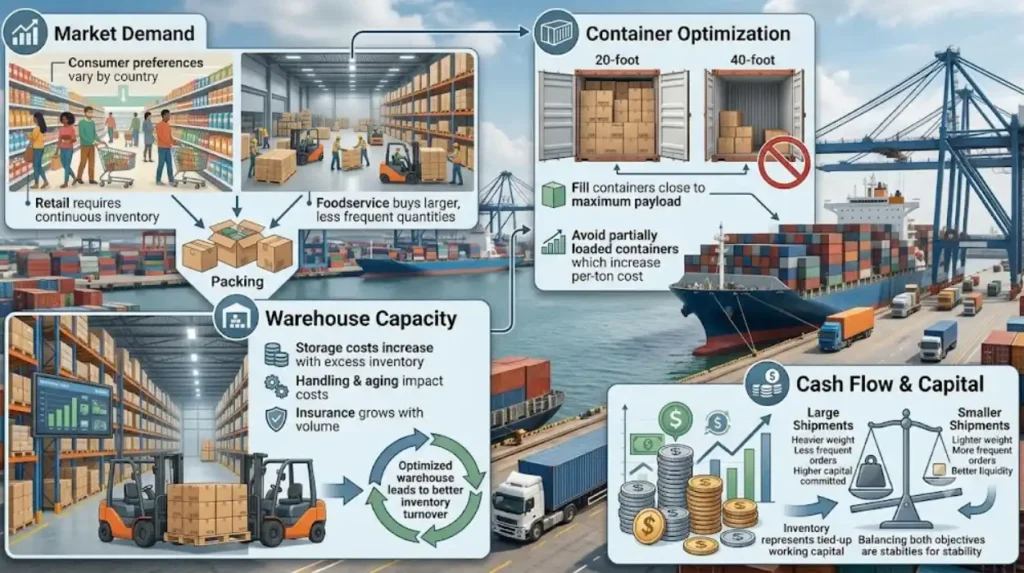
Several measurable variables influence purchasing volume, including market demand, warehouse infrastructure, financing capacity, freight efficiency, supplier production schedules, government regulations, and seasonal consumption. Combining these factors produces an economical and operationally stable import strategy.
Market demand
Consumer demand differs between countries.
Retail supermarkets require continuous inventory.
Foodservice distributors purchase larger but less frequent quantities.
Private label brands often order according to packaging production schedules.
Warehouse capacity
Warehouse size determines practical shipment volume.
Excess inventory increases:
- Storage costs
- Handling expenses
- Inventory aging
- Insurance costs
Proper warehouse utilization improves inventory turnover.
Container optimization
Rice exports primarily use:
- 20-foot containers
- 40-foot containers
Most buyers optimize freight by filling containers close to their maximum safe payload.
Partially loaded containers increase transportation cost per metric ton.
Cash flow
Inventory represents working capital.
Large shipments reduce purchasing frequency but increase capital commitment.
Smaller shipments improve liquidity while increasing ordering frequency.
Successful importers balance both objectives.
Where is 1509 Steam Basmati Rice produced?
Export-quality 1509 Steam Basmati Rice is cultivated mainly in Punjab using fertile alluvial soils, canal irrigation systems, and favorable climatic conditions that support long grain development, aroma retention, and consistent milling quality suitable for international markets.
Punjab remains the primary production region because of its agricultural infrastructure.
Rice cultivation follows several stages.
Land preparation
Fields are leveled to improve irrigation efficiency.
Uniform water distribution supports consistent crop growth.
Seedling development
Certified seed varieties are planted in nurseries.
Healthy seedlings improve field establishment.
Transplanting
Young plants move into prepared paddy fields.
Proper spacing improves sunlight exposure.
Crop management
Farmers monitor:
- Irrigation
- Fertilization
- Weed control
- Pest management
Balanced nutrient application supports long grain formation.
Harvesting
Modern harvesting equipment minimizes grain damage.
Harvest timing directly affects grain moisture.
Drying
Fresh paddy is dried before milling.
Controlled drying preserves grain integrity.
How is 1509 Steam Basmati Rice processed before export?
Steam processing follows sequential industrial stages that improve grain strength, appearance, cooking performance, and transportation durability while maintaining export specifications required by international food safety and quality management systems.
Processing begins after harvested paddy reaches the rice mill.
Cleaning
Machines remove:
- Dust
- Stones
- Straw
- Metal particles
Clean raw material protects milling equipment.
Steaming
The rice undergoes controlled steam treatment.
Steam hardens the grain structure.
This reduces broken kernels during milling.
Drying
Moisture is reduced gradually.
Controlled drying prevents grain cracking.
Milling
The husk is removed.
The bran layer is polished according to customer specifications.
Length grading
Mechanical graders separate kernels according to size.
Uniform grain length improves commercial value.
Color sorting
Optical sorting machines eliminate:
- Discolored grains
- Chalky kernels
- Foreign material
Packaging
Rice is packed in export bags.
Examples include:
- 1 kg retail bags
- 5 kg bags
- 10 kg bags
- 25 kg bags
- 50 kg bags
Finished products undergo final inspection before container loading.
What grades of 1509 Steam Basmati Rice are available?
Export markets purchase multiple grades based on grain length, percentage of broken kernels, customer specifications, and target price segments. Grade selection determines product positioning within retail, wholesale, catering, and industrial food manufacturing sectors.
The most common export grades include:
Premium Grade
- Extra-long kernels
- High uniformity
- Minimal broken grains
- Premium retail packaging
Standard Grade
- Commercial grain consistency
- Balanced quality
- Suitable for supermarkets
5% Broken
Limited broken kernels.
Suitable for premium wholesale distribution.
10% Broken
Cost-efficient option.
Popular among foodservice businesses.
15% Broken
Designed for institutional buyers.
Examples include schools, hospitals, and catering companies.
25% Broken
Lower-cost commercial grade.
Used in industrial food processing.
Buyer specifications determine the exact export grade before production begins.
Which countries import 1509 Steam Basmati Rice?
International demand comes from regions with established South Asian cuisine, expanding foodservice industries, growing ethnic populations, and increasing premium rice consumption across retail and wholesale distribution channels.
Major importing regions include:
Middle East
Examples include:
- United Arab Emirates
- Saudi Arabia
- Qatar
- Oman
- Kuwait
- Bahrain
The Middle East imports significant quantities because of strong Basmati consumption.
Europe
Examples include:
- United Kingdom
- Germany
- Netherlands
- Belgium
- Italy
Retail chains increasingly stock premium aromatic rice.
North America
Examples include:
- United States
- Canada
Demand comes from ethnic grocery stores, supermarkets, restaurants, and food distributors.
Africa
Examples include:
- South Africa
- Kenya
- Tanzania
Urbanization supports increasing rice consumption.
Asia-Pacific
Examples include:
- Australia
- New Zealand
- Singapore
- Malaysia
Premium rice demand continues expanding through modern retail channels.
Readers interested in planning reliable shipment schedules after selecting their import volume can continue with the guide on:
1509 Steam Basmati Rice delivery commitments for UAE buyers, which explains shipment timelines, production planning, and delivery coordination for Gulf markets.
What certifications support international exports?
Exported 1509 Steam Basmati Rice follows internationally recognized quality management, food safety, inspection, and phytosanitary requirements that enable market access across regulated importing countries and satisfy commercial buyer compliance programs.
Certification requirements vary by destination.
Common export documentation includes:
ISO 22000
Food safety management.
HACCP
Hazard analysis and preventive food safety controls.
Phytosanitary Certificate
Confirms agricultural health compliance.
Fumigation Certificate
Required by numerous importing countries.
Certificate of Origin
Verifies manufacturing country.
Packing List
Provides shipment details.
Commercial Invoice
Supports customs clearance.
Bill of Lading
Confirms ocean shipment.
Some buyers also request independent laboratory analysis for:
- Moisture
- Broken percentage
- Grain length
- Purity
- Foreign matter
What are the advantages of importing the right quantity?
Accurate purchasing improves profitability by lowering logistics costs, reducing warehouse expenses, maintaining inventory availability, stabilizing cash flow, and supporting stronger customer relationships through uninterrupted product supply.
Inventory optimization creates measurable operational improvements.
Benefits include:
- Better inventory turnover
- Lower warehouse occupancy
- Reduced financing costs
- Stable retail supply
- Lower emergency freight expenses
- Improved purchasing planning
Consistent purchasing schedules also strengthen supplier production planning.
This improves shipment predictability.
What misconceptions cause import planning mistakes?
Many importers assume larger shipments always reduce costs, demand remains constant throughout the year, and warehouse capacity has little influence on profitability. These assumptions increase inventory costs and reduce operational efficiency.
One misconception is purchasing annual inventory in a single shipment.
Large inventory increases:
- Storage costs
- Capital requirements
- Inventory aging
Another misconception is ignoring seasonal demand.
Rice consumption often increases before major religious holidays and festival seasons.
Examples include Ramadan, Eid celebrations, and year-end retail campaigns.
Demand forecasting should include these recurring consumption patterns.
Another misunderstanding involves shipping frequency.
Smaller scheduled shipments often improve inventory control while maintaining consistent supply.
Successful import planning balances purchasing economics with operational efficiency instead of maximizing shipment size.
The ideal quantity of 1509 Steam Basmati Rice depends on measurable operational factors rather than fixed purchasing rules. Monthly demand, inventory turnover, warehouse capacity, shipping schedules, working capital, and supplier lead times together determine the most efficient shipment size. Understanding how the rice is cultivated, processed, graded, certified, and distributed also helps importers make informed procurement decisions. A structured inventory strategy reduces costs, maintains consistent availability, and supports long-term supply chain performance.
Frequently Asked Questions
How do I calculate the right quantity of 1509 Steam Basmati Rice to import?
Calculate your import quantity using average monthly sales, supplier lead time, shipping duration, customs clearance time, warehouse capacity, and safety stock. This approach helps maintain continuous inventory while reducing storage costs and avoiding stock shortages.
Is 1509 Steam Basmati Rice suitable for long-distance export?
Yes. Steam processing strengthens the grain, reduces breakage during transportation, and improves shelf stability. These characteristics make 1509 Steam Basmati Rice well suited for international shipping to markets across the Middle East, Europe, Africa, North America, and Asia-Pacific.
Which countries import the highest volumes of 1509 Steam Basmati Rice?
Major importers include the United Arab Emirates, Saudi Arabia, Qatar, Oman, Kuwait, Bahrain, the United Kingdom, Germany, Canada, the United States, Australia, South Africa, Kenya, and Singapore. Demand varies according to retail, wholesale, and foodservice sectors.
What grades of 1509 Steam Basmati Rice are available for export?
Export grades commonly include Premium Grade, Standard Grade, 5% Broken, 10% Broken, 15% Broken, and 25% Broken. Buyers choose a grade based on grain quality, intended market, customer preferences, and budget.
How is 1509 Steam Basmati Rice processed before export?
The processing sequence includes cleaning, steaming, controlled drying, milling, polishing, length grading, color sorting, quality inspection, packaging, and container loading. Each stage improves grain quality and ensures compliance with international export standards.
What certifications are commonly required for exporting 1509 Steam Basmati Rice?
Common export certifications include ISO 22000, HACCP, Phytosanitary Certificate, Fumigation Certificate, Certificate of Origin, Commercial Invoice, Packing List, and Bill of Lading. Some buyers also require independent laboratory test reports.
How long can 1509 Steam Basmati Rice be stored?
When stored in a cool, dry, and well-ventilated warehouse with proper moisture control, 1509 Steam Basmati Rice typically maintains its quality for 12–24 months, depending on packaging and storage conditions.
Why is warehouse capacity important when deciding import quantity?
Warehouse capacity determines how much rice can be stored safely without increasing handling costs or affecting product quality. Proper inventory planning helps improve stock rotation, reduce storage expenses, and maintain fresh inventory.
Is importing larger quantities always more cost-effective?
No. While larger shipments can reduce freight costs per metric ton, they also increase storage costs, insurance expenses, and working capital requirements. The most economical import quantity balances logistics efficiency with inventory turnover.
What packaging options are available for 1509 Steam Basmati Rice exports?
Exporters typically offer packaging in 1 kg, 5 kg, 10 kg, 20 kg, 25 kg, and 50 kg bags, along with customized private-label packaging to meet the requirements of different retail and wholesale markets.