Why Does Moisture Matter When Indonesia Imports Basmati Rice from Pakistan?
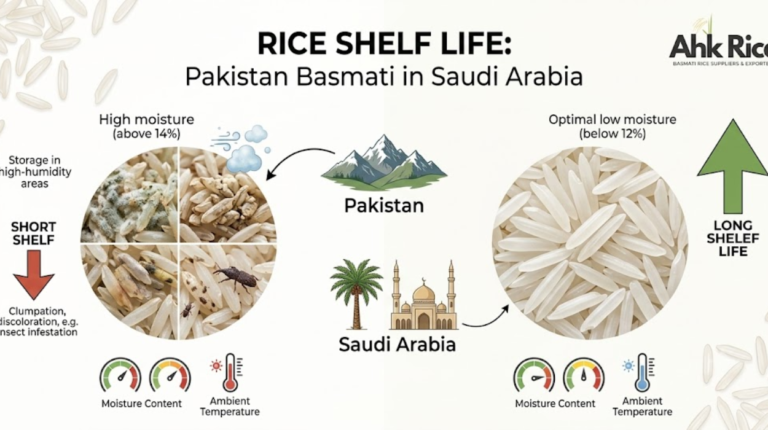
Moisture controls rice stability, milling quality, storage life, and food safety during Indonesia-bound shipments from Pakistan. Here is why: rice absorbs water from humid air, while excessive moisture supports mould, insects, heating, and quality deterioration. FAO identifies 13% moisture for milled rice as a general long-term storage guideline in tropical conditions.
Pakistani Basmati rice includes long-grain varieties cultivated mainly in Punjab. AHK Rice supplies 1121, Super Kernel, and 1509 Basmati rice varieties. These varieties are milled, dehusked, polished, graded, sorted, packed, and dispatched for international markets. Moisture remains a measurable quality parameter throughout this chain.
Indonesian importers therefore treat moisture as part of the physical specification. The value appears in quality testing, laboratory reports, inspection documents, and shipment specifications. Indonesian rice quality rules are governed by Badan Pangan Nasional regulations, including Regulation No. 2 of 2023 on rice quality and labeling.
What is moisture content in Basmati rice?
Moisture content is the percentage of water contained inside rice grains, measured on a wet-weight basis. A reading of 13% means water represents 13% of the grain’s total weight.
Moisture content describes the amount of water present in a rice sample. Indonesian rice standards also define moisture content as the quantity of water in rice expressed as a percentage of wet weight.
A moisture reading does not describe the rice variety. It describes the physical condition of the grain. Therefore, 1121 Basmati and Super Kernel rice each require their own batch-level moisture verification.
Moisture changes during storage because rice is hygroscopic. A hygroscopic grain exchanges moisture with surrounding air until it approaches equilibrium. High relative humidity therefore affects stored rice even after milling and packing.
The important distinction is between processing moisture and storage moisture. Rice can require controlled moisture during milling to reduce cracking, then require drying before storage. FAO reports that tempering rice around 14–16% before milling can reduce cracking, while milled rice is redried toward approximately 14% for safe storage.
This distinction explains why moisture control is not a single measurement taken only after harvesting. It is a quality-control process from paddy handling through export.
How does moisture affect Pakistan Basmati rice processing?
Moisture affects drying, dehusking, milling, grain breakage, sorting, storage, and final quality. Controlled moisture supports higher head-rice recovery and reduces cracking during processing.
How does drying control moisture?
Drying removes excess water from harvested paddy. The process begins after harvest and continues until the grain reaches a suitable condition for storage and milling.
FAO identifies 18–20% moisture as a useful initial drying range for rough rice before further drying. Final storage requires substantially lower moisture. The general tropical guideline is approximately 14% for paddy and 13% for milled rice.
How does moisture affect milling?
Milling removes the husk and bran layers from paddy. Moisture affects grain strength during this operation. Rice that is excessively dry becomes more susceptible to cracking, while controlled conditioning improves milling performance.
FAO reports that conditioning rice to 14–16% moisture before milling can improve head-rice yield and reduce breakage. Milled rice is then dried again for storage.
How does moisture affect grading?
Grading separates rice according to measurable characteristics. Examples include whole grains, broken grains, damaged kernels, discolored kernels, foreign matter, and moisture.
Moisture therefore works alongside grain length, broken percentage, foreign matter, and appearance. A shipment cannot rely on long grain length alone to establish quality.
With moisture defined and its role in processing established, the next question concerns the specific quality controls used before export.
What are the key moisture-control components for Indonesian rice imports?
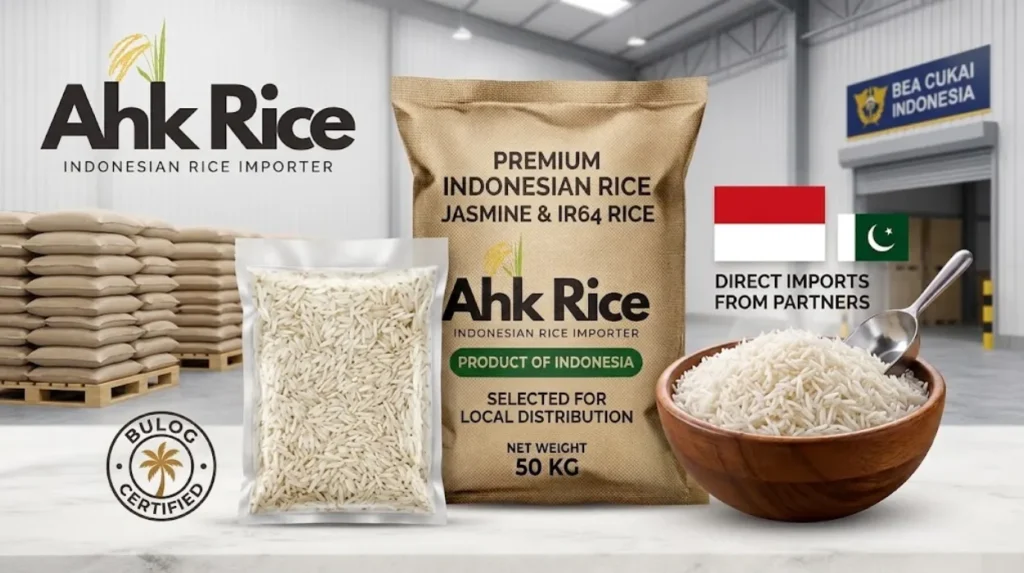
The main controls are sampling, calibrated measurement, drying, conditioning, laboratory verification, storage monitoring, packaging, and shipment inspection. Each control protects a different stage of rice quality.
Sampling
Sampling provides the material used for moisture testing. A representative sample must reflect the shipment rather than one convenient bag.
Moisture measurement
Moisture meters provide rapid readings during quality control. Indonesian rice standards also recognize laboratory methods for determining moisture content. SNI documentation describes oven testing and calibrated electronic moisture testers as measurement approaches.
Drying
Drying reduces excessive water after harvesting or processing. Controlled drying protects grain structure and supports stable storage.
Conditioning
Conditioning balances grain moisture before milling. Proper conditioning reduces stress differences within kernels and limits cracking.
Laboratory verification
Laboratory testing provides documented evidence of measured quality. Importers can compare the laboratory result with the contractual specification and shipment documents.
Storage monitoring
Storage requires control of temperature and humidity as well as grain moisture. FAO states that high moisture, temperature, and relative humidity create conditions favorable to insects and fungi.
Packaging
Packaging reduces direct exposure to external humidity. Packaging does not replace moisture control because rice remains sensitive to the surrounding storage environment.
Shipment inspection
Pre-shipment inspection confirms that the physical cargo matches the agreed specification. Moisture testing forms part of this wider quality verification process.
These controls connect moisture measurement with the full export chain rather than treating it as an isolated laboratory number.
What Basmati rice grades from Pakistan require moisture attention?
AHK Rice supplies 1121, Super Kernel, and 1509 Basmati varieties in multiple processing grades, including White, Steam, Golden Sella, Creamy Sella, and Brown formats.
1121 Basmati
1121 is a long-grain Pakistani Basmati variety. AHK Rice supplies 1121 White, 1121 Steam, 1121 Golden Sella, 1121 Creamy Sella, and 1121 Brown.
White rice passes through dehusking and milling. Steam rice receives steam treatment before drying and grading. Golden Sella and Creamy Sella are parboiled formats with controlled soaking, steaming, drying, milling, and sorting.
Super Kernel Basmati
Super Kernel is another Pakistani long-grain Basmati variety. AHK Rice supplies Super Kernel White, Super Kernel Steam, Super Kernel Sella, and Super Kernel Parboiled.
Moisture control remains important across these formats because drying follows processing treatments. Parboiled products require controlled drying after soaking and steaming.
1509 Basmati
1509 is a Pakistani Basmati variety supplied in 1509 White, 1509 Golden Sella, and 1509 Steam formats.
Each format has a different processing sequence. Moisture therefore needs verification after the relevant processing stage rather than assuming identical values across every grade.
The grade determines the processing route, while moisture testing confirms the condition of the finished grain.
How does moisture support Indonesian storage and shipment quality?
Controlled moisture reduces deterioration risks during storage and transport. FAO identifies 13% as a general safe-storage guideline for milled rice under tropical conditions.
Rice can absorb moisture from humid air during storage. Indonesia’s tropical environment makes humidity control important for imported grain.
FAO states that rice is highly hygroscopic and generally requires approximately 14% moisture or lower for safe storage in tropical conditions, while another FAO guideline gives 13% for milled rice under long-term storage conditions.
The exact contractual specification should therefore be established between importer and exporter. A general storage guideline is not automatically a shipment specification.
High moisture creates conditions that support microbial growth and insect activity. FAO identifies relative humidity above approximately 65–70% as favorable for mould development in stored products.
Temperature also interacts with moisture. Stored grain with high moisture and high temperature experiences faster respiration and deterioration. Localized heating can create hot spots inside a shipment.
Moisture also affects transit quality. Rice can encounter temperature changes during container transport. Condensation can increase localized wetting when environmental conditions shift.
Indonesia therefore requires attention to both the moisture reading at dispatch and the storage environment after arrival.
Which certifications and documents apply to Pakistan Basmati rice entering Indonesia?
Relevant documents include phytosanitary certification, food-safety documentation, laboratory test reports, certificates of analysis, and commercial export documents, subject to the shipment and Indonesian requirements.
Indonesia maintains plant-quarantine requirements for imported plant products. The International Plant Protection Convention lists Indonesia’s phytosanitary legislation and certificate framework.
Food-safety controls also apply to plant-origin food imports. Indonesia’s regulatory framework includes requirements covering food safety, quality, labeling, and related controls.
A Certificate of Analysis documents laboratory results such as moisture and other tested parameters. A Phytosanitary Certificate addresses plant-health requirements. A Health Certificate addresses food safety under applicable procedures.
Certification requirements depend on the product classification, origin, importer, current Indonesian rules, and shipment purpose. Exporters should therefore verify the current Indonesian requirement before dispatch.
Indonesia’s quarantine authority also provides a certificate verification system for plant and plant-product documents.
The documentation chain connects physical moisture testing with regulatory verification, which leads directly to common misunderstandings about moisture.
What are the common moisture problems when importing Basmati rice?
The main problems are excessive moisture, uneven moisture, inaccurate testing, condensation, poor storage, and confusion between processing moisture and final shipment moisture.
Excessive moisture
Excessive moisture increases storage risk. High moisture supports conditions associated with fungi, insects, heating, and faster deterioration.
Uneven moisture
A shipment can contain different moisture readings across bags or sampling points. Representative sampling therefore matters more than testing one container location.
Inaccurate measurement
Uncalibrated moisture meters create unreliable results. SNI documentation recognizes calibrated electronic moisture testers and oven-based measurement methods.
Condensation
Condensation can create localized wet spots during storage and transport. FAO explains that moisture moves between grain and surrounding air until equilibrium develops.
Wrong specification comparison
A common mistake is treating a general safe-storage guideline as a universal contractual limit. Import specifications must follow the agreed product standard and applicable Indonesian regulations.
Processing versus shipment moisture
Another misconception is that the moisture value used during milling equals the finished rice specification. Processing can require conditioning, followed by drying before storage and dispatch.
Understanding these differences prevents a single moisture number from being interpreted without its processing and storage context.
How should Indonesian importers understand moisture verification?
Indonesian importers should compare the agreed moisture specification with representative sampling, calibrated measurement, laboratory results, storage conditions, and shipment documentation before accepting Pakistan Basmati rice.
The verification process begins with the product specification. The importer identifies the variety, processing grade, packaging, moisture requirement, and applicable regulatory conditions.
The exporter then samples the finished rice and measures moisture using an appropriate method. Laboratory testing provides documented results for the shipment file.
The importer compares the result with the agreed specification. The same documentation can support inspection, customs clearance, food-safety review, and supplier quality records.
For readers who want the practical verification process, the next-stage topic is how Indonesian importers verify moisture levels in Pakistan Basmati rice. This link belongs in this section because it naturally moves from the informational explanation into the evaluation stage.
What should buyers remember?
Moisture is not simply a number printed on a quality report. It connects rice processing, storage, transport, food safety, and import quality.
For Indonesian Basmati rice imports, the most useful approach is to evaluate moisture together with grain quality, processing grade, laboratory evidence, packaging, storage conditions, and regulatory documentation.
Frequently Asked Questions
Why does moisture matter in Basmati rice imports?
Moisture affects storage stability, grain quality, mould risk, insect activity, milling performance, and transport condition. A controlled moisture level helps maintain the physical quality of milled rice.
What is a safe moisture level for milled rice?
FAO gives 13% moisture as a general guideline for long-term storage of milled rice under tropical conditions. The contractual export specification remains dependent on the product and applicable market requirements.
How is rice moisture measured?
Rice moisture is measured using calibrated electronic moisture meters or laboratory methods. Indonesian SNI documentation describes electronic moisture testing and oven-based determination methods.
Does moisture affect rice breakage?
Yes. Moisture affects kernel strength and cracking during milling. FAO reports that conditioning rice around 14–16% moisture before milling can reduce breakage and improve head-rice yield.
Which Pakistani Basmati varieties does AHK Rice supply?
AHK Rice supplies 1121, Super Kernel, and 1509 varieties. Available formats include White, Steam, Golden Sella, Creamy Sella, Brown, Sella, and Parboiled grades.
What documents support moisture verification?
Typical quality documentation includes a Certificate of Analysis or laboratory report showing tested parameters. Other shipment documents can include phytosanitary, health, origin, inspection, and commercial documents according to the applicable import requirements.