How Do Factory Audits Verify Basmati Rice Processing Standards?
Factory audits verify Basmati rice processing standards most effectively when auditors inspect the complete production chain, compare actual practices with documented specifications, trace raw paddy through milling and packing, review laboratory records, and confirm that corrective actions are closed before shipment.
For rice importers, a factory audit is more valuable when it connects physical production controls with commercial specifications. Buyers evaluating:
Why third-party factory audits matter for rice procurement should examine what auditors actually verify, how inspection methods differ, and which evidence supports a repeatable supply program.
What does a factory audit verify in a Basmati rice processing facility?
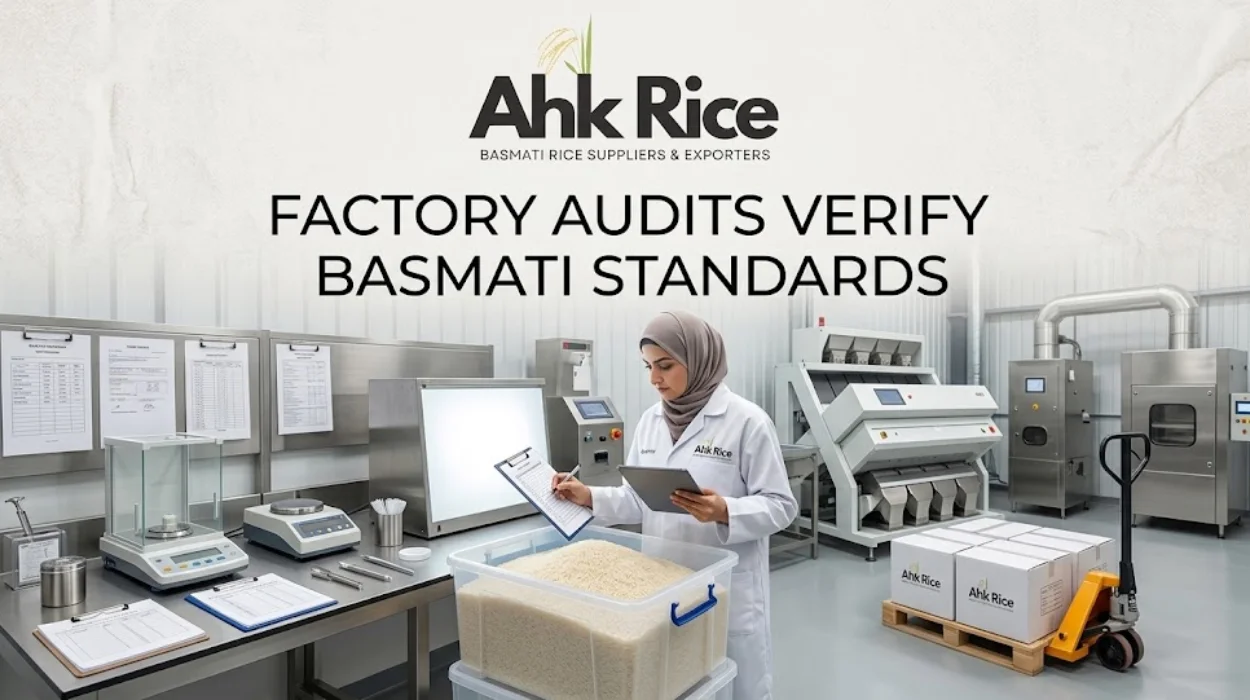
A Basmati rice factory audit verifies raw-material control, processing equipment, hygiene, grading, sorting, moisture management, laboratory testing, traceability, packaging, documentation, storage, and corrective actions against defined buyer and food-safety requirements.
A factory audit is a structured assessment of a processing facility. It is different from testing one rice sample. A sample measures product characteristics at a specific point. An audit evaluates the system that produces those characteristics.
For Basmati rice, the audit normally begins with paddy procurement and traceability. Auditors examine supplier records, incoming-paddy inspection, lot identification, and storage conditions. The objective is to determine whether the facility can identify the origin and production batch of the raw material.
The next stage is pre-cleaning. Industrial cleaners remove stones, dust, straw, soil, and other foreign material. Auditors inspect machine condition, cleaning frequency, maintenance records, and process controls.
De-husking converts paddy into brown rice by removing the outer husk. Paddy separation then removes grains that remain unhusked. An effective audit checks whether these stages are controlled to prevent excessive broken grains and unintended mixing between lots.
Whitening and polishing remove bran layers from brown rice. The auditor reviews equipment settings, maintenance, product flow, and the separation of different grades. Excessive polishing can affect appearance and yield, while inadequate control can produce inconsistent commercial specifications.
Grading and length sorting are particularly important for Basmati. Buyers commonly specify grain length, broken-grain percentage, chalkiness, foreign matter, moisture, and appearance. Optical and mechanical sorting equipment should therefore be inspected for calibration, maintenance, and operating records.
Color sorting provides another control point. Optical sorters identify discolored or defective grains and remove them from the finished lot. Auditors verify that the equipment is operational and that rejected material is controlled.
Laboratory controls provide supporting evidence. Records can include moisture analysis, broken-grain measurement, purity testing, foreign-matter checks, and other quality parameters required by the buyer.
The final audit stages cover packaging, labeling, warehouse storage, pest-control programs, finished-product identification, container loading, and export documentation.
What are the available solutions for verifying Basmati rice processing standards?
Importers can verify processing standards through factory audits, third-party inspections, supplier self-audits, laboratory testing, certification reviews, and combined audit programs, with each method providing different evidence about facility capability, product conformity, and shipment-level compliance.
A factory audit evaluates the processing system. It answers whether the facility has suitable equipment, procedures, personnel, records, hygiene controls, traceability, and corrective-action systems.
A third-party inspection evaluates a shipment or production lot against agreed specifications. Organizations such as SGS and Bureau Veritas can provide independent inspection services. The inspection can include quantity verification, visual checks, sampling, and laboratory analysis depending on the agreed scope.
Supplier self-audits are completed internally. They are useful for routine monitoring because they cost less and can be performed frequently. Their weakness is independence. The supplier evaluates its own controls.
Laboratory testing provides quantitative evidence. It can verify parameters such as moisture, broken grains, foreign matter, and other agreed product characteristics. Laboratory results do not, however, prove that the factory consistently maintains the same process controls.
Certification audits assess management systems against defined standards. Relevant frameworks can include ISO 22000 for food-safety management, HACCP-based controls, ISO 9001 for quality management, GMP principles, and destination-specific regulatory requirements.
The strongest commercial approach combines these methods. A buyer can audit the factory before approval, inspect the first commercial shipment, test representative samples, and review certificates and corrective-action records throughout the supply relationship.
How do different Basmati rice audit approaches compare?
Factory audits provide the broadest view of production capability, third-party inspections provide independent shipment evidence, laboratory testing provides measurable product data, and certifications demonstrate structured management controls rather than replacing physical verification.
| Audit or verification method | Primary evidence | Coverage | Independence | Best commercial use | Main limitation | Typical frequency |
|---|---|---|---|---|---|---|
| Factory audit | Production and management controls | Whole facility | High with independent auditor | Supplier approval | Requires site access | Annual or risk-based |
| Third-party inspection | Shipment and lot conformity | Specific order | High | Pre-shipment approval | Limited historical coverage | Every shipment or risk-based |
| Laboratory testing | Measured product properties | Sample or lot | High when independent lab is used | Specification verification | Does not audit the factory | Every lot or defined schedule |
| Supplier self-audit | Internal procedures and records | Facility | Low | Routine monitoring | Self-reported evidence | Monthly or quarterly |
| Certification audit | Management system conformity | Defined system scope | Independent certification body | System-level assurance | Certification is not a product guarantee | Annual surveillance cycle |
| Buyer audit | Commercial and technical controls | Defined buyer scope | High | Strategic sourcing | Higher buyer cost | Initial and periodic |
| Combined audit program | Facility + shipment + laboratory evidence | End-to-end | High | Long-term contracts | Highest coordination requirement | Risk-based |
This comparison shows why one verification method cannot answer every procurement question.
A laboratory report can show that a particular lot meets a moisture specification. It cannot establish whether the factory has effective pest control.
A factory audit can establish that pest-control procedures exist and records are maintained. It cannot prove that every future shipment will meet the same moisture specification.
Third-party inspection bridges part of this gap by independently checking the commercial shipment. Certification adds evidence that formal management systems exist.
Which audit approach works best for different importer cases?
New importers benefit most from a combined factory audit, product testing, and pre-shipment inspection, while established buyers can use risk-based audits supported by shipment testing, certifications, supplier records, and corrective-action reviews.
A new importer approving a supplier should prioritize a factory audit. The buyer has limited historical evidence, so facility capability is the central question.
A large distributor signing a recurring contract should combine an initial factory audit with defined product specifications, laboratory testing, pre-shipment inspection, and periodic surveillance.
A private-label retailer needs additional controls around packaging, label accuracy, batch coding, traceability, and finished-product release. The audit should extend beyond milling into packaging and documentation.
A foodservice distributor should emphasize cooking performance, grain uniformity, breakage, moisture, and repeatability. The factory audit should verify that the approved specification can be reproduced across production lots.
A price-sensitive commodity buyer may use a narrower inspection program. However, reducing the audit scope should not remove controls for food safety, traceability, foreign material, moisture, and shipment conformity.
For Washington State import programs, the audit should also be connected to U.S. import documentation and food-safety requirements. The commercial objective is not merely to prove that a Pakistani factory operates correctly. It is to demonstrate that the approved product can be consistently produced, documented, packed, and shipped for the destination market.
How do Pakistan Basmati rice grades affect factory audit requirements?
Basmati grade determines which processing controls deserve the greatest audit attention because 1121, Super Kernel, and 1509 differ in grain characteristics, processing formats, market positioning, and buyer specifications for length, breakage, moisture, appearance, and cooking performance.
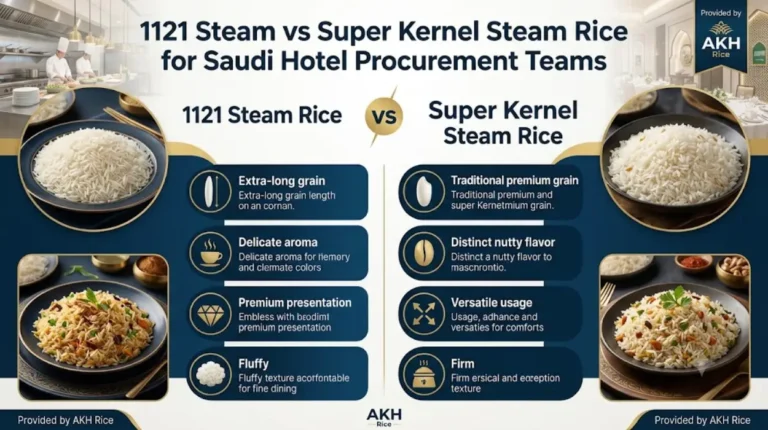
1121 Basmati is associated with extra-long grain characteristics and is widely used in premium retail, foodservice, and South Asian cuisine markets. Auditors should pay particular attention to length sorting, broken-grain control, polishing, moisture, and lot consistency.
Super Kernel Basmati requires consistent grain appearance, purity, length, and cooking performance. Audit evidence should show that grading and sorting systems separate commercial grades accurately.
1509 Basmati is available in processing formats including Steam and Sella. Parboiling creates additional process-control requirements. Auditors should examine soaking, steaming, drying, moisture control, and equipment sanitation in addition to conventional milling controls.
The first product mention should connect directly to the relevant export specification and service information. For commercial buyers evaluating Pakistani Basmati rice, AHK Rice documents processing from paddy procurement through cleaning, de-husking, separation, whitening, grading, packaging, and container loading, with export documentation managed as part of the process.
The audit should therefore evaluate the actual processing route used for the selected grade rather than applying one generic checklist to every Basmati product.
Which Basmati grades do different market regions prefer?
Middle Eastern markets commonly prioritize aromatic long-grain Basmati grades for biryani, kabsa, mandi, and foodservice applications, while North American buyers place greater emphasis on consistent specifications, documentation, packaging, traceability, and repeatable retail or restaurant performance.
| Market region | Common grade preference | Typical commercial focus | Indicative price positioning per MT* | Shelf-life planning |
| Middle East | 1121 Steam, 1121 Sella, 1509 Steam/Sella | Long grain, aroma, elongation, cooking performance | Premium for extra-long and higher-grade specifications | Usually planned around 12–24 months depending on product and packaging |
| North America | 1121 Sella/Steam, Super Kernel, selected 1509 | Specification consistency, labeling, documentation, low breakage, private label | Premium grades command higher values; exact FOB varies by crop and contract | Usually planned around 12–24 months depending on specification and storage |
*Rice prices change with crop year, paddy cost, milling yield, grade, packaging, order volume, Incoterm, freight, and currency. A fixed 2026 market price would therefore misrepresent the commercial procurement environment.
Shelf life should also be separated from quality retention. A package can remain within its declared shelf-life period while grain appearance, aroma, moisture stability, or cooking performance changes if storage conditions are poor.
For this reason, factory audits should inspect finished-goods warehouses, palletization, ventilation, pest-control records, stock rotation, humidity exposure, packaging integrity, and batch identification.
What are the pros and cons of factory audits?
Factory audits provide strong visibility into supplier capability and process controls, but they require time, cost, site access, and periodic repetition; their value increases when audit findings are linked to laboratory results, shipment inspections, specifications, and corrective-action evidence.
Factory audit advantages
The first advantage is process visibility. Buyers can see how rice moves through the facility instead of relying only on a finished-product certificate.
The second is root-cause identification. If broken-grain levels increase, an auditor can investigate equipment condition, machine settings, handling practices, and operator controls.
The third is supplier qualification. A buyer can reject a facility before investing in a long-term supply agreement.
The fourth is traceability verification. Auditors can follow a lot from incoming paddy to finished bags and shipment documents.
Factory audit limitations
The main limitation is snapshot risk. An audit represents conditions during the audit period. Production practices can change later.
The second limitation is cost. Independent auditors, travel, laboratory testing, and document reviews increase procurement expenses.
The third is scope dependency. A poorly designed checklist can miss critical controls. An audit should therefore be built around the buyer’s actual product specification and destination requirements.
The fourth is corrective-action dependency. Finding a problem is not the same as resolving it. Buyers should require evidence that corrective actions were implemented and verified.
What decision factors should rice importers use when evaluating factory audits?
Importers should prioritize audit scope, auditor independence, product specifications, traceability, testing evidence, corrective actions, certification status, and destination requirements, then connect those factors to shipment history before approving a supplier for recurring Basmati rice procurement.
| Decision factor | What the buyer should verify | Why it matters |
| Audit scope | Milling, sorting, laboratory, packaging, storage, loading | Prevents critical production stages from being excluded |
| Auditor independence | Qualified independent auditor and defined methodology | Reduces self-reporting risk |
| Product specification | Grain length, moisture, broken grains, purity, appearance | Connects audit findings to commercial requirements |
| Traceability | Paddy, production lot, packaging batch, shipment records | Enables investigation and recall management |
| Corrective actions | Finding, responsible party, deadline, evidence of closure | Shows whether identified weaknesses were actually fixed |
The strongest supplier evaluation also compares audit evidence with actual shipment performance.
For example, if a factory audit reports calibrated graders but three consecutive shipments show elevated broken-grain percentages, the buyer should investigate the discrepancy. The audit result should not automatically override shipment evidence.
Likewise, a clean shipment inspection does not eliminate the need for periodic factory audits. A supplier can produce one compliant lot without demonstrating stable process capability.
How should importers use factory audit results before signing a supply contract?
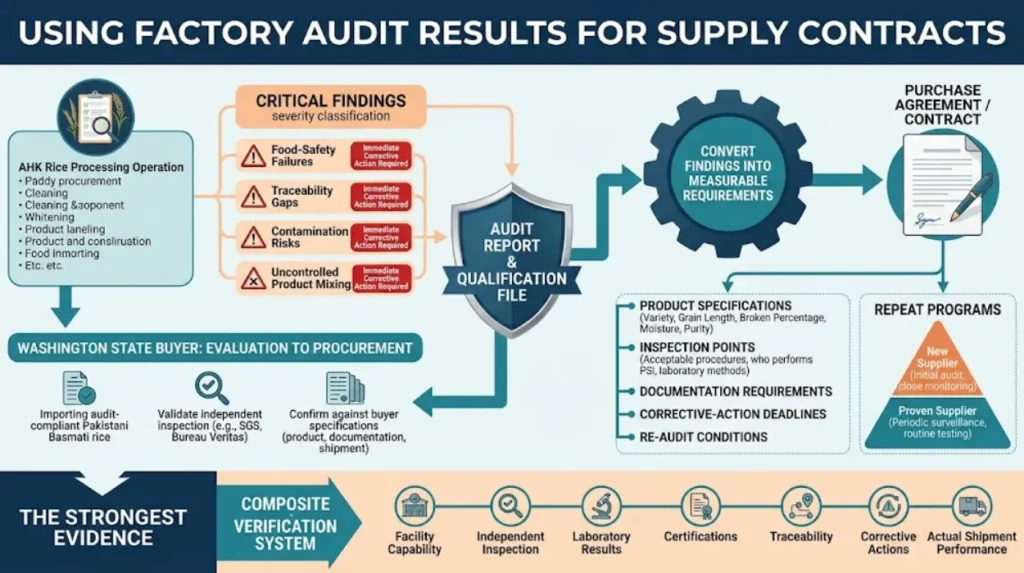
Importers should convert audit findings into measurable procurement requirements before signing a contract, defining product specifications, inspection points, documentation requirements, corrective-action deadlines, and re-audit conditions so quality expectations remain enforceable across repeat shipments.
The audit report should become part of the supplier qualification file. Critical findings should be classified by severity. Food-safety failures, traceability gaps, contamination risks, or uncontrolled product mixing require immediate corrective action.
Commercial specifications should then be written into the purchase agreement. These can include variety, grain length, broken percentage, moisture, purity, packaging format, net weight, batch identification, and acceptable inspection procedures.
The buyer should also define who performs pre-shipment inspection and which laboratory methods apply. This prevents disputes caused by different testing procedures.
For repeat programs, audit frequency should follow risk. A new supplier may require an initial audit and closer shipment monitoring. A supplier with strong historical performance can move toward periodic surveillance supported by routine testing.
AHK Rice states that its processing operation covers paddy procurement, cleaning, de-husking, separation, whitening, grading, customized packaging, documentation, and container loading, while its published USA export program includes independent inspection through organizations such as SGS and Bureau Veritas.
For a Washington State buyer moving from evaluation to procurement, the decision-focused next step is to assess the requirements for:
Importing audit-compliant Pakistani Basmati rice into Washington State against the buyer’s product, documentation, inspection, packaging, and shipment specifications.
A factory audit is therefore best treated as one layer of a supplier-verification system. The strongest evidence comes from connecting facility capability, independent inspection, laboratory results, certifications, traceability, corrective actions, and actual shipment performance.
Frequently Asked Questions
How do factory audits verify Basmati rice processing standards?
Factory audits verify Basmati rice processing by inspecting raw-material control, cleaning, milling, grading, sorting, moisture management, laboratory testing, packaging, storage, traceability, hygiene, and export documentation.
What does a third-party factory audit check in a rice mill?
A third-party audit checks production equipment, sanitation procedures, quality-control records, employee practices, traceability systems, pest control, laboratory facilities, storage conditions, packaging operations, and corrective-action records.
Why are factory audits important for Basmati rice importers?
Factory audits help importers confirm that a supplier has the equipment, procedures, quality controls, and traceability systems required to produce consistent Basmati rice according to agreed specifications.
What quality parameters are checked during a Basmati rice audit?
Common parameters include grain length, broken grains, moisture, purity, foreign matter, chalkiness, appearance, milling quality, packaging accuracy, and compliance with the buyer’s product specification.
Can a factory audit verify rice grain quality?
Yes. An audit can verify the systems used to control grain quality, while laboratory testing and shipment inspection provide direct evidence that a specific rice lot meets the required specifications.
How does an audit verify Basmati rice traceability?
Auditors review records linking incoming paddy to production batches, finished rice, packaging lots, warehouse inventory, and shipment documentation. This allows a buyer to trace a commercial lot through the processing chain.
What is the difference between a factory audit and a rice inspection?
A factory audit evaluates the facility and its production systems, while a rice inspection generally evaluates a specific shipment or lot. Using both provides broader evidence of supplier and product conformity.
Which Basmati rice grades require strict factory controls?
1121 Basmati, Super Kernel, and 1509 Basmati require controlled processing. Auditors should pay particular attention to grain length, sorting, breakage, moisture, purity, and processing consistency according to the selected grade.