Why Do Saudi Arabian Food Service Buyers Check Moisture Levels Before Importing Pakistan Rice?
Saudi Arabian food service buyers check moisture levels before importing Pakistan rice because moisture percentage determines storage stability, cooking consistency, grain appearance, transportation safety, shelf life, and financial value. Moisture testing protects importers from quality deterioration during long-distance sea shipments and commercial warehouse storage.
Rice quality begins long before cooking. Moisture content influences nearly every stage of the international supply chain, from milling and packaging to shipping, customs clearance, storage, distribution, and final preparation in restaurants, hotels, catering companies, and institutional kitchens.
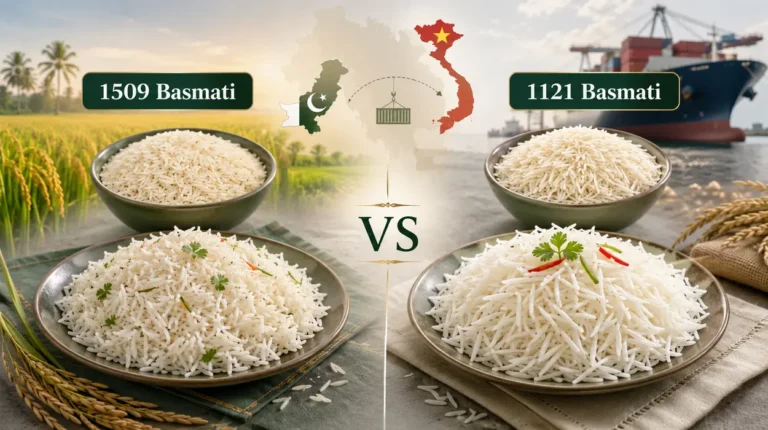
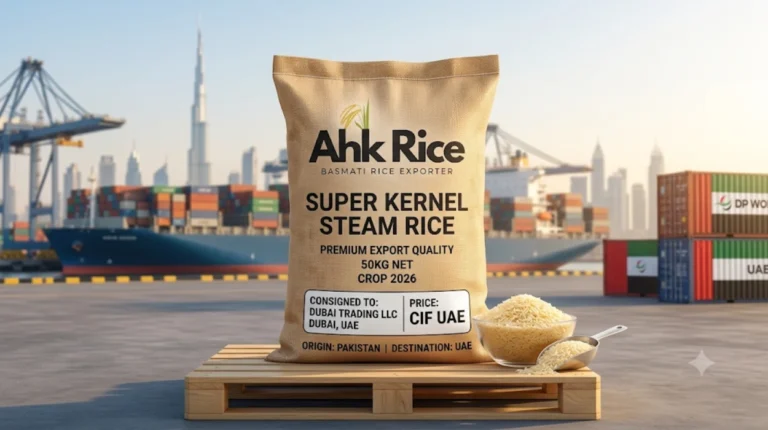
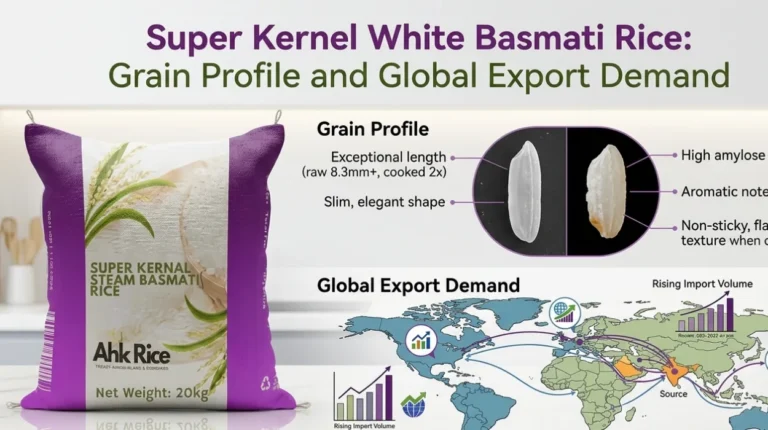
Pakistan remains one of the largest exporters of premium Basmati rice, producing internationally recognized varieties including 1121 Basmati, Super Kernel Basmati, and 1509 Basmati across Punjab’s fertile agricultural regions. Saudi Arabia imports substantial volumes of Pakistani rice every year because consumers prefer long grains, aromatic flavor, and high elongation after cooking. Maintaining the correct moisture percentage ensures these quality characteristics remain unchanged throughout the export journey.
What Is Moisture Content in Pakistan Rice?
Moisture content is the percentage of water naturally present inside rice grains after harvesting and processing. Saudi Arabian importers verify this measurement because internationally accepted moisture levels preserve grain quality, reduce storage losses, prevent fungal growth, and maintain consistent cooking performance during commercial food preparation.
Moisture content represents the amount of water contained within each rice grain. Laboratories express this value as a percentage of the grain’s total weight.
For exported Pakistani rice, moisture testing forms one of the most important quality control procedures before shipment.
The internationally accepted export moisture level for premium Pakistani Basmati generally remains between 12% and 14%, depending on buyer specifications, processing method, destination climate, and contractual requirements.
Rice harvested directly from fields contains considerably higher moisture. Freshly harvested paddy normally contains approximately 20% to 24% moisture. Drying facilities gradually reduce this percentage before milling begins.
Every reduction stage serves a specific purpose.
Higher moisture shortens storage life.
Lower moisture improves transportation safety.
Controlled moisture preserves cooking quality.
Professional rice mills verify moisture repeatedly during processing instead of testing only once before export.
How Does Moisture Control Work Throughout Pakistan’s Rice Processing?
Moisture control follows a continuous process from harvesting through drying, milling, grading, polishing, packaging, and container loading. Every stage protects grain quality by maintaining stable moisture percentages that comply with export specifications and international food safety standards.
Moisture management begins immediately after harvesting.
Harvesting
Farmers harvest mature paddy when grain moisture reaches suitable harvesting levels.
Harvesting too early produces immature grains.
Harvesting too late increases field cracking and weather damage.
Drying
Mechanical dryers or controlled sun drying gradually reduce moisture without creating thermal stress inside the grain.
Rapid drying damages kernels.
Controlled drying preserves grain structure.
Storage Before Milling
Paddy enters ventilated storage facilities where temperature and humidity remain stable.
Proper storage prevents moisture reabsorption.
Stable conditions preserve milling yield.
Milling
Rice passes through several processing stages.
These include:
- Cleaning
- Dehusking
- Paddy separation
- Whitening
- Polishing
- Length grading
- Color sorting
Modern processing facilities measure moisture before and after milling because polishing changes grain temperature slightly.
Quality Inspection
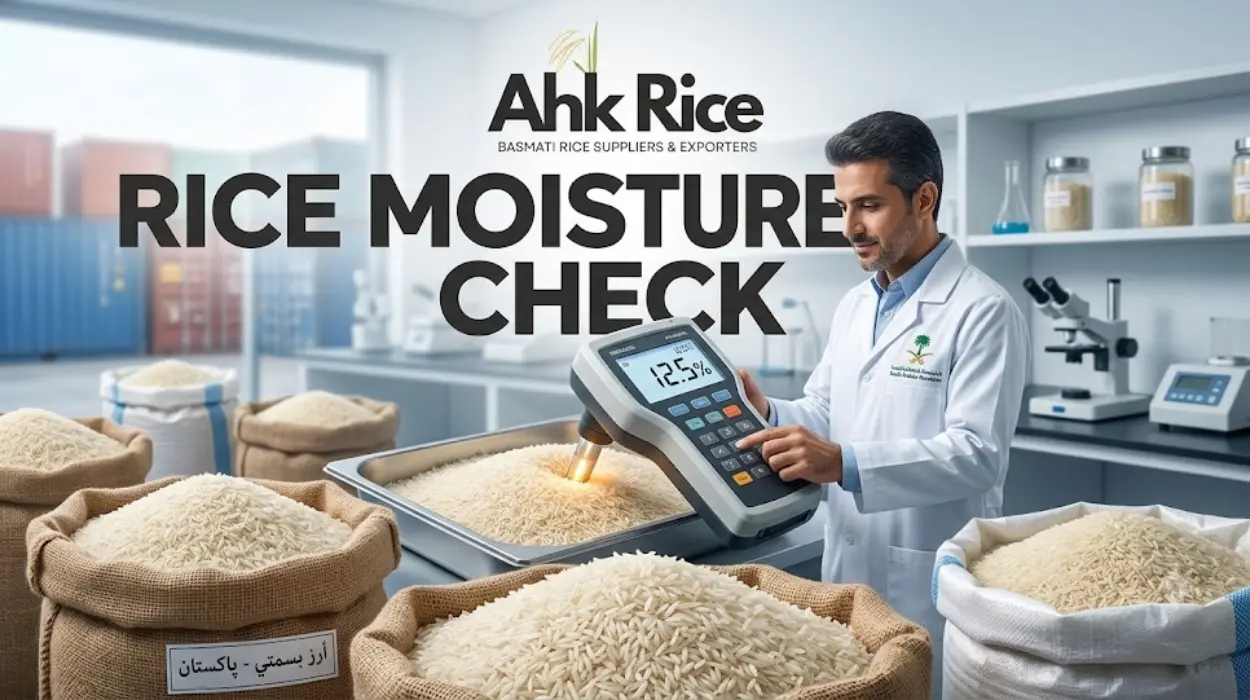
Laboratories inspect representative samples using calibrated digital moisture meters.
Export documentation records these measurements for buyer verification.
Packaging
Moisture-resistant packaging materials reduce environmental humidity exposure during transportation.
Proper sealing prevents external moisture from entering the bags.
Container Loading
Dry containers protect rice throughout sea transportation from Pakistan to Saudi Arabian ports.
Container inspection reduces condensation risks during changing ocean temperatures.
Which Components Affect Rice Moisture Levels?
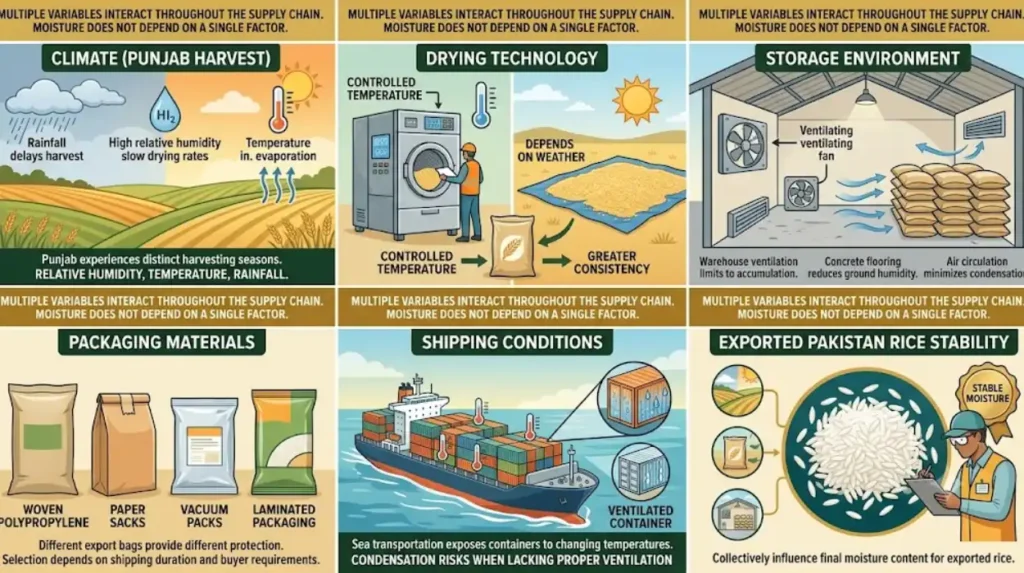
Several agricultural, environmental, and processing factors determine final moisture content. Climate, harvesting time, drying methods, storage systems, packaging quality, transportation conditions, and warehouse humidity collectively influence the stability of exported Pakistan rice.
Moisture does not depend on a single factor.
Multiple variables interact throughout the supply chain.
Climate
Punjab experiences distinct harvesting seasons.
Relative humidity affects natural drying rates.
Temperature influences moisture evaporation.
Rainfall delays harvesting schedules.
Drying Technology
Mechanical dryers provide controlled temperature.
Traditional drying depends on weather conditions.
Controlled systems produce greater consistency.
Storage Environment
Warehouse ventilation limits moisture accumulation.
Concrete flooring reduces ground humidity.
Air circulation minimizes condensation.
Packaging Materials
Different export bags provide different protection.
Examples include woven polypropylene bags, paper sacks, vacuum packs, and laminated packaging.
Packaging selection depends on shipping duration and buyer requirements.
Shipping Conditions
Sea transportation exposes containers to changing temperatures.
Temperature variation produces condensation when containers lack proper ventilation.
Professional exporters monitor container conditions before loading.
Why Do Saudi Arabian Food Service Buyers Pay Close Attention to Moisture Levels?
Saudi Arabian commercial kitchens require predictable cooking performance, long storage life, and minimal product loss. Moisture verification ensures imported Pakistan rice performs consistently across restaurants, hotels, catering companies, hospitals, airlines, and institutional food service operations.
Commercial kitchens prepare thousands of meals daily.
Consistency becomes essential.
Rice with stable moisture absorbs water uniformly during cooking.
Uniform hydration produces consistent grain expansion.
Kitchen managers calculate cooking yields accurately.
Predictable cooking reduces food waste.
Large catering operations also benefit from uniform cooking times.
Hotels require identical rice quality throughout the year.
Restaurant chains expect every branch to serve identical products.
Institutional buyers evaluate rice as an operational ingredient rather than only an agricultural commodity.
Moisture directly affects operational efficiency.
What Benefits Result from Proper Moisture Levels?
Correct moisture percentages improve storage stability, cooking consistency, grain integrity, export safety, milling efficiency, shelf life, food safety, and customer satisfaction. Stable moisture protects product quality throughout the complete international supply chain from Pakistan to Saudi Arabia.
Longer Shelf Life
Lower moisture slows microbial activity.
Proper storage extends product stability.
Better Cooking Performance
Uniform moisture creates even water absorption.
Rice cooks consistently across large commercial batches.
Reduced Grain Breakage
Balanced moisture strengthens grain structure during milling.
Higher head rice recovery increases export quality.
Improved Food Safety
Lower moisture reduces fungal development.
Controlled moisture discourages insect infestation.
Lower Financial Losses
Reduced spoilage protects importer investments.
Stable product quality decreases customer complaints.
Better Appearance
Proper moisture preserves natural grain color.
Premium Basmati maintains its attractive long-grain appearance after processing.
Which Types of Saudi Arabian Buyers Depend on Moisture Testing?
Many commercial sectors verify moisture specifications before purchasing Pakistan rice because storage duration, cooking volume, inventory turnover, and operational requirements differ across food service industries. Each buyer category evaluates moisture according to its commercial application.
Hotels
Hotels maintain inventory for continuous guest service.
Stable rice quality supports consistent dining experiences.
Restaurants
Restaurants require predictable cooking every day.
Uniform batches improve kitchen efficiency.
Catering Companies
Large catering businesses prepare thousands of meals within limited production schedules.
Consistent hydration simplifies large-scale cooking.
Hospitals
Healthcare institutions require standardized meal preparation.
Reliable rice quality supports nutritional planning.
Airlines
Airline catering depends on uniform cooking because meals are prepared in centralized production facilities before distribution.
Food Manufacturers
Manufacturers producing ready meals require stable raw material quality for automated processing lines.
What Problems Develop When Moisture Levels Become Too High?
Excess moisture accelerates biological activity, reduces storage life, increases fungal development, encourages insects, damages grain appearance, lowers milling quality, and decreases commercial value throughout transportation, warehousing, distribution, and food service operations.
High moisture creates measurable quality problems.
Microorganisms multiply faster.
Warehouse temperatures increase.
Grains lose visual quality.
Packaging absorbs excess humidity.
Long-distance shipping amplifies these issues because containers experience changing environmental conditions during ocean transport.
Import inspections frequently identify moisture-related quality deterioration before product distribution.
Commercial buyers therefore specify maximum moisture percentages within purchase contracts.
What Problems Occur When Moisture Levels Become Too Low?
Excessively dry rice becomes brittle during milling and transportation. Lower moisture increases grain breakage, reduces whole-kernel recovery, decreases visual quality, and affects commercial grading despite maintaining safe storage characteristics.
Moisture reduction has practical limits.
Rice requires structural balance.
Extremely dry grains crack more easily during handling.
Broken kernels reduce export grades.
Visual presentation influences wholesale market pricing.
Professional mills therefore target optimized moisture rather than the lowest possible percentage.
Which Misconceptions Exist About Rice Moisture?
Several common misconceptions confuse buyers. Moisture percentage does not measure freshness alone, higher moisture never improves quality, lower moisture does not guarantee better cooking, and visual inspection cannot accurately determine moisture content without laboratory testing.
Higher Moisture Means Fresher Rice
Fresh harvest does not equal export quality.
Freshly harvested rice contains excessive moisture.
Drying remains necessary.
Dry Rice Always Cooks Better
Extremely dry grains break more frequently.
Balanced moisture supports better grain integrity.
Appearance Shows Moisture
Grain appearance cannot accurately reveal internal moisture.
Laboratory instruments provide precise measurements.
Moisture Only Matters During Export
Moisture affects harvesting, milling, storage, transportation, warehousing, cooking, and long-term inventory management.
Every supply chain stage depends on proper moisture control.
How Is Moisture Measured Before Export?
Professional laboratories measure rice moisture using calibrated digital moisture analyzers following standardized sampling procedures. Multiple representative samples improve testing accuracy and verify compliance with export contracts and international quality assurance systems.
Quality inspectors collect representative grain samples.
Sampling represents the complete production lot instead of individual bags.
Digital moisture analyzers provide precise percentage readings within minutes.
Quality assurance teams document results before shipment approval.
Testing often occurs at several stages.
Examples include:
- Before milling
- After milling
- Before packaging
- Before container loading
- During final export inspection
Repeated verification reduces quality variation between production batches.
Why Does Moisture Control Support International Rice Trade?
Moisture control establishes confidence between exporters and importers by creating measurable quality standards. Consistent moisture percentages simplify commercial transactions, reduce disputes, improve storage performance, and maintain the premium reputation of Pakistan Basmati rice in Saudi Arabia.
International food trade depends on standardized quality measurements.
Moisture percentage remains one of the simplest measurable quality indicators.
Importers compare supplier specifications objectively.
Inspection agencies verify compliance before shipment acceptance.
Food safety systems also incorporate moisture management because stable moisture supports hygienic storage practices throughout international logistics.
Understanding moisture also helps buyers evaluate how rice performs after arrival. Readers interested in the relationship between moisture percentage and kitchen performance can continue with:
How proper moisture levels affect cooking consistency in Saudi Arabian commercial kitchens.
Frequently Asked Questions
Why do Saudi Arabian food service buyers test moisture levels before importing Pakistan rice?
Saudi Arabian buyers test moisture levels to ensure rice remains stable during shipping, resists spoilage, maintains grain quality, and delivers consistent cooking performance in commercial kitchens.
What is the ideal moisture content for exporting Pakistan Basmati rice?
Premium Pakistan Basmati rice is typically exported with a moisture content between 12% and 14%, depending on buyer specifications, processing methods, and contractual requirements.
How does moisture content affect the shelf life of Pakistan rice?
Proper moisture levels reduce the risk of fungal growth, insect infestation, and quality deterioration, allowing rice to maintain its quality during long-term storage and international transportation.
Why is high moisture content a problem in exported rice?
High moisture accelerates microbial activity, increases the risk of mold and insects, reduces storage stability, and can damage grain quality during sea transportation and warehouse storage.
Can rice with very low moisture content be considered higher quality?
No. Excessively low moisture makes rice brittle, increases grain breakage during milling and handling, and lowers the percentage of whole kernels despite improving storage stability.
How is moisture content measured before Pakistan rice is exported?
Professional laboratories use calibrated digital moisture meters to test representative grain samples before milling, after milling, before packaging, and before container loading.
Does moisture content influence the cooking performance of Basmati rice?
Yes. Rice with balanced moisture absorbs water evenly, cooks uniformly, produces better grain elongation, and delivers consistent texture in restaurants, hotels, and catering operations.
Which Pakistani rice varieties are commonly imported into Saudi Arabia?
Saudi Arabia imports several premium Pakistani varieties, including 1121 Basmati Rice, Super Kernel Basmati Rice, and 1509 Basmati Rice, depending on market preferences and food service requirements.
Does packaging help maintain the moisture level of exported rice?
Yes. Moisture-resistant export packaging minimizes humidity exposure during shipping and storage, helping preserve rice quality until it reaches the importer.
Why is moisture testing important for international rice trade?
Moisture testing provides a measurable quality standard that reduces commercial disputes, supports food safety compliance, protects product value, and ensures consistent quality throughout the export supply chain.