Understanding Production Lead Times Before Basmati Rice Export Shipments
Production lead times determine export success. Here is why: processing schedules, quality inspections, packaging requirements, documentation, and container booking directly affect shipment readiness. Buyers who understand lead times secure consistent supply, avoid stock shortages, and reduce logistics costs.
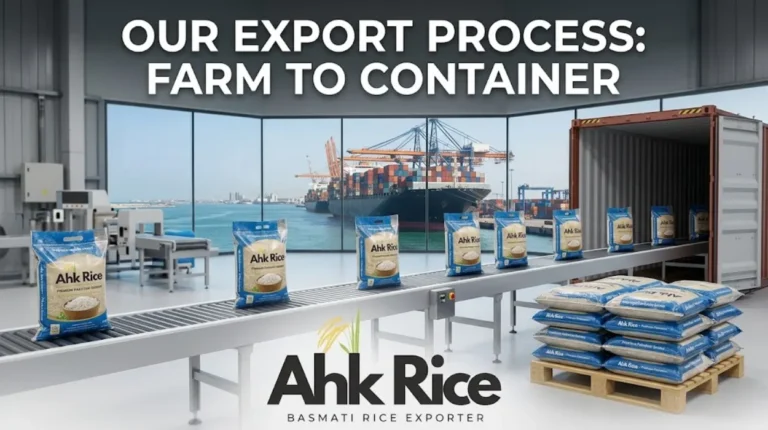
Basmati rice exporters manage several interconnected stages before shipment. Rice must be milled, graded, tested, packed, inspected, cleared, and loaded before dispatch. Every stage influences the final export schedule. Buyers seeking predictable deliveries should first understand the complete production timeline and the factors that extend or shorten it. For a broader understanding of how Pakistani Basmati moves from cultivation to international markets, read our guide on the complete Basmati rice production and export process.
AHK Rice supplies 1121, Super Kernel, and 1509 Basmati varieties to international markets. The company manages processing, grading, packaging, quality verification, and export preparation under one system. This integrated approach reduces delays and improves shipment predictability compared with fragmented sourcing models.
What Creates Production Lead Times Before Basmati Rice Export Shipments?
Most export shipments require 15–35 days from order confirmation to container readiness because milling, grading, testing, packaging, documentation, and logistics coordination must occur sequentially before dispatch.
Production lead time refers to the period between order confirmation and container loading. Every export order follows a structured workflow.
Which Steps Influence Export Lead Times?
AHK Rice follows nine processing stages before shipment:
- Clean the paddy
- De-husk the grain
- Dry the rice
- Polish the kernels
- Grade by size
- Sort by colour
- Inspect quality parameters
- Pack according to specifications
- Load export containers
Each stage requires specific machinery, labour allocation, and quality controls.
Typical Lead Time Breakdown
| Activity | Average Duration |
|---|---|
| Production scheduling | 1–2 days |
| Milling and grading | 3–5 days |
| Quality testing | 1–2 days |
| Packaging | 2–4 days |
| Documentation | 2–3 days |
| Container booking | 3–7 days |
| Port preparation | 2–4 days |
Orders requiring custom packaging usually add several days. Orders using standard export packaging move faster.
Large-volume contracts often require staggered production. A 500 MT shipment moves differently than a 25 MT container because production planning becomes more complex.
With the drivers of lead times explained, the next question is which production approaches deliver the fastest export readiness.
What Are the Available Solutions for Managing Basmati Rice Export Lead Times?
Three common solutions exist: stock-based supply, made-to-order production, and integrated processing systems, with integrated systems delivering the most balanced performance.
Exporters use different operational models. Each model influences delivery speed and product flexibility.
Stock-Based Supply
Stock-based exporters maintain finished inventory.
Advantages include:
- Immediate availability
- Faster dispatch
- Reduced scheduling complexity
Limitations include:
- Limited packaging options
- Restricted specifications
- Higher inventory carrying costs
Stock models suit urgent orders.
Made-to-Order Production
Made-to-order exporters begin production after order confirmation.
Advantages include:
- Customized specifications
- Flexible packaging
- Precise quality targets
Limitations include:
- Longer lead times
- Greater scheduling requirements
This model suits buyers needing unique specifications.
Integrated Processing Systems
Integrated systems combine milling, grading, packing, and export coordination.
Advantages include:
- Better production control
- Faster quality verification
- Reduced coordination delays
- Consistent shipment schedules
AHK Rice operates under this model, enabling efficient movement from processing to export readiness.
Specification Comparison Table
| Attribute | Stock-Based Supply | Made-to-Order Production | Integrated Processing |
|---|---|---|---|
| Lead Time | 5–10 days | 20–35 days | 15–25 days |
| Custom Packaging | Limited | Extensive | Extensive |
| Quality Consistency | Medium | High | High |
| Inventory Dependence | High | Low | Medium |
| Production Flexibility | Low | High | High |
| Container Readiness | Fast | Moderate | Fast |
| Cost Efficiency | Medium | Medium | High |
The available solutions show clear differences, making comparison essential before selecting an export strategy.
How Do Different Export Approaches Compare Across Major Markets?
Gulf markets prioritize speed and stock availability, while European markets prioritize documentation, traceability, and specification compliance, creating different lead-time requirements.
Market requirements significantly affect production schedules.
Gulf Cooperation Council (GCC) Markets
Countries include:
- Saudi Arabia
- United Arab Emirates
- Qatar
- Kuwait
- Oman
GCC buyers often prefer:
- 1121 Golden Sella
- 1121 Steam Basmati
- Super Kernel Basmati
These markets frequently prioritize quick replenishment.
Average lead time:
15–25 days
Typical pricing:
USD 950–1,300 per MT
(source: REAP export data, 2025)
Golden Sella performs well in hot storage environments. UAE warehouse operators commonly store inventory for extended periods. Golden Sella maintains quality longer than Steam rice under similar conditions.
European Markets
Countries include:
- United Kingdom
- Germany
- Netherlands
- Belgium
European buyers often prefer:
- Premium White Basmati
- Steam Basmati
- Organic Basmati
These markets prioritize certifications and traceability.
Average lead time:
25–35 days
Typical pricing:
USD 1,100–1,600 per MT
(source: REAP export data, 2025)
European documentation requirements frequently extend preparation timelines.
Shelf Life Comparison
| Rice Type | Average Shelf Life |
|---|---|
| White Basmati | 12–18 months |
| Steam Basmati | 12–18 months |
| Golden Sella Basmati | 18–24 months |
Golden Sella lasts longer than White rice. Golden Sella also performs better in warmer climates. GCC importers commonly choose Golden Sella for this reason.
Market differences highlight why no single export strategy suits every buyer. The next question examines which approach works best in specific situations.
Which Method Works Best for Different Export Cases?
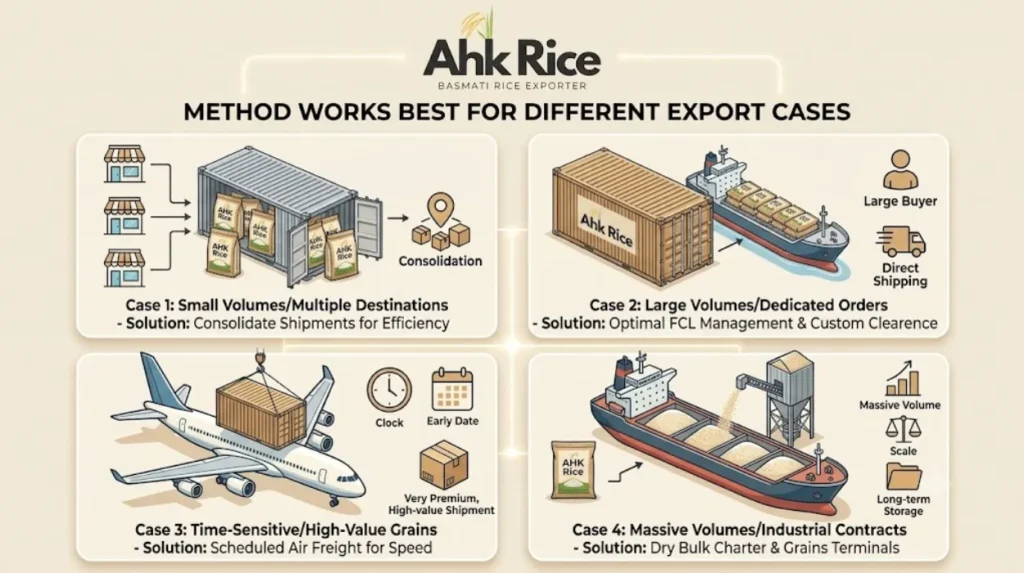
Integrated processing works best for most commercial buyers because it balances customization, quality control, and shipment speed without excessive inventory costs.
Different buyers face different requirements.
Case 1: Distributor Requiring Fast Replenishment
Requirements:
- Immediate inventory replacement
- Standard specifications
- Fast dispatch
Best option:
Stock-based supply
This approach minimizes waiting time.
Case 2: Retail Brand Requiring Custom Packaging
Requirements:
- Private labeling
- Special packaging
- Product differentiation
Best option:
Made-to-order production
This approach supports customization.
Case 3: Importer Requiring Consistent Monthly Supply
Requirements:
- Stable quality
- Predictable scheduling
- Container planning
Best option:
Integrated processing
This approach provides operational consistency.
Case 4: Government Tender Supply
Requirements:
- Documentation accuracy
- Volume reliability
- Strict specifications
Best option:
Integrated processing
Centralized coordination reduces compliance risks.
Understanding use cases helps buyers evaluate strengths and weaknesses. The next section examines those advantages and limitations directly.
What Are the Pros and Cons of Different Lead-Time Strategies?
Faster models reduce waiting time, while customized models improve flexibility; integrated systems provide the strongest balance between both objectives.
Stock-Based Supply
Advantages
- Immediate availability
- Rapid shipment scheduling
- Lower planning complexity
Limitations
- Limited specification flexibility
- Restricted packaging choices
- Inventory quality variation
Made-to-Order Production
Advantages
- Tailored specifications
- Custom branding
- Buyer-specific packaging
Limitations
- Longer production schedules
- Higher planning requirements
- Greater dependency on raw material availability
Integrated Processing
Advantages
- Controlled production flow
- Consistent quality verification
- Faster container preparation
- Better scheduling visibility
Limitations
- Higher operational investment
- More sophisticated management systems
Integrated systems create the strongest balance. Understanding decision factors helps buyers select the right model.
What Factors Should Buyers Evaluate Before Selecting an Export Supplier?
Lead time reliability, processing capacity, quality controls, documentation capability, and logistics coordination determine export performance more than quoted prices alone.
Buyers often focus only on price. Export reliability depends on multiple operational factors.
Decision Framework
| Decision Factor | Why It Matters | Priority |
|---|---|---|
| Processing Capacity | Supports volume commitments | High |
| Quality Testing | Prevents shipment disputes | High |
| Documentation Management | Enables customs clearance | High |
| Packaging Flexibility | Supports branding goals | Medium |
| Logistics Coordination | Reduces shipping delays | High |
Questions Buyers Should Ask
- What is the average production lead time?
- What packaging options are available?
- What certifications are maintained?
- What grading systems are used?
- What container loading capacity exists monthly?
Clear answers reveal operational maturity.
Certifications Commonly Requested
- ISO Certification
- HACCP Certification
- Phytosanitary Certification
- Fumigation Certification
- Health Certification
International buyers increasingly require documentation before shipment approval.
Production lead times become predictable when suppliers manage processing, quality control, and logistics under one coordinated system.
Production lead times directly affect inventory planning, customer satisfaction, and supply continuity. Buyers who understand processing schedules can select suppliers more effectively and reduce shipment uncertainty. Integrated processing systems consistently deliver the strongest balance between speed, customization, quality control, and export readiness.
Frequently Asked Questions
How long does Basmati rice production take before export?
Most export orders require 15–35 days from order confirmation to container readiness. Volume, packaging requirements, testing procedures, and shipping schedules affect the timeline.
What causes delays in rice export shipments?
Production scheduling, container shortages, documentation processing, custom packaging, and quality inspections are the most common causes of delays.
Which Basmati grade ships fastest?
Standard 1121 Golden Sella and 1121 Steam Basmati typically move fastest because exporters commonly maintain production schedules for these grades.
Does custom packaging increase lead time?
Yes. Private-label packaging, custom bag designs, and specialized retail formats usually add several days to production schedules.
Which market requires the longest preparation time?
European markets generally require longer preparation periods because certification, traceability, and compliance documentation requirements are more extensive.
What is container readiness in rice exports?
Container readiness means the rice has been processed, inspected, packed, documented, and prepared for loading and dispatch.