How Do Saudi Arabian Importers Evaluate Moisture Levels in Pakistan Basmati Rice?
Moisture level is the percentage of water present inside rice kernels after milling and before export. Saudi Arabian importers evaluate this value because it directly affects storage stability, cooking quality, grain appearance, transportation performance, and compliance with commercial import specifications during international trade in 2026.
Moisture content is one of the first technical specifications checked during Pakistan Basmati rice imports into Saudi Arabia. It represents the amount of water retained inside every grain after harvesting, drying, milling, grading, and packaging.
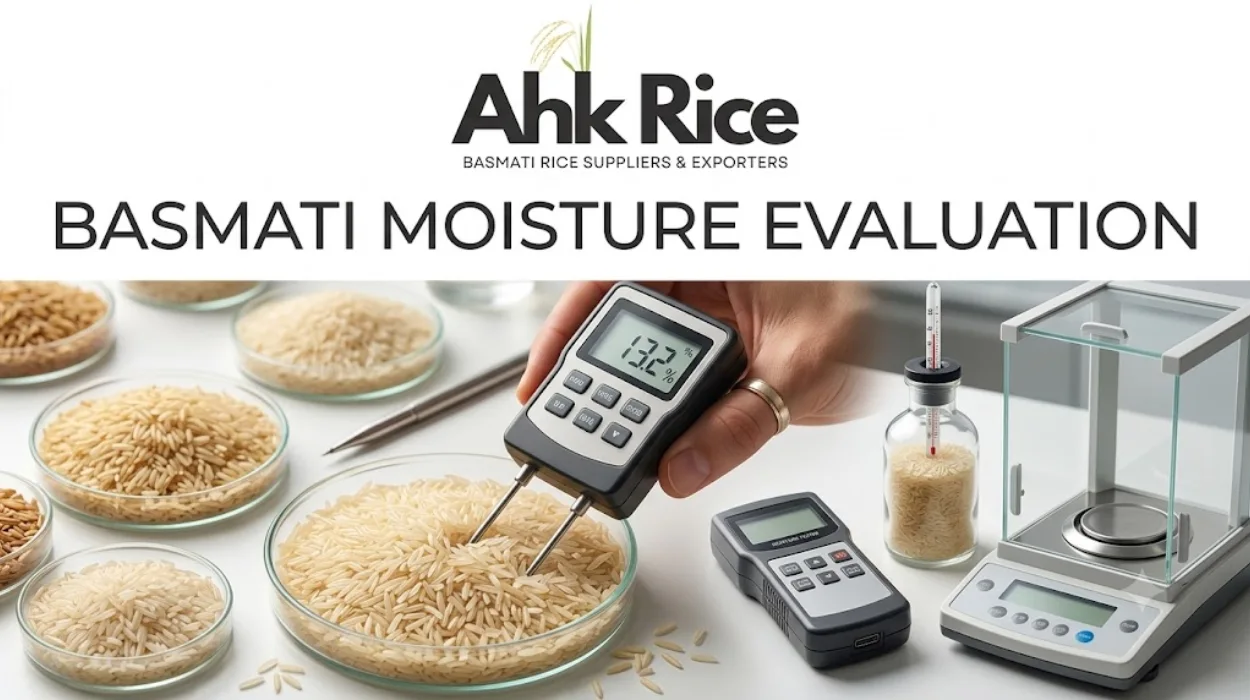
Rice moisture is expressed as a percentage. Modern export laboratories measure it with calibrated digital moisture analyzers before loading containers.
For example, common export specifications include:
- 12.0% moisture
- 12.5% moisture
- 13.0% moisture
- Maximum 14.0% moisture depending on contract specifications
Saudi Arabian buyers evaluate moisture because it influences every stage after shipment, including warehouse storage, retail shelf life, commercial distribution, and food service preparation.
The central entity is moisture content, not water on the surface of rice. Moisture exists inside the grain structure and determines how the rice behaves during transportation and cooking.
Why do Saudi Arabian importers check moisture before purchasing Pakistan Basmati rice?
Saudi Arabian importers inspect moisture before confirming purchases because the measurement predicts storage safety, export quality consistency, cooking performance, commercial shelf life, and compliance with contractual specifications across wholesale distribution, supermarkets, food manufacturers, and hospitality businesses throughout the Saudi food supply chain.
Moisture testing reduces quality variation between production lots.
Every commercial shipment includes technical specifications that define acceptable moisture percentages alongside broken grains, foreign matter, chalkiness, damaged kernels, grain length, and milling degree.
Importers compare laboratory reports with purchase contracts before shipment approval.
Examples of commercial buyers include:
- supermarket chains
- food distributors
- hotel suppliers
- restaurant wholesalers
- government procurement agencies
Each buyer evaluates moisture because rice often remains in storage for several months after arrival.
Higher moisture accelerates quality deterioration during long storage periods.
Lower controlled moisture supports stable grain quality throughout transportation and warehousing.
This evaluation begins before containers leave Pakistan rather than after arrival in Saudi Arabia.
Readers interested in how moisture specifications distinguish export grades can continue with the detailed comparison article about premium export standards in Pakistan rice for Saudi buyers:
What Moisture Specifications Differentiate Premium and Standard Pakistan Rice for Saudi Arabia? which explains how different moisture requirements influence commercial grade selection.
How is moisture measured before Pakistan Basmati rice is exported?
Export laboratories measure moisture using calibrated electronic moisture analysers that determine the percentage of water inside rice kernels. Testing occurs during processing, grading, packaging, container loading, and final shipment inspection to maintain consistent export specifications according to contractual quality requirements.
The measurement process follows several controlled steps.
Sampling
Technicians collect representative rice samples from different production batches.
Sampling from multiple locations prevents inaccurate readings caused by uneven moisture distribution.
Cleaning
Foreign materials are removed before testing.
Examples include:
- dust
- husks
- straw particles
- stones
Only clean rice enters laboratory analysis.
Instrument calibration
Laboratory equipment is calibrated before testing.
Calibration ensures every measurement follows standardized reference values.
Moisture analysis
Rice enters the analyzer.
The equipment calculates the moisture percentage after controlled heating and measurement.
Modern export facilities complete this process within minutes.
Documentation
The final value becomes part of the shipment quality documentation.
Inspection reports normally include several specifications together rather than moisture alone.
Which factors influence moisture levels during rice processing?

Moisture changes throughout harvesting, drying, milling, polishing, grading, packaging, storage, and transportation. Each processing stage influences the amount of water retained inside rice kernels before export, making production control essential for maintaining consistent commercial quality standards.
Harvest timing strongly affects moisture.
Rice harvested too early contains higher internal moisture than mature crops.
Drying is the next critical stage.
Mechanical dryers gradually reduce moisture until the target export specification is achieved.
After drying, milling removes the outer husk.
Polishing removes bran layers depending on the required product type.
Sorting machines separate kernels according to commercial grade.
Packaging also contributes to moisture stability.
Examples include:
- woven polypropylene bags
- laminated bags
- vacuum packaging
- retail consumer packs
Warehouse conditions remain important before shipment.
Temperature and humidity influence moisture stability while rice waits for container loading.
Proper warehouse ventilation helps maintain specification consistency.
Which quality components do Saudi Arabian importers evaluate together with moisture?
Moisture forms only one part of a complete quality evaluation. Saudi Arabian importers simultaneously inspect grain length, broken percentage, damaged kernels, chalkiness, foreign matter, purity, milling quality, aroma, packaging, and laboratory certification before approving export shipments.
Commercial rice evaluation combines multiple technical characteristics.
Grain length determines visual appearance.
Broken percentage affects commercial value.
Foreign matter measures contamination.
Purity identifies the percentage of the declared rice variety.
Examples of foreign matter include:
- stones
- husk fragments
- weed seeds
- dust
Aroma receives attention in fragrant Basmati varieties.
Packaging quality protects rice during transportation.
Laboratory reports verify technical specifications.
Together, these measurements create a complete quality profile instead of relying on moisture alone.
What benefits does proper moisture control provide?
Controlled moisture improves storage stability, protects grain appearance, preserves cooking consistency, reduces quality deterioration, supports international transportation, extends commercial shelf life, and helps maintain uniform product quality across large export consignments delivered to Saudi Arabian importers.
Controlled moisture supports stable grain performance throughout the export journey.
Rice maintains its appearance more effectively during handling.
Uniform moisture contributes to consistent cooking behavior.
Commercial warehouses experience fewer quality losses when moisture remains within specification.
Retail distributors also benefit because rice retains acceptable appearance during storage.
Food service operators value consistency between different shipments.
Consumers experience similar cooking performance when product quality remains stable across production batches.
These benefits explain why moisture receives continuous attention throughout export processing.
Which Pakistan Basmati rice grades are commonly exported to Saudi Arabia?
Saudi Arabian importers purchase several Pakistan Basmati grades according to market segment, cooking preference, grain appearance, and commercial application. Each variety follows moisture specifications alongside separate grading standards established through export contracts and laboratory quality inspections.
Pakistan exports multiple Basmati varieties.
Examples include:
- 1121 Steam Basmati Rice
- 1121 Sella Basmati Rice
- 1121 White Basmati Rice
- Super Kernel Basmati Rice
- 1509 Steam Basmati Rice
- 1509 White Basmati Rice
- Brown Basmati Rice
Each grade differs in grain length, appearance, processing method, and cooking characteristics.
Saudi Arabian wholesalers select varieties according to customer demand.
Retail markets often prioritize premium appearance.
Food service buyers frequently focus on cooking consistency.
Industrial food manufacturers evaluate technical specifications required for their production processes.
Regardless of variety, moisture remains an essential inspection parameter.
Which certifications support moisture evaluation during exports?
Export certifications document quality compliance through laboratory inspection, food safety management, phytosanitary verification, and product traceability. Moisture measurements become part of broader inspection systems that verify shipment conformity before international transportation to Saudi Arabia.
Commercial rice exports include several certification systems.
Examples include:
- ISO quality management documentation
- HACCP food safety systems
- Phytosanitary certificates
- Fumigation certificates
- Certificate of Origin
- Third-party laboratory inspection reports
These documents describe shipment quality according to contractual requirements.
Inspection organizations verify technical specifications before export.
Moisture measurements become one documented element within comprehensive quality inspection procedures.
Certification increases transparency between exporters and importers during international trade.
What misconceptions exist about moisture testing in Pakistan Basmati rice?
Several misconceptions confuse moisture evaluation with visible wetness, grain freshness, cooking quality, or storage duration. Moisture percentage measures internal water content only, while complete rice quality depends on multiple technical characteristics evaluated together during commercial inspections.
One common misconception states that dry-looking rice always has low moisture.
Appearance alone does not determine internal water content.
Laboratory testing provides accurate measurement.
Another misconception assumes moisture alone defines rice quality.
Commercial buyers evaluate numerous specifications simultaneously.
Examples include grain size, purity, broken percentage, milling quality, aroma, and packaging.
Some people also believe every importing country uses identical moisture specifications.
Commercial contracts differ between buyers, product grades, and intended applications.
Scientific measurement replaces visual estimation throughout professional rice trading.
How does moisture evaluation support international rice trade in 2026?
Moisture evaluation supports standardized international trade by providing measurable quality data that improves contract compliance, inspection consistency, shipment transparency, storage planning, and product reliability across Pakistan’s Basmati rice exports entering Saudi Arabian commercial supply chains during 2026.
International food trade depends on measurable specifications rather than visual judgment.
Moisture provides one numerical indicator that every participant understands.
Farmers, processors, laboratories, exporters, shipping companies, inspection agencies, importers, distributors, and retailers all reference documented moisture values during the supply chain.
This standardized measurement improves communication between trading partners.
Saudi Arabian importers continue using moisture evaluation because it supports quality consistency throughout transportation, warehousing, commercial distribution, and final food preparation.
Understanding moisture also helps buyers compare export grades more accurately, making it easier to interpret quality specifications before purchasing Pakistan Basmati rice.
Frequently Asked Questions
How do Saudi Arabian importers measure moisture in Pakistan Basmati rice?
Saudi Arabian importers rely on calibrated digital moisture analyzers and laboratory testing reports to verify the moisture percentage before approving rice shipments.
What is the ideal moisture level for Pakistan Basmati rice exports to Saudi Arabia?
Most export contracts specify moisture levels between 12% and 14%, depending on the rice variety, buyer requirements, and agreed commercial specifications.
Why is moisture testing important before exporting rice?
Moisture testing helps maintain storage stability, cooking consistency, grain appearance, and compliance with import quality standards during international transportation.
Which Pakistan Basmati rice varieties are commonly exported to Saudi Arabia?
The most common varieties include 1121 Steam Basmati, 1121 White Basmati, 1121 Sella Basmati, Super Kernel Basmati, and 1509 Basmati rice.
How is moisture measured during rice processing?
Moisture is measured by collecting representative samples and testing them with calibrated electronic moisture meters in export quality laboratories.
Does moisture affect the cooking quality of Basmati rice?
Yes. Proper moisture levels contribute to consistent grain elongation, texture, aroma retention, and uniform cooking performance.
What other quality factors do Saudi Arabian importers inspect besides moisture?
Importers also evaluate grain length, broken percentage, purity, damaged kernels, foreign matter, chalkiness, aroma, milling quality, and packaging.
Which certifications support moisture compliance for rice exports?
Common certifications include ISO quality management documentation, HACCP food safety systems, phytosanitary certificates, fumigation certificates, certificates of origin, and third-party laboratory inspection reports.
Can moisture levels change after rice has been packaged?
Yes. Storage conditions, humidity, warehouse management, and transportation environments influence moisture stability if packaging and storage are not properly controlled.
Is moisture percentage the only indicator of rice quality?
No. Moisture is one important quality parameter, but buyers assess multiple technical specifications together before approving commercial rice shipments.