What Is 1509 Basmati Rice? Features, Benefits and Uses
1509 Basmati Rice is a premium Pakistani Basmati variety known for its extra-long grains, strong post-cooking elongation, high yield, and competitive pricing. Here is why: 1509 matures faster than traditional Basmati varieties, delivers long cooked grains, and serves retail, catering, and food service markets across Asia, Africa, Europe, and the Middle East.
1509 Basmati Rice has become one of the most traded Basmati varieties in international markets. Farmers cultivate it extensively in Punjab because it offers strong productivity and reliable grain quality. Exporters supply it in multiple processing forms, including White Rice, Steam Rice, and Sella Rice.
AHK Rice exports 1509 Basmati Rice alongside 1121 and Super Kernel varieties. The variety supports different buyer requirements because processors can mill, polish, grade, sort, and package it according to destination market specifications.
What Is 1509 Basmati Rice?
1509 Basmati Rice is an early-maturing aromatic rice variety with grain lengths of approximately 8.10–8.40 mm, excellent cooking performance, and strong export demand across multiple international markets.
1509 Basmati Rice belongs to the Basmati family cultivated in Pakistan and India. Plant breeders developed this variety to combine traditional Basmati characteristics with improved agricultural performance.
1509 Basmati Rice grows primarily in Punjab, Pakistan. Punjab provides fertile soil, irrigation networks, and climatic conditions that support grain development and aroma formation.
1509 Basmati Rice differs from older Basmati varieties because it matures in approximately 115–125 days. Traditional varieties often require significantly longer growing cycles.
The variety produces slender grains with high elongation after cooking. Restaurants and catering businesses prefer this characteristic because presentation quality remains important in commercial food service operations.
With the definition of 1509 Basmati Rice established, the next question is how farmers cultivate and processors prepare it for export.
How Does 1509 Basmati Rice Work From Field to Export?
1509 Basmati Rice follows a structured process involving cultivation, harvesting, drying, milling, grading, quality testing, packaging, and export shipment.
How Is 1509 Basmati Rice Cultivated?
Farmers cultivate 1509 Basmati Rice during the Kharif season. Seed sowing generally begins between May and July.
Farmers irrigate fields according to crop development stages. Controlled irrigation supports grain filling and quality formation.
Farmers harvest mature paddy when moisture levels reach suitable harvesting conditions. Proper harvesting reduces grain breakage during milling.
How Is 1509 Basmati Rice Processed?
Processors transform paddy into export-quality rice through a series of controlled steps.
- Clean the paddy.
- Dry the harvested grain.
- De-husk the rice.
- Remove bran layers.
- Polish the kernels.
- Sort by grain length.
- Grade by quality.
- Colour-sort defective kernels.
- Pack for shipment.
Each processing stage improves consistency. Export buyers require uniform grain size, appearance, and cooking performance.
How Is Quality Verified?
Processors inspect every batch before export.
Quality teams test:
- Moisture content
- Broken percentage
- Grain length
- Foreign matter
- Purity level
- Cooking performance
- Aroma characteristics
Many exporters conduct laboratory testing before shipment because importing countries require compliance with food safety regulations.
The processing journey explains how rice reaches export quality standards. The next step is understanding the major characteristics that define this variety.
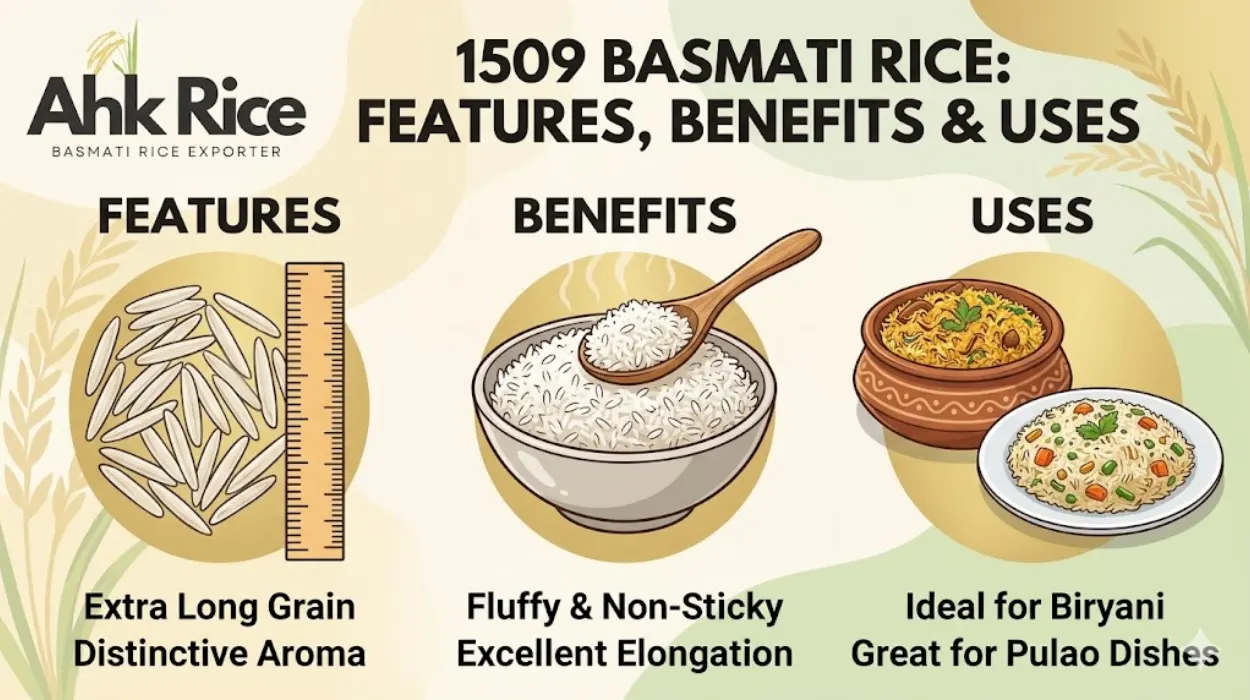
What Are the Key Features of 1509 Basmati Rice?
Extra-long grains, high elongation, strong yield, shorter crop duration, multiple processing options, and competitive export pricing define 1509 Basmati Rice.
Grain Length
1509 Basmati Rice typically measures 8.10–8.40 mm before cooking.
Long grain appearance supports premium positioning in retail and food service sectors.
Cooking Elongation
Cooked grains often expand significantly in length while maintaining a slender profile.
Restaurants value elongation because plated dishes appear more attractive and premium.
Short Crop Cycle
1509 Basmati Rice matures within 115–125 days.
Shorter maturity enables farmers to manage production efficiently and improve land utilization.
Processing Flexibility
Exporters supply multiple forms:
- White Rice
- Steam Rice
- Golden Sella Rice
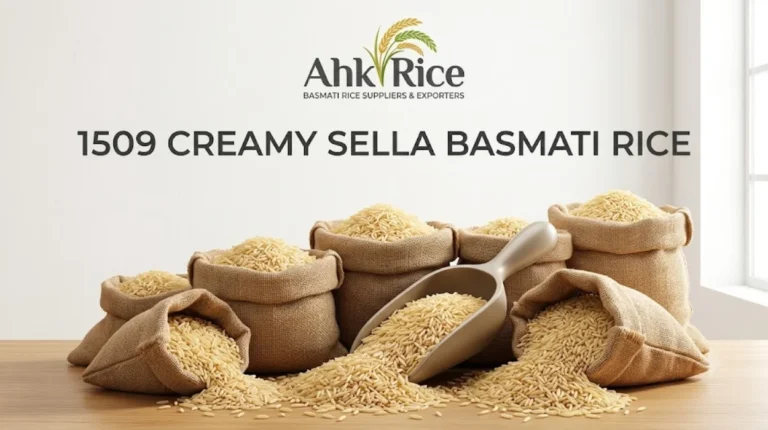
- Creamy Sella Rice
Different markets select different processing methods according to culinary preferences.
Export Availability
1509 Basmati Rice remains widely available due to large cultivation areas across Punjab.
Consistent supply supports international procurement programs.
The features establish the variety’s identity. The next section explains the practical benefits these features create.
What Benefits Does 1509 Basmati Rice Provide?
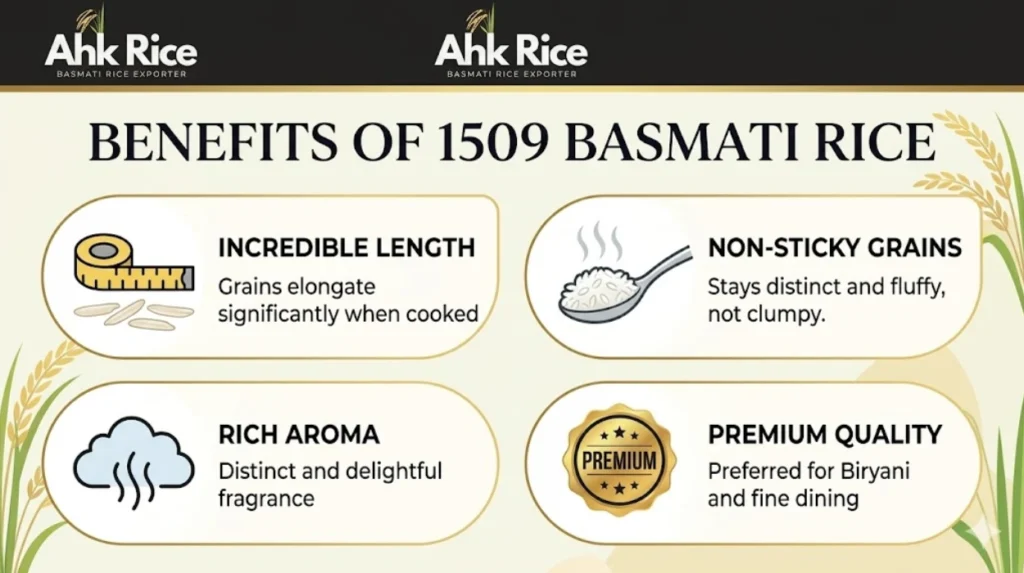
High cooking yield, attractive grain appearance, supply consistency, export affordability, and broad market acceptance make 1509 Basmati Rice valuable for buyers and consumers.
High Cooking Yield
1509 Basmati Rice expands efficiently during cooking.
Food service operators benefit because larger cooked volume improves meal production efficiency.
Attractive Presentation
Long grains remain visually appealing after cooking.
Hotels, restaurants, and catering companies use elongated grains in biryani, pulao, and rice-based dishes.
Competitive Pricing
1509 Basmati Rice generally costs less than premium-aged varieties while maintaining Basmati characteristics.
Importers often select this variety when balancing quality and budget requirements.
Consistent Supply
Large cultivation areas support stable export volumes.
Reliable supply reduces procurement challenges for importers and distributors.
Global Acceptance
Multiple international markets recognize and import 1509 Basmati Rice.
Widespread acceptance simplifies commercial trade and distribution.
The benefits explain market demand. The next question focuses on the specific grades available to buyers.
What Grades of 1509 Basmati Rice Are Available?
White Rice, Steam Rice, Golden Sella Rice, Creamy Sella Rice, and varying broken percentages represent the most common commercial grades.
1509 White Rice
White Rice undergoes milling and polishing.
This grade offers a bright appearance and soft cooking characteristics.
1509 Steam Rice
Steam Rice receives controlled steam treatment before final processing.
Steam treatment improves grain strength and enhances storage stability.
1509 Golden Sella Rice
Golden Sella Rice undergoes parboiling before milling.
Parboiling creates a golden colour and stronger grain structure.
1509 Creamy Sella Rice
Creamy Sella Rice follows a modified parboiling process.
This grade produces a lighter colour than Golden Sella while retaining durability.
| Grade | Appearance | Processing Method | Common Markets |
|---|---|---|---|
| White Rice | Bright White | Milled and polished | Europe, Retail |
| Steam Rice | Light Cream | Steam processed | Middle East |
| Golden Sella | Golden Yellow | Parboiled | Africa, Gulf |
| Creamy Sella | Creamy White | Special parboiling | Middle East |
The available grades help buyers select specifications. The next section explains where these grades are consumed globally.
Which Markets Import 1509 Basmati Rice?
Middle Eastern, African, Asian, European, and North American markets import 1509 Basmati Rice for retail, wholesale, and food service applications.
Middle East
Countries in the Gulf region import significant quantities of Basmati Rice.
Long grain appearance supports traditional rice dishes and hospitality sectors.
Africa
African markets import White Rice and Sella Rice grades.
Food service distributors and wholesalers represent major buyers.
Europe
European importers focus on retail packaging and food safety compliance.
Premium ethnic food segments contribute to demand growth.
Asia
Asian markets import various Basmati grades for commercial distribution.
Demand remains strong in urban retail channels.
Pakistan remains among the world’s leading rice exporters.
Understanding export markets explains demand patterns. The next section examines certifications required for international trade.
What Certifications Apply to 1509 Basmati Rice?
ISO certification, HACCP systems, food safety compliance programs, phytosanitary certification, and quality inspection reports support international rice exports.
Food Safety Certifications
Food safety systems verify processing controls and hygiene standards.
Common certifications include:
- ISO 22000
- HACCP
- GMP
Export Documentation
International shipments typically require:
- Phytosanitary Certificate
- Certificate of Origin
- Fumigation Certificate
- Commercial Invoice
- Packing List
- Bill of Lading
Quality Verification
Independent inspections verify shipment specifications.
Importers often request laboratory testing reports before cargo loading.
Certification requirements vary by destination country. Understanding these requirements helps explain common misconceptions about the variety.
What Common Misconceptions Exist About 1509 Basmati Rice?
1509 Basmati Rice is often misunderstood regarding aroma, quality, grain length, and market positioning despite its strong commercial performance.
Misconception: Longer Grain Means Higher Quality
Grain length represents only one quality factor.
Quality evaluation also includes purity, cooking performance, moisture content, and broken percentage.
Misconception: 1509 Has No Aroma
1509 Basmati Rice possesses natural Basmati aroma.
Super Kernel and aged varieties often produce stronger fragrance, but 1509 still qualifies as aromatic rice.
Readers interested in aroma differences between major Pakistani varieties should review the detailed comparison between 1509 and Super Kernel Basmati varieties through our analysis of aroma performance across leading export grades.
Misconception: All Grades Cook the Same Way
White Rice, Steam Rice, and Sella Rice perform differently during cooking.
Golden Sella lasts longer than White Rice. In high-temperature storage environments, Golden Sella maintains structural integrity for extended periods. Wholesale buyers serving large catering operations often select Golden Sella specifications because durability remains important during storage and transportation.
Misconception: 1509 Is Only for Export
Domestic markets also consume 1509 Basmati Rice.
Retail consumers appreciate its grain length and cooking performance.
The misconceptions clarify how buyers should evaluate the product. The final section explains its most common applications.
What Are the Main Uses of 1509 Basmati Rice?
Biryani production, restaurant meals, catering services, retail sales, food manufacturing, and export distribution represent the primary uses of 1509 Basmati Rice.
Biryani Preparation
1509 Basmati Rice performs well in biryani because grains remain separate after cooking.
Long grain appearance enhances presentation quality.
Restaurant Operations
Restaurants use 1509 Basmati Rice for rice platters, grilled meals, and traditional dishes.
Consistent cooking behaviour supports operational efficiency.
Catering Services
Catering companies prepare large food volumes using 1509 Basmati Rice.
High cooking yield supports banquet and event requirements.
Retail Packaging
Retail brands package 1509 Basmati Rice in consumer formats.
Common pack sizes include 1 kg, 5 kg, 10 kg, and 20 kg.
Export Distribution
International distributors source 1509 Basmati Rice for wholesale and retail channels.
Global demand continues to support trade activity across multiple regions.
1509 Basmati Rice combines long grain appearance, strong cooking performance, multiple processing options, and broad international acceptance. These characteristics explain why it remains one of the most widely traded Pakistani Basmati varieties.
Frequently Asked Questions
Is 1509 Basmati Rice aromatic?
Yes. 1509 Basmati Rice contains natural Basmati aroma, although Super Kernel and aged Basmati varieties often produce stronger fragrance.
What is the grain length of 1509 Basmati Rice?
1509 Basmati Rice generally measures 8.10–8.40 mm before cooking.
Which grade is best for catering businesses?
Golden Sella Rice is commonly selected for catering because the grains remain strong during large-scale cooking operations.
Where is 1509 Basmati Rice grown?
1509 Basmati Rice is primarily cultivated in Punjab, Pakistan, and other recognized Basmati-growing regions.
What are the main forms of 1509 Basmati Rice?
The main commercial forms are White Rice, Steam Rice, Golden Sella Rice, and Creamy Sella Rice.
Does 1509 Basmati Rice elongate after cooking?
Yes. 1509 Basmati Rice is known for significant grain elongation while maintaining a slender shape.