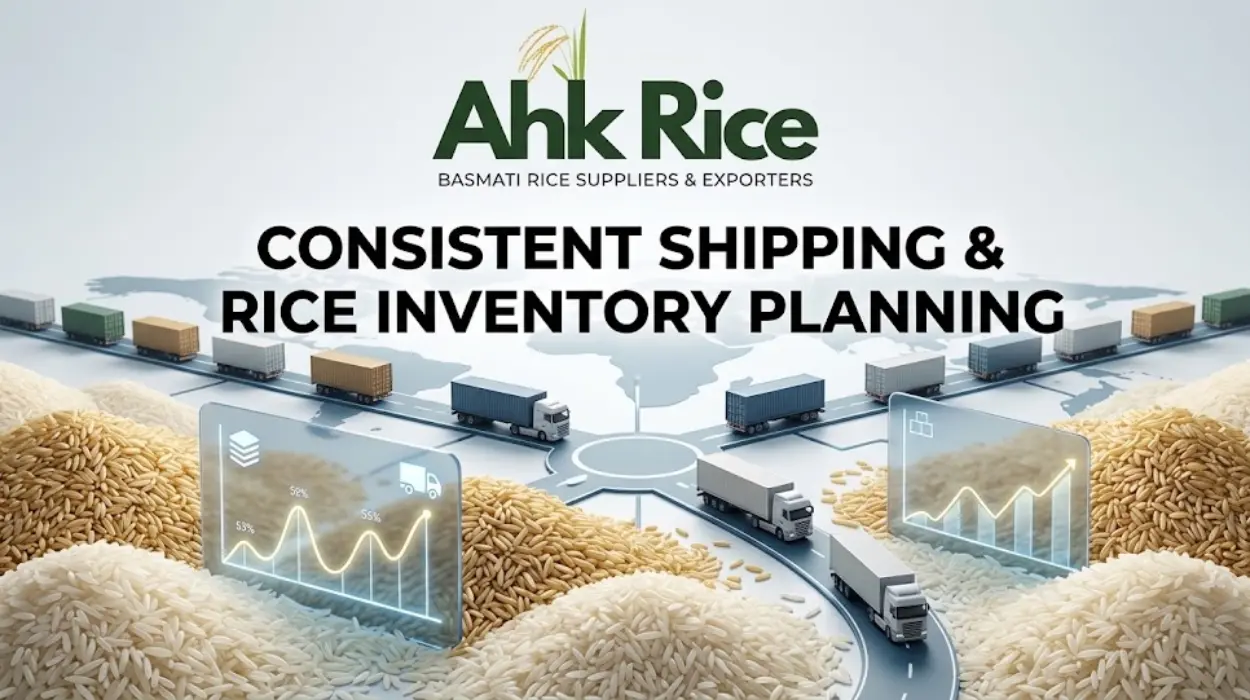
How Does Consistent Shipping Improve Rice Inventory Planning?
Consistent shipping improves rice inventory planning because predictable dispatch intervals, shipment quantities, product grades, and arrival windows let importers calculate reorder points, safety stock, warehouse capacity, and customer commitments with greater accuracy. For Indiana buyers, this reduces stockouts and excess inventory.
Inventory planning is the process of deciding how much rice to hold, when to reorder it, and how much stock must remain available while the next shipment is in transit. Shipment consistency makes this calculation more reliable because inventory decisions are connected to a repeatable supply schedule rather than isolated container arrivals.
For buyers evaluating supplier reliability, the relationship between shipment timing and procurement risk is explained in:
Why Indiana buyers monitor shipment consistency from suppliers. The issue matters more in 2026 because U.S. rice imports remain structurally important. USDA projects total U.S. rice imports at a record 49.8 million cwt for 2026/27, with long-grain imports forecast at 43.0 million cwt. USDA also expects Asian aromatic varieties, including Basmati from Pakistan and India, to remain the main component of U.S. long-grain imports.
What are the available solutions for improving rice inventory planning?
The main solutions are scheduled replenishment, safety-stock planning, forecast-based purchasing, buffer inventory, and supplier-controlled shipment programs. Each approach links inventory levels to expected demand, transit time, shipment frequency, and rice grade requirements.
Scheduled replenishment
Scheduled replenishment establishes fixed shipment intervals such as monthly, twice-monthly, or quarterly dispatches. An Indiana distributor receiving 26 MT every four weeks can build warehouse planning around a known replenishment cycle instead of waiting until inventory becomes critically low.
The method works best when demand is relatively stable. It also makes warehouse labor easier to schedule because receiving activity follows a predictable pattern.
Safety-stock planning
Safety stock is additional inventory held to absorb delays or unexpected demand. For imported rice, the calculation should account for production time, container booking, port handling, ocean transit, customs clearance, and inland delivery.
For example, an importer selling 20 MT per month may hold an additional 10 MT as protection against a delayed shipment. The exact level should be based on historical demand and supplier performance rather than an arbitrary percentage.
Forecast-based purchasing
Forecast-based purchasing uses previous sales, seasonal demand, customer orders, promotional activity, and expected market growth to determine future requirements.
This approach becomes stronger when shipment history is consistent. If a supplier repeatedly ships the same grade and quantity within a defined schedule, the importer can connect sales forecasts to actual replenishment dates.
Buffer inventory
Buffer inventory protects operations when demand changes faster than supply can respond. It is especially useful for distributors supplying restaurants, wholesalers, and retailers that cannot tolerate stockouts.
The disadvantage is carrying cost. Excess rice occupies warehouse space and ties up working capital. Therefore, buffer stock should compensate for measurable supply or demand variation rather than replace supplier planning.
Supplier-controlled shipment programs
A supplier-controlled program coordinates production, packing, documentation, container loading, and dispatch against an agreed purchasing schedule. This approach creates greater visibility between the buyer’s inventory position and the exporter’s production plan.
AHK Rice operates an integrated rice processing and export system covering paddy sourcing, cleaning, milling, grading, packaging, documentation, and container loading. Its product range includes 1121, Super Kernel, and 1509 Pakistani Basmati rice.
How do different rice shipping approaches compare?
Scheduled shipments provide the strongest routine predictability, safety stock provides protection against disruption, spot buying provides flexibility, and supplier-managed programs provide the highest coordination. The correct method depends on demand stability, warehouse capacity, product grade, cash flow, and service requirements.
| Attribute | Scheduled Replenishment | Safety-Stock Model | Spot Purchasing | Supplier-Managed Program |
|---|---|---|---|---|
| Shipment predictability | High | Medium | Low | Very high |
| Inventory requirement | Medium | High | Variable | Medium |
| Stockout protection | High | Very high | Low | Very high |
| Working-capital efficiency | High | Medium | Variable | High |
| Demand flexibility | Medium | High | Very high | Medium-high |
| Supplier coordination | High | Medium | Low | Very high |
| Best application | Stable demand | Uncertain demand | Opportunistic buying | Recurring contracts |
Scheduled replenishment is the strongest basic model for an Indiana importer with repeat monthly demand. Safety stock strengthens it when transit or demand variability creates additional risk.
Spot purchasing has a different purpose. A buyer may use it when prices are attractive or when a short-term requirement appears. However, spot buying makes inventory planning more difficult because the next shipment date and quantity are not structurally connected to previous purchases.
Supplier-managed programs provide the strongest coordination when the buyer has recurring demand. The supplier can align procurement, processing, packing, and export preparation with the agreed shipment calendar.
Which method works best for Indiana rice importers?
Indiana importers with stable Basmati demand should use scheduled replenishment supported by safety stock and supplier shipment records. High-volume distributors should add forecast-based purchasing, while spot buying should remain a tactical option for temporary demand or price opportunities.
Indiana belongs to the U.S. Midwest market, where rice inventory planning can involve several layers after the cargo reaches a U.S. port. Imported Basmati may move through a port, customs clearance, inland transportation, distributor storage, and then regional foodservice or retail customers.
That means the buyer should measure the complete replenishment cycle rather than only ocean transit. A shipment that arrives at a U.S. port on schedule can still create an inventory gap if customs, trucking, warehouse receiving, or internal distribution adds unexpected time.
The importer should therefore track at least five shipment dates: production completion, container loading, vessel departure, U.S. arrival, and warehouse receipt. These dates establish the actual lead-time distribution.
The supplier should also preserve grade consistency. A buyer planning inventory around 1121 Steam Basmati should not receive a materially different grade simply because the next shipment is available sooner. Grade substitution changes customer acceptance, cooking performance, selling price, and inventory turnover.
For U.S. food imports, regulatory preparation is also part of shipment planning. FDA states that imported foods must meet U.S. requirements and that applicable facilities must be registered, while Prior Notice must be provided before covered food shipments arrive.
Which rice grades are suitable for different inventory programs?
1121 Basmati suits premium and foodservice programs requiring long cooked grain and strong presentation; Super Kernel fits broad premium distribution; 1509 provides a value-oriented long-grain option. Grade selection should match demand, price positioning, and replenishment frequency.
1121 Basmati is generally positioned toward premium retail, restaurants, catering, and foodservice applications where grain length and cooked appearance matter. Its higher-value positioning makes shipment consistency particularly important because buyers need to maintain a defined product specification across replenishment cycles.
Super Kernel provides another long-grain Basmati option for distributors serving customers who require aroma, grain separation, and consistent appearance without necessarily selecting the longest-grain specification.
1509 Basmati can support programs where buyers want long-grain characteristics with a different cost and processing position. The specific choice should be established through a product specification sheet before a recurring inventory program begins.
A consistent shipment program therefore does not mean shipping any available Basmati. It means repeating the agreed variety, processing grade, moisture specification, broken-grain limit, packaging format, quantity, and documentation requirements.
How do two market regions compare in grade, price, and shelf-life planning?
Indiana and Gulf markets require different inventory assumptions because customer preferences, climate, distribution structures, and purchasing patterns differ. Indiana programs prioritize dependable replenishment and warehouse rotation, while Gulf programs place greater emphasis on climate-controlled storage and moisture stability.
| Market region | Common grade preference | 2026 planning price benchmark* | Practical shelf-life planning | Inventory priority |
| Indiana / U.S. Midwest | 1121, Super Kernel, 1509 according to customer segment | About $1,100–$1,300/MT | Up to about 2 years for properly stored milled rice as a general U.S. storage reference | Replenishment reliability |
| Gulf / Middle East | 1121 Steam/Sella, Super Kernel, 1509 Steam/Sella | About $1,100–$1,300+/MT | Storage life depends strongly on moisture, packaging, heat, and humidity | Moisture and warehouse stability |
*These are budgetary planning ranges, not live supplier quotations or official market prices. Actual export prices vary by grade, crop, milling specification, packaging, Incoterm, destination, freight, inspection, and contract volume.
The price difference between grades can be smaller than the financial effect of inconsistent replenishment. A lower-priced shipment that arrives late can force an importer to purchase replacement inventory at a higher spot price or lose sales entirely.
For shelf life, USDA guidance classifies rice as shelf-stable and lists rice and dried pasta at two years in its general shelf-stable storage chart. Proper packaging and cool, dry storage remain essential. USA Rice also notes that properly stored milled white rice can retain quality for a very long period when protected from moisture and contaminants.
Gulf storage requires additional attention because temperature and humidity can accelerate quality problems when moisture control is poor. For export Basmati, moisture specifications should therefore be treated as part of the inventory plan rather than only a pre-shipment quality test.
What are the pros and cons of consistent rice shipping?
Consistent shipping reduces stockout exposure, improves purchasing forecasts, stabilizes warehouse utilization, and supports customer commitments. Its limitations are reduced flexibility when demand falls, greater dependence on supplier performance, and possible excess stock if forecasts are inaccurate.
The first advantage is better reorder-point calculation. If shipments arrive according to a repeatable schedule, the buyer can determine when available inventory will fall below the required level.
The second advantage is lower emergency purchasing. Emergency purchases often involve different prices, packaging, grades, or freight conditions. A planned replenishment cycle reduces dependence on those short-term decisions.
The third advantage is warehouse efficiency. Receiving 26 MT every four weeks is easier to organize than receiving 15 MT one month and 40 MT the next without a defined schedule.
The fourth advantage is customer continuity. Restaurants, distributors, and retailers can maintain product availability when the importer has a reliable replenishment pipeline.
The main disadvantage is reduced flexibility. If demand suddenly falls, a fixed shipment program can create excess stock.
Another disadvantage is supplier dependency. A schedule is only useful when the supplier can repeatedly meet the agreed dispatch window and specification.
For this reason, shipment consistency should be measured with data. Buyers should record promised shipment date, actual loading date, vessel departure, arrival, quantity, grade, moisture, broken percentage, packaging, and documentation status.
What decision factors should buyers use before choosing a shipping strategy?
Buyers should evaluate demand variability, shipment lead time, safety-stock requirements, grade stability, warehouse capacity, working capital, supplier production capability, documentation readiness, and historical on-time performance before selecting an inventory replenishment strategy.
Demand stability
Stable monthly demand supports scheduled replenishment. Highly variable demand requires greater safety stock and more frequent forecast updates.
Shipment lead time
The relevant lead time is the full period from purchase confirmation to warehouse receipt. Ocean transit alone does not represent the buyer’s inventory exposure.
Supplier production capacity
The supplier must have sufficient paddy access, milling capacity, grading capability, packaging resources, and container-loading capacity to support recurring orders.
Pakistan’s 2026/27 rice production is forecast by USDA at approximately 9.8 million metric tons, while exports are forecast at 5.0 million tons. This provides a substantial export supply base, but supplier-level capacity still determines whether an individual contract can be fulfilled consistently.
Grade consistency
The buyer should establish a written specification for variety, grain length, moisture, broken grains, purity, packaging, and labeling before recurring shipments begin.
Warehouse capacity
Inventory planning must consider both average stock and peak stock. A buyer receiving one container every month needs enough space for the incoming load while older inventory remains available for distribution.
Working capital
Higher safety stock improves protection but increases capital tied up in inventory. The optimal level balances carrying cost against the financial impact of stockouts.
Documentation and compliance
For U.S. food imports, documentation must support the shipment’s identity and regulatory entry process. FDA requires Prior Notice for covered imported food and applies U.S. food requirements to imported products.
How can buyers build a practical rice inventory planning model?
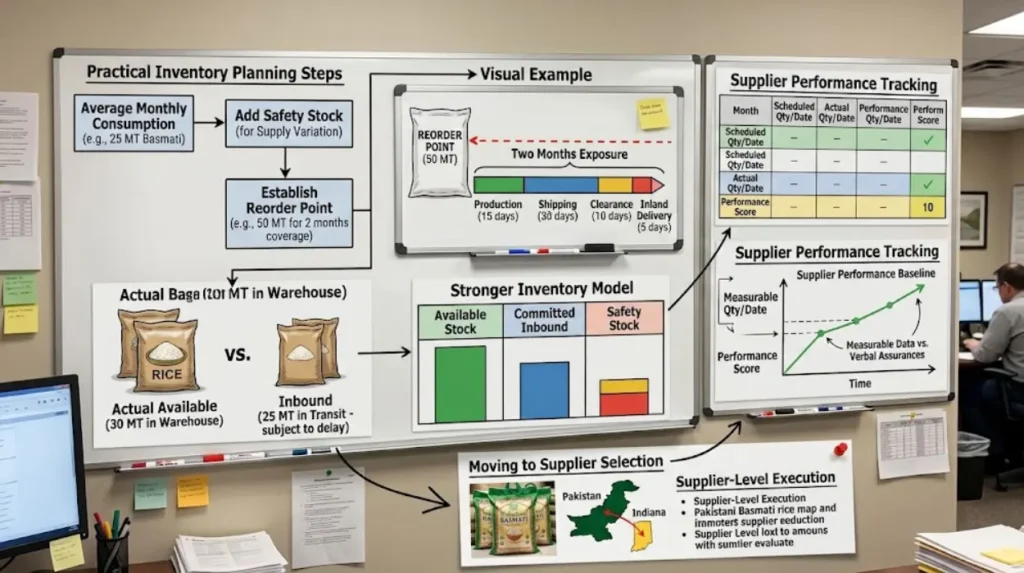
A practical model begins with average monthly consumption, adds safety stock for measured supply variation, subtracts available inventory and confirmed incoming stock, and then triggers replenishment early enough to cover production, shipping, clearance, and inland delivery.
For example, an Indiana distributor consuming 25 MT of Basmati each month could establish a 50 MT reorder point if its combined production and logistics exposure requires roughly two months of coverage.
If 30 MT remains in the warehouse and another 25 MT is confirmed in transit, the buyer should not treat the full 55 MT as equally available. The inbound shipment still carries arrival and clearance exposure.
A stronger planning model separates inventory into three categories: available stock, committed inbound stock, and safety stock. This prevents buyers from counting delayed cargo as immediately available inventory.
The buyer should then compare actual shipment performance against the original schedule every month. After six to twelve shipments, the resulting dataset can show whether the supplier consistently delivers the agreed quantity and timing.
This creates a measurable supplier-performance baseline rather than relying on verbal assurances.
For buyers moving from evaluation to supplier selection, the decision stage can continue with:
Source consistently shipped Pakistani Basmati rice for Indiana markets, where the focus shifts from inventory-planning principles to supplier-level execution.
What is the final decision framework for consistent rice inventory planning?
The strongest inventory strategy connects demand forecasting, safety stock, shipment scheduling, product specifications, and supplier performance into one system. Buyers should select the method that minimizes total supply risk rather than simply choosing the lowest rice price.
| Decision factor | Question to ask | Preferred response |
| Demand | How predictable is monthly consumption? | Stable forecast supported by sales history |
| Lead time | How long from order to warehouse receipt? | Measured full-cycle lead time |
| Shipment consistency | Does actual dispatch match the agreed schedule? | Documented recurring performance |
| Product quality | Does each shipment match the specification? | Same grade and measurable quality limits |
| Financial exposure | How much stock can the business carry? | Safety stock aligned with working capital |
The comparison shows why shipment consistency is an inventory-control issue rather than only a logistics issue. A reliable arrival pattern improves reorder calculations, warehouse scheduling, purchasing forecasts, and customer-service continuity.
For Indiana buyers, the strongest model is a recurring shipment program supported by documented supplier performance and an appropriate safety-stock level. The buyer should still maintain flexibility for seasonal demand and market changes.
In 2026, the wider U.S. rice market continues to depend heavily on imported aromatic long-grain rice, while Pakistan remains an important Basmati origin. This makes supplier consistency increasingly relevant for importers that build their customer offering around Pakistani Basmati.
Frequently Asked Questions
How does consistent shipping improve rice inventory planning?
Consistent shipping gives importers predictable replenishment dates and quantities, making it easier to calculate reorder points, safety stock, warehouse capacity, and customer demand.
Why is shipment consistency important for Indiana rice importers?
Shipment consistency helps Indiana importers maintain steady Basmati inventory despite production, ocean freight, customs clearance, and inland transportation requirements.
What is the best inventory strategy for imported Basmati rice?
Scheduled replenishment supported by safety stock is the strongest strategy for stable Basmati demand. It balances predictable supply with protection against shipment or demand variations.
How much safety stock should a rice importer maintain?
Safety stock should reflect average demand, actual supplier lead-time variation, and the financial impact of stockouts. Importers should calculate it from historical sales and shipment data rather than use a fixed percentage.
Which Pakistani Basmati rice grades are suitable for Indiana markets?
1121 Basmati, Super Kernel, and 1509 Basmati can serve different Indiana customer segments. The appropriate grade depends on customer requirements, price positioning, cooking performance, and demand volume.
How does shipment timing affect rice warehouse costs?
Predictable shipment timing helps warehouses schedule receiving, storage space, labor, and outbound distribution. Irregular arrivals can create temporary storage congestion or require expensive emergency handling.
What should buyers track to measure supplier shipment consistency?
Buyers should track promised dispatch date, actual loading date, vessel departure, arrival, warehouse receipt, shipment quantity, rice grade, quality specifications, packaging, and documentation status.
Does consistent shipping reduce rice stockouts?
Yes. Predictable replenishment allows buyers to reorder before inventory reaches a critical level and reduces dependence on emergency purchases when shipments are delayed.
How does rice grade consistency affect inventory planning?
Consistent grades allow buyers to forecast sales and replenishment against a defined product specification. Unexpected grade changes can affect customer acceptance, pricing, cooking performance, and inventory turnover.
What is the difference between safety stock and buffer inventory?
Safety stock is inventory deliberately maintained to protect against supply and demand variation. Buffer inventory is a broader term for additional stock held to absorb operational uncertainty.