Why American Restaurants Prefer Long Grain 1121 Steam Basmati Rice
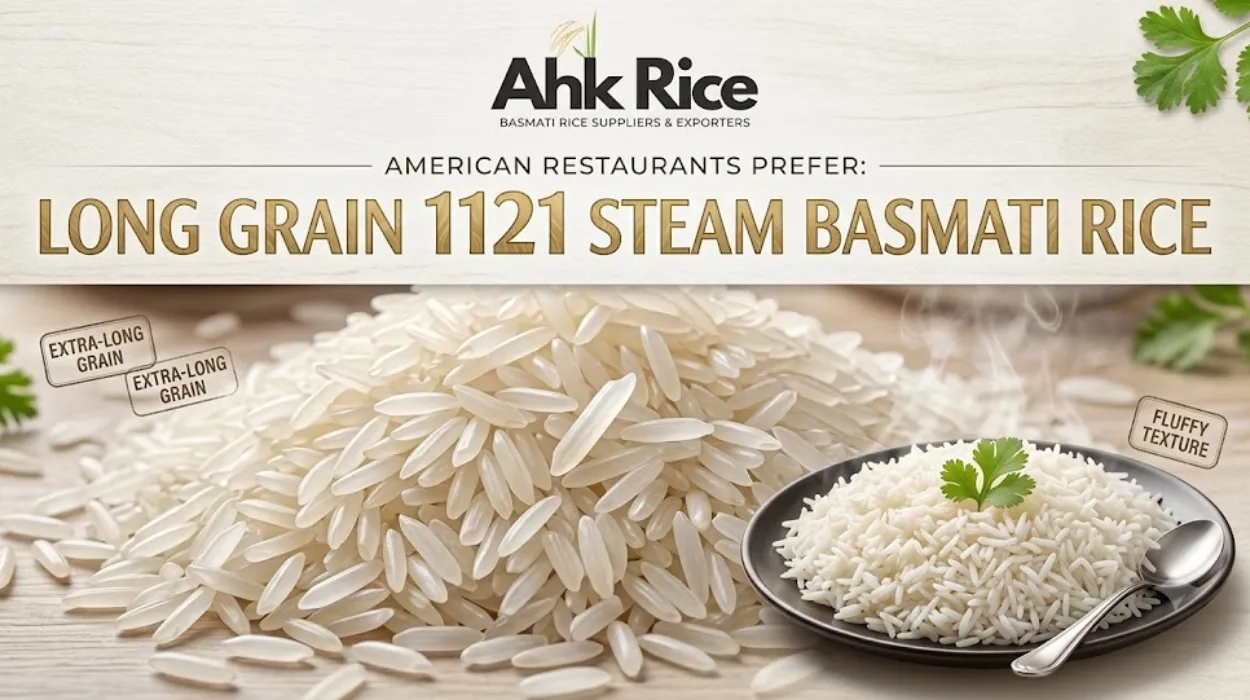
American restaurants choose long grain 1121 Steam Basmati rice because it delivers consistent grain length, high cooked volume, separate grains, stable cooking performance, and broad menu compatibility. From Indian restaurants to Middle Eastern kitchens, chefs prioritize rice that performs the same way every day while maintaining quality throughout storage and service.
What Is Long Grain 1121 Steam Basmati Rice?
Long Grain 1121 Steam Basmati rice is a premium aromatic rice variety grown primarily in Pakistan and India. It features extra-long kernels, undergoes steam treatment before milling, and produces long, separate, fluffy grains after cooking, making it suitable for commercial food service operations.
1121 Steam Basmati rice belongs to the Basmati family, which is known for naturally long grains, distinct aroma, and soft yet separate texture after cooking. The variety was developed through selective breeding to improve grain length while preserving traditional Basmati characteristics.
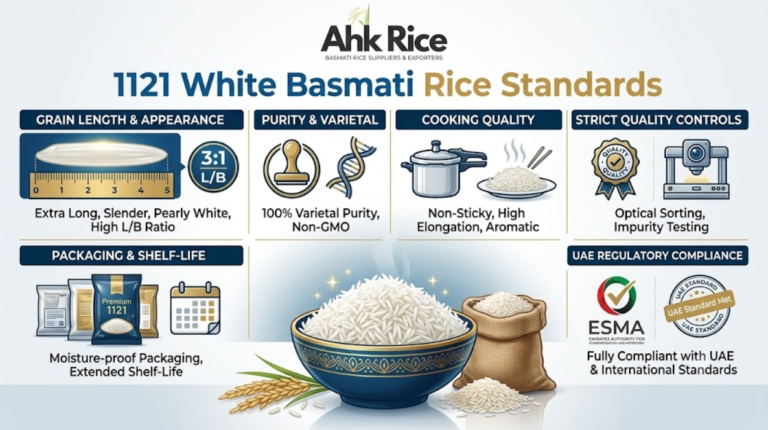
The term 1121 identifies the specific cultivar. It is recognized worldwide for producing some of the longest rice grains available in international trade. Before cooking, kernels generally measure around 8.2–8.5 mm. After cooking, grain length often exceeds 17 mm under standard commercial cooking conditions.
The word Steam refers to the processing method rather than the cooking method. During processing, paddy rice receives controlled steam treatment before milling. This process strengthens the grain structure and improves milling recovery while preserving its natural color.
Pakistan remains one of the world’s leading exporters of 1121 Steam Basmati rice. Production concentrates in Punjab, where fertile alluvial soils, seasonal monsoon rainfall, irrigation systems, and favorable temperatures support premium Basmati cultivation.
Restaurants across the United States import this variety because consistent cooking performance directly influences food quality, kitchen efficiency, and customer satisfaction.
Readers interested in cooking characteristics can later continue with a detailed discussion on how grain dimensions and cooking behavior affect food service efficiency in the article about:
Evaluating grain quality and cooking performance.
How Does Long Grain 1121 Steam Basmati Rice Work During Production?
1121 Steam Basmati rice passes through planting, harvesting, drying, steaming, milling, grading, sorting, and packaging. Every stage protects grain length, preserves aroma, improves durability, and creates uniform rice suitable for international food service standards.
Production begins with certified seed selection.
Farmers prepare fields before the monsoon planting season. Seedlings grow in nursery beds before transplanting into flooded fields. Controlled irrigation supports steady crop development throughout the growing cycle.
During maturation, plants develop long panicles containing mature rice kernels.
Harvesting begins once moisture reaches appropriate field levels. Modern combine harvesters reduce grain loss while maintaining kernel quality.
Freshly harvested paddy undergoes controlled drying.
Drying reduces moisture to storage-safe levels before processing. Proper drying prevents cracking and protects grain integrity during milling.
Steam processing follows drying.
The paddy receives carefully controlled steam treatment under regulated temperature and pressure. Unlike parboiled rice, steam rice maintains a lighter appearance while improving kernel strength.
After steaming, the rice rests before milling.
Milling removes the husk and bran layers while preserving maximum kernel length. Advanced milling equipment minimizes broken grains and improves recovery rates.
Electronic color sorting follows milling.
Optical sorters remove discolored kernels, foreign material, immature grains, and defects using high-speed cameras and air ejectors.
Final grading separates rice into commercial specifications.
Quality Parameters Evaluated During Processing
Export processors inspect multiple quality characteristics before shipment.
These include:
- Grain length
- Broken percentage
- Moisture content
- Foreign matter
- Chalkiness
- Damaged kernels
- Purity
- Aroma
- Color consistency
Every batch receives laboratory testing before export documentation is completed.
What Are the Key Components That Make 1121 Steam Basmati Rice Different?
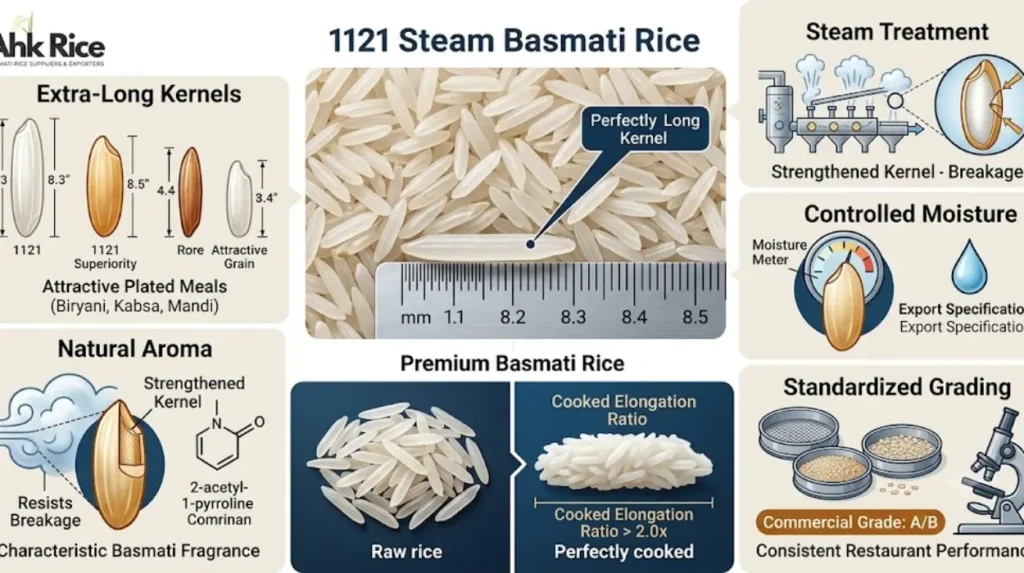
The defining components include extra-long kernels, natural aroma compounds, steam-treated grain structure, controlled moisture, low broken percentage, high elongation ratio, and standardized export grading that supports consistent restaurant performance.
Each quality characteristic influences kitchen results.
Grain length remains the most visible feature.
Extra-long kernels create attractive plated meals. Restaurants serving biryani, kabsa, pulao, mandi, and grilled meat combinations value visual presentation because customers immediately notice rice quality.
Natural aroma forms another important characteristic.
The compound 2-acetyl-1-pyrroline produces the characteristic Basmati fragrance that distinguishes genuine Basmati from ordinary long-grain rice.
Steam treatment strengthens kernels.
Stronger kernels resist breakage during transport, storage, washing, and cooking.
Moisture control improves stability.
Export specifications generally maintain moisture around internationally accepted limits to preserve storage quality and reduce spoilage risks during ocean transportation.
Grading systems improve consistency.
Commercial grades classify rice according to grain length, purity, broken percentage, and appearance so buyers receive standardized shipments.
Common Export Grades
Typical export grades include:
- Sortex Clean
- Double Sortex
- Premium Export Grade
- Extra Long Grain Grade
- Customized buyer specifications
Importers choose grades according to menu requirements and customer expectations.
Why Do American Restaurants Choose Long Grain 1121 Steam Basmati Rice?
American restaurants value 1121 Steam Basmati rice because it produces uniform cooked grains, maintains attractive presentation, supports high-volume food preparation, reduces cooking inconsistencies, and complements many international cuisines served throughout the United States.
Restaurants require predictable cooking every day.
Commercial kitchens prepare hundreds of portions during busy service periods. Consistency reduces operational errors and improves customer experience.
Long grain appearance enhances presentation.
Individual grains remain visibly separate after cooking. This appearance suits premium dishes where rice serves as the centerpiece rather than simply a side item.
The rice also performs well during holding.
Many restaurants prepare rice before peak dining hours. Properly cooked 1121 Steam Basmati maintains acceptable texture during controlled hot holding periods used in commercial kitchens.
Another advantage involves menu flexibility.
The same rice variety supports multiple recipes.
Examples include biryani, chicken over rice, lamb mandi, kabsa, pilaf, grilled seafood platters, butter chicken, tikka masala, kebab plates, vegetable pulao, and buffet service.
Food cost management also benefits from high cooked yield.
Long grain rice expands significantly during cooking, increasing serving portions from the same quantity of raw rice when standard cooking procedures are followed.
Which Types of Restaurants Use Long Grain 1121 Steam Basmati Rice?
Restaurants representing South Asian, Middle Eastern, Central Asian, fusion, halal, catering, and premium buffet concepts regularly use 1121 Steam Basmati rice because its grain characteristics match traditional regional recipes and modern commercial food preparation.
Different cuisines require different rice textures.
Indian restaurants prepare biryani, pulao, and curry combinations.
Pakistani restaurants serve traditional rice with barbecue dishes, karahi, nihari, and pulao.
Middle Eastern restaurants prepare mandi, kabsa, maqluba, and grilled meat platters.
Mediterranean restaurants serve rice alongside grilled chicken, lamb, seafood, and vegetables.
Catering companies value consistent cooking because banquet events require large production volumes.
Hotel buffets benefit from attractive presentation throughout extended serving periods.
Meal preparation companies also use premium long-grain rice because portion consistency supports standardized packaging.
Examples of Commercial Food Service Applications
Commercial applications include:
- Fine dining restaurants
- Casual dining chains
- Catering companies
- University cafeterias
- Hotel kitchens
- Airline catering
- Hospital food services
- Corporate dining facilities
Each operation prioritizes consistency over individual batch variation.
What Certifications Apply to 1121 Steam Basmati Rice Exports?
International buyers verify food safety, quality management, traceability, and regulatory compliance through recognized certifications that support global trade requirements and commercial food service purchasing standards.
Certification demonstrates that production follows documented systems rather than informal practices.
Food safety management remains essential.
Processors commonly implement HACCP systems that identify hazards and establish preventive controls throughout production.
Quality management systems frequently follow ISO standards.
Export facilities also implement traceability procedures that record production batches from procurement through packaging.
Many importers require compliance with regulations administered by the United States Food and Drug Administration for imported food products.
Depending on customer requirements, exporters also obtain additional certifications covering food safety management, laboratory testing, social compliance, or specific customer audits.
Documentation accompanies commercial shipments.
Examples include phytosanitary certificates, fumigation certificates where required, certificates of origin, laboratory reports, packing lists, commercial invoices, and bills of lading.
What Misconceptions Exist About Long Grain 1121 Steam Basmati Rice?
Several misconceptions confuse buyers, including assumptions that all long-grain rice is Basmati, steam rice equals parboiled rice, longer grains always indicate higher quality, and aroma alone determines authenticity. Actual quality depends on multiple measurable specifications.
One misconception states that every long-grain rice belongs to the Basmati category.
This statement is incorrect.
Many long-grain rice varieties exist, including Jasmine, American long-grain rice, and several hybrid cultivars. Genuine Basmati possesses distinct botanical and quality characteristics.
Another misconception treats steam rice and parboiled rice as identical.
The processing methods differ.
Steam rice undergoes controlled steaming designed to strengthen kernels while maintaining a lighter appearance. Traditional parboiling involves soaking, steaming, and drying, producing different grain characteristics.
Another misunderstanding focuses only on grain length.
Long kernels alone do not guarantee premium quality.
Commercial buyers also evaluate purity, broken percentage, moisture, milling quality, chalkiness, color consistency, aroma, and laboratory specifications.
Some buyers believe stronger aroma always indicates better rice.
Authentic Basmati presents a natural fragrance that complements food rather than overwhelming it.
Finally, some assume imported premium rice requires complicated preparation.
Commercial kitchens routinely cook 1121 Steam Basmati using standardized procedures with predictable results after staff training and recipe standardization.
Why Does Long Grain 1121 Steam Basmati Rice Continue to Grow in Popularity?
Global demand continues increasing because consumers value premium presentation, authentic regional cuisine, consistent cooking performance, and reliable food quality while restaurants prioritize operational efficiency and standardized meal preparation.
International dining continues expanding across North America.
Consumers increasingly seek authentic South Asian and Middle Eastern cuisine.
Restaurant operators respond by selecting ingredients that deliver traditional appearance and flavor.
Premium rice contributes directly to customer perception.
Long, separate grains create visual quality before customers taste the meal.
International trade infrastructure also supports wider availability.
Modern container shipping, improved processing technology, electronic grading systems, and standardized export specifications enable restaurants to source consistent rice throughout the year.
Research into grain characteristics also helps buyers understand quality differences beyond simple appearance.
A detailed companion article examining cooking behavior, grain elongation, and commercial kitchen performance fits naturally after readers understand the foundations presented in this guide.
Frequently Asked Questions
Why do American restaurants prefer long grain 1121 Steam Basmati rice?
American restaurants prefer long grain 1121 Steam Basmati rice because it delivers consistent grain length, excellent cooked appearance, high volume expansion, and reliable performance across commercial kitchens.
What makes 1121 Steam Basmati rice different from other long-grain rice?
1121 Steam Basmati rice offers extra-long kernels, a natural Basmati aroma, superior grain elongation after cooking, and steam processing that strengthens the grain without changing its light color.
Where is 1121 Steam Basmati rice grown?
Most 1121 Steam Basmati rice is grown in the Punjab region of Pakistan and neighboring Basmati-growing areas where fertile soil, irrigation, and climate support premium-quality production.
How is 1121 Steam Basmati rice processed?
The rice is harvested, dried, steam treated, milled, color sorted, graded, laboratory tested, and packed before being prepared for international export.
What does steam processing mean for Basmati rice?
Steam processing exposes paddy rice to controlled steam before milling, improving grain strength, reducing breakage, and maintaining an attractive natural appearance.
How long are 1121 Steam Basmati rice grains?
Raw kernels generally measure about 8.2–8.5 mm, while properly cooked grains can exceed 17 mm, making them among the longest commercial Basmati rice varieties.
Why is grain length important for restaurants?
Long grains improve plate presentation, maintain separation after cooking, and create the premium appearance expected in dishes such as biryani, pulao, and mandi.
Which dishes commonly use 1121 Steam Basmati rice?
Restaurants commonly use it for biryani, kabsa, mandi, pulao, grilled meat platters, curry meals, buffet service, and premium rice bowls.
What quality standards are checked before export?
Exporters inspect grain length, moisture content, broken percentage, purity, chalkiness, damaged kernels, aroma, color consistency, and foreign matter before shipment.
Which certifications are commonly required for exports?
Common certifications include HACCP, ISO-based quality systems, phytosanitary certification, certificates of origin, and documentation that meets importing country requirements.
Is steam Basmati rice the same as parboiled rice?
No. Steam Basmati rice undergoes controlled steam treatment before milling, while parboiled rice follows a different soaking and steaming process that changes grain characteristics.
Does longer grain always mean better quality?
No. Premium quality depends on multiple specifications, including purity, moisture level, broken percentage, aroma, milling quality, and grading standards, not grain length alone.
Which types of restaurants use 1121 Steam Basmati rice?
Indian, Pakistani, Middle Eastern, Mediterranean, halal, catering, hotel, airline, and institutional kitchens frequently use this rice for consistent commercial cooking.
Why is consistency important in commercial kitchens?
Consistent rice quality helps chefs achieve predictable cooking results, reduce food waste, standardize recipes, and maintain customer satisfaction across every service.
Why is demand for 1121 Steam Basmati rice increasing in the United States?
Demand continues to grow because consumers seek authentic international cuisine, while restaurants value premium presentation, reliable cooking performance, and consistent food quality.