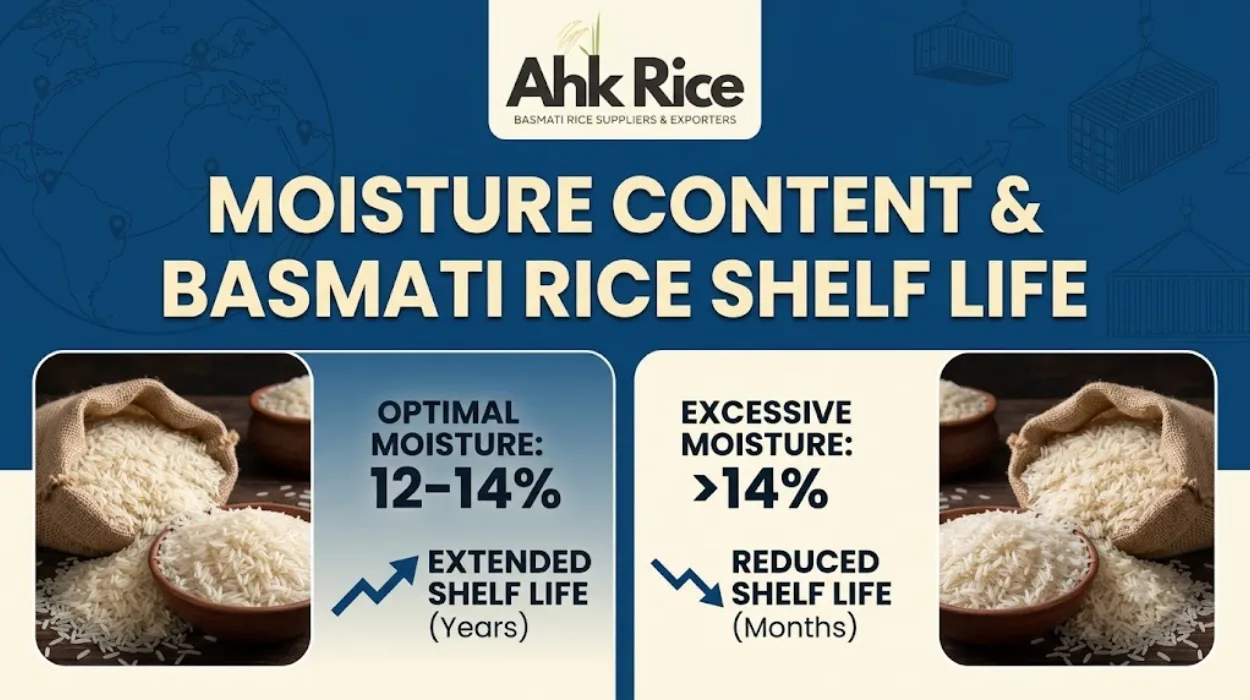
How Moisture Content Affects Imported Basmati Rice Shelf Life
Imported Basmati rice shelf life depends heavily on moisture content. Moisture determines grain stability during storage, influences aroma retention, controls microbial growth, and affects cooking quality. Across international rice trade in 2026, exporters, importers, warehouse operators, and food manufacturers use moisture testing as one of the primary quality indicators before shipment and during storage.
Basmati rice is naturally a low-moisture agricultural product after milling and drying. Once moisture exceeds recommended storage limits, grain quality declines faster. When moisture remains within internationally accepted ranges, rice maintains its appearance, texture, fragrance, and nutritional value for extended storage periods.
Storage conditions, packaging materials, transportation methods, and warehouse environments all interact with moisture content. However, moisture remains the central factor because every other storage condition directly influences the amount of water present inside or around each grain.
Readers who want to understand the exact moisture specifications used by international importers should also explore the detailed discussion on recommended storage moisture levels in the upcoming article about:
Ideal moisture standards for imported 1121 Creamy Sella rice, which explains the quality requirements used during commercial purchasing.
What Is Moisture Content in Imported Basmati Rice?
Moisture content is the percentage of water contained inside each rice grain after harvesting, drying, milling, and packaging. It is measured using calibrated moisture meters and laboratory testing because water directly determines storage stability, grain safety, cooking performance, and commercial quality throughout international distribution.
Moisture content represents the amount of water remaining inside the grain after processing. It is expressed as a percentage of the grain’s total weight.
For example:
- 12% moisture means 12 kilograms of water exist in every 100 kilograms of rice.
- 13% moisture means 13 kilograms of water exist in every 100 kilograms of rice.
- 14% moisture means 14 kilograms of water exist in every 100 kilograms of rice.
International rice buyers evaluate moisture before accepting shipments because excessive moisture reduces storage life.
Modern rice processing facilities use electronic moisture analyzers, oven-drying methods, and digital grain testers to verify moisture before packaging.
Why Moisture Is Measured Before Export
Every export shipment passes through several environments before reaching consumers.
Examples include:
- Processing facilities
- Storage warehouses
- Shipping containers
- Distribution centers
- Retail warehouses
Each stage exposes rice to different temperatures and humidity levels. Accurate moisture measurement ensures the grain remains stable throughout the logistics chain.
How Does Moisture Content Affect Imported Basmati Rice Shelf Life?
Shelf life depends on moisture because water supports biological activity inside stored grain. Lower moisture slows deterioration, preserves aroma, reduces microbial development, limits insect activity, and maintains grain integrity during long-distance transportation and warehouse storage across international markets.
Dry grain remains chemically stable for longer periods.
When moisture increases, biological processes accelerate.
Higher moisture encourages:
- Mold development
- Fungal growth
- Bacterial activity
- Insect infestation
- Grain discoloration
- Odor formation
These conditions shorten commercial shelf life.
For example, rice stored inside humid coastal warehouses experiences greater moisture absorption than rice stored inside temperature-controlled facilities.
Proper moisture management protects:
- Grain length
- Surface color
- Natural aroma
- Cooking texture
- Consumer acceptance
Storage specialists therefore monitor both grain moisture and warehouse humidity throughout storage.
How Does Moisture Move Through Basmati Rice During Storage?
Moisture constantly moves between rice grains and surrounding air until equilibrium develops. Warehouse humidity, storage temperature, packaging quality, and ventilation determine whether grains absorb moisture or release moisture throughout storage and international transportation.
Rice behaves as a hygroscopic agricultural product.
A hygroscopic material absorbs or releases moisture depending on surrounding environmental conditions.
For example:
When warehouse humidity reaches high levels, rice gradually absorbs moisture from the air.
When warehouse humidity remains controlled, moisture stays relatively stable.
This continuous moisture exchange explains why warehouse climate management remains important even after export packaging.
Transportation also influences moisture movement.
Shipping containers crossing tropical oceans experience daily temperature fluctuations.
Warm air condenses into water droplets when container temperatures decline.
This phenomenon is commonly called container condensation.
Condensation increases the risk of localized moisture accumulation if ventilation and packaging are inadequate.
What Components Determine Moisture Stability During Storage?
Several physical and environmental components work together to maintain stable moisture levels. Grain structure, packaging material, warehouse climate, transportation conditions, processing quality, and storage duration collectively influence imported Basmati rice shelf life and overall commercial quality.
Grain Structure
Whole grains retain structural strength better than broken grains.
Broken rice exposes larger internal surfaces.
These surfaces absorb moisture more rapidly.
Drying Process
Rice drying removes excess water after harvesting.
Modern drying systems reduce moisture gradually.
Uniform drying prevents internal stress and surface cracking.
Packaging Materials
Packaging creates a protective barrier.
Examples include:
- Polypropylene woven bags
- Laminated bags
- Vacuum packaging
- Multi-layer moisture-resistant sacks
Better packaging slows moisture exchange with surrounding air.
Warehouse Environment
Storage facilities monitor:
- Relative humidity
- Temperature
- Air circulation
Stable environmental conditions preserve grain quality for longer periods.
Transportation
Ocean freight exposes containers to changing climates.
Proper container preparation reduces moisture-related quality changes.
What Benefits Does Proper Moisture Content Provide?

Maintaining appropriate moisture preserves grain quality throughout storage. Stable moisture improves appearance, protects fragrance, supports food safety, extends storage duration, maintains cooking consistency, reduces quality losses, and improves inventory management across domestic and international supply chains.
One important benefit is aroma preservation.
Basmati rice develops its characteristic fragrance during maturation.
Stable moisture helps preserve aromatic compounds during storage.
Another benefit involves cooking quality.
Rice with balanced moisture cooks more consistently.
The grains remain separate after cooking instead of becoming excessively soft.
Commercial food manufacturers also benefit.
Consistent raw material quality produces predictable finished products.
Examples include:
- Ready meals
- Frozen rice products
- Restaurant meal preparation
- Retail packaged rice
Warehouse operators benefit because moisture stability reduces spoilage losses during long-term inventory storage.
Where Is Moisture Management Most Important?
Moisture control becomes especially important whenever rice remains in storage for extended periods or travels long international distances. Importers, processors, retailers, food manufacturers, distributors, and institutional food suppliers all depend on stable grain moisture to maintain product quality.
Large importing regions frequently store rice before distribution.
Examples include:
- Gulf countries
- European markets
- North America
- Australia
- Southeast Asia
Large warehouses hold inventory for several months before retail distribution.
Food processing industries also require stable moisture.
Examples include:
- Rice flour production
- Instant rice manufacturing
- Meal kit production
- Hospitality supply chains
Retail packaging companies monitor moisture because consumers expect uniform cooking performance throughout the product’s shelf life.
What Problems Are Commonly Associated with Moisture Content?
Most storage problems originate from uncontrolled moisture rather than grain age alone. Elevated moisture encourages spoilage, while extremely low moisture increases grain brittleness, breakage, and reduced milling quality during handling and transportation.
One misconception states that older rice automatically loses quality.
Age alone does not determine quality.
Storage conditions determine quality.
Another misconception assumes sealed bags completely prevent moisture changes.
Packaging slows moisture transfer.
Packaging does not eliminate environmental influence.
Some people believe visible mold appears immediately after moisture increases.
Actual deterioration begins before visible damage becomes noticeable.
Professional inspections therefore include laboratory moisture testing instead of relying only on visual examination.
Common Moisture-Related Problems
Examples include:
- Mold growth
- Yellow grain formation
- Surface discoloration
- Condensation damage
- Clumping
- Musty odor
- Increased insect activity
- Reduced cooking consistency
Each problem develops faster when moisture remains above recommended storage levels.
How Is Moisture Content Tested According to Modern Rice Industry Practices?
Modern rice facilities use standardized testing equipment that measures moisture accurately before storage, shipment, and import inspection. Digital moisture analyzers, laboratory oven methods, calibrated grain meters, and sampling procedures ensure reliable quality verification throughout international trade.
Sampling begins by collecting rice from multiple positions within each lot.
Representative samples provide accurate measurements.
Digital grain moisture meters produce rapid readings.
Laboratory oven methods provide reference measurements.
Quality laboratories compare moisture values with grading specifications before approving export documentation.
Repeated testing occurs during:
- Processing
- Packaging
- Warehouse storage
- Container loading
- Import inspection
Continuous monitoring helps maintain consistent grain quality across the supply chain.
Why Does Moisture Remain the Most Important Shelf Life Indicator?
Moisture remains the primary shelf life indicator because it directly influences biological stability, physical grain quality, storage performance, transportation safety, processing consistency, and consumer satisfaction more than any other measurable rice quality parameter.
Grain quality depends on several measurable characteristics.
Examples include:
- Grain length
- Purity
- Broken percentage
- Chalkiness
- Color
- Aroma
- Moisture
Among these characteristics, moisture affects almost every stage of storage.
Maintaining stable moisture supports longer storage life, preserves appearance, protects aroma, improves cooking consistency, and reduces spoilage risks throughout the international supply chain. Modern rice exporters and importers therefore treat moisture testing as a standard quality control procedure before shipment, during transportation, and throughout warehouse storage.
Frequently Asked Questions
What is moisture content in Basmati rice?
Moisture content is the percentage of water present inside a rice grain after drying and processing. It is measured before export because it directly affects storage stability, grain quality, and shelf life.
Why does moisture content affect Basmati rice shelf life?
Moisture influences microbial growth, insect activity, aroma retention, and grain stability. Rice stored within recommended moisture levels maintains its quality for a longer period than rice exposed to excessive moisture.
How is moisture content measured in imported Basmati rice?
Moisture content is measured using calibrated digital moisture meters and laboratory oven-drying methods. Exporters and import inspectors test representative grain samples to verify compliance with quality standards.
What is the recommended moisture level for storing Basmati rice?
Most international buyers prefer Basmati rice stored at approximately 12–13% moisture, as this range supports longer shelf life while preserving cooking quality and aroma under proper storage conditions.
Can high moisture cause mold in Basmati rice?
Yes. Excess moisture encourages mold, fungal growth, unpleasant odors, grain discoloration, and faster quality deterioration, especially during long-term storage or ocean transportation.
Does low moisture damage Basmati rice?
Very low moisture reduces biological activity but makes rice grains more brittle. This increases grain breakage during handling, milling, packaging, and transportation.
How do storage conditions influence moisture content?
Warehouse temperature, relative humidity, ventilation, packaging quality, and storage duration determine whether rice absorbs or releases moisture during storage.
Why do importers check moisture before purchasing Basmati rice?
Importers verify moisture because it predicts storage performance, food safety, cooking consistency, and the product’s commercial shelf life before distribution and retail sale.
Does packaging help control moisture?
Yes. Moisture-resistant packaging slows the exchange of water vapor between rice and the surrounding environment, helping maintain stable grain quality during transportation and storage.
Which industries benefit most from proper moisture control?
Food manufacturers, supermarkets, wholesalers, restaurant suppliers, hospitality businesses, and international rice distributors all depend on proper moisture management to maintain consistent product quality and shelf life.