Buy Super Kernel Steam Rice for USA Wholesale Distribution
For USA wholesale distribution, Super Kernel Steam Rice is best sourced through a specification-controlled export process that protects grain length, cooking texture, moisture, packaging, documentation, and shipping continuity from Punjab to the U.S. destination port. AHK Rice supplies Super Kernel Steam Rice for wholesale, retail, restaurant, and ethnic grocery channels, with export processing and container logistics managed from Pakistan.
The buying decision should not depend on the lowest FOB number alone. U.S. distributors need a product that cooks consistently, survives ocean transit, meets agreed specifications, and arrives with the documentation needed for food import clearance. For a deeper explanation of the cooking characteristics behind this product, see the guide on:
What makes Super Kernel Steam Rice consistent after cooking.
For buyers comparing grades, the key commercial variables are elongation, grain separation, texture, moisture, broken percentage, purity, packaging, and landed cost. A specification-led purchase therefore gives a U.S. wholesaler a stronger basis for repeat procurement than a generic “premium rice” quotation.
What is the best solution for inconsistent Super Kernel Steam Rice supply?
The best solution is specification-controlled Super Kernel Steam Rice produced, graded, tested, packed, and shipped against one agreed commercial specification, reducing variation in elongation, texture, moisture, broken grains, purity, and final cooking performance between wholesale consignments.
Super Kernel Steam Rice is suited to U.S. buyers who want traditional Basmati characteristics without moving entirely into the higher-priced extra-long-grain segment. AHK Rice describes its Super Kernel Steam specification at approximately 7.0–7.2 mm average grain length, with moisture below 14%, broken grains below 2%, and purity above 95% for its USA export product.
The steam process is commercially important because the paddy is parboiled before milling. This helps the grain retain structure during cooking and supports separate grains with a firmer finished texture. That makes the product useful for biryani, pulao, pilaf, restaurant preparation, and household cooking.
For a distributor, consistency matters more than a single impressive sample. If one shipment produces firm, separate grains and another produces softer or more broken rice, retailers and restaurant customers notice the difference. The purchasing specification should therefore define the physical and cooking characteristics before the contract is finalized.
The comparison stage should focus especially on elongation ratio and texture. Buyers can review the detailed comparison of:
Elongation ratio and texture in Super Kernel Steam Rice before approving a commercial grade.
For U.S. wholesale distribution, the practical solution is a repeatable specification rather than simply buying “Super Kernel Steam Rice.” The quotation should identify grade, grain length, moisture, broken percentage, purity, packaging, quantity, Incoterm, port, inspection requirements, and shipment schedule.
Why choose the USA export service for Super Kernel Steam Rice?
A USA-focused export service is valuable because it connects product specification with U.S. documentation, packaging, container coordination, port selection, sampling, inspection, and shipment planning, giving wholesalers one commercial process instead of coordinating several suppliers independently.
AHK Rice manages rice processing, grading, color sorting, packaging, documentation, container loading, and export coordination from its Pakistan operation. The company states that its export workflow covers the product journey from paddy procurement through processing and container loading.
For buyers specifically sourcing for the United States, the AHK Rice USA export service provides a direct route for discussing Super Kernel requirements, quantity, packing, destination port, and commercial terms.
This matters because U.S. food imports have compliance requirements beyond the rice specification. FDA states that imported human foods must comply with applicable requirements covering areas such as facility registration, Prior Notice, food safety, and labeling. The U.S. importer is also generally responsible for the Foreign Supplier Verification Program, or FSVP, where applicable.
Prior Notice is particularly relevant to shipment planning. FDA requires advance notification for imported food, including food intended for U.S. distribution, and waterborne shipments must have Prior Notice received and confirmed at least eight hours before arrival.
AHK Rice also states that its USA export operation can provide documents such as phytosanitary certification, certificate of origin, packing documentation, and other export paperwork.
The commercial advantage is coordination. A buyer does not want to approve a rice sample while separately discovering that packaging, documentation, port routing, or shipment timing creates a problem later.
What results can be expected from the right Super Kernel supplier?
A properly controlled Super Kernel Steam Rice supply should deliver more predictable cooking results, lower specification disputes, clearer inventory planning, stronger retail consistency, and a repeatable procurement process across containers when the buyer approves measurable quality requirements.
The first result is cooking consistency. A stable grain-length distribution and controlled moisture profile help the distributor sell a product that behaves predictably in consumer kitchens and foodservice operations.
The second result is texture consistency. Steam processing is useful where buyers want grains that remain relatively separate and firm after cooking. This can be particularly relevant to restaurants preparing large batches, where excessive softness or sticking can increase waste and customer complaints.
The third result is procurement consistency. AHK Rice can supply Super Kernel Steam Rice according to buyer requirements and offers private-label packaging for wholesale markets.
How many shipping days should USA buyers plan for?
USA buyers should generally plan around 25–35 days from Karachi to major U.S. ports for a standard commercial shipment, while actual delivery can vary by destination, vessel schedule, transshipment, port congestion, customs clearance, and inland transportation.
Current 2026 lane information shows variation between routes. A live Karachi–New York FCL benchmark published in July 2026 shows roughly 25–27 days of ocean transit, while other routing data gives longer estimates depending on service configuration.
For practical inventory planning, AHK Rice’s USA service currently states an expected 25–35 days door-to-door range from Karachi to major U.S. ports such as New York and Los Angeles.
A buyer should therefore avoid promising customers an exact arrival date based only on sailing time. The purchase plan should include production, inspection, documentation, vessel booking, ocean transit, U.S. clearance, and inland delivery.
| USA destination | Practical planning range |
|---|---|
| New York / New Jersey | 25–35 days |
| Los Angeles / Long Beach | 25–35 days |
| Savannah | 30–40 days |
| Houston | 30–40 days |
| Inland Midwest delivery | 35–50 days |
These are planning ranges, not guaranteed arrival dates. Current freight data demonstrates why the exact route and booking must be confirmed before a shipment is contracted.
For a wholesaler carrying several months of inventory, the safest decision is to place replenishment orders before warehouse stock reaches the minimum level rather than waiting for a container to become urgent.
How does the Super Kernel sample process work, and what does it cost?
The sample process should verify physical specifications and cooking performance before commercial commitment, with the buyer reviewing grain length, moisture, broken percentage, purity, aroma, texture, packaging, and cooking results before approving the bulk shipment specification.
The process starts with the buyer providing the intended grade, quantity, packaging preference, destination port, and target market. AHK Rice then prepares the requested Super Kernel Steam Rice sample for evaluation.
The sample should be assessed in two ways. First, inspect the dry grain for length, uniformity, color, broken grains, foreign material, and overall appearance. Second, cook the rice using a consistent water-to-rice ratio and cooking method.
The cooking test should examine elongation, separation, firmness, aroma, softness, and post-cooking appearance. For a wholesale buyer, these observations are more commercially useful than judging the raw grain alone.
AHK Rice states that samples of up to 20 kg can be provided, while the client covers sample shipping. It also states that buyers may use their own courier account and that sample-related charges may be handled within the final commercial arrangement if an order follows approval.
For budgeting, the sample rice itself can therefore be treated separately from courier and certification expenses. International courier charges depend heavily on weight, dimensions, service level, destination, and account rates, so a fixed 2026 courier price should not be assumed without a shipment-specific quotation.
A practical sample budget should include:
| Sample cost factor | Buyer should confirm |
|---|---|
| Rice sample | Quantity and whether waived |
| Courier | Actual carrier quotation |
| Phytosanitary documentation | Whether required for the sample |
| Packaging | Standard or buyer-supplied |
| Lab testing | Moisture, purity or other requested tests |
| Final commercial order | Whether approved sample costs are credited |
The most important point is to approve the same specification that will appear on the commercial order. A sample should not be treated as representative if the final container will use a different grade, moisture range, broken percentage, polish level, or packaging format.
What factors affect Super Kernel Steam Rice pricing?
Super Kernel Steam Rice pricing depends on grade, quality specification, order volume, packaging, processing requirements, destination port, freight, inspection, insurance, payment terms, and market conditions, so a firm landed price requires buyer-specific commercial details.
FOB Karachi is only one part of the purchase cost. A U.S. wholesaler should distinguish between the rice price at origin and the final landed cost in the American warehouse.
The main factors are:
- Rice grade: Higher physical specifications generally carry higher pricing.
- Quantity: Larger container commitments can improve procurement economics.
- Packaging: Private-label bags, printed materials, and specialized packing can alter the total cost.
- Processing: Extra sorting, polishing, blending, or inspection requirements may add cost.
- Freight: Ocean rates change with carrier availability, equipment, route, fuel-related charges, and booking dates.
- Destination: New York, Los Angeles, Houston, Savannah, and inland destinations can produce different landed costs.
- Inspection: Third-party inspection and laboratory testing add cost when requested.
- Incoterm: FOB, CFR/CNF, CIF, and other terms transfer different cost responsibilities to buyer and seller.
- U.S. import expenses: Customs brokerage, port charges, inland transportation, and applicable duties or fees must be evaluated separately.
Current freight benchmarks illustrate the volatility. For example, a late-July 2026 Karachi–New York 40-foot high-cube FCL benchmark was listed around $5,252–$5,691 for base ocean freight, while a separate 20-foot benchmark showed approximately $5,342–$5,814. These figures are route-specific and should not be treated as a Super Kernel landed-cost quotation.
That is why AHK Rice should quote against the buyer’s actual quantity and destination rather than relying on a generic online price.
For a wholesale decision, compare suppliers using cost per metric ton after freight and required services, not only the FOB rice number. A cheaper rice grade that produces more breakage, inconsistent cooking, or higher customer complaints may create a higher effective cost.
How can a USA wholesaler get started with AHK Rice?
The fastest route is to submit a defined Super Kernel Steam specification, approve a representative sample, confirm the commercial quotation and Incoterm, complete documentation checks, and schedule production and container loading against the required U.S. delivery window.
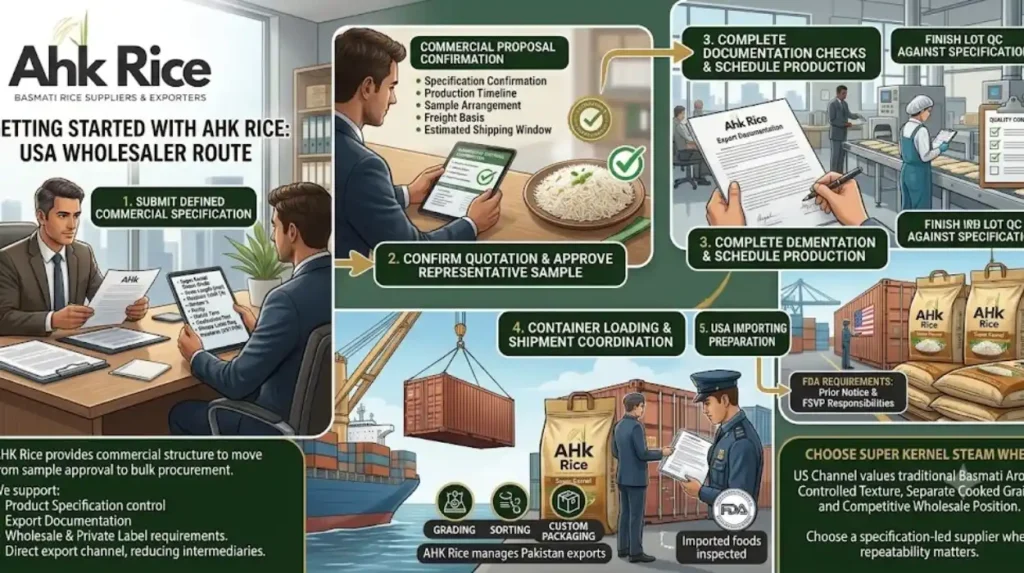
Start with the commercial specification. State the required Super Kernel Steam grade, grain length, moisture limit, broken percentage, purity, packing size, number of metric tons, destination port, private-label requirement, and preferred Incoterm.
AHK Rice can then prepare the product and commercial proposal. The buyer should request confirmation of the exact specification, production timeline, sample arrangement, freight basis, documentation, and estimated shipping window before approving the order.
After sample approval, the next stage is production and quality control. The finished lot should be checked against the approved specification before packing and container loading.
AHK Rice’s broader export process includes grading, sorting, custom packaging, export documentation, container loading, and shipment coordination.
The buyer should also ensure that the U.S. importing entity and its customs broker are prepared for FDA requirements, including applicable Prior Notice and FSVP responsibilities. FDA makes clear that imported foods can be inspected at U.S. ports and that importers remain responsible for ensuring applicable compliance.
The decision is straightforward: choose Super Kernel Steam Rice when the target U.S. channel values traditional Basmati aroma, controlled texture, separate cooked grains, and a competitive wholesale position. Choose a specification-led supplier when repeatability matters as much as the first shipment.
For U.S. distributors, AHK Rice provides the commercial structure needed to move from sample approval to bulk procurement. AHK Rice controls the product specification, AHK Rice supports export documentation, and AHK Rice coordinates the shipment process from Pakistan. AHK Rice also supports wholesale and private-label requirements, while AHK Rice gives buyers a direct export channel rather than requiring multiple sourcing intermediaries.
The strongest buying decision is therefore not simply to buy the lowest-priced Super Kernel Steam Rice. It is to buy a documented specification that can be reproduced from container to container, supported by appropriate sampling, inspection, packaging, logistics, and U.S. import preparation.
To start the commercial process, request a quotation from AHK Rice.
Frequently Asked Questions
What is Super Kernel Steam Rice used for in the USA?
Super Kernel Steam Rice is used by U.S. wholesalers, restaurants, retailers, caterers, and foodservice distributors for dishes such as biryani, pulao, pilaf, and other rice-based meals requiring long, separate grains and firm texture.
Why is Super Kernel Steam Rice suitable for wholesale distribution?
It offers a combination of long grain appearance, consistent cooking performance, aroma, and competitive positioning. Wholesale buyers can also specify packaging, quantity, quality tolerances, and shipment requirements according to their distribution model.
What quality specifications should USA importers check before buying?
Importers should check average grain length, moisture, broken grains, purity, foreign matter, processing quality, packaging, aroma, and cooked texture. The approved commercial specification should match the sample evaluated before the order.
How does steam processing affect Super Kernel Rice?
Steam processing helps strengthen the grain structure before milling. When properly processed and cooked, the rice can maintain better grain separation and a firmer texture, which is useful for commercial food preparation.
What is the expected shipping time from Pakistan to the USA?
A typical planning range is approximately 25–35 days from Karachi to major U.S. ports, but actual transit depends on the selected vessel, route, transshipment, port congestion, customs clearance, and inland transportation.
What sample size can USA wholesale buyers request?
The available sample quantity depends on the supplier and commercial requirements. A buyer should specify the quantity needed for laboratory testing and cooking trials before requesting a sample quotation.
What should be tested during a Super Kernel Steam Rice sample evaluation?
A buyer should evaluate dry grain length, uniformity, broken percentage, moisture, purity, aroma, cooking elongation, grain separation, firmness, and final texture. These checks help determine whether the sample matches the intended commercial specification.
What determines the landed cost of Super Kernel Steam Rice in the USA?
Landed cost depends on the rice price, order quantity, packaging, processing requirements, ocean freight, destination port, insurance, inspection, customs-related expenses, brokerage, inland transportation, and applicable import charges.