Optimize Nebraska Rice Procurement with AHK Rice Supply Solutions
Nebraska rice buyers can reduce procurement risk by using a planned Pakistan-to-USA supply program that fixes rice specifications, sample approval, production capacity, documentation, container scheduling, freight planning, and delivery windows before inventory becomes critical, rather than relying on last-minute spot purchases.
Nebraska wholesalers, distributors, restaurants, retailers, and foodservice operators sourcing Pakistani Basmati need more than an attractive FOB price. The purchasing decision must account for product consistency, import compliance, ocean transit, inland transportation, packaging, working capital, and replenishment timing. USDA’s August 2026 outlook projects U.S. all-rice imports at a record 49.8 million hundredweight for 2026/27, while ending stocks remain 33% below the previous year. That combination makes structured procurement increasingly important for buyers exposed to imported rice.
Before committing to a supplier, Nebraska importers should understand:
Why buyers should create procurement plans before importing rice and then convert the planning principles into a commercial purchasing program. The objective is straightforward: approve the exact rice specification early, reserve supply, coordinate inspection and packaging, book freight, and establish enough safety stock to protect sales when vessel schedules or inland delivery change.
What is the best solution for Nebraska rice procurement problems?
The strongest solution is a forecast-based, specification-controlled supply program that connects Nebraska demand with Pakistani Basmati production, sampling, quality inspection, packaging, export documentation, ocean freight, customs coordination, and inland delivery through defined commercial milestones and reorder points.
Spot purchasing creates several risks for Nebraska buyers. A supplier may have rice available, but the available lot may not match the previous shipment in grain length, broken percentage, moisture, milling appearance, aroma, or cooking performance. A low quoted price can therefore become expensive if the buyer must reformulate packaging, change retail positioning, or manage customer complaints.
AHK Rice approaches procurement as a controlled sequence rather than an isolated container sale. Its Punjab operation handles paddy sourcing, cleaning, dehusking, paddy separation, whitening, polishing, grading, length sorting, packaging, export documentation, and container loading. This integrated structure gives a Nebraska importer a defined origin-side process before the shipment enters international logistics.
For Nebraska, the practical procurement model should begin with a rolling forecast. A buyer can estimate monthly demand, establish minimum inventory, identify peak periods, and calculate the purchase quantity required before the next shipment is needed. The supplier can then align production and packing with the required shipment window.
A typical specification should identify:
- Variety and processing grade
- Grain-length requirement
- Broken-grain tolerance
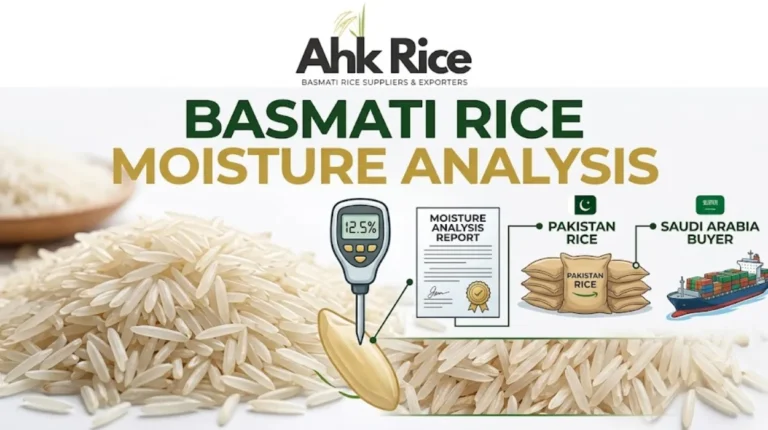
- Moisture limit
- Foreign-matter and purity requirements
- Packaging material and bag size
- Private-label requirements, if applicable
- Inspection requirements
- Destination port and delivery point
- Incoterm and payment structure
This specification becomes the reference point for sampling, production, inspection, and repeat orders.
Why choose the USA service from AHK Rice for Nebraska buyers?
AHK Rice’s USA export service combines Pakistani Basmati sourcing, processing, grading, customized packaging, inspection coordination, export documentation, and shipment support, giving Nebraska importers one origin-side supply process instead of coordinating multiple disconnected suppliers.
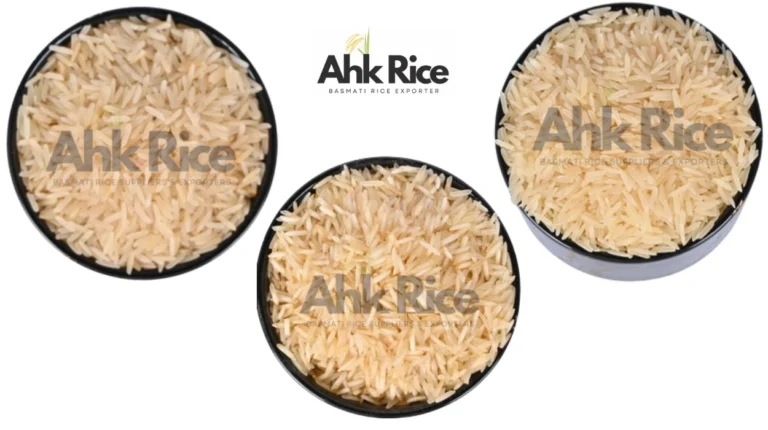
The USA rice export service is designed for U.S. importers purchasing Pakistani Basmati. AHK Rice lists 1121, Super Kernel, and other Basmati options for the American market, with product specifications and packaging structured around commercial buyer requirements.
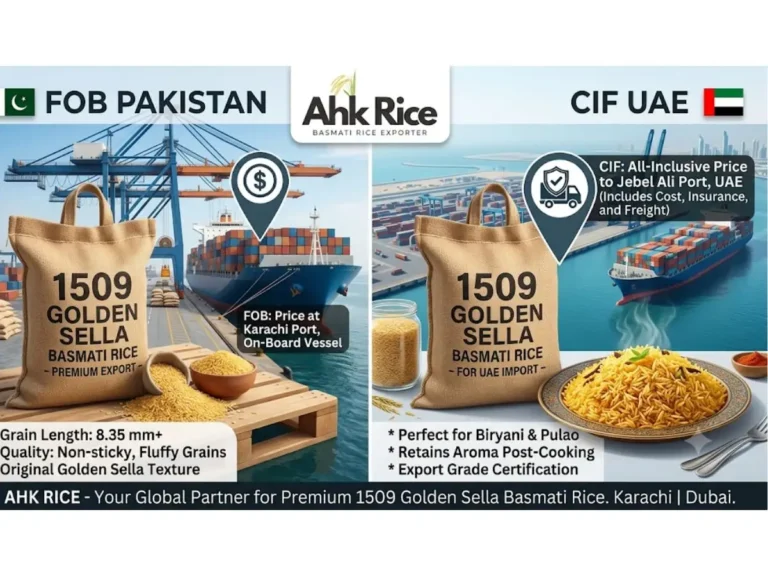
The commercial advantage is specification control. A Nebraska buyer can select the variety according to its market position rather than simply purchasing whatever grade is immediately available. 1121 is suited to buyers seeking extra-long grain presentation and strong Basmati positioning. Super Kernel provides another premium option, while 1509 can be considered when the buyer wants a cost-conscious Basmati program with appropriate cooking characteristics.
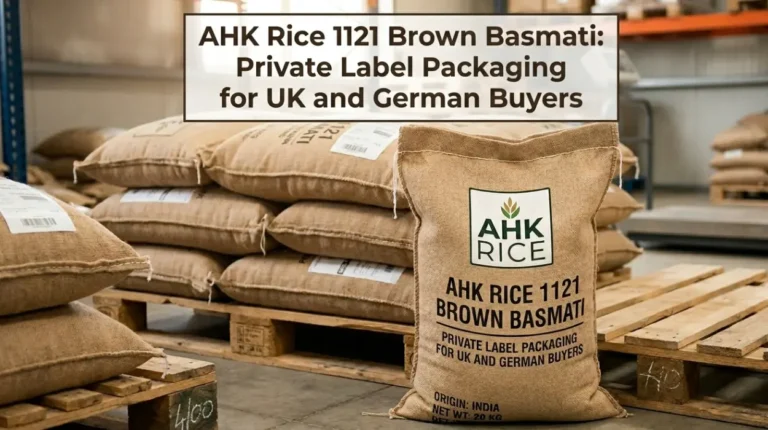
AHK Rice also supports custom packaging and private-label requirements. This matters for Nebraska retailers and distributors because packaging is part of the procurement specification, not a separate marketing decision. Bag material, weight, labeling information, pallet configuration, and production timing should be agreed before the commercial shipment is scheduled.
Quality verification is another decision factor. AHK Rice states that it can coordinate third-party pre-shipment inspection through internationally recognized inspection organizations, including SGS and Bureau Veritas. Its USA service also identifies documentation and shipment support as part of the export process.
U.S. buyers must also manage their own applicable import responsibilities. FDA requirements apply to imported food, and importers may have obligations under the Foreign Supplier Verification Program. Supplier verification should therefore be incorporated into procurement approval rather than treated as a problem after the container has sailed.
How should Nebraska buyers evaluate the rice specification before ordering?
Nebraska buyers should approve a physical sample against a written specification, compare cooking performance and appearance, confirm laboratory or inspection requirements, and retain the approved specification as the commercial reference for production, packing, inspection, and subsequent repeat shipments.
A sample should represent the product that will actually be supplied. Nebraska buyers should avoid approving a generic photograph or an unspecified sample because visual appearance alone cannot establish commercial consistency.
Step 1: Define the target specification
The importer provides the desired variety, processing type, grain length, broken percentage, moisture, packaging, quantity, and destination. If the buyer already sells another Basmati product, its existing specification can be used as the benchmark.
Step 2: Receive the physical sample
AHK Rice states that samples of up to 20 kg can be supplied free of rice charges, while the client pays applicable sample shipping costs. Its USA service also states that clients can use their own courier account, which can simplify sample logistics.
Step 3: Test the sample
The buyer should assess raw appearance, grain uniformity, aroma, broken grains, cooking elongation, texture, flavor, and post-cooking separation. For commercial buyers, the test should reproduce the conditions used in the buyer’s restaurant, foodservice, retail, or processing operation.
Step 4: Approve the specification
Once the sample passes, the buyer should record the approved parameters in the purchase contract or specification sheet. This prevents later disagreements over what “premium,” “extra-long,” or “low broken” means.
Step 5: Move to production and inspection
AHK Rice’s stated processing flow includes cleaning, dehusking, paddy separation, whitening, polishing, grading, length sorting, packaging, and container loading. This creates identifiable control points before shipment.
Step 6: Release the shipment
After production and inspection, export documents and container logistics are completed before the cargo moves into the international transportation stage.
The comparison stage should also examine the commercial differences between procurement approaches. Buyers can use:
Procurement planning to improve supply chain performance when deciding whether a planned supply agreement offers better inventory protection than repeated spot purchases.
How many shipping days should Nebraska buyers plan for?
Nebraska buyers should plan from approximately 35–45 days for a well-coordinated Pakistan-to-Nebraska ocean supply cycle, while allowing additional buffer for port handling, customs, inland transportation, transshipment, and schedule variability rather than treating ocean transit alone as total delivery time.
Transit depends heavily on the U.S. entry port. Current August 2026 lane data shows Karachi-to-New York ocean FCL transit around 27 days, while Port Qasim-to-New York is shown around 23–33 days.
For a Nebraska importer using an East Coast gateway, a practical planning model is:
| Supply stage | Planning allowance |
|---|---|
| Sample and specification approval | 5–10 days |
| Production and packing | 7–14 days |
| Export inspection and documentation | 2–5 days |
| Vessel and ocean transit | 23–30 days |
| U.S. port, customs and release | 3–7 days |
| Inland delivery to Nebraska | 2–5 days |
| Recommended total planning window | 42–71 days |
These are planning allowances, not guaranteed delivery times. A Nebraska buyer should therefore place replenishment orders before existing inventory approaches its physical stockout point.
The route can also affect the final landed cost and timing. Current freight data shows Karachi-to-New York 40-foot FCL rates around $7,519–$8,155 on one public lane benchmark, while another August 2026 public rate source shows a substantially higher indicative benchmark under a different service and commercial basis. This illustrates why Nebraska buyers should request shipment-specific freight rather than relying on an old freight estimate.
What results can Nebraska buyers expect from planned AHK Rice supply?
A properly planned AHK Rice program can improve specification consistency, reduce emergency purchasing, create clearer reorder timing, support predictable packaging, improve shipment visibility, and give Nebraska buyers greater control over landed-cost planning and inventory availability.
The most important result is not simply a lower rice price. It is a more predictable purchasing system.
Consider a Nebraska distributor selling 20 MT of Basmati per month. If its replenishment cycle requires approximately 45 days, it should not wait until 10 MT remain before ordering. The importer should calculate expected demand during production, inspection, ocean transportation, customs, inland delivery, and its safety-stock period.
A planned program could reserve two or more shipment windows rather than negotiating every container independently. The buyer can also align packaging production with the same forecast. This reduces the risk that rice is ready but packaging is unavailable.
AHK Rice provides an origin-side structure for this approach. The company states that it manages processing through container loading and supplies international markets including the USA.
For Nebraska buyers, measurable procurement outcomes can include:
- Better stock continuity: Orders are triggered by forecast and lead time rather than panic.
- Specification consistency: Approved samples become the reference for repeat production.
- Lower procurement disruption: Production and shipping are scheduled before inventory becomes critical.
- Better landed-cost visibility: Product, freight, documentation, inspection, and inland costs are evaluated together.
- Improved supplier accountability: Each shipment can be connected to specifications, inspection, documentation, and delivery milestones.
What does Nebraska rice procurement cost in 2026?
Rice procurement cost depends on variety, processing grade, specification, quantity, packaging, inspection, Incoterm, freight, destination port, inland delivery, tariffs or applicable duties, payment terms, and market conditions, so buyers should evaluate total landed cost instead of comparing FOB prices alone.
Indicative August 2026 Pakistan market data places premium 1121 Basmati FOB Karachi around $1,135–$1,205 per metric ton depending on processing grade, while Super Kernel is also positioned in the premium range. These figures are market indications rather than a fixed AHK Rice quotation and can change with shipment timing and specifications.
For a Nebraska buyer, the landed-cost calculation should follow:
Rice FOB price + export-side charges + inspection/documentation + ocean freight + U.S. port charges + customs-related costs + inland transportation + warehousing = estimated landed cost.
Packaging can also change the final price. Standard bulk PP bags may produce a different commercial cost from customized retail packaging. Smaller pack sizes generally introduce additional material, printing, filling, handling, and production considerations.
Freight should be quoted against the actual cargo-ready date. Public August 2026 freight benchmarks demonstrate that prices can vary substantially according to route, equipment, service, and commercial terms.
AHK Rice can therefore be evaluated on the complete quotation rather than a headline commodity price. The buyer should request the variety, grade, quantity, packing, Incoterm, destination port, inspection requirements, and required delivery window in one commercial brief.
How can Nebraska buyers get started with AHK Rice?
Nebraska buyers should begin by submitting their product specification, forecast quantity, preferred packaging, destination port, delivery requirement, and commercial terms, then approve samples before production and establish a repeat shipment schedule based on actual inventory consumption.
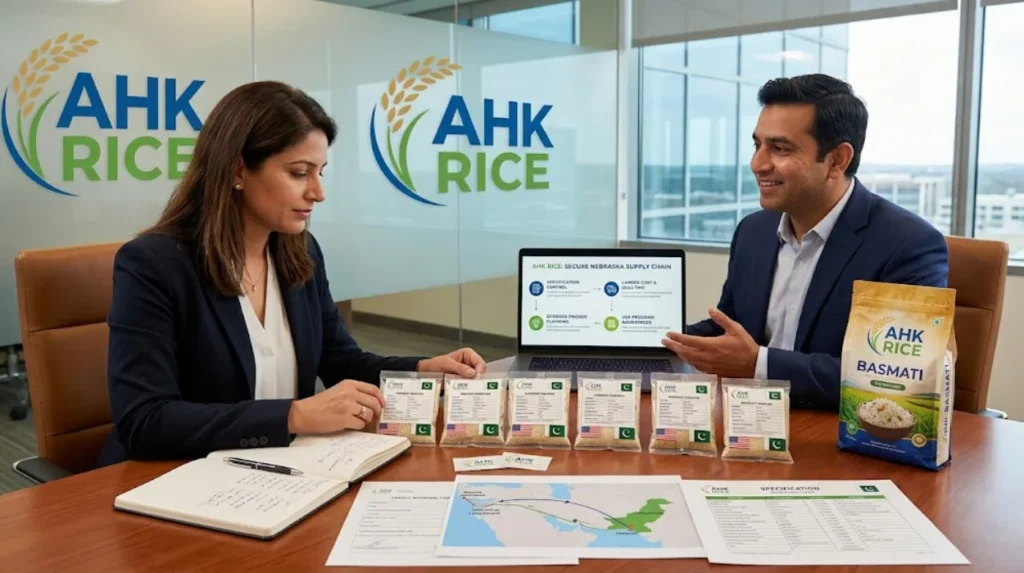
The first commercial conversation should answer five questions: What rice is required? How many metric tons are needed? Where must it arrive? When must the inventory be available? Which quality and packaging specifications must every shipment meet?
AHK Rice can then structure the supply discussion around the selected Basmati variety, production requirements, sample approval, packaging, inspection, documentation, and shipping route.
For a first order, the buyer should avoid treating one successful sample as the entire supplier qualification process. The stronger decision is to confirm the supplier’s ability to reproduce the approved specification, maintain production availability, prepare export documentation, and coordinate shipment milestones.
A Nebraska importer should also establish a reorder trigger. If average monthly demand is 20 MT and the complete procurement cycle can reach 50 days, the buyer needs enough inventory to cover that cycle plus an appropriate safety margin. The exact safety stock should reflect demand variability, supplier capacity, seasonal sales, port congestion, and the buyer’s tolerance for stockouts.
AHK Rice’s USA program is particularly relevant when the buyer wants one origin-side process covering Pakistani Basmati sourcing, processing, packaging, inspection, documentation, and shipment coordination.
The final decision should therefore be based on specification control, landed cost, lead time, documentation, sample performance, production capability, and repeat-order reliability. For Nebraska buyers, the best procurement strategy is not necessarily the lowest initial FOB price; it is the supply arrangement that consistently delivers the approved rice specification when inventory requires it.
Nebraska importers ready to convert their forecast into a defined product, shipment, and landed-cost plan can request a customized rice quotation from AHK Rice.
Frequently Asked Questions
What rice varieties can Nebraska buyers source from AHK Rice?
AHK Rice supplies Pakistani Basmati varieties including 1121, Super Kernel, and 1509, with specifications selected according to grain length, processing grade, packaging, and buyer requirements.
How does AHK Rice support Nebraska rice importers?
AHK Rice supports sourcing, milling, grading, sorting, packaging, inspection coordination, export documentation, container loading, and shipment coordination for U.S. buyers.
How long does rice shipping from Pakistan to Nebraska take?
A Nebraska buyer should generally plan around 42–71 days for the complete procurement cycle, including production, inspection, ocean freight, U.S. port handling, customs, and inland delivery. Actual timing depends on the selected route and shipment conditions.
What affects the landed cost of Pakistani rice in Nebraska?
Landed cost depends on the rice variety and grade, quantity, packaging, inspection, Incoterm, ocean freight, U.S. port charges, customs-related costs, inland transportation, and warehousing.
Can Nebraska buyers request rice samples before placing an order?
Yes. AHK Rice can provide samples for evaluation, allowing buyers to assess grain appearance, aroma, cooking performance, texture, broken percentage, and other specification requirements before commercial production.
How should Nebraska importers approve a rice specification?
Buyers should define the variety, processing type, grain length, broken percentage, moisture, purity, packaging, inspection requirements, and destination. The approved physical sample should then become the reference for commercial production.
Does AHK Rice offer customized rice packaging for U.S. buyers?
Yes. AHK Rice supports customized packaging requirements, including buyer-specific pack sizes and private-label requirements, subject to production and packaging specifications.