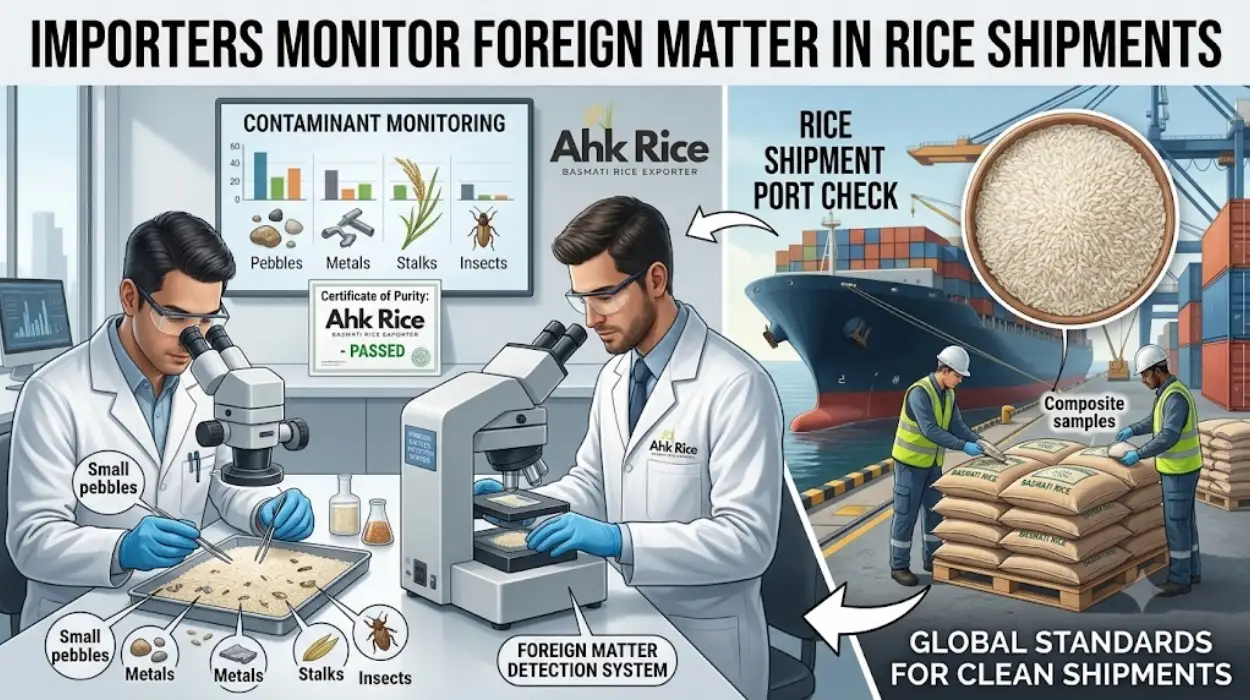
Why Do UK Importers Monitor Foreign Matter in Rice Shipments?
UK importers monitor foreign matter in rice shipments because foreign materials reduce food safety, affect retail compliance, increase customer complaints, and create financial losses. Here is why: UK food businesses must meet strict quality standards, and rice containing stones, husk particles, dust, weed seeds, or other contaminants faces rejection, recalls, or reduced market value.
Rice importers in the United Kingdom inspect every shipment because rice moves through multiple stages before reaching consumers. Cultivation, harvesting, storage, milling, transport, and packaging introduce contamination risks. Foreign matter inspection protects food quality and ensures compliance with UK food regulations. Imported rice must arrive clean, safe, and consistent to satisfy retailers, wholesalers, catering businesses, and consumers.
The UK remains one of the largest import markets for Basmati rice outside South Asia. Pakistan and India supply significant volumes of Basmati rice to British buyers due to strong consumer demand (source: UK Government Trade Data, 2025). Quality specifications often include maximum foreign matter limits, moisture limits, grain length requirements, and broken grain percentages. Understanding foreign matter explains why importers pay close attention to shipment inspections.
What Is Foreign Matter in Rice?
Foreign matter includes stones, dust, husk fragments, weed seeds, metal particles, soil, insects, and other non-rice materials.
Foreign matter refers to any material that does not belong in the finished rice product. Rice buyers classify contaminants into organic and inorganic categories. Organic contaminants include straw, husk pieces, weed seeds, and insect fragments. Inorganic contaminants include stones, sand, glass, and metal particles.
Rice contamination occurs during cultivation, harvesting, storage, transportation, and milling. Harvesting equipment collects soil particles. Storage facilities introduce dust. Transport containers accumulate debris. Processing plants remove these materials before export.
Food safety standards require exporters to inspect and remove contaminants before loading shipments. Clean rice improves consumer confidence and protects retail brands.
With the definition established, the next question is how foreign matter affects importers and consumers.
Why Does Foreign Matter Matter to UK Importers?
Foreign matter increases food safety risks, raises operational costs, and threatens regulatory compliance.
UK importers purchase rice according to written specifications. These specifications often define maximum foreign matter levels. A shipment exceeding the permitted level requires additional cleaning or faces rejection.
Retailers demand consistency. Consumers expect clean rice that cooks properly. Stones damage kitchen equipment. Dust affects product appearance. Metal fragments create serious safety concerns.
Importers also protect their reputation. A contaminated shipment can trigger customer complaints, product withdrawals, and retailer penalties. Large supermarket chains maintain strict supplier standards because consumer trust directly affects sales.
Food manufacturers using rice as an ingredient also require contamination-free products. Ready meals, rice mixes, and packaged food products depend on uniform quality.
Understanding importer concerns leads naturally to the inspection methods used throughout the supply chain.
How Do Importers Detect Foreign Matter in Rice Shipments?
Importers use sampling, laboratory testing, visual inspection, and specification verification.
Rice inspection begins before unloading. Quality inspectors collect representative samples from different shipment locations. Multiple samples improve accuracy and reveal contamination patterns.
What Inspection Steps Are Used?
Rice inspectors follow a structured process:
- Clean the sampling equipment.
- Collect representative grain samples.
- Separate visible contaminants.
- Weigh foreign materials.
- Calculate contamination percentages.
- Verify contract specifications.
- Approve or reject the shipment.
Laboratories conduct additional testing for heavy metals, pesticide residues, and microbiological safety. These tests complement visual inspections.
Modern importers often require pre-shipment inspection certificates. Independent inspection companies verify shipment quality before loading.
Inspection explains detection, while processing explains how exporters remove contaminants before shipment.
How Is Foreign Matter Removed During Modern Rice Processing?
Modern rice mills remove contaminants through multiple cleaning and sorting stages before export.
Rice processing transforms harvested paddy into export-ready rice. Each stage targets specific contaminants and improves product purity.
Readers seeking a deeper understanding of advanced cleaning technologies can explore how modern mills use colour sorting, destoning, grading, and optical inspection in our article about advanced rice purification systems: How foreign contaminants are eliminated during industrial rice processing.
What Processing Steps Remove Foreign Matter?
Modern rice mills follow these steps:
- Clean the paddy.
- Remove large impurities.
- Separate stones.
- Dehusk the grain.
- Polish the rice.
- Grade by size.
- Sort by colour.
- Inspect final output.
- Package clean rice.
Destoners remove heavy particles. Magnets capture metal fragments. Colour sorters identify discoloured grains and contaminants. Grading machines separate broken grains from whole kernels.
Advanced facilities combine mechanical, optical, and electronic systems to achieve high purity levels. Export markets often require strict contamination thresholds before shipment approval.
With processing explained, the next question concerns the specific components that protect rice quality.
What Components Help Prevent Foreign Matter Contamination?
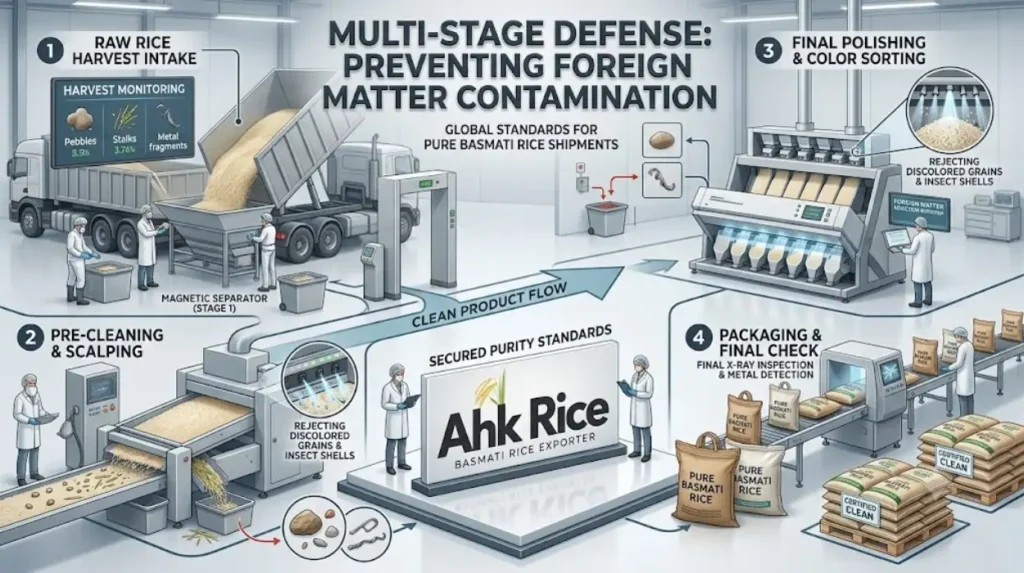
Colour sorting, destoning, magnetic separation, grading systems, and quality inspections provide contamination control.
Modern rice processing depends on specialized equipment. Each system performs a specific function.
Key Quality Control Components
- Colour sorting
- Magnetic separation
- Destoning equipment
- Length grading
- Moisture control
- Metal detection
- Optical inspection
- Laboratory testing
Colour sorters use cameras to identify unwanted particles. Destoners separate heavier contaminants. Metal detectors identify metallic fragments before packaging.
Quality control teams inspect products throughout production. Continuous monitoring reduces contamination risks and maintains consistency.
These components create measurable benefits for both exporters and importers.
What Benefits Come from Monitoring Foreign Matter?
Higher food safety, improved compliance, better customer satisfaction, and reduced financial risk result from contamination control.
Food safety remains the primary benefit. Clean rice protects consumers from physical contaminants. Reduced contamination also lowers product complaint rates.
Importers gain operational advantages. Clean shipments require less reprocessing. Faster distribution reduces storage costs. Consistent quality improves supplier relationships.
Retailers benefit from stronger customer trust. Consumers prefer products that appear clean and uniform. Better presentation supports repeat purchases.
Exporters benefit through market access. Premium markets often demand stricter quality standards. Meeting those standards increases competitiveness.
These benefits become clearer when examining real-world applications.
Where Is Foreign Matter Monitoring Most Important?
Retail, wholesale, food manufacturing, hospitality, and government procurement sectors depend on contamination-free rice.
Retail supermarkets maintain strict quality standards because products reach millions of consumers. Even minor contamination creates reputational damage.
Food manufacturers require clean rice for packaged foods. Production lines depend on consistent raw materials. Contaminants disrupt manufacturing processes.
Hospitality businesses purchase rice in large volumes. Restaurants, hotels, and catering operations need dependable quality to maintain customer satisfaction.
Government procurement programs also require strict specifications. Public food programs often establish detailed quality requirements before accepting deliveries.
Different sectors share one objective: safe and consistent rice products.
Understanding these use cases helps address common misconceptions surrounding rice contamination.
What Misconceptions Exist About Foreign Matter in Rice?
Foreign matter is not limited to stones, and contamination control does not end at milling.
Many buyers assume foreign matter only means stones. Foreign matter includes many materials. Examples include husk particles, weed seeds, metal fragments, dust, and insect matter.
Another misconception involves processing. Buyers often believe milling alone eliminates all contaminants. Modern quality control requires multiple cleaning technologies and repeated inspections.
Some importers focus only on visual appearance. Laboratory testing remains equally important because certain contaminants remain invisible during routine inspections.
Another misunderstanding concerns transportation. Clean rice can become contaminated during storage or shipping. Proper packaging, container inspection, and loading procedures remain essential quality controls.
Foreign matter management extends across the entire supply chain, from harvested paddy to retail shelves.
Foreign matter monitoring protects food safety, regulatory compliance, and commercial value. UK importers inspect rice shipments because contaminants affect consumer trust, retailer standards, and product performance. Modern rice processing removes unwanted materials through cleaning, destoning, grading, magnetic separation, colour sorting, and laboratory testing. Effective contamination control supports reliable international trade and ensures that rice reaches consumers in a safe and consistent condition.
Frequently Asked Questions
What is considered foreign matter in rice?
Foreign matter includes stones, dust, husk particles, weed seeds, metal fragments, soil, insect matter, and other non-rice materials.
What foreign matter level is acceptable in rice shipments?
Acceptable levels depend on buyer specifications, destination regulations, and contract requirements. Premium buyers typically require very low contamination levels.
How do rice exporters remove foreign matter?
Exporters use cleaning machines, destoners, magnets, graders, colour sorters, and manual inspections to remove contaminants.
Why do UK retailers require strict rice inspections?
UK retailers prioritize food safety, regulatory compliance, consumer satisfaction, and brand protection.
Can contaminated rice shipments be rejected?
Yes. Buyers can reject shipments that exceed agreed quality specifications or fail safety requirements.
Does foreign matter affect rice prices?
Yes. Higher contamination levels reduce product value because additional cleaning and quality corrections increase costs.