Why Does Crop Year Influence Basmati Rice Purchasing Decisions?
Crop year directly affects rice aroma, moisture content, grain stability, cooking performance, shelf life, and market value. Here is why: freshly harvested rice contains higher moisture and less-developed aroma compounds, while matured rice offers more stable cooking results and stronger fragrance.
Basmati rice buyers evaluate more than grain length and price. Crop year determines how the rice behaves during storage, transportation, processing, and cooking. Importers, wholesalers, retailers, and foodservice distributors use crop year information to predict product performance. Understanding this factor helps buyers select the correct specification for their target market.
What Does Crop Year Mean in Basmati Rice?
Crop year identifies the specific harvest season in which the paddy was cultivated and harvested. Buyers use crop year data to determine freshness, maturity level, storage age, and expected cooking characteristics.
Crop year refers to the agricultural season when farmers cultivate and harvest Basmati paddy. Pakistan generally harvests Basmati rice between September and November. Rice harvested during this period becomes part of that crop year’s inventory.
Crop year information appears on export contracts, quality certificates, and commercial specifications. Buyers use this information to distinguish newly harvested stocks from matured inventories.
Freshly harvested Basmati contains higher moisture levels. Matured stocks undergo controlled storage for several months. This storage period changes the physical and chemical characteristics of the grain.
For example, a buyer comparing Crop Year 2025 and Crop Year 2024 stocks evaluates two products with different aging profiles despite belonging to the same variety.
Understanding crop year creates the foundation for understanding how rice quality evolves during storage.
How Does Crop Year Affect Basmati Rice Quality?
Crop year influences moisture content, aroma intensity, grain hardness, cooking expansion, and storage stability. Rice matured for 6–12 months generally provides more consistent cooking performance.
Freshly harvested Basmati retains greater moisture. Moisture levels often range between 13–14% immediately after harvest. Higher moisture affects milling efficiency and storage performance.
Matured Basmati gradually loses excess moisture during controlled storage. Moisture stabilizes near 11–12%, creating a firmer grain structure.
Aroma compounds also develop during maturation. Basmati fragrance becomes more pronounced as natural aging progresses. Buyers supplying premium retail markets often prefer matured stocks because consumers expect stronger aroma.
Cooking performance changes as well. Matured grains absorb water more evenly. Rice expansion becomes more predictable during commercial cooking operations.
Foodservice operators value consistency. Consistency reduces waste and improves menu standardization.
With quality effects established, the next question is how maturation physically changes the grain.
How Does the Rice Maturation Process Work?
Basmati maturation requires controlled storage for 6–24 months, allowing moisture redistribution and aroma development within the grain.
What Happens During Maturation?
Freshly harvested paddy enters storage facilities after drying and cleaning. Storage conditions remain carefully controlled to preserve grain integrity.
During maturation, natural biochemical reactions occur within the grain. Moisture redistributes evenly throughout the kernel. Aroma compounds continue developing.
Processors monitor storage conditions to maintain quality standards. Temperature fluctuations and excessive humidity reduce grain performance.
What Processing Steps Occur Before Export?
Basmati processing follows a structured workflow:
- Clean the paddy
- Dry the grain
- Store for maturation
- De-husk the kernels
- Polish the rice
- Sort by length
- Grade by quality
- Inspect for defects
- Pack for export
Each step influences final product consistency. Buyers receive rice that matches agreed specifications.
Understanding maturation leads naturally to examining which rice grades buyers encounter in international trade.
What Basmati Rice Grades Are Available Across Different Crop Years?
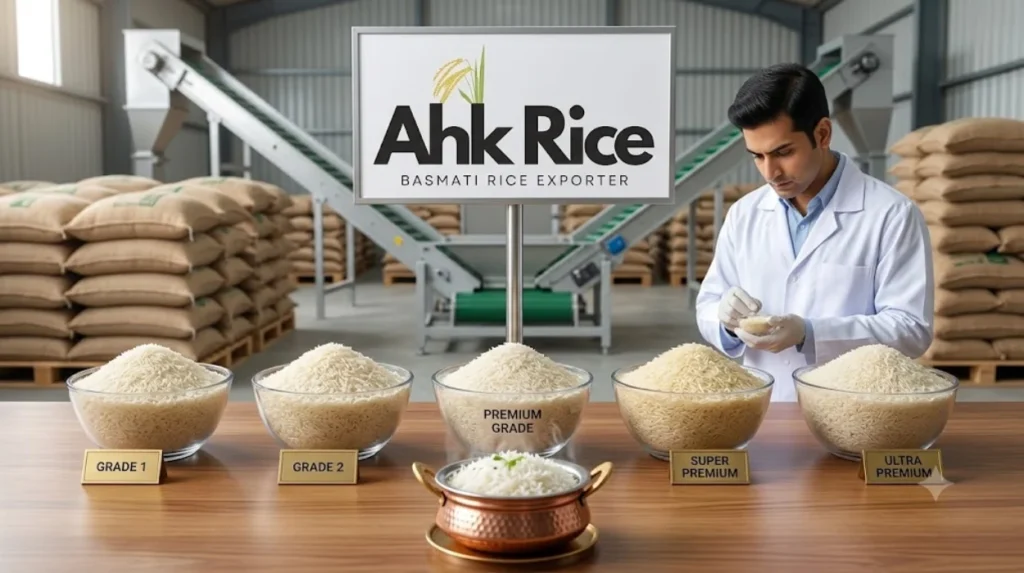
Export markets trade multiple grades including 1121, Super Kernel, and 1509 Basmati in White, Steam, Sella, and Golden Sella processing categories.
1121 Basmati Rice
1121 Basmati is known for exceptional grain length. Average grain length reaches 8.30–8.50 mm before cooking.
1121 varieties expand significantly during cooking. Gulf countries frequently import this grade for hospitality and catering sectors.
Super Kernel Basmati Rice
Super Kernel Basmati offers traditional aroma and strong market recognition. Many European and Middle Eastern importers source this variety.
Super Kernel delivers balanced cooking performance and premium fragrance characteristics.
1509 Basmati Rice
1509 Basmati matures earlier than many traditional varieties. Buyers value its affordability and reliable grain appearance.
African and Asian markets often import 1509 because it provides competitive pricing while maintaining Basmati characteristics.
Processing Grades
Common export processing grades include:
- White Rice
- Steam Rice
- Sella Rice
- Golden Sella Rice
Golden Sella lasts longer than White Rice. In high-temperature Gulf warehouses, Golden Sella maintains quality for longer storage cycles. White Rice generally enters retail channels more quickly.
With grades identified, the next question concerns which international markets prioritize crop year information.
Which Markets Pay Close Attention to Crop Year?
Middle Eastern, European, North American, and premium Asian buyers actively evaluate crop year specifications before purchasing Basmati rice.
Gulf countries import substantial volumes of Basmati rice each year because rice forms a staple component of regional cuisine (source: REAP export data, December 2025).
UAE buyers often compare new-crop and matured inventories before procurement. Catering businesses require consistent cooking performance across large batch sizes.
European importers focus on traceability and quality consistency. Crop year information helps retailers manage inventory planning and shelf-life expectations.
North American specialty retailers frequently market aged Basmati as a premium product. Consumers associate aged rice with enhanced aroma and cooking quality.
Premium Asian distributors evaluate crop year because restaurant operators demand predictable grain elongation and texture.
Market preferences highlight why buyers carefully compare newer and older stocks.
What Benefits Does Crop Year Information Provide Buyers?
Crop year data improves procurement decisions, inventory planning, quality forecasting, and customer satisfaction.
Better Product Selection
Crop year allows buyers to match specifications with customer requirements. Premium retail channels often prefer matured inventories.
Improved Inventory Planning
Crop year helps distributors rotate stock efficiently. Older inventories generally require different storage planning than new-crop arrivals.
More Accurate Quality Expectations
Crop year establishes realistic expectations regarding aroma, moisture, and cooking performance.
Stronger Price Evaluation
Crop year assists buyers when comparing offers from multiple suppliers. Similar grades often command different prices based on maturity.
Buyers benefit most when crop year information supports broader procurement analysis.
What Common Misconceptions Exist About New Crop and Matured Rice?
New crop rice is not automatically better, and aged rice is not automatically superior. Product suitability depends on the intended application.
Many buyers assume newer rice always provides better quality. Fresh harvests offer freshness but not necessarily superior cooking performance.
Another misconception states that all aged rice delivers premium results. Poor storage conditions reduce quality regardless of age.
Some importers believe crop year only affects aroma. Crop year also influences moisture balance, grain hardness, storage behavior, and cooking consistency.
Another misunderstanding involves pricing. Higher prices do not always indicate better suitability. Budget-conscious foodservice operations sometimes benefit from newer crop inventories.
Accurate evaluation requires examining crop year alongside variety, processing grade, packaging specification, and destination market requirements.
Understanding misconceptions prepares buyers to compare stock options more effectively.
How Should Buyers Evaluate Crop Year During Procurement?
Buyers should compare crop year alongside moisture levels, grain length, processing grade, certification status, and intended market use.
Procurement teams should inspect official quality documents before purchase. Crop year information becomes valuable when combined with measurable specifications.
Key evaluation criteria include:
| Specification | Importance |
|---|---|
| Crop Year | Indicates harvest season |
| Moisture Content | Influences storage stability |
| Grain Length | Determines market grade |
| Broken Percentage | Affects value |
| Processing Type | Impacts cooking performance |
| Aroma Level | Supports premium positioning |
| Packaging Format | Influences logistics |
Restaurant distributors often prioritize cooking consistency. Retail importers often prioritize aroma and presentation. Food manufacturers frequently prioritize specification uniformity.
Buyers seeking a deeper understanding of stock selection strategies can benefit from learning how inventory age influences commercial comparisons and procurement decisions.
What Certifications Apply to Basmati Rice Exports?
Major export certifications include ISO standards, HACCP compliance, phytosanitary certification, fumigation certification, and laboratory testing reports.
Exporters inspect and certify rice before shipment. Certification verifies product quality, safety, and compliance with destination market requirements.
Common export documents include:
- Phytosanitary Certificate
- Certificate of Origin
- Fumigation Certificate
- Packing List
- Commercial Invoice
- Quality Inspection Report
- Bill of Lading
These documents support customs clearance and international trade compliance.
Crop year information becomes most useful when combined with verified quality documentation and clear product specifications.
Frequently Asked Questions
Does matured Basmati rice cook better than new crop rice?
Yes. Matured rice generally provides more consistent water absorption, stronger aroma, and better grain elongation.
How long is Basmati rice typically matured?
Commercial maturation usually ranges from 6 to 24 months depending on buyer requirements and storage conditions.
Why do importers ask for crop year information?
Importers use crop year data to predict quality, cooking behavior, shelf life, and inventory performance.
Which Basmati variety is most commonly traded internationally?
1121 Basmati remains one of the most widely traded export varieties due to its extra-long grain length.
Does crop year affect rice pricing?
Yes. Matured inventories often command higher prices because of storage costs and stronger market demand.