How Do Buyers Compare New Crop and Matured Rice Stocks?
The most effective way to compare new crop and matured rice stocks is to evaluate aroma development, grain behavior after cooking, moisture levels, storage age, shelf life, market demand, and landed cost per metric ton rather than relying only on appearance.
For importers, wholesalers, distributors, and food service buyers, choosing between freshly harvested rice and matured rice directly affects customer satisfaction, inventory turnover, and profit margins. Understanding the differences helps buyers align purchases with market expectations and product positioning.
Buyers who want a deeper understanding of harvesting cycles, storage periods, and crop characteristics should first review our guide on understanding Pakistani Basmati crop seasons and harvesting timelines. Once the crop cycle is understood, evaluating stock maturity becomes significantly easier.
AHK Rice is a trusted Pakistani Basmati rice exporter based in Punjab, supplying multiple varieties through its comprehensive export services. Buyers evaluating stock options often compare products available through the Source Current Crop Pakistani Basmati Rice for UK Importers guide before making procurement decisions.
What Is the Difference Between New Crop and Matured Rice Stocks?
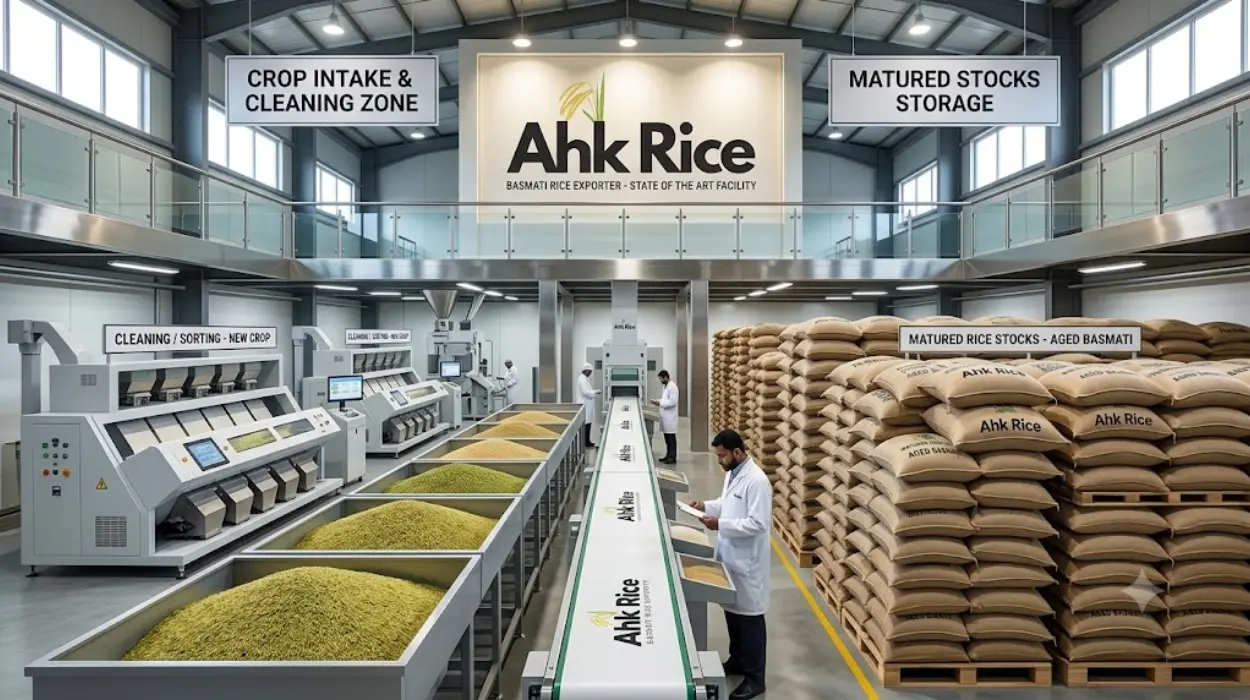
New crop rice refers to recently harvested rice that has completed milling and stabilization, while matured rice refers to rice stored under controlled conditions for a defined aging period to enhance aroma, cooking performance, and grain characteristics demanded by premium markets.
Rice begins changing immediately after harvest.
Freshly harvested paddy contains higher moisture content. During processing, moisture levels are reduced to export standards. However, the grain continues undergoing physical and chemical changes while stored.
New crop rice generally enters the market within weeks or months after harvesting. Matured rice remains stored under controlled warehouse conditions for extended periods, commonly ranging from 6 to 24 months depending on market requirements.
Aging affects starch structure, aroma concentration, grain firmness, elongation during cooking, and overall eating quality. Premium Basmati markets often prefer matured stocks because these characteristics become more pronounced over time.
For buyers, maturity is not simply a storage period. It is a quality variable that influences commercial value.
How Do Buyers Compare New Crop and Matured Rice Specifications?
Professional buyers compare measurable specifications including moisture content, grain elongation, aroma intensity, cooking behavior, storage age, shelf life, breakage percentage, and price per metric ton to determine which stock delivers the best commercial outcome.
The comparison process starts with technical specifications.
New Crop vs Matured Rice Specification Comparison
| Attribute | New Crop Rice | Matured Rice |
|---|---|---|
| Storage Age | 0–6 Months | 6–24 Months |
| Moisture Content | Slightly Higher | More Stabilized |
| Aroma Development | Moderate | Strong |
| Grain Elongation | Good | Excellent |
| Cooking Performance | Softer Texture | Firmer Texture |
| Shelf Life Remaining | Longer | Slightly Reduced |
| Average Market Value | Lower | Higher |
Importers often request laboratory reports alongside physical samples.
Technical reports verify moisture levels, broken grain percentages, foreign matter limits, damaged grain percentages, and purity standards.
Sample cooking tests then confirm commercial suitability.
This two-stage evaluation process reduces purchasing risk and improves procurement accuracy.
What Are the Available Solutions for Buyers Evaluating Rice Stocks?
Importers typically use supplier specifications, laboratory testing, physical inspection, cooking trials, warehouse verification, and sample-based comparisons to evaluate stock maturity and determine the most suitable purchasing option for their target market.
Different evaluation methods provide different levels of certainty.
Supplier documentation offers initial insight into harvest dates, milling periods, and storage duration.
Independent laboratory testing validates technical specifications.
Cooking trials reveal practical differences that laboratory reports cannot fully demonstrate.
Warehouse inspections confirm storage conditions.
Many experienced importers combine all methods before committing to large-volume purchases.
This multi-layer verification approach is especially common among buyers sourcing multiple containers for retail distribution.
How Do Different Approaches Compare?
Each evaluation approach serves a different purpose, with laboratory analysis providing measurable data, cooking tests demonstrating consumer experience, and warehouse inspections validating stock condition and storage integrity.
Comparison of Evaluation Approaches
| Evaluation Method | Main Purpose | Strength | Limitation |
|---|---|---|---|
| Supplier Specifications | Initial Screening | Fast Review | Depends on Documentation |
| Laboratory Testing | Technical Validation | Accurate Data | Additional Cost |
| Cooking Trial | Consumer Experience | Practical Results | Small Sample Size |
| Warehouse Inspection | Storage Verification | Physical Evidence | Travel Requirement |
| Third-Party Audit | Compliance Assurance | Independent Assessment | Higher Cost |
The strongest procurement decisions combine multiple evaluation methods.
Importers relying solely on specifications often miss quality differences visible only after cooking.
Conversely, buyers relying only on cooking samples may overlook technical compliance issues.
Balanced assessment produces better purchasing outcomes.
Which Method Works Best for Different Buyer Types?

The best evaluation method depends on the buyer’s business model, market expectations, inventory strategy, customer segment, and desired product positioning within the destination market.
Retail distributors often prioritize consistency.
Restaurant suppliers focus on cooking performance.
Private label brands emphasize consumer experience and repeat purchases.
Government tenders prioritize technical compliance.
Wholesale traders frequently balance quality and cost.
Decision Framework for Buyers
| Buyer Situation | Recommended Stock Type | Main Reason |
|---|---|---|
| Premium Retail Market | Matured Rice | Superior Aroma |
| Restaurant Chains | Matured Rice | Better Cooking Performance |
| Budget Wholesale Market | New Crop Rice | Lower Cost |
| Fast Inventory Turnover | New Crop Rice | Longer Remaining Shelf Life |
| Premium Private Label Brand | Matured Rice | Higher Consumer Satisfaction |
The correct choice depends on commercial objectives rather than universal quality rankings.
Why Do Premium Markets Prefer Matured Rice?
Premium rice markets value matured stocks because aging enhances aroma concentration, grain elongation, texture stability, and overall cooking characteristics that consumers associate with authentic high-quality Basmati rice.
Aroma is one of the most important purchase drivers.
As Basmati ages, volatile aromatic compounds become more concentrated and balanced.
This improvement becomes noticeable during cooking.
Grain structure also changes.
Matured rice generally produces better elongation and reduced stickiness.
Consumers often perceive these characteristics as indicators of premium quality.
As a result, matured rice frequently commands higher prices across international markets.
Which Grades Are Preferred in Different Regions?
Regional preferences differ significantly because consumer expectations, culinary traditions, purchasing power, and retail positioning influence the preferred maturity level and rice grade.
United Kingdom Market
The UK remains one of the largest destinations for Pakistani Basmati rice.
Retail brands, ethnic supermarkets, and food service distributors commonly prefer matured stocks.
Popular grades include:
- 1121 Basmati Rice
- Super Kernel Basmati Rice
- Premium Long Grain Basmati
The emphasis is placed on aroma, elongation, and consistent cooking performance.
Middle East Market
The Middle East purchases both new crop and matured rice depending on segment.
Premium hospitality sectors generally prefer matured stocks.
Wholesale trading channels often accept newer crop rice due to pricing advantages.
Popular grades include:
- 1121 Steam Basmati
- 1121 Sella Basmati
- Super Kernel Basmati
- 1509 Basmati Rice
The market values both quality and volume efficiency.
How Does Price Per Metric Ton Compare?
Price differences between new crop and matured rice reflect storage costs, inventory carrying expenses, quality improvements, and market demand for aged Basmati characteristics.
Although exact pricing fluctuates throughout the year, matured rice consistently commands a premium.
Typical Export Price Comparison
| Stock Type | Relative Price Position |
|---|---|
| New Crop Rice | Baseline Market Price |
| 6–12 Month Matured Rice | 5–12% Premium |
| 12–24 Month Matured Rice | 10–20% Premium |
The premium reflects additional warehousing costs and increased market value.
Buyers must determine whether their customers will recognize and pay for the quality difference.
When consumers value aroma and cooking performance, matured rice often generates stronger margins despite higher procurement costs.
How Does Shelf Life Compare?
Shelf life evaluation requires considering both remaining storage life and product performance because aged rice has already consumed part of its storage timeline before reaching the importer.
New crop rice generally offers a longer remaining shelf-life window.
Matured rice enters the market after spending months in storage.
However, properly stored matured rice maintains quality exceptionally well.
Commercial buyers therefore evaluate both current condition and remaining shelf life.
Inventory planning becomes particularly important for slower-moving markets.
Fast-turnover distributors often find shelf-life concerns less significant than quality improvements.
What Are the Pros and Cons of Each Option?
Both stock types offer distinct advantages and limitations, making selection dependent on business goals, customer expectations, and pricing strategy rather than a universal quality hierarchy.
New Crop Rice
Advantages
- Lower procurement cost
- Longer remaining shelf life
- Faster market availability
- Suitable for price-sensitive segments
Disadvantages
- Less developed aroma
- Reduced grain elongation
- Lower premium positioning potential
Matured Rice
Advantages
- Stronger aroma
- Better cooking performance
- Improved grain elongation
- Higher premium market acceptance
Disadvantages
- Higher purchase cost
- Reduced remaining shelf-life period
- Longer inventory preparation timeline
The optimal choice depends on target market requirements.
What Decision Factors Matter Most?
The most important decision factors include customer expectations, target market positioning, inventory turnover rate, price sensitivity, quality requirements, and regional demand patterns.
Professional buyers evaluate five core areas:
- Customer quality expectations
- Price competitiveness
- Inventory turnover speed
- Target market preference
- Product positioning strategy
When premium positioning is the objective, matured rice frequently delivers stronger commercial results.
When volume sales dominate purchasing decisions, new crop rice often provides greater pricing flexibility.
The most successful importers align stock maturity with consumer expectations rather than treating maturity as a standalone quality metric.
Conclusion
Comparing new crop and matured rice stocks requires more than reviewing harvest dates. Professional buyers evaluate aroma development, cooking behavior, shelf life, market preferences, and commercial objectives before making procurement decisions. New crop rice offers pricing advantages and longer remaining shelf life, while matured rice delivers stronger aroma, superior elongation, and premium market acceptance. The best choice depends on the target customer, distribution channel, and desired market position.
FAQs
Is matured rice always better than new crop rice?
No. Matured rice offers stronger aroma and cooking performance, but new crop rice can be more suitable for budget-conscious markets and fast inventory turnover businesses.
How long is Basmati rice typically matured?
Premium Basmati rice is commonly matured between 6 and 24 months under controlled storage conditions before export.
Why does matured rice cost more?
Storage expenses, inventory holding costs, and quality improvements increase the commercial value of matured rice.
Which markets prefer matured Basmati rice?
The UK, Europe, premium retail channels, hospitality sectors, and private label brands commonly prefer matured Basmati rice.
Does matured rice have a shorter shelf life?
It has less remaining shelf life because part of its storage period has already passed, although properly stored matured rice remains highly stable.
How do importers verify rice maturity?
Importers use supplier documentation, laboratory testing, cooking trials, warehouse inspections, and third-party audits to verify stock maturity and quality.