Market Positioning Strategies for Premium Imported Sella Rice
Premium imported 1509 Sella Rice performs best when it is positioned according to buyer segment, quality specifications, and market demand rather than competing only on price. In the USA rice market, distributors, retailers, food service businesses, and private-label brands each evaluate different product attributes before making purchasing decisions.
The USA imported rice market has become more competitive in 2026 because consumers have greater awareness of grain quality, cooking consistency, sustainability, and product origin. Buyers no longer evaluate imported rice solely by country of origin. They compare grain length, milling quality, packaging, certifications, shelf stability, cooking performance, and supply reliability. Understanding how imported Sella rice fits different commercial segments becomes easier after reading our guide on:
Where 1509 Sella rice has established its position across American retail and food-service channels. Effective market positioning begins with matching product characteristics to customer expectations instead of competing through discounts alone.
1509 Sella Rice is a premium parboiled long-grain Basmati variety developed in Pakistan. During the parboiling process, nutrients migrate from the bran into the grain before milling, resulting in stronger kernels, lower breakage, longer shelf life, and better cooking stability. These characteristics make it attractive for commercial importers supplying supermarkets, wholesalers, restaurants, ethnic stores, and institutional buyers.
AHK Rice is a Pakistani Basmati rice exporter based in Punjab that supplies 1121, Super Kernel, and 1509 varieties to more than fifteen countries. The company manages sourcing, milling, grading, packaging, quality inspection, and export logistics to meet international buyer specifications.
What market positioning strategies are available for premium imported Sella rice?
Premium imported Sella rice succeeds when suppliers position it around measurable product value instead of commodity pricing. Quality differentiation, customer segmentation, certification compliance, packaging customization, and dependable logistics create stronger market acceptance than competing only through lower prices across wholesale and retail distribution channels.
Several positioning strategies are available for importers and exporters.
The first strategy is quality positioning. This focuses on grain length, uniformity, low broken percentage, moisture control, cooking performance, aroma retention, and visual appearance. Buyers seeking premium products usually compare technical specifications before reviewing prices.
The second strategy is application positioning. Instead of marketing rice as a general food product, suppliers target specific users such as restaurants, catering companies, meal-kit businesses, institutional kitchens, and ethnic grocery retailers. Each customer category values different product characteristics.
The third strategy is origin positioning. Pakistan remains one of the world’s leading producers of premium Basmati rice. Buyers often associate Pakistani Basmati with naturally long grains, strong aroma, and consistent cooking quality.
Another strategy focuses on private-label development. Retail chains increasingly prefer customized packaging, multilingual labels, nutritional information, barcode integration, and retail-ready branding rather than generic export bags.
Certification positioning also continues growing in importance. Buyers increasingly request ISO 22000, HACCP, BRCGS, FDA registration for applicable facilities, phytosanitary documentation, and laboratory testing before shipment.
Finally, suppliers differentiate through supply chain reliability. Stable production schedules, container availability, documentation accuracy, and consistent shipment timelines reduce purchasing risks for importers.
How do different positioning approaches compare?
Each positioning strategy emphasizes different commercial strengths. Premium quality attracts specialty retailers, competitive pricing supports volume distribution, customized branding strengthens retail growth, certification builds importer confidence, while dependable logistics improve long-term purchasing relationships across multiple market segments.
The most effective strategy depends on customer priorities rather than a single universal approach.
| Specification | Premium Quality Positioning | Value Positioning | Private Label Positioning |
|---|---|---|---|
| Target Customer | Premium retailers | Bulk wholesalers | Retail chains |
| Grain Grade | Extra long uniform grains | Standard export grades | Buyer-selected grades |
| Packaging | Premium branded packs | Bulk bags | Customized retail packaging |
| Primary Selling Point | Superior cooking quality | Competitive pricing | Brand differentiation |
| Typical Order Size | Medium to large | Very large | Medium to large |
| Consumer Focus | Premium households | Price-sensitive buyers | Brand-loyal consumers |
| Long-Term Value | High customer retention | Volume growth | Brand equity |
Quality positioning generally creates stronger repeat purchasing because consumers experience consistent cooking results.
Value positioning remains suitable for food processors and wholesalers operating in price-sensitive markets.
Private-label positioning allows retailers to develop their own market identity while maintaining imported product quality.
No single strategy replaces another. Each serves different commercial objectives.
Which positioning strategy works best in different international markets?
Different importing regions evaluate premium Sella rice using unique commercial priorities. Grade selection, acceptable pricing, consumer preferences, packaging expectations, and purchasing volumes vary significantly between North America and the Middle East, making regional positioning essential for sustainable business growth.
Although this article focuses on the USA market, comparing regional preferences demonstrates why positioning strategies cannot remain identical worldwide.
| Market Region | Preferred Grade | Typical Buyer Preference | Estimated Premium Price (USD/MT, 2026)* | Typical Shelf Life |
|---|---|---|---|---|
| USA | 1509 Premium Sella Extra Long Grain | Retail, restaurants, private label | 1,180–1,380 | Up to 24 months |
| GCC (UAE & Saudi Arabia) | Premium Golden/White Sella | Food service, wholesale, hospitality | 1,080–1,300 | Up to 24 months |
*Prices vary according to contract volume, packaging specifications, freight costs, certifications, and seasonal crop conditions during 2026.
USA buyers typically emphasize packaging quality, traceability, nutrition labeling, and cooking consistency.
GCC buyers frequently prioritize grain appearance, cooking elongation, hospitality requirements, and bulk purchasing efficiency.
Understanding these differences improves market positioning decisions.
What are the advantages and disadvantages of different positioning methods?
Every positioning method creates measurable commercial benefits while introducing certain limitations. Businesses achieve stronger performance when strategy selection matches customer expectations, purchasing behavior, operational capabilities, and competitive market conditions instead of following a single universal approach.
Quality positioning offers several benefits.
It supports higher perceived value.
Consumers notice consistent cooking performance.
Restaurants experience predictable food preparation.
Repeat purchasing becomes more common.
However, premium quality requires stricter grading standards, additional quality inspections, and better inventory management.
Value positioning provides different advantages.
Large buyers appreciate competitive pricing.
High-volume distribution becomes easier.
Market penetration accelerates in price-sensitive channels.
The disadvantage is narrower profit margins and stronger competition from lower-priced alternatives.
Private-label positioning creates long-term retail partnerships.
Retailers build brand recognition.
Packaging flexibility supports regional consumer preferences.
However, customized packaging requires longer preparation time, design approval, and inventory planning.
Certification positioning improves importer confidence.
Food safety documentation simplifies compliance.
Regulatory requirements become easier to satisfy.
Certification management also increases operational costs because audits, inspections, laboratory testing, and documentation require continuous investment.
Supply chain positioning emphasizes dependable delivery.
Importers reduce stock shortages.
Forecast planning improves.
Customer satisfaction increases.
The challenge is maintaining logistics consistency despite global freight fluctuations.
How should buyers decide which positioning strategy fits their business?
The best positioning strategy depends on measurable purchasing objectives instead of assumptions. Importers should evaluate customer demographics, sales channels, product specifications, operational costs, branding opportunities, and long-term growth before selecting premium imported Sella rice marketing approaches.
Decision-making becomes simpler when buyers evaluate structured commercial factors.
| Decision Factor | Recommended Strategy | Best Application |
|---|---|---|
| Premium supermarkets | Quality positioning | Higher retail margins |
| Ethnic grocery chains | Origin + quality positioning | Consumer trust |
| Restaurant distributors | Performance positioning | Cooking consistency |
| National retail chains | Private-label positioning | Brand expansion |
| Large wholesalers | Value positioning | High-volume distribution |
Rather than asking which strategy is universally best, businesses should determine which solution aligns with their customer base.
Restaurants rarely prioritize identical features compared with supermarket chains.
Institutional buyers evaluate different metrics than specialty retailers.
Retail consumers often purchase based on packaging, appearance, and brand reputation.
Food service buyers focus on yield, consistency, and cooking performance.
Successful positioning therefore depends on understanding end-user expectations before selecting product specifications.
What factors influence successful premium imported Sella rice positioning?
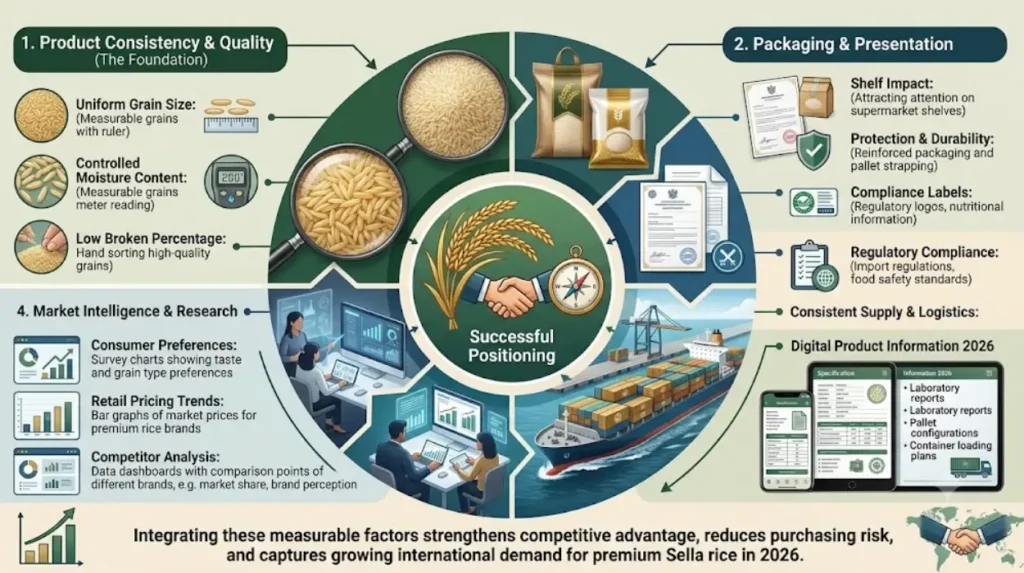
Successful positioning combines product quality, customer understanding, reliable supply, regulatory compliance, and commercial consistency. Businesses that integrate these measurable factors create stronger competitive advantages while reducing purchasing risk across evolving international imported rice markets throughout 2026.
Several measurable factors determine positioning success.
Product consistency remains the most influential factor. Buyers expect uniform grain size across every shipment.
Moisture control directly influences storage performance and cooking quality.
Broken percentage affects visual appeal and perceived value.
Packaging quality influences shelf presentation and transportation protection.
Certification documentation supports regulatory compliance.
Reliable shipping schedules reduce inventory disruption.
Transparent product specifications improve purchasing confidence.
Digital product information has also become increasingly important in 2026. Buyers frequently request specification sheets, laboratory reports, product images, packaging dimensions, pallet configurations, and container loading plans before confirming purchases.
Market research remains equally valuable.
Importers should monitor consumer preferences.
Retail pricing trends should be reviewed regularly.
Competitor positioning should be analyzed using measurable performance indicators rather than assumptions.
Companies that continuously refine their positioning strategy remain more competitive than businesses relying on outdated marketing approaches.
Premium imported Sella rice continues expanding its presence in international markets because it delivers consistent cooking performance, attractive grain appearance, and dependable storage characteristics. Positioning success depends on selecting the correct commercial strategy for the intended customer segment instead of treating every buyer as having identical purchasing priorities. Businesses evaluating long-term sourcing decisions can continue their research by reviewing:
Frequently Asked Questions
What is premium imported 1509 Sella Rice?
Premium imported 1509 Sella Rice is a parboiled Pakistani Basmati variety known for its extra-long grains, excellent cooking performance, low breakage, and long shelf life. It is widely used in retail, food service, and wholesale markets.
Why is market positioning important for imported Sella Rice?
Market positioning helps suppliers differentiate their rice based on quality, certifications, packaging, pricing, and target customers instead of competing only on cost. It improves brand value and attracts the right buyers.
Which market positioning strategy works best for the USA?
For the USA market, quality-focused positioning combined with strong packaging, food safety certifications, traceability, and consistent grain specifications delivers the best long-term commercial results.
How does quality positioning differ from value positioning?
Quality positioning emphasizes premium grain length, cooking consistency, and certifications, while value positioning focuses on competitive pricing and high-volume sales for cost-sensitive buyers.
What factors do USA importers consider before buying premium Sella Rice?
USA importers typically evaluate grain length, broken percentage, moisture content, certifications, packaging quality, shelf life, origin, pricing, and supplier reliability before placing orders.
How do USA and GCC markets differ in their preferences?
USA buyers prioritize packaging, traceability, and consistent cooking quality, whereas GCC buyers often focus on grain appearance, elongation after cooking, hospitality requirements, and bulk purchasing.
What is the average shelf life of 1509 Sella Rice?
When stored under recommended dry and cool conditions, premium 1509 Sella Rice generally has a shelf life of up to 24 months while maintaining its quality.
What certifications strengthen the market position of imported Sella Rice?
Common certifications include ISO 22000, HACCP, BRCGS, phytosanitary certification, and laboratory quality reports, depending on the destination market and buyer requirements.
What packaging options are commonly used for premium imported Sella Rice?
Exporters typically offer 1 kg, 2 kg, 5 kg, 10 kg, 20 kg, 25 kg, and 50 kg packaging, along with custom private-label solutions for retailers and distributors.
How can importers choose the right positioning strategy?
Importers should evaluate their target customers, sales channels, pricing goals, branding requirements, quality expectations, and regional market demand before selecting the most suitable positioning strategy.