How Do Moisture Levels Affect Basmati Rice Storage and Shelf Life?
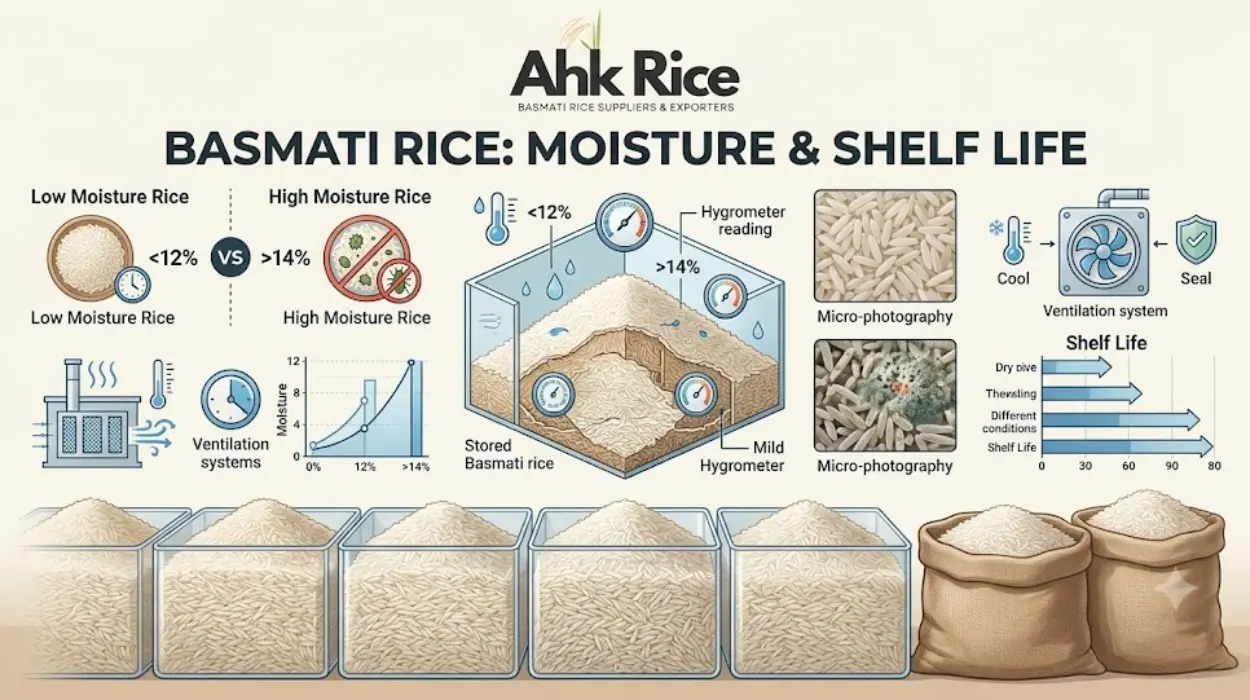
Moisture levels determine Basmati rice shelf life more than any other storage factor because correct moisture preserves aroma, grain strength, cooking quality, and food safety, while excessive moisture accelerates microbial growth, discoloration, insect activity, and quality deterioration throughout domestic storage and international supply chains.
Importers, wholesalers, retailers, and food manufacturers increasingly evaluate moisture specifications before approving shipments because storage performance directly influences inventory turnover, customer satisfaction, and product profitability. If you want to understand why exporters pay close attention to moisture before storage begins, read our guide explaining:
Why moisture management matters throughout the export process.
AHK Rice, a Pakistani Basmati rice exporter based in Punjab, supplies 1121, Super Kernel, and 1509 Basmati varieties to more than 15 countries. During export preparation, moisture management becomes one of several quality parameters alongside grain length, purity, milling quality, foreign matter limits, and packaging integrity. Maintaining the correct moisture range helps preserve grain quality from processing until final consumption.
What is the relationship between moisture levels and Basmati rice shelf life?
Moisture content directly determines how long Basmati rice maintains its aroma, grain integrity, cooking performance, and food safety because water availability controls microbial growth, enzymatic activity, insect development, and physical grain deterioration during storage and transportation across different climates and distribution systems.
Moisture content refers to the percentage of water contained within each rice kernel. Export-grade Pakistani Basmati is generally processed within internationally accepted moisture specifications, typically between 12% and 13%, depending on customer requirements, destination climate, packaging type, and intended storage duration.
Lower moisture slows biological activity inside the grain. This helps preserve:
- Natural aroma
- Grain elongation
- Cooking consistency
- Kernel hardness
- Milling quality
- Color stability
Higher moisture accelerates quality loss.
When moisture exceeds approximately 14%, several storage risks increase significantly:
- Mold development
- Fungal contamination
- Insect infestation
- Kernel discoloration
- Aroma reduction
- Broken grain formation
- Reduced shelf life
International buyers increasingly request moisture analysis reports because inventory often remains in warehouses for several months before reaching retailers or foodservice customers.
Why do different moisture levels produce different storage outcomes?
Different moisture levels change the internal stability of every rice kernel because additional water increases biological activity, while controlled moisture keeps grains dormant, stable, and resistant to spoilage during extended storage under proper warehouse conditions and export packaging systems.
Storage quality depends on multiple factors working together.
These include:
- Moisture percentage
- Storage temperature
- Relative humidity
- Packaging quality
- Warehouse ventilation
- Storage duration
- Handling frequency
Even excellent warehouse conditions cannot fully compensate for excessive grain moisture.
Moisture Level Comparison
| Specification | Low Moisture (≈12%) | Standard Export Moisture (12.5–13%) | Higher Moisture (>14%) |
|---|---|---|---|
| Shelf life | Very long | Long | Reduced |
| Aroma retention | Excellent | Very good | Declines faster |
| Mold resistance | Excellent | High | Low |
| Insect resistance | High | Good | Lower |
| Grain breakage | Minimal | Low | Higher |
| Cooking consistency | Excellent | Excellent | Variable |
| Export suitability | Excellent | Excellent | Limited |
This comparison demonstrates that moisture influences both product quality and commercial value throughout the distribution chain.
Which moisture management solutions are available for preserving Basmati rice?
Modern exporters combine drying technology, environmental monitoring, protective packaging, warehouse control, and routine quality testing because no single storage solution maintains rice quality without complementary handling practices throughout production, shipping, warehousing, and retail distribution.
Effective moisture management begins immediately after harvesting.
Several solutions work together.
1. Controlled Mechanical Drying
Mechanical drying reduces moisture gradually to export specifications.
Benefits include:
- Uniform drying
- Reduced cracking
- Better grain strength
- Consistent moisture distribution
2. Moisture Meter Testing
Digital moisture meters verify moisture before:
- Milling
- Packaging
- Container loading
- Export documentation
Routine testing prevents inconsistent batches.
3. High-Barrier Packaging
Modern packaging reduces moisture exchange with outside air.
Common export packaging includes:
- Laminated PP bags
- PE-lined woven sacks
- Vacuum packaging for premium retail
- Bulk container liners
4. Climate-Controlled Warehousing
Warehouses maintain:
- Stable temperatures
- Low humidity
- Proper ventilation
- Elevated pallet storage
These practices reduce condensation.
5. Continuous Quality Monitoring
Large exporters monitor:
- Warehouse humidity
- Grain moisture
- Pest activity
- Storage duration
Routine inspections identify problems before significant losses occur.
How do different moisture management approaches compare?
Every moisture control strategy solves a different storage challenge because drying stabilizes grain, packaging prevents moisture exchange, warehouse management protects inventory, and continuous monitoring maintains quality throughout long-term storage and international transportation.
Moisture Management Strategy Comparison
| Attribute | Controlled Drying | Premium Packaging | Climate-Controlled Storage |
|---|---|---|---|
| Primary purpose | Reduce moisture | Prevent moisture gain | Maintain storage conditions |
| Initial investment | Medium | Medium | High |
| Long-term effectiveness | High | High | Very High |
| Shelf-life improvement | Excellent | Very Good | Excellent |
| Risk reduction | High | High | Very High |
| Export compatibility | Excellent | Excellent | Excellent |
| Suitable storage period | Long-term | Medium to Long | Long-term |
Each method addresses different stages of the supply chain rather than replacing another solution.
Which moisture management method works best for different markets?
The most effective moisture strategy depends on destination climate, storage duration, inventory turnover, packaging preference, and customer expectations because market conditions influence how quickly rice experiences environmental moisture changes after importation.
Different regions prioritize different specifications.
Market Comparison
| Market Region | Preferred Grades | Typical Storage Expectations | Preferred Moisture Range | Estimated Export Price (USD/MT)* | Shelf Life Under Proper Storage |
|---|---|---|---|---|---|
| USA | 1121 Steam, Super Kernel, 1509 Steam | Long warehouse storage and retail distribution | 12–13% | $1,050–1,450 | Up to 24 months |
| Middle East (GCC) | 1121 Sella, 1121 Steam, Super Kernel | Wholesale distribution and foodservice | 12.5–13% | $980–1,380 | 18–24 months |
*Indicative 2026 export pricing varies according to variety, milling quality, packaging specifications, shipment volume, and contractual terms.
Longer storage cycles generally favor tighter moisture control because inventory remains in warehouses for extended periods before reaching consumers.
What are the advantages and disadvantages of different moisture control strategies?
Every storage solution improves specific quality parameters while introducing different operational costs because stronger protection requires greater investment, monitoring, and process consistency throughout harvesting, processing, packaging, transportation, and warehouse management.
Controlled Drying
Advantages
- Excellent grain stability
- Longer shelf life
- Better aroma retention
- Lower microbial risk
Limitations
- Requires specialized equipment
- Needs accurate calibration
Example
Premium retail rice benefits from consistent drying because customers expect uniform cooking quality.
Premium Packaging
Advantages
- Reduces external moisture absorption
- Protects aroma
- Supports export logistics
Limitations
- Higher packaging costs
- Limited benefit if rice begins with excessive moisture
Example
Private-label retail brands often select laminated bags for improved shelf stability.
Climate-Controlled Warehousing
Advantages
- Excellent long-term preservation
- Stable grain quality
- Reduced condensation
Limitations
- Higher infrastructure investment
- Continuous monitoring required
Example
Importers maintaining six to twelve months of inventory benefit from controlled warehouse environments.
Which decision factors should buyers evaluate before selecting moisture specifications?
Choosing the correct moisture specification requires evaluating storage duration, climate, packaging, logistics, customer expectations, and product application because every commercial supply chain exposes rice to different environmental conditions before final consumption.
Decision-making should extend beyond moisture percentage alone.
Buyers should also evaluate overall quality management.
Decision Framework
| Decision Factor | Low Priority | Medium Priority | High Priority |
|---|---|---|---|
| Storage duration | Less than 3 months | 3–9 months | More than 9 months |
| Climate exposure | Dry climate | Moderate humidity | High humidity |
| Packaging quality | Standard woven bag | PE-lined bag | High-barrier packaging |
| Distribution channel | Local wholesale | Regional distribution | National retail chain |
| Inventory turnover | Fast | Moderate | Slow |
Higher-priority scenarios benefit from stricter moisture control because products remain exposed to storage environments for longer periods.
How can importers verify moisture compliance before shipment?
Reliable moisture verification combines laboratory testing, calibrated digital instruments, documented quality procedures, and pre-shipment inspections because objective measurement provides greater confidence than visual grain assessment before international transportation begins.
Professional exporters typically perform moisture verification at several stages:
- Paddy reception
- Post-drying inspection
- Milling
- Final grading
- Packaging
- Container loading
Quality reports often accompany export documentation, allowing buyers to compare actual specifications with contractual requirements before shipment.
Independent third-party inspections may also verify compliance when requested by commercial buyers or institutional importers.
What is the best approach for maximizing Basmati rice storage life?
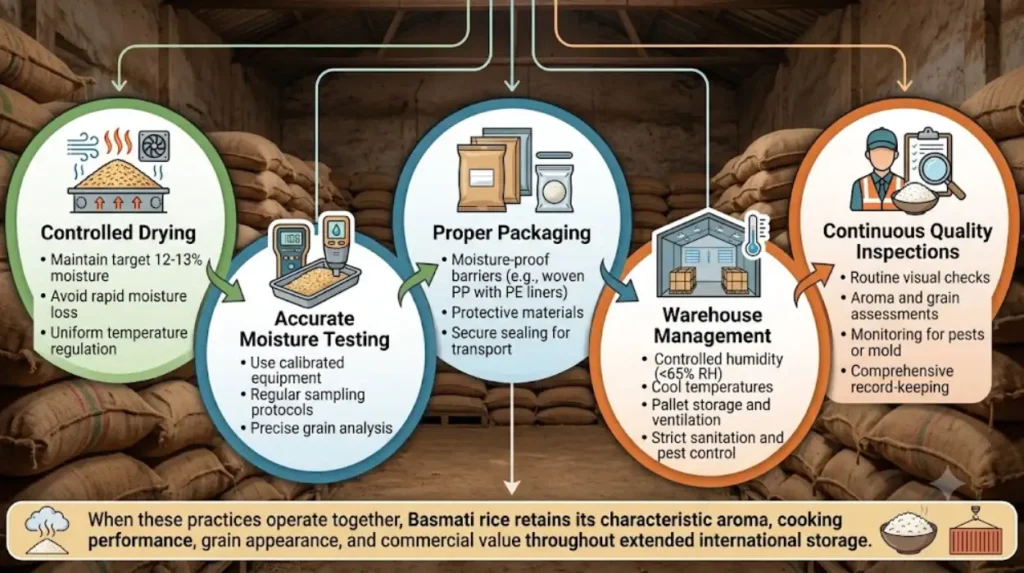
Maintaining export-grade moisture between accepted specifications, combining protective packaging, controlling warehouse humidity, and performing routine monitoring consistently delivers the longest shelf life because every stage of storage contributes to preserving grain quality from production until final consumption.
No single practice protects Basmati rice throughout the supply chain.
Instead, successful exporters integrate:
- Controlled drying
- Accurate moisture testing
- Proper packaging
- Warehouse management
- Continuous quality inspections
When these practices operate together, Basmati rice retains its characteristic aroma, cooking performance, grain appearance, and commercial value throughout extended international storage.
For buyers comparing exporters based on storage performance and moisture-controlled processing, a natural next step is a decision-focused guide explaining:
Frequently Asked Questions
How does moisture content affect the shelf life of Basmati rice?
Moisture content directly influences shelf life by controlling the risk of mold growth, insect infestation, and grain deterioration. Export-grade Basmati rice stored at approximately 12–13% moisture under proper warehouse conditions can maintain its quality for up to 24 months.
What is the ideal moisture level for exporting Basmati rice?
The ideal export moisture level is generally between 12% and 13%, depending on the destination market, packaging type, and storage requirements. This range helps preserve aroma, cooking performance, and grain integrity during international shipping.
Why is high moisture harmful to stored Basmati rice?
High moisture encourages microbial growth, mold formation, insect activity, discoloration, and loss of aroma. It also increases the likelihood of broken grains and reduces the rice’s overall storage stability and commercial value.
Which packaging helps maintain Basmati rice moisture levels?
Laminated polypropylene bags, polyethylene-lined woven sacks, vacuum packaging, and container liners provide better protection against external humidity. These packaging options reduce moisture exchange and extend shelf life during storage and transportation.
How can importers verify the moisture content of Basmati rice?
Importers can verify moisture content through calibrated digital moisture meters, laboratory analysis, pre-shipment inspection reports, and third-party quality certifications provided before container loading.
Does climate affect Basmati rice storage performance?
Yes. High-humidity climates increase the risk of moisture absorption, making proper packaging and climate-controlled storage more important. Dry climates generally allow rice to maintain quality for longer periods when stored correctly.
Which Basmati rice varieties are commonly stored for long-term export?
Popular export varieties for long-term storage include 1121 Steam Basmati, Super Kernel Basmati, 1509 Steam Basmati, and 1121 Sella Basmati because they maintain grain quality well under proper moisture-controlled storage conditions.
How often should moisture levels be checked during storage?
Professional exporters typically monitor moisture during drying, milling, packaging, warehouse storage, and before shipment. Long-term stored inventory should also be inspected periodically to ensure moisture remains within acceptable limits.
Can proper moisture control improve cooking quality?
Yes. Maintaining the correct moisture level preserves grain structure, resulting in better elongation, fluffier texture, consistent cooking performance, and retention of the natural Basmati aroma.
What factors should buyers evaluate besides moisture content?
Buyers should also assess grain purity, milling quality, packaging, warehouse conditions, storage duration, quality certifications, and the exporter’s quality control process, as these factors collectively determine long-term storage performance and product consistency.