How Can Buyers Track Basmati Rice from Farm to Shipment?
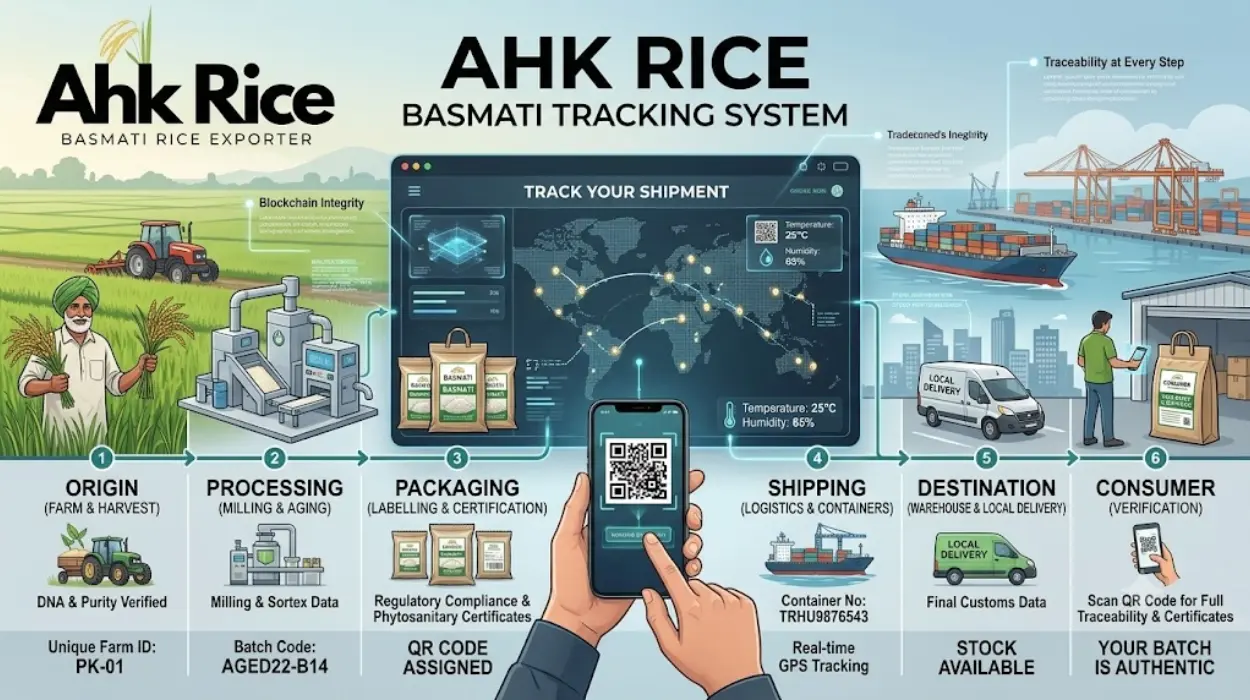
Buyers can track Basmati rice through farm records, batch identification, mill records, laboratory testing, packaging data, and shipment documents. Here is why: each stage creates evidence connecting the crop to the exported container. A traceable chain lets importers verify origin, processing, quality, and shipment identity before approving commercial supply.
Basmati traceability starts with cultivation records and continues through harvesting, paddy procurement, milling, grading, testing, packing, container loading, and dispatch. Buyers need this complete chain rather than a single certificate. For a broader understanding of how Pakistani Basmati moves through production and export, review this guide to how Pakistani Basmati rice is grown and processed.
Traceability also differs by market. European buyers place strong emphasis on farm origin, pesticide records, laboratory results, and batch documentation. GCC buyers place greater emphasis on crop year, processing grade, storage stability, packaging, and shipment consistency. UK imports also require documented product identity and traceability across the supply chain.
What are the available solutions for tracking Basmati rice?
The strongest traceability system combines farm identification, batch records, controlled milling, laboratory testing, packaging codes, inspection certificates, and shipment documents. Each method records a different stage, while the combined system connects cultivation directly with the exported container.
Farm and procurement records
Farm records establish the beginning of the traceability chain. They identify the growing area, crop year, paddy variety, harvesting period, and procurement source.
Paddy procurement records then connect harvested material with the receiving mill. A buyer can request procurement dates, crop information, supplier records, and batch references.
This approach matters for Basmati because origin influences commercial identity. Pakistan’s Basmati production is concentrated in Punjab, creating a clear geographic foundation for traceable sourcing.
Mill batch records
Mill records connect paddy with finished rice. The records should identify receiving dates, processing batches, milling operations, grading results, and packing dates.
A controlled mill can therefore connect one shipment with a defined production run. This creates stronger evidence than a supplier simply stating that the rice comes from Pakistan.
AHK Rice uses an end-to-end processing structure covering paddy procurement, cleaning, de-husking, separation, polishing, grading, and sorting. Its published process identifies traceability from field to container.
Laboratory and inspection records
Laboratory testing verifies measurable specifications. Typical parameters include moisture, broken kernels, foreign matter, purity, grain dimensions, and pesticide residues.
Independent inspection adds another verification layer. Buyers can appoint third-party inspection companies to examine samples, production conditions, packaging, or loading.
This approach works particularly well for European procurement. EU import controls emphasize food safety, pesticide compliance, and traceability documentation.
Packaging and batch identification
Packaging converts production records into a physical identification system. Bags can carry product name, origin, lot number, packing date, crop information, and importer details.
Batch identification also improves recall control. A buyer can isolate affected inventory without withdrawing every shipment from the same supplier.
UK guidance published for rice imports similarly connects product identity, origin, certification, and shipment information within the import process.
Export and shipment documents
Export documents connect the finished batch with the physical container. Common records include the commercial invoice, packing list, certificate of origin, phytosanitary certificate, inspection report, and bill of lading.
The bill of lading establishes the shipment movement. The packing list connects quantities and packages with the container. The certificate of origin establishes country of origin.
Together, these documents create the final link from processed rice to international shipment.
With the available tracking solutions established, the next question is which system gives buyers the strongest control.
How do different Basmati traceability approaches compare?
Direct exporter traceability provides the strongest control because one supply chain can connect cultivation, milling, testing, packaging, documentation, and dispatch. Trading houses provide broader sourcing access, while agents and platforms provide convenience with less upstream processing visibility.
Specification comparison
| Attribute | Direct Exporter | Trading House | Import Agent | B2B Platform |
|---|---|---|---|---|
| Farm traceability | Full or high | Partial | Limited | Variable |
| Mill visibility | High | Medium | Low | Supplier-dependent |
| Batch control | Strong | Medium | Limited | Variable |
| Laboratory access | Direct | Shared | Compliance-led | Supplier-dependent |
| Documentation control | Full | Shared | Import-focused | Variable |
| Price control | Higher | Medium | Lower | Negotiated |
| Shipment control | End-to-end | Shared | Destination-focused | External |
Direct exporter sourcing gives buyers the clearest relationship between product specification and production batch. Trading houses can aggregate larger volumes but may combine material from several processors.
Import agents add value through destination-market knowledge. They handle local compliance, customs, warehousing, or distribution. Their role does not automatically provide upstream farm or mill visibility.
B2B platforms simplify supplier discovery. They provide many offers but require additional verification before a buyer accepts traceability claims.
The choice therefore depends on the buyer’s market, risk tolerance, volume, and compliance requirements.
Which method works best for different market regions?
European buyers benefit most from hybrid traceability combining farm records, laboratory testing, certification, and batch documentation, while GCC buyers gain strong value from crop-year, processing, storage, and shipment traceability. Market priorities determine the evidence buyers should request.
European market
European buyers commonly evaluate 1121 Basmati, Super Kernel Basmati, and 1509 Basmati based on grain specifications, purity, moisture, broken percentage, certification, and traceability.
EU traceability requirements connect farm origin, processing facility, packaging date, and shipment details. This supports recall management and food safety verification.
For European retail, 1121 Basmati suits premium long-grain positioning. Super Kernel provides traditional Basmati characteristics. 1509 provides a cost-conscious alternative while retaining Basmati positioning.
European buyers should therefore prioritize laboratory evidence, pesticide testing, mill records, batch identification, and complete export documentation.
GCC market
GCC buyers often place greater commercial weight on processing type, crop year, moisture, grain length, packaging, and storage stability. UAE buyers, for example, request verified crop-year information before confirming many Basmati purchases.
1121 Golden Sella suits buyers seeking parboiled grain, strong cooking structure, and longer storage performance. 1121 Steam suits buyers seeking a different texture and cooking profile. Super Kernel supports traditional Basmati positioning.
For UAE wholesale and foodservice channels, traceability should therefore connect crop year with milling, processing, moisture testing, packaging, and container loading.
Indicative price and shelf-life comparison
| Market region | Common traceability priority | Suitable grades | Indicative FOB planning range* | Practical shelf-life planning |
|---|---|---|---|---|
| Europe | Residue, farm, batch, certification | 1121, Super Kernel, 1509 | $950–$1,250/MT | 12–24 months |
| GCC | Crop year, processing, moisture | 1121 Sella, 1121 Steam, Super Kernel | $900–$1,200/MT | 12–24 months |
*These are planning ranges, not live quotations. Actual FOB pricing changes with crop year, processing grade, broken percentage, packaging, order volume, inspection requirements, and freight conditions.
Shelf life also depends on processing, moisture, packaging, warehouse temperature, and storage humidity. Golden Sella can provide stronger storage stability than fresh Steam rice under demanding commercial conditions because parboiling changes grain structure.
For a UAE buyer using non-climate-controlled storage, a stable parboiled specification provides a stronger operational fit. For a European retailer prioritizing residue documentation, traceability evidence becomes more important than maximizing storage duration.
With regional differences established, the next step is matching traceability methods to actual buyer requirements.
Which traceability method works best for each buyer case?
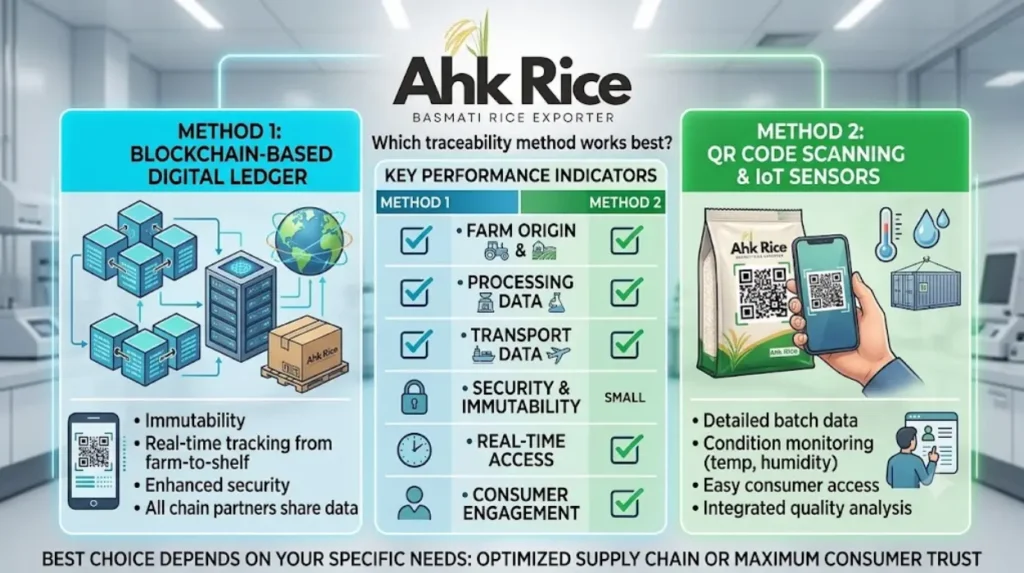
The best method depends on the commercial risk being controlled: farm records suit origin verification, mill records suit consistency, laboratory reports suit compliance, and shipment documents suit customs and delivery control. Buyers should combine these records rather than rely on one document.
Retail supermarket buyers
Retail buyers should prioritize batch traceability, laboratory reports, packaging identification, pesticide compliance, and consistent grade specifications.
A supermarket may receive several containers across a year. Batch records help compare each delivery against the approved specification.
Foodservice distributors
Foodservice distributors should prioritize processing consistency, moisture control, broken percentage, packaging strength, and shipment reliability.
Large kitchens need predictable cooking performance. A traceable production batch helps distributors investigate complaints without questioning the entire supply relationship.
Private-label brands
Private-label buyers should prioritize farm origin, crop year, milling batch, laboratory results, packaging records, and label accuracy.
Private-label products place the retailer’s reputation directly on the package. Traceability therefore becomes both a compliance tool and a brand-protection system.
Industrial and bulk buyers
Industrial buyers should prioritize volume consistency, batch segregation, moisture, processing type, and container-level documentation.
Large contracts require repeatability. The buyer needs evidence that subsequent containers match the approved sample.
Importers entering regulated markets
Regulated-market importers should prioritize certification, laboratory testing, phytosanitary documentation, origin records, and pre-shipment inspection.
The UK, EU, UAE, Saudi Arabia, and other markets apply different import systems. Buyers must therefore match traceability documents with destination requirements. UK imports, for example, use systems including IPAFFS and customs declarations.
With buyer-specific needs defined, the main advantages and limitations become easier to evaluate.
What are the pros and cons of different traceability approaches?
Direct traceability provides stronger verification and faster problem resolution, but it requires more records and supplier coordination. Aggregated sourcing reduces procurement complexity, while weaker upstream visibility increases the buyer’s verification workload.
| Approach | Main advantage | Main limitation | Example |
|---|---|---|---|
| Direct exporter | Strong production visibility | Requires supplier documentation | 20 MT 1121 contract |
| Trading house | Broad sourcing capacity | Multiple upstream sources | Multi-grade procurement |
| Import agent | Strong local market support | Limited farm visibility | UK distribution |
| B2B platform | Fast supplier discovery | Variable evidence quality | Initial supplier search |
| Hybrid verification | Highest evidence coverage | More coordination | EU retail contract |
Direct exporter sourcing works best when the buyer needs consistent specifications across repeat shipments.
Trading houses work better when volume flexibility matters more than detailed mill-level visibility.
Import agents work well when destination compliance and local distribution are the main challenges.
B2B platforms work best during supplier discovery. Buyers should then verify the selected supplier through samples, records, inspection, and documentation.
Hybrid verification creates the strongest commercial evidence. It combines supplier records with independent testing and shipment documentation.
With the strengths and weaknesses clear, the final decision should focus on measurable procurement criteria.
What decision factors should buyers use before selecting a traceable supplier?
Buyers should score traceability across five factors: origin evidence, batch control, quality verification, documentation completeness, and shipment visibility. A supplier meeting all five provides stronger procurement control than one offering only certificates or tracking numbers.
Five-row decision framework
| Decision factor | Buyer question | Strong evidence |
|---|---|---|
| Origin | Can the supplier identify the crop source? | Farm and procurement records |
| Batch | Can the shipment connect to a mill batch? | Production and lot records |
| Quality | Can specifications be independently verified? | Lab and inspection reports |
| Compliance | Can documents support destination entry? | Phytosanitary, origin and export records |
| Logistics | Can the buyer follow the shipment? | Container, loading and bill-of-lading data |
Origin evidence confirms where the crop began. Batch evidence confirms how the rice entered production. Quality evidence verifies measurable specifications.
Compliance evidence protects the import process. Logistics evidence confirms physical movement from loading to destination.
AHK Rice’s published process connects paddy procurement, cleaning, de-husking, polishing, grading, sorting, inspection, packaging, and export documentation. Its export operation also supports third-party inspection and pre-shipment quality verification.
For buyers comparing product supply options, AHK Rice supplies 1121, Super Kernel, and 1509 Basmati through an end-to-end processing and export structure. The first product specification should therefore be evaluated alongside its traceability evidence, not separately.
A buyer should request the traceability package before approving the commercial shipment. The package should connect the crop, batch, test results, packing data, certificates, container, and bill of lading.
This approach turns traceability from a marketing statement into a measurable procurement system.
FAQs about tracking Basmati rice from farm to shipment
How does Basmati rice traceability work?
Basmati traceability connects farm records with procurement, milling, grading, testing, packaging, certification, container loading, and shipment documents. Each stage creates evidence that identifies the product and its movement.
What documents prove Basmati rice traceability?
Farm records, procurement records, mill batch records, laboratory reports, inspection certificates, packing lists, certificates of origin, phytosanitary certificates, and bills of lading provide traceability evidence.
Can buyers track Basmati rice by batch number?
Yes. A batch number can connect packaged rice with production records, quality tests, packing dates, and shipment documents. Buyers should require the same lot reference across the documentation chain.
Which Basmati grades are suitable for traceable export?
1121, Super Kernel, and 1509 Basmati can all operate within documented export traceability systems. Processing choices include Steam, Sella, Golden Sella, Brown, and other buyer-specific specifications.
Why does crop year matter for traceability?
Crop year identifies the harvest period and helps buyers distinguish fresh and aged inventory. UAE buyers commonly use crop-year information when evaluating aroma, moisture, cooking performance, and storage stability.
Is third-party inspection necessary?
Third-party inspection is valuable for buyers requiring independent verification. Inspectors can examine quality, sampling, packaging, loading, and shipment compliance before dispatch.
How can European buyers verify Pakistani Basmati?
European buyers should verify farm or origin records, mill batches, pesticide testing, laboratory reports, certifications, packaging information, and shipment documents. EU controls emphasize traceability and food-safety verification.
How can UK buyers verify Pakistani Basmati?
UK buyers should verify product identity, origin, batch information, phytosanitary documentation, customs information, and shipment records. UK import procedures also use pre-notification and customs systems.