How Do Pakistani Rice Export Licenses Support USA Import Compliance?
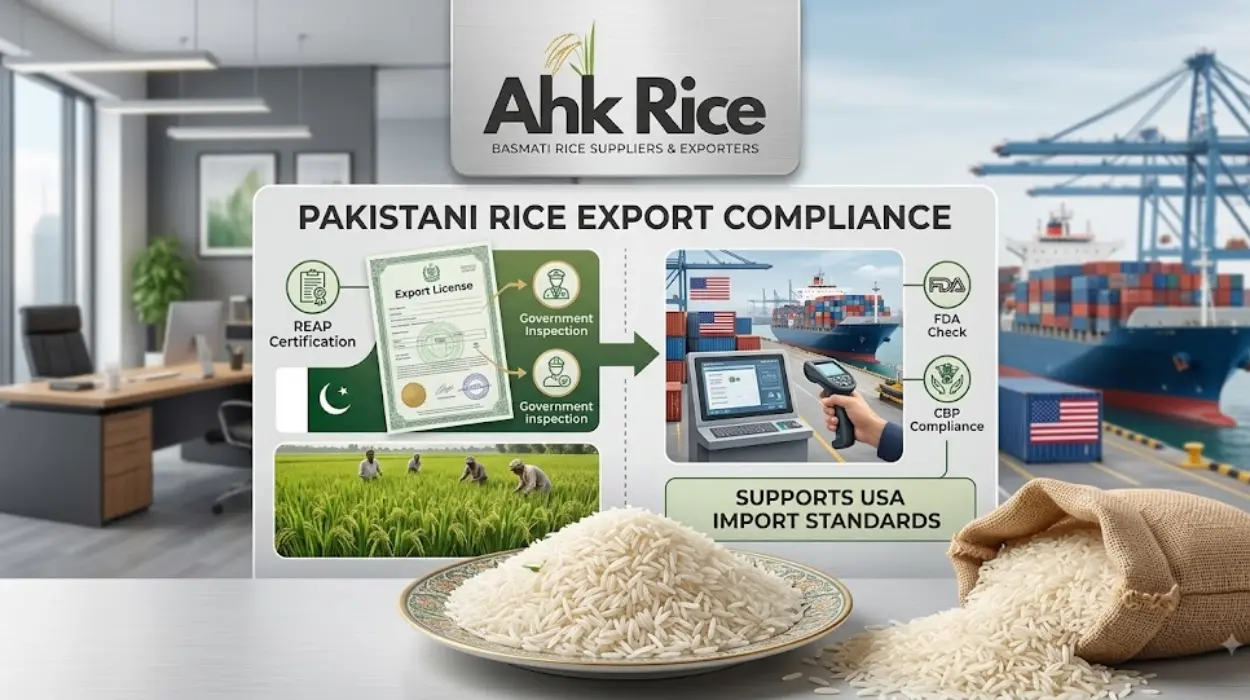
Pakistani rice export licenses support USA import compliance by establishing exporter legitimacy, enabling controlled export documentation, and connecting the shipment with phytosanitary, customs, food-safety, and traceability requirements; however, an export license alone does not satisfy U.S. import obligations.
For Texas buyers, the important distinction is between Pakistan-side export authorization and U.S.-side import compliance. An exporter must legally prepare and dispatch the commodity from Pakistan, while the U.S. importer remains responsible for applicable FDA, FSVP, Customs and Border Protection (CBP), labeling, and entry requirements. The FDA defines the FSVP importer as the U.S. owner or consignee, or the U.S. agent or representative in specified circumstances.
Before evaluating suppliers, Texas importers should understand the verification logic explained in:
Why Texas rice importers verify export licenses before purchasing. This establishes why supplier documentation matters before a purchase order, rather than after the container reaches a U.S. port.
What export compliance solutions are available for Pakistani rice shipments?
Pakistani rice exporters can support U.S. compliance through documented exporter credentials, phytosanitary certification, commercial export documents, traceability records, food-safety documentation, and shipment-level verification; the strongest approach connects these documents into one controlled export file.
Exporter registration and authorization
An exporter is the Pakistani business responsible for legally presenting the rice for export. Export authorization and business documentation establish the commercial identity behind the shipment. They help buyers distinguish a functioning exporter from an informal intermediary.
For plant and plant products, Pakistan’s Department of Plant Protection (DPP) controls phytosanitary export procedures. Its current export procedure requires the exporter to meet the importing country’s phytosanitary requirements before inspection and certification. Required documents include the commercial invoice, packing list, container information, import permit or relevant notification where applicable, and other documents prescribed by the department.
Phytosanitary certification
A phytosanitary certificate is an official plant-health document issued by the competent authority. For rice exports, it demonstrates that the shipment was inspected and certified according to applicable plant-health requirements.
Pakistan’s Plant Quarantine Act requires export consignments of plant material to undergo inspection. Where the shipment satisfies the applicable conditions, a phytosanitary certificate accompanies the export. Treatment or fumigation can also be required before certification.
Food-safety and FDA documentation
U.S. food compliance adds another layer. Rice entering the United States falls within the federal food regulatory framework administered by the U.S. Food and Drug Administration (FDA). The U.S. importer must meet applicable FSVP obligations unless an exemption applies.
FSVP means Foreign Supplier Verification Programs. It requires covered U.S. food importers to evaluate foreign suppliers and verify that imported food meets applicable U.S. safety requirements. Required activities can include hazard analysis, supplier evaluation, verification activities, corrective actions, recordkeeping, and importer identification.
Shipment-level documentation
A complete export file normally connects the exporter identity with the actual shipment. Typical documents include the commercial invoice, packing list, bill of lading, certificate of origin, phytosanitary certificate, treatment or fumigation certificate where required, and applicable inspection or laboratory reports.
This approach is stronger than presenting a single license because compliance depends on the relationship between the supplier, product, shipment, destination, and supporting records.
How do Pakistani export documentation methods compare for USA buyers?
The strongest documentation method combines exporter verification, phytosanitary certification, commercial records, food-safety evidence, and shipment traceability; relying on an exporter license alone provides weaker compliance control because U.S. import obligations extend beyond Pakistan’s export authorization.
| Compliance attribute | Export license only | Export documents | Phytosanitary-focused file | Integrated compliance file |
|---|---|---|---|---|
| Exporter identity | Strong | Strong | Strong | Strong |
| Plant-health evidence | Limited | Moderate | Strong | Strong |
| Shipment traceability | Low | Moderate | Moderate | Strong |
| U.S. food-safety support | Low | Moderate | Limited | Strong |
| Customs documentation | Low | Strong | Moderate | Strong |
| Supplier verification | Low | Moderate | Moderate | Strong |
| Repeat-order control | Low | Moderate | Moderate | Strong |
The table shows why a license should be treated as a foundation document, not a complete U.S. compliance package.
An export license can demonstrate that the business has an established export identity. It does not automatically prove that a particular shipment satisfies every U.S. requirement.
Commercial documentation provides stronger shipment-level evidence. A commercial invoice identifies the seller, buyer, product, quantity, price, and trade terms. A packing list connects the physical packages with the commercial transaction.
A phytosanitary certificate addresses plant-health requirements. It does not replace FDA food-safety responsibilities.
An integrated compliance file combines these functions. It gives the Texas importer a clearer supplier-verification record and creates a more consistent basis for repeat purchases.
How do USA and Gulf markets differ when evaluating Pakistani rice compliance?
USA buyers place greater emphasis on FDA and FSVP responsibilities alongside exporter and phytosanitary documentation, while Gulf buyers often prioritize destination-specific conformity, labeling, halal or food-control requirements, and rapid document matching. The compliance structure therefore changes by market.
| Market region | Common premium grades | Indicative FOB price/MT, July 2026 | Typical shelf-life planning | Primary compliance emphasis |
|---|---|---|---|---|
| USA | 1121 White, 1121 Steam, 1121 Sella, Super Kernel | $1,135–$1,205 | Commonly 12–24 months depending on grade, packaging and storage | FDA, FSVP, CBP, labeling, supplier verification |
| Gulf | 1121 Sella, Golden Sella, 1121 Steam, Super Kernel | $1,135–$1,205 | Commonly 12–24 months depending on grade, packaging and storage | Phytosanitary, destination conformity, labeling, food-control requirements |
The July 2026 indicative FOB range of approximately $1,135–$1,205 per metric ton reflects published Pakistan market quotations for 1121 Basmati grades. Actual prices vary by grade, specification, packing, quantity, crop, freight conditions, and contract date.
The price comparison is important because compliance should not be evaluated separately from procurement economics. A supplier offering a lower FOB rate may still create higher administrative costs if documents require repeated correction or verification.
Shelf life also requires specification control. Rice is a dry, shelf-stable commodity, but commercial shelf life depends on moisture, packaging, storage temperature, humidity, pest protection, processing quality, and the manufacturer’s declared specification. Importers should therefore use the supplier’s documented shelf-life specification instead of assuming one universal period.
For Texas distributors, 1121 Basmati is often positioned toward premium retail and foodservice channels because of its long grain and cooking expansion. Super Kernel provides another premium positioning option. Sella and Steam grades can serve buyers prioritizing grain separation and commercial cooking performance.
Which Pakistani rice export method works best for different USA cases?
A basic document package suits low-complexity transactions, while an integrated export compliance file is better for recurring Texas distribution, private-label programs, and larger container orders where supplier verification, traceability, consistent specifications, and repeat documentation directly affect commercial risk.
Small or first-time buyer
A first-time buyer should begin with exporter verification, product specifications, sample documentation, commercial credentials, and the required shipment certificates.
The objective is supplier validation. The buyer should confirm that the company named in the commercial documents matches the entity responsible for production and export.
Wholesale distributor
A distributor importing multiple containers needs stronger document continuity. Every shipment should maintain consistent product descriptions, grade specifications, packing information, lot identification, and supporting certificates.
This reduces reconciliation problems when the importer manages several purchase orders simultaneously.
Private-label importer
Private-label buyers require greater control because packaging becomes part of regulatory compliance. Product identity, net quantity, country-of-origin information, importer details, and other applicable labeling requirements must be reviewed before production.
The exporter should therefore receive the approved artwork and specifications before final packing.
Foodservice importer
Foodservice buyers typically prioritize cooking consistency, grain integrity, moisture, broken percentage, packaging strength, and repeatability. Compliance documentation should support the same product specification across shipments.
A supplier that changes grade characteristics while keeping the same commercial product name creates unnecessary procurement risk.
What are the advantages and disadvantages of each compliance approach?
License-only verification is fast but incomplete; document-based verification improves shipment control; phytosanitary verification addresses plant-health requirements; and integrated compliance provides the strongest repeat-order structure because commercial, regulatory, quality, and traceability records remain connected.
License-only approach
Pros: It is simple and fast. It confirms that the exporter has an identifiable business and export capability.
Cons: It does not establish shipment-level compliance. It does not replace phytosanitary certification, FDA requirements, FSVP verification, customs documentation, or labeling review.
For example, a Texas buyer could verify an export credential and still receive a shipment whose invoice, packing list, product specification, or certificate requires correction.
Document-by-document approach
Pros: It provides broader evidence. The buyer can verify invoices, packing lists, certificates, and shipping information individually.
Cons: Fragmented documentation increases administrative work. A mismatch between documents can delay internal approval or create questions during customs processing.
Integrated compliance approach
Pros: It connects supplier identity, product specification, lot information, certificates, packaging, inspection, and shipment records.
Cons: It requires more preparation before dispatch. Buyers and exporters must maintain organized records and agree on specifications early.
For repeat Texas purchasing, the additional administrative discipline creates greater value because each shipment can follow the same documentation structure.
What five factors should Texas importers use when choosing an export compliance method?
Texas importers should rank exporter legitimacy, U.S. regulatory responsibility, shipment documentation, product consistency, and repeat-order traceability; these factors provide a practical decision framework for comparing Pakistani rice suppliers before commercial procurement begins.
| Decision factor | What the buyer should verify | Why it matters |
|---|---|---|
| Exporter legitimacy | Business identity and export documentation | Confirms who is responsible for the shipment |
| U.S. compliance | FDA and FSVP responsibilities | Prevents treating Pakistan-side documents as complete U.S. compliance |
| Phytosanitary status | Certificate and destination requirements | Supports applicable plant-health entry requirements |
| Product consistency | Grade, moisture, broken percentage, purity and packaging | Protects retail and foodservice performance |
| Traceability | Lot, invoice, packing list and certificate alignment | Supports repeat orders and document audits |
This framework changes the buying conversation from “Does the supplier have a license?” to “Can the supplier consistently document a compliant shipment?”
That distinction matters because U.S. import compliance is distributed across several authorities and responsibilities. The Pakistani exporter manages export-side obligations. The U.S. importer manages its applicable import responsibilities. Customs and FDA processes then operate at the U.S. entry stage.
The FDA also requires covered FSVP importers to provide an acceptable unique facility identifier for each food entry line. FDA recognizes the DUNS number for this purpose.
How can AHK Rice support a structured USA rice export program?
AHK Rice supports structured Pakistani rice exports through integrated processing, grading, packaging, inspection, and export-document coordination, giving USA buyers a single commercial workflow for varieties such as 1121, Super Kernel, and 1509 while preserving shipment-level documentation.
AHK Rice is based in Punjab and supplies Pakistani Basmati rice to international buyers. Its product range includes 1121, Super Kernel, and 1509 varieties. The company describes an integrated process covering paddy procurement, cleaning, de-husking, milling, grading, sorting, packaging, and container loading.
For a USA buyer, this integrated structure matters because compliance starts before the container reaches Karachi. Product specifications must first be defined. The rice must then be processed and packed according to those specifications. Documentation must match the physical shipment.
A practical compliance workflow therefore looks like this:
- Buyer specification: Define variety, grade, grain length, broken percentage, moisture, purity, packing, labeling, and quantity.
- Supplier verification: Confirm the exporter identity and documentation capability.
- Sample approval: Evaluate the actual rice before commercial production.
- Production: Process and grade the approved specification.
- Quality verification: Check the finished lot against agreed parameters.
- Export documentation: Prepare invoice, packing list, certificates, and shipping records.
- Phytosanitary certification: Complete applicable DPP inspection and certification requirements.
- U.S. import preparation: The importer completes its applicable FDA, FSVP, CBP, and labeling responsibilities.
- Shipment reconciliation: Match product, quantity, container, lot, and documents before dispatch.
This sequence reduces the risk of treating export licensing as the entire compliance solution. For deeper insight explore:
AHK Rice Supplies Licensed Basmati Rice Export Programs to Texas
What should buyers conclude before approving a Pakistani rice exporter?
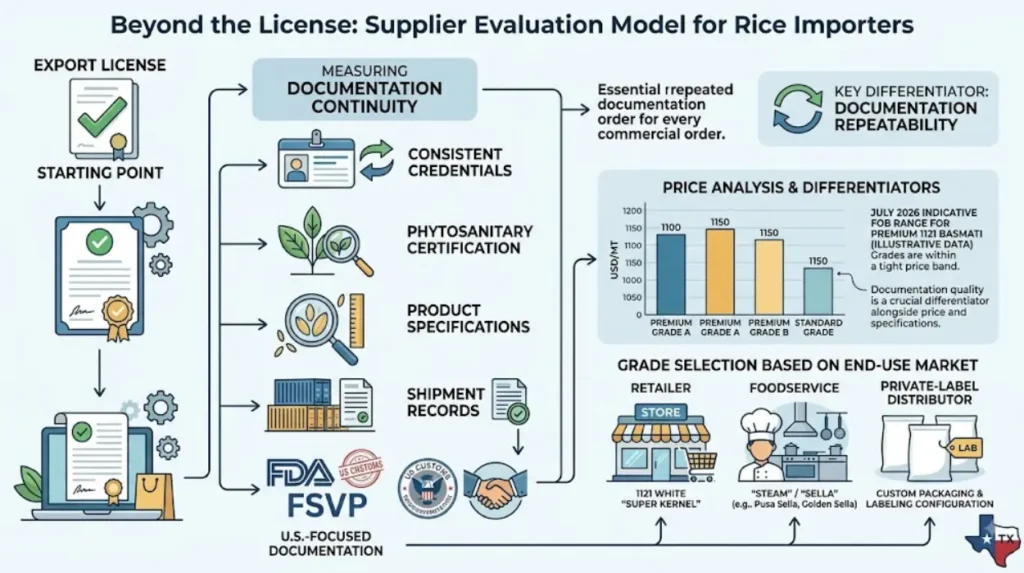
The best compliance strategy is not to select an exporter solely because it holds an export license; Texas buyers should select suppliers capable of maintaining consistent exporter credentials, phytosanitary certification, product specifications, shipment records, and U.S.-focused documentation throughout repeated commercial orders.
The export license establishes a starting point. The commercial file establishes shipment identity. The phytosanitary certificate addresses plant-health requirements. FDA and FSVP requirements establish the U.S. food-import framework. Product and packaging records connect regulatory compliance with commercial quality.
For Texas importers, the strongest supplier evaluation therefore measures documentation continuity rather than one certificate.
Price remains important. The July 2026 indicative FOB range for premium Pakistani 1121 Basmati demonstrates that several grades can occupy a relatively narrow commercial price band, making documentation quality and repeatability important differentiators alongside product specifications.
The final decision should also account for grade selection. A retailer may prioritize 1121 White or Super Kernel. A foodservice buyer may prefer Steam or Sella grades. A private-label distributor may require a specific packaging and labeling configuration.
The compliance method should match that commercial model.
Frequently Asked Questions
What is a Pakistani rice export license?
A Pakistani rice export license or relevant export authorization establishes that an exporter is legally positioned to conduct international trade. It supports supplier verification but does not by itself satisfy all U.S. import requirements.
Does a Pakistani rice export license guarantee USA import compliance?
No. U.S. import compliance involves additional requirements, including applicable FDA rules, Foreign Supplier Verification Program (FSVP) responsibilities, Customs and Border Protection procedures, phytosanitary requirements, labeling, and shipment documentation.
Why do Texas rice importers verify Pakistani exporter licenses?
Texas importers verify exporter credentials to confirm supplier legitimacy and establish who is responsible for the commercial shipment. Verification also helps buyers evaluate whether the supplier can consistently provide required export and shipment documentation.
What documents should Pakistani rice exporters provide for USA shipments?
Depending on the shipment and applicable requirements, buyers may need commercial invoices, packing lists, bills of lading, certificates of origin, phytosanitary certificates, treatment or fumigation records where applicable, product specifications, and quality or laboratory reports.
What is a phytosanitary certificate for Pakistani rice?
A phytosanitary certificate is an official plant-health document issued by the competent Pakistani authority after the applicable inspection and certification process. It demonstrates that the shipment meets relevant plant-health requirements for export.
Does FDA regulate Pakistani Basmati rice imported into the USA?
Yes. Rice imported into the United States is subject to applicable FDA food requirements. The U.S. importer must also meet applicable entry and food-safety obligations, including FSVP requirements where applicable.
What is FSVP for rice imported from Pakistan?
FSVP stands for Foreign Supplier Verification Programs. It requires covered U.S. food importers to establish procedures for verifying that foreign suppliers produce food in accordance with applicable U.S. food-safety requirements.
Who is responsible for FSVP compliance when importing Pakistani rice?
The U.S. importer is generally responsible for applicable FSVP obligations. The Pakistani exporter supports the process by providing supplier information, product specifications, safety records, and other documentation required for verification.
Which Pakistani Basmati rice grades are suitable for USA importers?
Common commercial choices include 1121 White, 1121 Steam, 1121 Sella, and Super Kernel. The appropriate grade depends on the buyer’s retail, foodservice, private-label, cooking-performance, and price requirements.
How does export documentation reduce rice import risk?
Accurate documentation connects the exporter, product, quantity, packaging, lot, certificates, and shipment. This makes discrepancies easier to identify before dispatch and supports more consistent customs and compliance processes.
Can an export license replace a phytosanitary certificate?
No. An exporter credential and a phytosanitary certificate serve different purposes. The export credential establishes exporter legitimacy, while the phytosanitary certificate addresses applicable plant-health requirements.
What should Texas importers check before buying Pakistani rice?
Texas buyers should verify exporter identity, product specifications, phytosanitary requirements, FDA and FSVP responsibilities, packaging and labeling, shipment documentation, traceability records, and the supplier’s ability to repeat the same compliance process on future orders.