How Do UK Retail Buyers Evaluate Broken Grain Specifications?
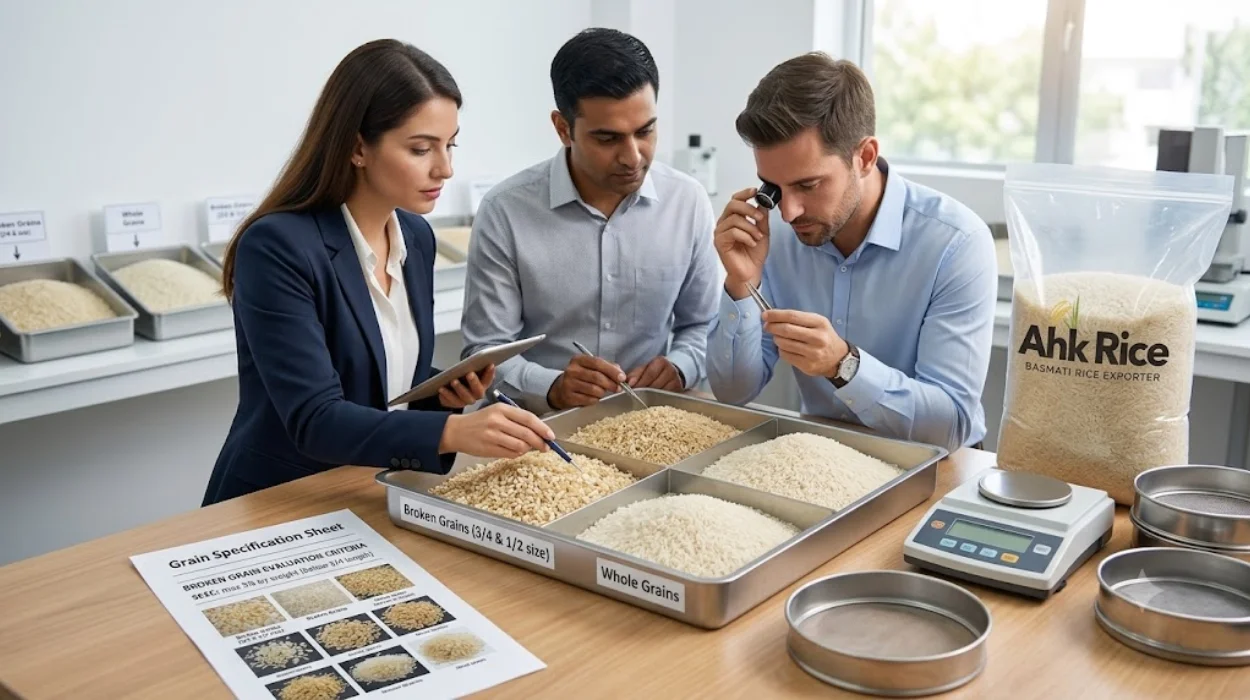
UK retail buyers evaluate broken grain specifications by prioritizing consistency, consumer acceptance, shelf presentation, and value per kilogram. Here is why: lower broken percentages improve visual quality, cooking performance, and brand perception, while higher broken percentages reduce procurement costs but can affect retail positioning. Premium retail channels in the UK typically prefer 2%–5% broken Basmati rice, whereas budget retail segments often accept 5%–10% broken grades.
Retail buyers compare more than price. They assess grain integrity, milling quality, moisture levels, packaging suitability, and shelf-life performance. Buyers also review how broken grain percentages influence cooking results and customer satisfaction. Understanding these specifications helps importers select the correct grade before committing to long-term supply contracts.
For buyers new to rice specifications, understanding grain length, milling standards, and processing methods provides essential context. Our guide on understanding Basmati quality indicators and grain specifications explains how exporters grade rice and how retailers evaluate quality across different market segments.
When sourcing premium retail grades, many UK importers evaluate specifications offered by AHK Rice’s export-grade Basmati rice solutions. AHK Rice supplies multiple Basmati specifications from Punjab, Pakistan, including 1121, Super Kernel, and 1509 varieties with custom grading and packaging options.
What Broken Grain Specification Do UK Retail Buyers Prefer?
UK premium retailers generally prefer 2%–5% broken grain, while value-focused retailers commonly accept 5%–10% broken grain to achieve lower shelf prices.
Broken grain percentage measures the amount of fragmented rice kernels within a shipment. A 5% broken specification means five kilograms of broken kernels exist in every 100 kilograms of rice.
Premium supermarket brands prioritize appearance. Long, uniform grains create stronger consumer perception and support premium pricing. UK consumers associate whole Basmati grains with quality and authenticity.
Budget retail channels focus on value. Lower-priced product lines often accept higher broken percentages because retail margins remain competitive while maintaining acceptable cooking performance.
Retail buyers therefore match broken specifications to their target customer segment rather than purchasing the lowest available percentage.
This preference framework establishes buyer expectations. The next question examines how available specification options compare.
What Are the Available Broken Grain Specification Solutions?
The most common retail specifications are 2%, 5%, 10%, 15%, and 25% broken grain grades, each serving different pricing and retail objectives.
Premium Retail Grades
Premium retail grades target supermarkets, specialty stores, and ethnic food chains.
| Specification | Typical Use |
|---|---|
| 2% Broken | Premium supermarket brands |
| 5% Broken | Mainstream retail brands |
| 10% Broken | Value retail products |
Commercial Grades
Commercial grades support wholesale and foodservice applications.
| Specification | Typical Use |
|---|---|
| 15% Broken | Catering and wholesale |
| 25% Broken | Food manufacturing |
| 100% Broken | Industrial and processed food applications |
Processing Factors
Rice mills influence broken percentages through:
- Precision grading
- Length sorting
- Colour sorting
- Moisture control
- Multiple polishing stages
Lower broken specifications require more intensive sorting and grading. Additional processing increases production costs while improving grain uniformity.
These available options create distinct purchasing choices. Comparing them directly reveals where value differences occur.
How Do Different Broken Grain Specifications Compare?
Premium grades deliver stronger shelf appeal, while higher broken grades provide lower procurement costs and broader commercial applications.
Specification Comparison Table
| Attribute | 2% Broken | 5% Broken | 10% Broken |
|---|---|---|---|
| Grain Uniformity | Excellent | Very Good | Good |
| Retail Appearance | Excellent | Excellent | Moderate |
| Consumer Perception | Premium | Premium | Value |
| Cooking Consistency | Excellent | Very Good | Good |
| Retail Channel Fit | Premium Supermarkets | Mainstream Retail | Discount Retail |
| Average Export Price/MT | Higher | Moderate | Lower |
| Brand Positioning | Premium | Mid-Premium | Value |
Lower broken percentages consistently command higher market prices because sorting losses increase production costs.
A retailer launching a premium private-label Basmati product gains greater value from 2% or 5% broken grades. A discount retailer focused on price competitiveness often selects 10% broken specifications.
Price Per Metric Ton Comparison
| Grade | Typical Relative Price |
|---|---|
| 2% Broken | Highest |
| 5% Broken | 5–8% lower |
| 10% Broken | 10–15% lower |
| 15% Broken | 15–20% lower |
Actual pricing changes according to crop conditions, harvest quality, freight rates, and exchange rates.
The specification comparison highlights performance differences. Regional buying preferences provide additional insight.
How Do UK and Middle East Retail Markets Differ?
UK retailers prioritize grain appearance and consistency, while Middle Eastern buyers often balance appearance with cooking expansion and value.
United Kingdom Preferences
UK retail buyers typically prefer:
- 2% broken Basmati
- 5% broken Basmati
- Premium private-label specifications
- Uniform grain appearance
- Consistent packaging presentation
British supermarkets compete heavily on perceived quality. Shelf appearance directly influences purchasing decisions.
Gulf and Middle East Preferences
Middle Eastern buyers commonly prefer:
- 5% broken Basmati
- 10% broken Basmati
- Strong cooking elongation
- Bulk retail packaging
- Catering-focused specifications
Saudi Arabia, UAE, Qatar, and Oman import significant volumes of Pakistani Basmati each year (source: REAP export data, December 2025).
Market preferences therefore depend on consumer expectations rather than a universal quality standard. The next consideration involves storage and shelf life.
How Does Broken Percentage Affect Shelf Life?
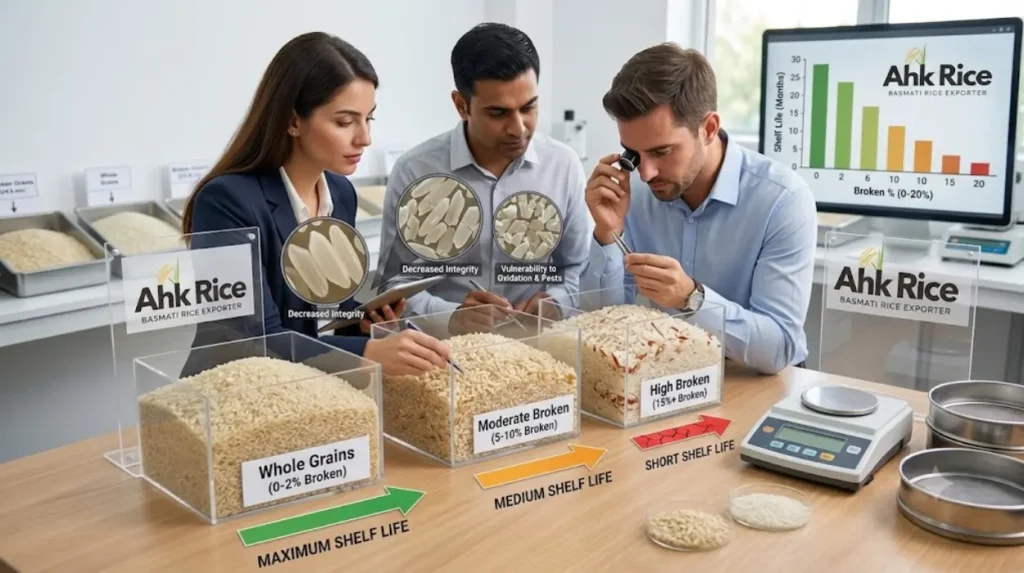
Shelf life remains similar across grades, but lower broken percentages maintain visual quality longer during storage and retail display.
Rice shelf life primarily depends on moisture content, packaging integrity, and storage conditions.
Shelf Life Comparison
| Specification | Typical Shelf Life |
|---|---|
| 2% Broken | 18–24 Months |
| 5% Broken | 18–24 Months |
| 10% Broken | 18–24 Months |
| 15% Broken | 18–24 Months |
Moisture content below 14% supports stable storage conditions.
Premium grades maintain shelf presentation longer because fewer fragmented kernels create less dust during handling and transportation.
In UK warehouse environments, 2% and 5% broken grades often preserve retail appearance throughout distribution cycles. Higher broken grades may generate more visible fragments inside transparent packaging.
Storage performance influences buying decisions. Buyers must also evaluate operational advantages and disadvantages.
What Are the Pros and Cons of Lower Broken Specifications?
Lower broken percentages improve retail value but increase procurement costs, while higher broken grades reduce costs but limit premium positioning opportunities.
Pros of Lower Broken Grades
- Better shelf presentation
- Stronger consumer perception
- Improved premium positioning
- Greater brand differentiation
- Consistent cooking performance
Example: A premium supermarket private-label product benefits from 2% broken rice because consumers visibly notice grain uniformity.
Cons of Lower Broken Grades
- Higher procurement costs
- Reduced supplier availability
- Longer grading requirements
Pros of Higher Broken Grades
- Lower landed costs
- Competitive retail pricing
- Broader sourcing options
Example: A discount retailer can achieve stronger price competitiveness using 10% broken specifications.
Cons of Higher Broken Grades
- Reduced visual appeal
- Weaker premium positioning
- Lower perceived quality
These trade-offs help buyers select suitable grades. A structured decision framework simplifies the process.
Which Broken Grain Specification Works Best for Different Retail Cases?
The correct specification depends on retail positioning, customer expectations, pricing strategy, and packaging format.
Decision Framework Table
| Retail Situation | Recommended Grade | Reason |
|---|---|---|
| Premium Supermarket Brand | 2% Broken | Maximum visual quality |
| Mainstream Retail Brand | 5% Broken | Quality-cost balance |
| Discount Retail Chain | 10% Broken | Price competitiveness |
| Ethnic Food Retailer | 5% Broken | Consumer expectations |
| Foodservice Retail Packs | 10%–15% Broken | Cost efficiency |
Premium retail positioning aligns with lower broken specifications.
Value-oriented retail strategies align with higher broken specifications.
Retail buyers should evaluate expected shelf price before selecting grain specifications. Specification choice affects procurement costs, retail margins, and customer perception simultaneously.
With the decision framework complete, buyers can assess specifications based on commercial objectives rather than generic quality assumptions.
Frequently Asked Questions
What does 5% broken rice mean?
A 5% broken specification means five kilograms of broken kernels exist within every 100 kilograms of rice.
Is 2% broken rice always better?
For premium retail channels, yes. For value retail channels, the additional cost may not create proportional commercial value.
Does broken rice affect taste?
Broken percentage does not significantly affect flavor. It mainly influences appearance and cooking uniformity.
Which broken grade do UK supermarkets prefer?
Most premium UK supermarket programs prefer 2% or 5% broken Basmati specifications.
Does lower broken rice cost more?
Yes. Additional grading, sorting, and processing increase production costs and export prices.
How long does Basmati rice last?
Properly stored Basmati rice typically maintains quality for 18–24 months.