How Do Factory Audits Reduce Risk When Importing Basmati Rice?
Factory audits reduce Basmati rice import risk by verifying the supplier’s actual processing controls, food-safety systems, traceability, grading accuracy, sanitation, packaging, and corrective-action records before a buyer commits to repeated commercial shipments.
For California importers, the audit should be evaluated alongside the Foreign Supplier Verification Program (FSVP), supplier records, product testing, and shipment documentation. The FDA requires covered U.S. food importers to conduct risk-based supplier verification and maintain an FSVP for each applicable food and foreign supplier. For a deeper explanation of why this matters specifically to California buyers, see the educational guide on:
Factory audits for California rice importers.
A factory audit is different from a pre-shipment inspection. A factory audit evaluates the supplier’s facility, systems, procedures, records, personnel practices, equipment, and controls. A pre-shipment inspection evaluates a specific shipment or production lot. A laboratory test examines measurable product characteristics such as moisture, broken grains, contaminants, or pesticide residues. These methods answer different procurement questions.
What risks can a factory audit identify before a Basmati rice shipment?
A factory audit identifies supplier-level risks before loading by checking whether processing, sanitation, grading, traceability, documentation, storage, packaging, and corrective-action systems operate consistently rather than relying only on samples or certificates from one shipment.
The first risk is process inconsistency. Basmati rice can meet a sample specification while later production varies because the supplier changes paddy sources, milling settings, sorting thresholds, or packing procedures.
The second risk is weak traceability. Traceability means the ability to connect finished rice with its production lot, raw paddy source, processing records, testing results, packaging batch, and shipment documents. Strong traceability makes a nonconforming lot easier to isolate.
The third risk is sanitation failure. Auditors examine cleaning schedules, pest-control systems, employee hygiene, equipment condition, waste handling, water controls, and storage conditions.
The fourth risk is grade inconsistency. Basmati buyers commonly specify grain length, broken percentage, moisture, purity, foreign matter, milling quality, and appearance. A supplier must demonstrate how these specifications are measured and controlled.
The fifth risk is documentation failure. A supplier may have good rice but weak records. For U.S. imports, this creates a separate compliance problem because FSVP requires documented supplier evaluation and verification activities.
What are the available solutions for verifying a Basmati rice supplier?
Importers can combine factory audits, certification reviews, pre-shipment inspections, laboratory testing, supplier questionnaires, document verification, and historical performance reviews; the strongest programs combine several methods according to product risk and supplier performance.
Factory audit
A factory audit is the broadest supplier-level assessment. It examines the facility and operating system rather than only the finished rice.
A useful Basmati audit covers paddy receiving, cleaning, dehusking, polishing, grading, optical sorting, storage, packaging, finished-goods control, laboratory testing, sanitation, pest management, traceability, and dispatch.
Certification review
Certification review verifies whether the supplier maintains recognized systems such as HACCP, ISO 22000, ISO 9001, GMP, or destination-specific certifications.
HACCP means Hazard Analysis and Critical Control Points, a preventive food-safety system that identifies hazards and establishes controls. ISO 22000 is an international food-safety management standard. ISO 9001 addresses quality-management systems. GMP means Good Manufacturing Practices.
Certification is useful evidence, but it does not replace supplier verification. FDA guidance allows importers to use different verification activities according to risk, including audits, testing, and record review.
Pre-shipment inspection
A pre-shipment inspection examines the actual commercial lot before loading. It can verify quantity, packaging, labeling, appearance, grain specifications, moisture, broken percentage, and other agreed characteristics.
It is stronger than relying on a historical certificate because the inspection relates to the shipment being purchased.
Laboratory testing
Laboratory testing provides objective measurements. Depending on the buyer’s risk assessment and specification, testing can cover moisture, pesticide residues, microbiological parameters, heavy metals, aflatoxins, and other relevant characteristics.
Testing is particularly useful where a hazard cannot be reliably evaluated through visual inspection.
Supplier performance review
Historical performance is another verification method. Importers can review previous certificates, complaints, rejected shipments, corrective actions, test results, delivery performance, and changes in facility or ownership.
FDA specifically identifies supplier performance history, including audit results, testing results, and corrective-action history, as relevant to supplier evaluation.
How do different supplier-verification approaches compare?
Factory audits provide the widest operational visibility, certification reviews provide system evidence, laboratory tests provide measurable product evidence, and pre-shipment inspections provide lot-specific confirmation; combining methods produces stronger risk control than relying on one document.
| Attribute | Factory Audit | Certification Review | Pre-Shipment Inspection | Laboratory Testing |
|---|---|---|---|---|
| Primary purpose | Evaluate facility and processes | Verify management system | Verify commercial shipment | Measure specific hazards/specifications |
| Timing | Before approval and periodically | Before supplier approval and renewal | Before shipment | Before shipment or during monitoring |
| Scope | Facility-wide | System-wide | Specific lot | Specific sample |
| Traceability | High | Medium–High | Medium | Low unless linked to lot records |
| Product measurement | Medium | Low | High | Very high for tested parameters |
| Operational visibility | Very high | Medium | Medium | Low |
| Best use | High-risk or strategic supplier | Established certified supplier | Every important shipment | Targeted food-safety verification |
The table shows why an audit should not be treated as a replacement for shipment testing. Each method closes a different risk gap.
An audit can reveal that a mill has poor pest-control documentation. A laboratory test can reveal whether a particular lot contains a chemical residue above the buyer’s specification. A pre-shipment inspection can show whether the correct grade was loaded. Certification can show that a formal management system exists.
Together, these controls create a more complete supplier-verification structure.
Which Basmati rice specifications should an importer examine during an audit?
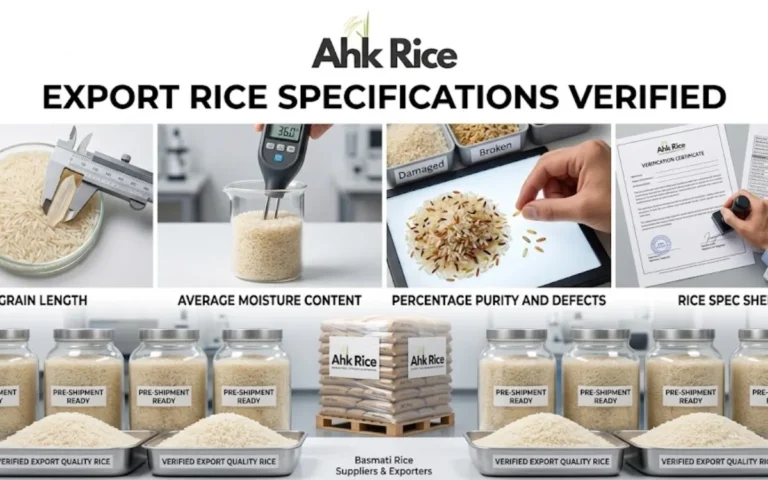
The audit should connect factory controls directly to the commercial rice specification, including variety identity, grain length, broken percentage, moisture, purity, foreign matter, milling quality, packaging, traceability, and testing records.
For example, a buyer sourcing 1121 Basmati should verify that the facility can repeatedly produce the contracted grade rather than simply provide an attractive sample.
The audit should examine how grain length is measured, how broken grains are separated, how optical sorting is calibrated, and how rejected material is controlled.
Moisture is another important control. Excess moisture increases storage and quality risks, while inconsistent moisture can affect cooking performance and commercial shelf stability.
AHK Rice describes its processing chain as including paddy procurement, pre-cleaning, dehusking, paddy separation, whitening, polishing, grading, and length sorting. Its published quality system references ISO 22000:2018, HACCP, ISO 9001:2015, GMP, and Halal certification.
For an importer, the important point is not simply whether a certificate exists. The audit should establish whether the facility’s documented system is reflected in actual production.
How do California and Gulf markets differ in audit priorities?
California importers place greater emphasis on documented U.S. food-safety verification and FSVP evidence, while Gulf buyers place stronger emphasis on shipment conformity, destination certifications, commercial specifications, and reliable high-volume supply.
California operates within the U.S. federal food-import framework. The FSVP importer must evaluate the food and foreign supplier, determine appropriate verification activities, conduct those activities, maintain records, and take corrective action where required. FDA also requires identification of the FSVP importer when filing applicable entries.
UAE and other Gulf buyers operate under different destination requirements. Commercial buyers commonly focus heavily on grade consistency, packaging, certification, inspection, and shipment timing. Pakistan-origin Basmati remains an important category in the Gulf, with 1121 and Super Kernel among the major commercial varieties.
For price comparison, July 2026 indicative Pakistan export pricing provides a useful reference point. Published FOB Karachi indications put 1121 Basmati White around $1,165–$1,205/MT, 1121 Steam around $1,160–$1,200/MT, and Super Kernel around $1,165–$1,205/MT. UAE-bound indications are also shown around these levels before destination freight and other landed costs.
California pricing cannot be compared directly with FOB Karachi because U.S. landed cost adds ocean freight, insurance, customs-related costs, port charges, brokerage, inland transportation, compliance costs, and importer margins. Therefore, a California buyer should compare landed cost per MT, not simply the supplier’s FOB quotation.
| Market region | Common commercial preference | Indicative Pakistan FOB reference, 2026 | Audit emphasis | Practical shelf-life planning |
| California / USA | 1121, Super Kernel, white or steam grades | ~$1,160–$1,205/MT | FSVP evidence, traceability, testing, supplier history | Plan around declared commercial shelf life and controlled storage |
| UAE / Gulf | 1121 White, Steam/Sella, Super Kernel | ~$1,135–$1,205/MT | Grade conformity, certificates, packaging, inspection | Plan around declared commercial shelf life and heat/humidity control |
These prices are market indicators, not AHK Rice contract quotations. Actual prices vary with grade, broken percentage, crop, packing, order size, Incoterm, freight, and shipment date.
Shelf life also requires careful interpretation. Dry white rice is highly shelf-stable under suitable conditions, but commercial buyers should follow the supplier’s declared shelf life, packaging specification, storage conditions, and applicable destination labeling requirements. USDA guidance emphasizes that dry rice remains shelf-stable but quality can deteriorate and moisture or damaged packaging can create problems.
Which audit approach works best for different importer situations?
The best approach depends on supplier risk, purchase volume, market regulation, product complexity, and previous performance; strategic California buyers benefit from a layered audit-and-testing program, while lower-risk repeat suppliers can use proportionate verification.
A new supplier should receive the most extensive evaluation. The importer should review certifications, conduct a factory audit, verify traceability, test samples, inspect the first commercial shipment, and establish corrective-action procedures.
A high-volume supplier also deserves periodic audits. A supplier shipping hundreds of metric tons can create significant financial exposure if a systemic problem affects multiple containers.
A repeat supplier with strong history can move toward risk-based monitoring. The importer can rely more heavily on historical performance, targeted testing, periodic audits, and document reviews.
A private-label buyer needs additional packaging and labeling controls. The audit should verify artwork approval, lot coding, packaging materials, label controls, and segregation of different customer specifications.
A California importer subject to FSVP should connect the audit directly to the written supplier-verification program. FDA allows supplier verification activities to include annual onsite audits where appropriate, sampling and testing, and review of relevant food-safety records.
What are the advantages and disadvantages of factory audits?
Factory audits provide deep supplier visibility and identify systemic weaknesses before commercial exposure becomes large, but they require qualified auditors, time, documentation review, and periodic repetition; an audit also cannot prove every individual shipment is compliant.
Advantages
A factory audit reveals conditions that a laboratory certificate cannot show.
An importer can see whether sanitation procedures are actually implemented, whether workers follow hygiene controls, whether pest-control records are maintained, whether calibration records exist, and whether rejected rice is controlled.
Audits also identify systemic risk. If the same weighing equipment is used across multiple production lines without calibration records, the issue could affect many future shipments.
Audits improve supplier accountability because corrective actions become documented rather than informal promises.
Disadvantages
Audits require time and qualified personnel.
A facility can also perform well on the audit date while later performance changes. That is why supplier verification must be ongoing rather than treated as a one-time approval.
An audit also cannot replace laboratory analysis. A clean production floor does not prove that a rice sample meets every chemical or microbiological specification.
The strongest program therefore combines facility assessment with shipment-level verification.
What five factors should guide the final supplier-verification decision?
Importers should prioritize regulatory exposure, supplier history, product risk, shipment value, and evidence quality when deciding how deeply to audit a Basmati rice supplier and how frequently to repeat verification.
| Decision factor | What to evaluate | Strong decision signal |
| Regulatory exposure | Destination requirements and FSVP obligations | Complete, reviewable compliance records |
| Supplier history | Complaints, deviations, recalls, rejected lots | Consistent performance and documented corrections |
| Product risk | Food-safety hazards and specification sensitivity | Risk-based testing and controls |
| Commercial exposure | MT volume and shipment value | Stronger controls for larger commitments |
| Evidence quality | Audits, tests, certificates, traceability | Independent, current, lot-linked evidence |
This framework prevents price from becoming the only procurement variable.
A supplier offering a lower FOB price can create higher total cost if inconsistent grading produces claims, delayed documentation creates port problems, or inadequate traceability makes corrective action difficult.
For California buyers, the central question is therefore not simply “What is the rice price per MT?” It is “Can the supplier produce the contracted specification consistently and provide evidence that supports my verification program?”
What does an audit-ready Pakistani Basmati rice supply system look like?
An audit-ready supply system connects paddy sourcing, processing, grading, testing, packaging, traceability, certifications, inspection, and export documentation into one evidence chain that an importer can review before approving repeated shipments.
For Pakistani Basmati rice, the chain begins with paddy procurement in Punjab and continues through cleaning, dehusking, polishing, grading, sorting, quality testing, packing, container loading, and export documentation.
AHK Rice states that it operates an integrated processing and export facility in Punjab and supplies 1121, Super Kernel, and 1509 varieties to international buyers. Its published process includes paddy procurement, pre-cleaning, dehusking, paddy separation, polishing, grading, and length sorting.
For a buyer, this creates a practical audit trail. The importer can request evidence for the production process, quality system, lot identification, inspection, packaging, and shipment documentation instead of evaluating the supplier only from marketing claims.
The supplier’s published USA program also identifies 1121 and Super Kernel as products supplied to U.S. buyers and describes quality checks involving moisture, purity, grain integrity, and export documentation. For deeper insight explore:
Audit-ready Pakistani Basmati rice for California buyers
When should a California importer choose an audit-led supplier-verification program?
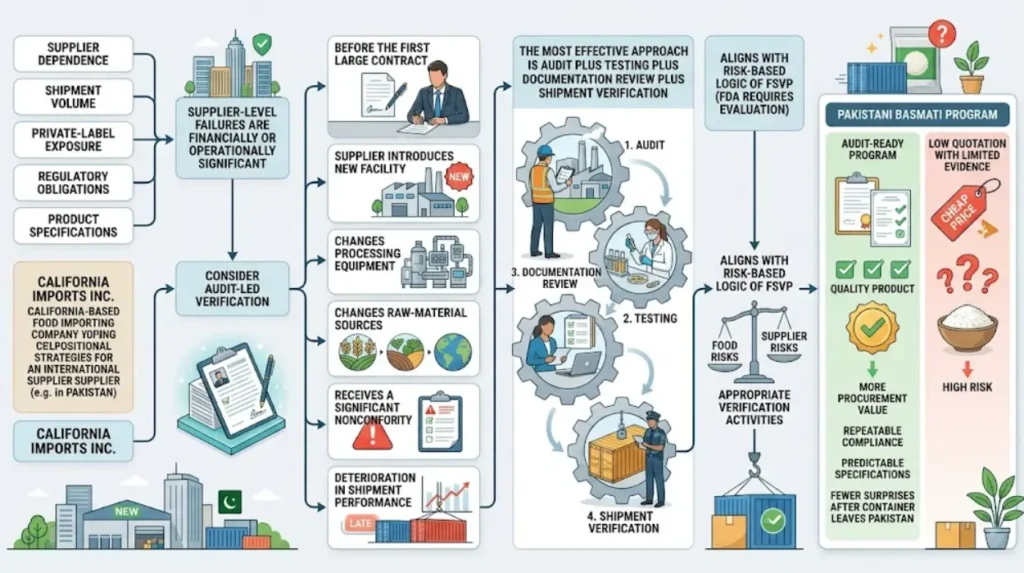
A California importer should choose an audit-led program when supplier dependence, shipment volume, private-label exposure, regulatory obligations, or product specifications make supplier-level failures financially or operationally significant.
A factory audit becomes especially valuable before the first large contract.
It is also valuable when a supplier introduces a new facility, changes processing equipment, changes raw-material sources, receives a significant nonconformity, or shows a deterioration in shipment performance.
The most effective approach is not “audit instead of testing.” It is audit plus testing plus documentation review plus shipment verification.
That structure aligns supplier evaluation with the risk-based logic of FSVP. FDA requires covered importers to evaluate food and supplier risks and select appropriate verification activities.
For buyers comparing suppliers, an audit-ready Pakistani Basmati program therefore provides more procurement value than a low quotation with limited evidence. The goal is repeatable compliance, predictable specifications, and fewer surprises after the container leaves Pakistan.
Frequently Asked Questions
What is a factory audit in Basmati rice importing?
A factory audit is a structured assessment of a rice processing facility, covering sanitation, processing controls, grading, traceability, testing, storage, packaging, certifications, documentation, and corrective-action procedures.
How does a factory audit reduce Basmati rice import risk?
A factory audit identifies weaknesses before a commercial shipment is approved. It helps importers verify whether the supplier can consistently control food safety, rice specifications, traceability, packaging, and production processes.
What should California rice importers check during a factory audit?
California importers should review processing controls, sanitation, traceability, supplier history, testing procedures, certifications, corrective actions, product specifications, and records needed to support applicable U.S. Food and Drug Administration Foreign Supplier Verification Program requirements.
Is a factory audit required for importing Basmati rice into the USA?
A factory audit is not universally required for every Basmati rice shipment. U.S. importers subject to FSVP must conduct appropriate supplier verification based on food and supplier risk. An onsite audit can be one verification activity when the risk assessment supports it.
What is the difference between a factory audit and pre-shipment inspection?
A factory audit evaluates the supplier’s facility and operating systems, while a pre-shipment inspection evaluates a specific commercial shipment. Using both provides broader supplier-level and lot-level verification.
Can factory audits verify Basmati rice quality?
Factory audits can verify the systems used to control Basmati rice quality, including grading, sorting, moisture control, testing, and traceability. Laboratory testing is still needed for characteristics that require analytical measurement.
Which Basmati rice specifications should an importer verify?
Importers should verify variety, grain length, broken percentage, moisture, purity, foreign matter, milling quality, appearance, packaging, labeling, lot identification, and applicable food-safety testing requirements.
How often should a Basmati rice factory be audited?
Audit frequency should depend on supplier risk, shipment volume, product risk, regulatory requirements, previous performance, and corrective-action history. New or higher-risk suppliers generally require stronger initial verification and closer monitoring.
What certifications are relevant when auditing a Pakistani rice exporter?
Relevant certifications and systems can include HACCP, ISO 22000, ISO 9001, GMP, and destination-specific certifications. Importers should verify that certificates are current, applicable to the facility, and supported by actual operating controls.
Do factory audits replace laboratory testing?
No. Factory audits and laboratory testing serve different purposes. An audit evaluates production and food-safety systems, while laboratory testing measures specific product characteristics or hazards in a sample.
How do factory audits support FSVP compliance?
Factory audits can serve as one supplier-verification activity within an FSVP program when appropriate to the importer’s risk assessment. The importer must maintain the required evaluation and verification records.
What records should a Basmati rice importer request from an audited supplier?
Importers can request audit reports, certifications, product specifications, laboratory reports, traceability records, sanitation records, pest-control records, calibration records, corrective-action records, inspection reports, and shipment documentation.
Which Basmati rice varieties can be evaluated through factory audits?
Factory audits can be applied to varieties such as 1121 Basmati, Super Kernel, and 1509 Basmati. The audit should verify that the facility can consistently produce the contracted variety and specification.
Why is traceability important when importing Basmati rice?
Traceability connects the finished rice to its production lot, raw-material source, processing records, testing results, packaging batch, and shipment documents. It helps importers investigate and isolate quality or food-safety problems.
Are factory audits useful for private-label Basmati rice?
Yes. Private-label buyers should audit packaging and labeling controls in addition to food-safety and processing systems. The audit should verify artwork control, lot coding, packaging materials, product segregation, and finished-goods identification.
What is the biggest benefit of auditing a Pakistani Basmati rice supplier?
The main benefit is greater visibility into the supplier’s actual production and control systems before large commercial commitments are made. This helps reduce risks associated with inconsistent quality, weak traceability, documentation failures, and process deficiencies.