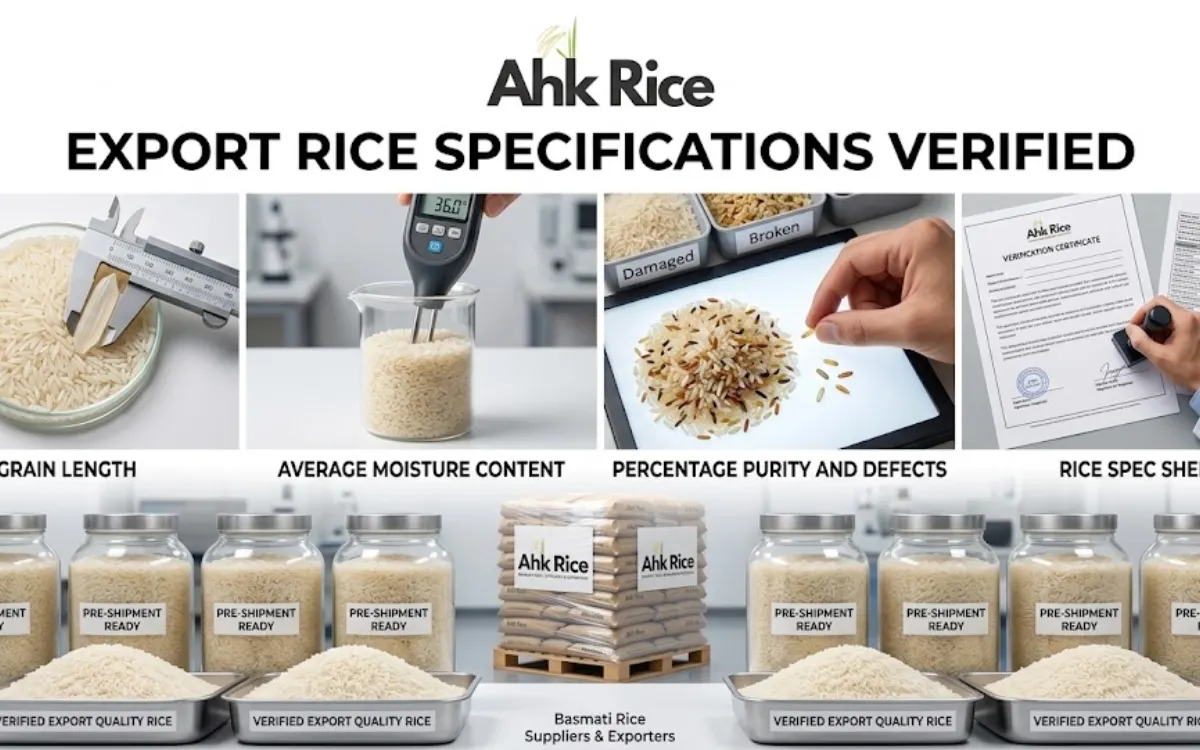
How Are Export Rice Specifications Verified Before Shipment?
Export rice specifications are verified most reliably through a layered process combining contract specifications, representative sampling, laboratory testing, physical inspection, production controls, and pre-shipment documentation. No single inspection method provides enough evidence for an importer buying commercial-volume Basmati rice.
For Maryland importers, this verification process matters because rice quality affects food safety, milling yield, cooking performance, shelf life, regulatory compliance, and landed cost. Before comparing suppliers, importers can review:
Why Maryland importers verify rice quality before purchase to understand the commercial risks behind specification control.
In 2026, U.S. importers remain responsible for ensuring imported food is safe, sanitary, and correctly labeled. FDA’s Foreign Supplier Verification Program (FSVP) requires covered importers to perform risk-based verification of foreign suppliers and imported food. Verification activities include sampling and testing, supplier record review, and, where appropriate, onsite audits.
What are the available solutions for verifying export rice specifications?
The main verification solutions are supplier documentation, physical inspection, laboratory analysis, pre-shipment sampling, production-line controls, and independent third-party inspection. The strongest commercial process combines these methods against one agreed specification sheet.
Supplier specification review
A specification sheet defines the commercial identity of the rice before production. It records variety, processing type, grain length, broken percentage, moisture, foreign matter, admixture, milling quality, packaging, crop year, and required certificates.
For Pakistani Basmati, the specification also identifies whether the buyer requires 1121, Super Kernel, or 1509 and whether the product is white, steam, or Sella.
AHK Rice operates an integrated processing workflow covering paddy procurement, cleaning, de-husking, separation, polishing, grading, length sorting, packaging, documentation, and container loading. Its published quality system includes ISO 22000:2018, HACCP, ISO 9001:2015, GMP, and Halal certification.
Physical inspection
Physical inspection evaluates the shipment against visible and measurable characteristics. Inspectors examine grain appearance, colour, broken kernels, foreign material, damaged grains, insect damage, packaging condition, markings, and loading practices.
A physical inspection does not replace laboratory analysis. It establishes whether the cargo visibly matches the contractual specification.
Laboratory testing
Laboratory testing provides quantitative evidence for parameters that visual inspection cannot reliably establish. Typical tests include moisture, pesticide residues, microbiological parameters, mycotoxins where relevant to the risk assessment, and other buyer- or destination-specific requirements.
For U.S. food imports, the verification program is risk-based rather than limited to one universal rice test panel. FDA identifies sampling and testing as one acceptable supplier-verification activity under FSVP.
Independent pre-shipment inspection
Independent inspection adds separation between the seller’s internal quality team and the buyer’s acceptance process. Organizations such as SGS, Bureau Veritas, and Intertek provide commercial inspection services.
AHK Rice states that shipments undergo pre-shipment inspections through internationally recognized organizations including SGS and Bureau Veritas.
The inspection certificate becomes part of the shipment documentation and provides evidence that the inspected lot was checked before loading.
How do different rice specification verification approaches compare?
Documentation is efficient but depends on supplier evidence; internal inspection controls production; laboratory testing measures critical attributes; third-party inspection adds independence. Importers obtain the strongest assurance by combining all four rather than selecting only one.
| Verification Attribute | Supplier Documents | Internal QC | Laboratory Test | Third-Party Inspection |
|---|---|---|---|---|
| Specification confirmation | High | High | Medium | High |
| Moisture verification | Document-based | High | Very high | High |
| Broken-kernel assessment | Medium | High | High | High |
| Food-safety evidence | Medium | High | Very high | High |
| Independence | Low | Low | Medium–High | Very high |
| Pre-shipment acceptance | Medium | High | High | Very high |
| Best commercial use | Initial screening | Production control | Risk verification | Final shipment assurance |
The comparison shows why a certificate alone is insufficient. A certificate confirms that a test or inspection occurred. It does not automatically prove that every container in a later shipment matches the same condition.
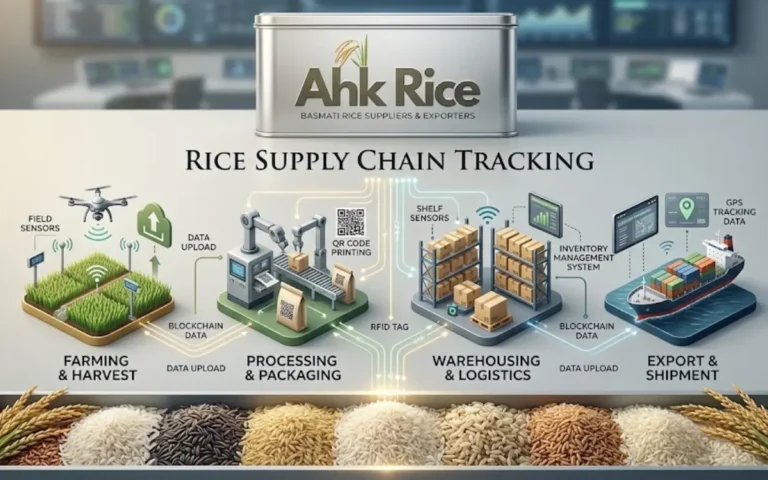
The buyer therefore needs a chain of evidence connecting the contract specification → production lot → sample → test result → inspection report → container → shipping documents.
The U.S. Department of Agriculture maintains official U.S. Standards for Milled Rice, providing a formal reference framework for rice grading and inspection.
Which specifications need to be checked before shipment?
The critical pre-shipment specifications are variety identity, grain dimensions, broken percentage, moisture, milling quality, foreign matter, damaged kernels, processing type, packaging, lot traceability, and destination compliance. Each specification controls a different commercial or regulatory risk.
Variety and grade
Variety verification confirms that the contracted rice is actually the purchased product. A shipment specified as 1121 Basmati requires controls that distinguish it from Super Kernel or 1509.
AHK Rice identifies 1121, Super Kernel, and 1509 among its Pakistani Basmati offerings.
Grain length
Grain length influences retail positioning and cooking appearance. Current commercial references place 1121 Basmati at approximately 8.30 mm raw grain length, with cooked elongation exceeding 22 mm in published specifications.
Length sorting therefore becomes an important production-stage control for premium Basmati contracts.
Broken kernels
Broken percentage directly affects appearance, yield, retail grade, and buyer economics. A premium specification with 0–2% broken kernels has a different commercial position from a specification allowing 5%, 15%, or 25% broken rice.
The important point is that the agreed broken percentage must appear in the purchase specification before inspection starts.
Moisture
Moisture affects storage stability and physical quality. A buyer must compare the supplier’s contractual moisture specification with the destination’s requirements and the testing method used.
AHK Rice publishes specifications for 1121 Basmati with moisture at a maximum of 13.5% on one current product reference.
Foreign matter and contamination
Foreign matter includes material that does not belong in the finished rice product. Cleaning, aspiration, grading, and optical sorting reduce this risk during processing.
Food-safety testing then addresses hazards that cannot be established through visual inspection alone.
Which market regions require different rice verification priorities?
U.S. buyers place greater emphasis on FDA compliance, FSVP documentation, traceability, testing evidence, and English labeling, while GCC buyers commonly prioritize premium Basmati appearance, grain elongation, aroma, processing type, Halal compliance, and destination-specific documentation.
U.S. Mid-Atlantic market
For Maryland and the wider U.S. Mid-Atlantic market, 1121 Basmati and parboiled or steam products fit premium ethnic retail, foodservice, wholesale, and distributor applications. The verification file needs to connect the foreign supplier’s controls with the importer’s FSVP responsibilities.
FDA states that covered importers must evaluate hazards, assess supplier performance, approve suppliers, conduct appropriate verification activities, and maintain an FSVP for covered food and foreign suppliers.
FDA also requires imported foods to meet U.S. safety, sanitary, and labeling requirements. Prior Notice applies before food is offered for import.
GCC market
The GCC, particularly the UAE and Saudi Arabia, has strong demand for long-grain Pakistani Basmati. Premium 1121 and Super Kernel are commonly positioned for the region.
Current commercial market references identify the UAE as a major destination for Pakistani Basmati and list 1121 and Super Kernel among the key products entering through Jebel Ali. Published shipping references place Karachi-to-Jebel Ali sailing at approximately 4–10 days, depending on the service.
GCC buyers therefore benefit from strong visual and cooking-quality verification because shorter ocean transit reduces the logistics window while retail competition places significant value on grain appearance, aroma, and consistency.
2026 indicative price comparison
For a practical 2026 benchmark, current published FOB Karachi references show premium Pakistani Basmati around US$1,135–1,205 per MT for 1121 variants and approximately US$1,165–1,205 per MT for Super Kernel. These are indicative FOB values, not destination landed prices.
| Market Region | Typical Premium Preference | Indicative FOB Benchmark | Transit Reference | Commercial Verification Priority |
| U.S. Mid-Atlantic | 1121 White, Steam/Sella | $1,135–$1,205/MT | Longer ocean transit | FSVP, testing, traceability |
| GCC | 1121, Super Kernel, Sella/Steam | $1,135–$1,205/MT | Karachi–Jebel Ali about 4–10 days | Grain appearance, aroma, Halal, consistency |
The FOB benchmark is comparable because both figures originate at Karachi. Actual Maryland or GCC landed costs differ after freight, insurance, port charges, customs costs, inland transportation, inspection, packaging, and other commercial charges.
How does shelf life affect specification verification?
Dry white rice is shelf stable, with USDA’s shelf-stable guidance listing rice and dried pasta at two years. Export buyers still need moisture, packaging, storage, and transit controls because shelf life describes storage performance rather than a guarantee of unchanged commercial quality.
USDA’s shelf-stable guidance lists rice and dried pasta at two years under the stated storage conditions. USDA also explains that shelf-stable foods require suitable storage and that quality can decline over time.
This distinction matters between the two regions.
For the U.S. Mid-Atlantic, a longer ocean route creates a larger gap between production and warehouse receipt. The buyer therefore benefits from tighter control over production date, moisture, packaging integrity, container condition, and storage instructions.
For the GCC, shorter Karachi-to-Jebel Ali transit reduces voyage duration, but hot and humid conditions make container stuffing, ventilation, moisture control, and warehouse conditions important.
The specification verification process must therefore record crop year, production lot, packing date where applicable, moisture result, packaging condition, container number, seal number, and inspection date.
Shelf life is not simply a number printed on a bag. It is the outcome of product condition plus packaging, handling, storage, and distribution.
Which verification method works best for different purchasing cases?
The best method depends on order size, product grade, destination risk, buyer experience, and contract value. Premium U.S. imports benefit from layered verification, while repeat buyers with proven suppliers can use documented risk-based controls and targeted independent testing.
| Purchasing Case | Preferred Verification Strategy | Why |
| First shipment from a new supplier | Sample + laboratory testing + third-party inspection | Establishes baseline supplier performance |
| Premium 1121 Basmati | Internal QC + grain analysis + independent inspection | Protects high-value specifications |
| Large recurring program | Approved supplier + periodic laboratory testing + inspection | Controls repeat-shipment consistency |
| Price-sensitive standard rice | Specification sheet + representative sampling | Controls cost without excessive testing |
| U.S. food import | Supplier records + risk assessment + testing where required | Supports FSVP verification |
| Private-label retail product | Full specification + packaging inspection + compliance review | Protects brand and labeling requirements |
The strongest approach is not automatically the most expensive inspection package. Verification needs to match the commercial risk.
What are the pros and cons of each verification strategy?
Supplier-only verification is fast but less independent; internal quality control provides strong process visibility but remains seller-controlled; laboratory testing gives measurable results but tests samples; third-party inspection provides independence but adds inspection cost and coordination.
Supplier documentation
Pros: Fast, inexpensive, useful for supplier screening and recordkeeping.
Cons: Documents alone do not prove physical shipment condition. A certificate of analysis represents the tested sample and must be linked to the actual production lot.
Internal quality control
Pros: Controls quality throughout cleaning, grading, polishing, sorting, packing, and loading.
Cons: The supplier controls the inspection process, so buyers requiring independent evidence need an external inspection layer.
Laboratory testing
Pros: Produces quantitative evidence for moisture and selected food-safety parameters.
Cons: Testing is sample-based. A laboratory result does not automatically represent every kernel in every container.
Third-party inspection
Pros: Provides independent verification of quantity, quality, packaging, loading, and contractual specifications.
Cons: Inspection adds cost and requires advance scheduling. The inspection scope must be defined clearly before the inspector arrives.
For example, an importer purchasing 100 MT of premium 1121 Basmati for U.S. retail distribution gains more from independent pre-shipment inspection and documented testing than from relying solely on a supplier’s specification sheet.
What decision factors determine the right verification process?
Importers should choose verification methods according to five factors: food-safety risk, specification value, supplier history, destination requirements, and shipment economics. The objective is documented conformity before loading, not simply obtaining the lowest inspection cost.
| Decision Factor | Key Question | Preferred Evidence |
| Food-safety risk | Which hazards require control or verification? | Risk assessment and laboratory reports |
| Product value | How costly is specification failure? | Detailed contract specification |
| Supplier history | Has the supplier repeatedly met requirements? | QC records and previous inspection results |
| Destination rules | What does the importing market require? | Regulatory and compliance documents |
| Shipment economics | Does inspection cost justify the exposure? | Risk-based inspection plan |
For U.S. importers, the FSVP framework is particularly important because FDA assigns covered importers responsibility for verifying foreign suppliers and imported food. FDA also permits importers to rely on activities performed by another entity when the importer reviews and assesses the relevant documentation.
That makes an organized exporter quality file commercially valuable. The file can include the agreed specification, supplier approval records, sample identification, laboratory reports, inspection certificate, packing details, certificate of origin, phytosanitary certificate, fumigation certificate, commercial invoice, packing list, and bill of lading.
How does AHK Rice approach pre-shipment specification control?
AHK Rice uses an end-to-end processing model in Punjab that connects paddy sourcing, cleaning, milling, grading, sorting, packaging, documentation, and container loading, with pre-shipment inspection available through recognized independent inspection organizations.
The process begins with paddy procurement from Punjab’s rice-growing region. Pre-cleaning removes field debris. De-husking removes the outer husk. Paddy separation removes unprocessed paddy. Whitening and polishing establish the required finish. Grading and length sorting separate rice according to size and quality.
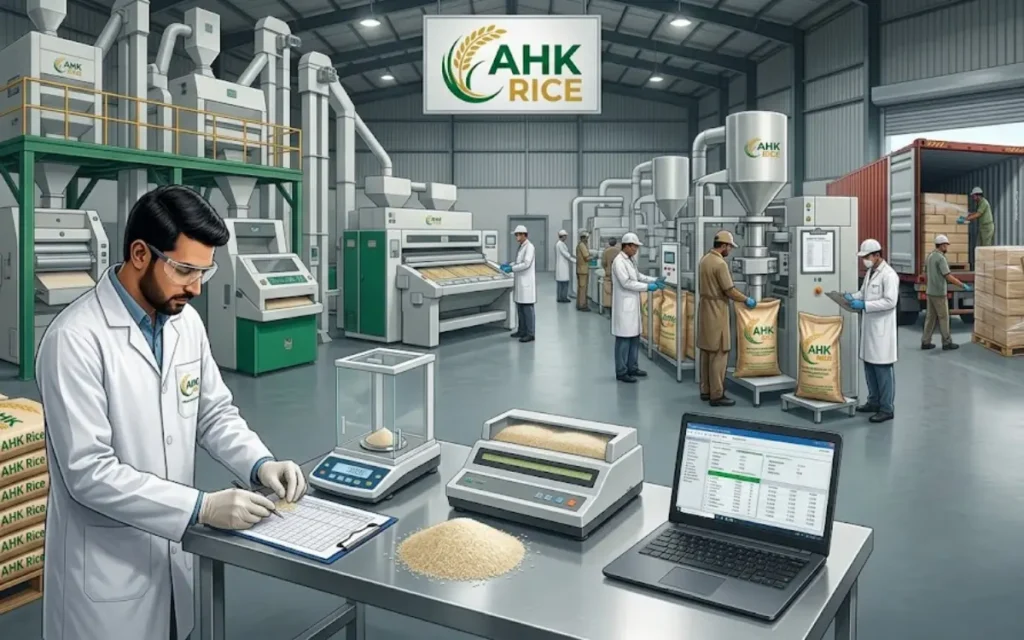
The final stage links product specifications with packaging and export documents. AHK Rice provides custom packaging and private-label options and manages export documentation including commercial invoices, packing lists, phytosanitary certificates, certificates of origin, fumigation certificates, and bills of lading.
For buyers evaluating a commercial supply program, the relevant service is Pakistan rice export with processing, packaging and export support. The value of this approach is not simply the number of inspections. It is the connection between production controls and the final shipment evidence.
What should importers verify before approving a rice shipment?
Before shipment approval, importers need one matching evidence chain covering product identity, specification, sample, test results, inspection findings, packaging, container details, and export documentation. Any mismatch needs resolution before cargo release or loading approval.
A practical approval sequence is:
- Confirm the purchase specification.
- Approve the exact variety and processing grade.
- Identify the production lot.
- Collect a representative sample.
- Check grain length and broken percentage.
- Test moisture and required food-safety parameters.
- Inspect packaging and labeling.
- Conduct independent pre-shipment inspection when required.
- Match the inspection report with the production lot and container.
- Verify export and destination documentation.
- Record the container and seal numbers.
- Approve shipment only after the evidence matches the contract.
This approach converts rice quality from a supplier promise into a documented procurement decision.
For Maryland buyers, the final evaluation must also distinguish commercial specification compliance from U.S. regulatory compliance. A rice shipment can meet a buyer’s grain-length and broken-kernel specification while still requiring separate regulatory documentation and verification under the applicable U.S. import framework. FDA’s current guidance confirms that covered FSVP importers need documented, risk-based supplier verification.
For Maryland buyers ready to move from specification verification to supplier evaluation:
Import verified quality Basmati rice into Maryland, USA with AHK Rice provides the next step for reviewing a commercial supply option.
The most reliable purchasing decision therefore combines product testing, independent inspection, supplier performance records, traceability, and destination-specific compliance rather than relying on price alone.
Frequently Asked Questions
How are rice specifications verified before shipment?
Rice specifications are verified through contract review, representative sampling, physical inspection, laboratory testing, internal quality control, and independent pre-shipment inspection.
What rice specifications should importers check before shipment?
Importers check variety, grain length, broken percentage, moisture, damaged kernels, foreign matter, processing type, packaging, labeling, and required compliance documents.
Why is laboratory testing important for export rice?
Laboratory testing provides measurable evidence for parameters such as moisture and selected food-safety risks that visual inspection cannot reliably confirm.
What is the role of third-party inspection in rice exports?
Third-party inspection provides independent verification of quality, quantity, packaging, loading condition, and compliance with the agreed purchase specification before shipment.
How is Basmati rice quality checked?
Basmati quality is checked through variety identification, grain length measurement, broken-kernel analysis, moisture testing, appearance assessment, processing verification, and cooking-quality requirements.
What is the difference between 1121, Super Kernel, and 1509 Basmati rice?
1121 Basmati is known for exceptional grain length and cooked elongation. Super Kernel provides long, premium grains, while 1509 offers long-grain Basmati with different commercial and price characteristics.
How does U.S. import compliance affect rice verification?
U.S. importers covered by FSVP need risk-based foreign-supplier verification. Evidence can include supplier records, sampling and testing, inspection results, and other appropriate verification activities.
How long does exported rice remain shelf stable?
Properly stored dry rice has a long shelf life. USDA shelf-stable guidance lists rice and dried pasta at approximately two years, while actual quality depends on moisture, packaging, storage, and handling.
Which rice verification method is best for Maryland importers?
A layered approach works best: approved supplier documentation, representative sampling, laboratory testing, production quality control, and independent pre-shipment inspection for higher-risk or higher-value shipments.
What documents should accompany a verified rice shipment?
Common export documents include the commercial invoice, packing list, certificate of origin, phytosanitary certificate, fumigation certificate, bill of lading, inspection certificate, and applicable laboratory reports.
How does AHK Rice verify export rice quality?
AHK Rice uses an end-to-end processing and quality-control system covering cleaning, milling, grading, sorting, packaging, documentation, and pre-shipment inspection for export consignments.
Does a certificate of analysis guarantee the entire rice shipment?
No. A certificate of analysis represents the tested sample. Importers gain stronger assurance when the sample is traceable to the production lot and supported by inspection and shipment records.