Why Do Welsh Buyers Review Food Safety Standards Before Importing Rice?
Welsh buyers review food safety standards because imported rice must meet UK food hygiene, composition, labelling, pesticide, traceability, and authenticity requirements before sale. Pakistani Basmati rice also requires controlled processing, documented testing, correct classification, and compliant packaging.
What are food safety standards for imported rice?
Food safety standards are legal controls covering hygiene, contaminants, pesticides, traceability, labelling, composition, and authenticity. Welsh buyers use these controls to verify that imported rice is safe, correctly described, properly documented, and suitable for retail, catering, and wholesale distribution in Wales.
UK cereal import guidance applies to England and Wales. Imported rice must meet the same or equivalent food hygiene standards required for food produced in Great Britain. Rice normally does not require a health certificate under the general cereal import guidance.
Food safety therefore covers more than visible grain quality. Buyers review the product, processing system, laboratory evidence, packaging, documentation, and supply-chain controls.
Welsh food businesses also operate within a strong food-safety culture. Business Wales identifies traceability, recognised accreditation, provenance, and food safety controls as important elements of consumer confidence.
The same principle applies to imported Basmati. A shipment can look clean while still failing an authenticity or residue requirement.
This distinction explains why buyers review safety standards before discussing volume or price.
Where is Pakistani Basmati rice grown and why does origin matter?
Pakistani Basmati rice is cultivated mainly across Punjab’s rice-growing areas, where soil, irrigation, climate, and established varieties support aromatic long-grain production. Origin documentation connects the shipment to its producing country and supports customs classification, traceability, authenticity, and commercial specification.
Punjab has a long-established rice research system. The Punjab Agriculture Department lists Basmati varieties including Super Basmati and PK-1121 Aromatic among varieties developed through the Rice Research Institute at Kala Shah Kaku.
Pakistan’s Basmati supply includes several commercial types. AHK Rice supplies 1121, Super Kernel, and 1509 varieties for international markets.
Origin matters because rice classification and customs treatment depend partly on the product and country of origin. UK customs guidance classifies rice under heading 1006 and distinguishes paddy, husked, milled, broken, and parboiled forms.
Pakistan also receives specific treatment in UK rice import arrangements. A 2026 UK notice identifies Pakistan under the tariff quota arrangements for semi-milled or wholly milled rice under CN code 1006 30.
Welsh buyers therefore examine the country of origin alongside the rice variety, processing type, tariff classification, and supporting documentation.
With origin established, the next question is how raw paddy becomes an export-ready rice product.
How is Pakistani Basmati rice processed before export?
Pakistani Basmati rice passes through cleaning, dehusking, milling, polishing, grading, optical sorting, quality inspection, packing, and final shipment preparation. Each stage controls a specific physical or food-safety attribute before the rice reaches the UK supply chain.
What happens during rice processing?
A commercial rice mill controls the grain through defined processing stages:
- Clean the paddy — remove stones, dust, straw, husk, and other foreign material.
- De-husk the grain — separate the edible brown rice from the outer husk.
- Mill the grain — remove bran layers to produce milled white rice.
- Polish the grain — improve surface appearance and remove remaining bran particles.
- Grade the grain — separate rice according to length, size, and broken percentage.
- Sort the grain — remove discoloured, damaged, immature, or unwanted grains through mechanical and optical sorting.
- Inspect the rice — test representative samples against the agreed specification.
- Pack the rice — use packaging suitable for the intended wholesale or retail market.
- Load the shipment — prepare containers and export documentation for dispatch.
UK customs guidance recognises milled, polished, parboiled, broken, husked, and paddy rice as distinct classification categories.
Processing also affects the commercial characteristics of the rice. White Basmati receives milling and polishing. Sella rice receives parboiling before drying and subsequent milling.
The processing route therefore connects directly to the product name, grain appearance, cooking behaviour, customs classification, and buyer specification.
Which Basmati grades do Welsh buyers encounter?
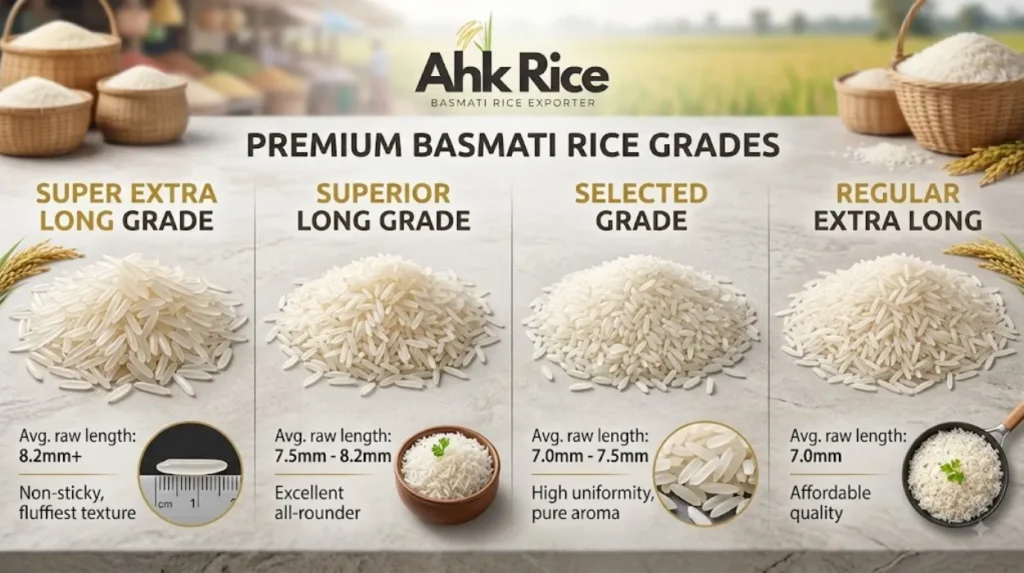
Welsh buyers commonly encounter White, Steam, Sella, and Golden Sella processing types across Basmati varieties. Pakistani commercial supply includes 1121, Super Kernel, and 1509, with specifications defined by grain length, broken percentage, moisture, appearance, and processing method.
What is 1121 Basmati rice?
1121 Basmati is an extra-long aromatic rice variety associated with PK-1121 Aromatic. Commercial products include White, Steam, Sella, and Golden Sella processing forms, with long slender grains used extensively in biryani, pulao, catering, retail, and foodservice applications.
The Punjab Agriculture Department lists PK-1121 Aromatic as a fine aromatic variety developed through the provincial rice research system.
What is Super Kernel Basmati rice?
Super Kernel Basmati is a premium Pakistani Basmati type valued for aromatic character, slender grain structure, cooking separation, and foodservice performance. Buyers specify its variety, processing method, broken percentage, moisture, grain appearance, packaging, and laboratory requirements before accepting commercial shipments.
Super Basmati is documented by Punjab’s Agriculture Department as a fine Basmati variety.
What is 1509 Basmati rice?
1509 is an extra-long Pakistani rice variety used in Steam and other commercial processing formats. Buyers assess its moisture, broken percentage, polishing, grain appearance, crop origin, and processing specification before accepting the product for UK distribution or foodservice use.
Pakistan Trade Portal listings identify 1509 Steam as Basmati, extra-extra-long grain rice with processing, moisture, broken-grain, polishing, crop-year, and origin specifications.
These grades show why “Basmati rice” alone is not a complete purchasing specification.
What food safety components do Welsh buyers check?
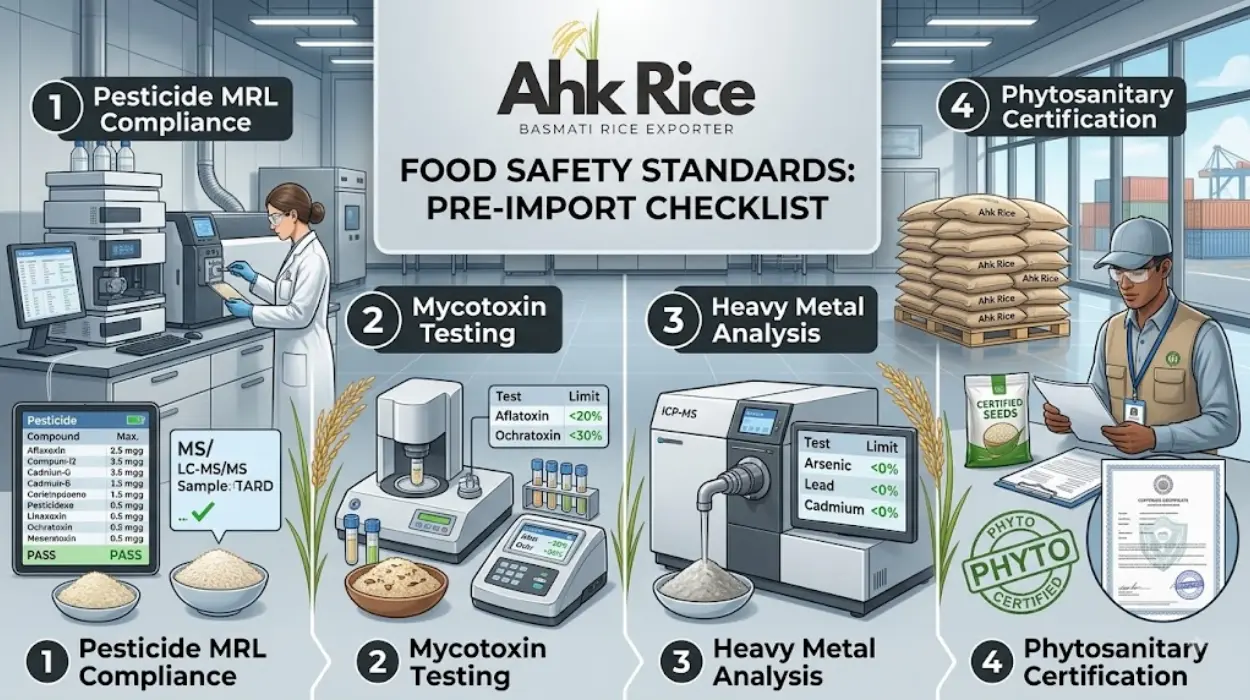
Welsh buyers check food hygiene systems, contaminant controls, pesticide compliance, authenticity, traceability, packaging, labelling, documentation, and product specifications. These controls connect the physical rice to measurable evidence that supports safe handling, lawful sale, and accurate consumer information.
Which safety controls matter most?
| Component | What buyers review | Why it matters |
|---|---|---|
| Hygiene | Processing controls and sanitation | Controls contamination risks |
| Pesticides | Residue compliance | Supports legal market access |
| Contaminants | Laboratory test results | Identifies chemical or biological hazards |
| Authenticity | Variety and Basmati composition | Prevents misdescription |
| Traceability | Lot and shipment records | Connects product to source |
| Packaging | Food-contact suitability and integrity | Protects the product |
| Labelling | Product and importer information | Supports lawful retail sale |
| Documentation | Certificates and records | Supports verification |
Basmati authenticity receives specific attention in UK surveillance. The Food Standards Agency reported that 30 uncooked Basmati samples were tested in its 2024/25 retail surveillance programme. The compliance rate was 87%, while 3 samples exceeded the 7% maximum non-Basmati content under the Basmati Code of Practice.
This makes authenticity a food-standard issue, not simply a marketing preference.
Labelling also matters. UK rules require information such as the food name, net quantity, relevant date, storage conditions, required origin information, and responsible business address.
Traceability supports the same objective. Welsh food-safety guidance identifies traceability and recognised accreditation as elements supporting food safety and consumer confidence.
Which certifications and documents apply to Pakistani rice exports?
Certifications and documents provide evidence for different controls. HACCP and ISO 22000 demonstrate food-safety management systems, while shipment documentation supports origin, inspection, traceability, and customs processes. Legal requirements depend on the product, destination, importer, and current UK rules.
HACCP means Hazard Analysis and Critical Control Points. A HACCP system identifies food hazards, establishes controls, monitors those controls, and keeps records. Welsh local authority guidance describes HACCP-based food safety management as a legal requirement for food businesses.
ISO 22000 is a food safety management standard. ISO 9001 addresses quality management rather than food safety itself. Buyers can use these certifications as supplier-assurance evidence.
Common export documents include:
- Commercial invoice — identifies the transaction and shipment value.
- Packing list — identifies package quantities and weights.
- Certificate of origin — identifies the producing country.
- Laboratory report — records tested product characteristics.
- Inspection certificate — records inspection results where required.
- Phytosanitary documentation — supports plant-health requirements where applicable.
- Bill of lading — records sea transportation and shipment details.
A certification does not replace UK legal compliance. Buyers still need to verify the actual product, label, specification, and applicable import requirements.
With the main safety controls established, the final issue is understanding why buyers use them during procurement.
Why do Welsh buyers review these standards before importing rice?
Welsh buyers review food safety standards before purchasing because non-compliant rice creates risks across customs clearance, retail sale, consumer safety, traceability, authenticity, and supplier performance. Pre-shipment verification moves quality control from complaint management to documented prevention.
A buyer purchasing 25 tonnes of 1121 Basmati needs more than a product name. The buyer needs a defined variety, processing type, broken percentage, moisture specification, packaging format, crop information, and supporting test documentation.
A retail buyer also needs compliant packaging. UK guidance requires mandatory food information to remain clear, visible, permanent, and non-misleading.
Authenticity creates another reason for inspection. A Basmati label must correspond with the applicable composition requirements. The FSA’s surveillance programme demonstrates that variety claims are actively tested.
Food safety therefore connects directly to commercial reliability. A compliant shipment supports customs processing, warehouse receiving, retail labelling, customer trust, and repeat purchasing.
What are common misconceptions about imported rice?
Food safety is not the same as appearance, certification alone does not guarantee compliance, and Basmati is not one single processing grade. Buyers need product-specific evidence covering safety, identity, processing, packaging, and documentation.
Misconception 1: Clean-looking rice is automatically safe.
Visible appearance cannot establish pesticide compliance, contaminant levels, or authenticity. Laboratory testing provides measurable evidence.
Misconception 2: HACCP certification alone proves every shipment complies.
HACCP demonstrates a food-safety management approach. Shipment-level specifications and testing still require verification.
Misconception 3: Basmati describes one identical product.
1121, Super Kernel, and 1509 represent different commercial varieties. White, Steam, Sella, and Golden Sella represent different processing formats.
Misconception 4: UK food rules do not affect Welsh buyers.
UK cereal import guidance expressly applies to England and Wales.
Misconception 5: Packaging is separate from food safety.
Packaging carries mandatory information that supports safe use, traceability, identification, and lawful sale.
Welsh buyers therefore review food safety standards as part of responsible rice procurement, not as an optional supplier preference.
Frequently Asked Questions
Why is food safety important when importing rice into Wales?
Food safety controls help Welsh buyers verify hygiene, contaminants, pesticide compliance, authenticity, traceability, packaging, labelling, and documentation before imported rice enters commercial distribution.
Does imported Pakistani rice need a health certificate?
UK guidance for imported cereals states that a health certificate is not normally required for these products. Specific requirements depend on the product and applicable import controls.
What Pakistani Basmati varieties are commonly exported?
Commercial Pakistani supply includes 1121, Super Kernel, and 1509, alongside other Basmati and non-Basmati varieties.
What does HACCP mean for rice exporters?
HACCP means Hazard Analysis and Critical Control Points. It identifies food hazards and establishes controls, monitoring procedures, and records to manage food-safety risks.
What does the UK Basmati authenticity standard require?
The Basmati Code of Practice allows a maximum of 7% non-Basmati rice when the product is described as Basmati rice.
What information must appear on packaged rice?
Required information can include the food name, net quantity, date marking, storage conditions, origin information where required, lot information, and the responsible food business address.