Why Is Production Capacity Critical for Large Rice Import Programs?
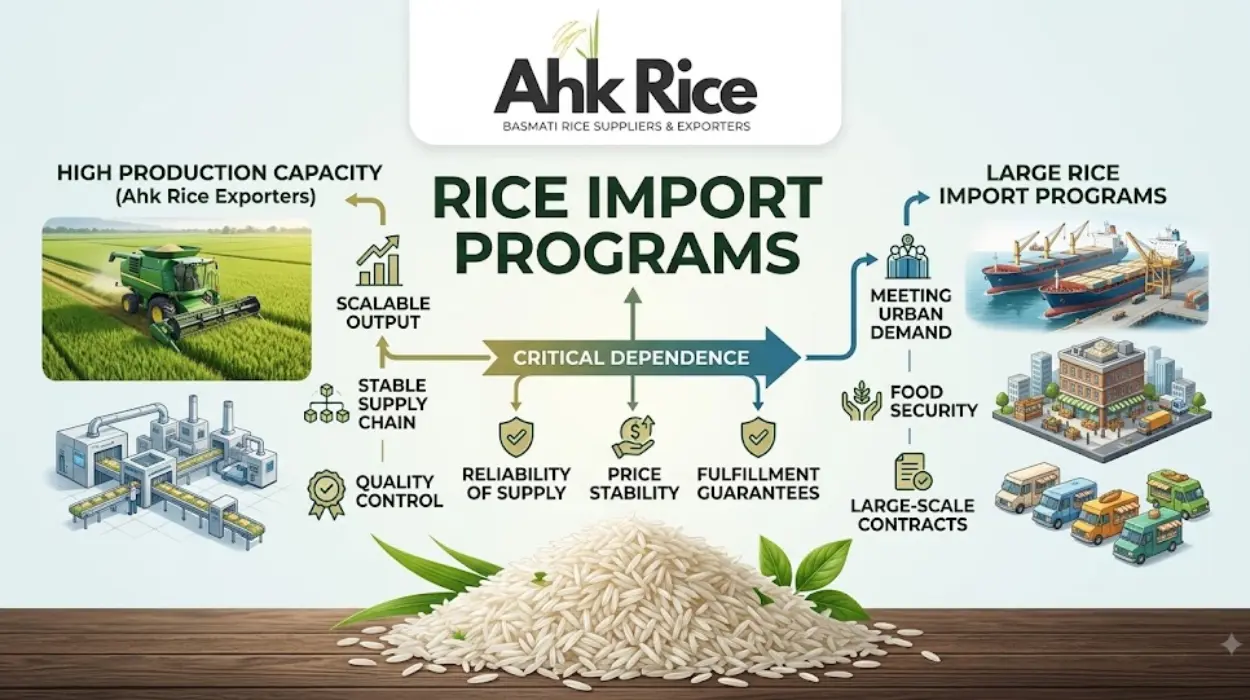
Production capacity is critical for large rice import programs because an importer needs more than available rice at one point in time. A large program requires continuous access to the same variety, grade, grain specification, packaging format, documentation, and shipment schedule. Capacity connects raw-material purchasing with milling, quality control, packing, storage, and export loading.
For a rice importer, production capacity means the volume an exporter can process and prepare for shipment within a defined period. A facility can state capacity in metric tons per day, month, or year. These figures describe throughput, but they do not automatically represent finished rice available for export.
A large import program also requires capacity across several stages. These include paddy procurement, drying, milling, steaming or parboiling where applicable, sorting, grading, packing, warehousing, inspection, and container loading. If one stage has lower capacity than the others, it becomes a production bottleneck.
What is production capacity in the rice export industry?
Production capacity is the amount of rice a facility can process, pack, store, and dispatch within defined periods while maintaining agreed specifications. Large import programs depend on capacity because repeated orders require stable output, controlled inventory, and predictable shipment schedules.
Rice production capacity starts with raw paddy availability. Paddy is unmilled rice with its husk intact. After procurement, it passes through controlled processing stages before becoming finished rice suitable for domestic or export markets.
A rice mill can have a high milling rate but limited finished-product capacity. For example, a plant can process 20 metric tons per hour through its milling line while its packing department handles only 8 metric tons per hour. In that situation, packing becomes the practical constraint.
Capacity also differs by product. Long-grain Basmati varieties such as 1121, Super Kernel, and 1509 require specific milling, sorting, grading, and quality controls. Steam and parboiled products use additional processing stages compared with white rice.
A useful capacity assessment therefore separates:
- Paddy intake capacity
- Drying capacity
- Milling capacity
- Steam or parboiling capacity
- Sorting and grading capacity
- Packing capacity
- Finished-goods storage capacity
- Container-loading capacity
This distinction gives importers a clearer view of how much specification-compliant rice an exporter can actually prepare for a shipment program.
How does production capacity work from paddy to export shipment?
Scaling production requires coordinated control of paddy supply, milling lines, labor, utilities, quality checks, packaging, storage, and container loading. Exporters increase throughput by scheduling shifts, allocating inventory, balancing bottlenecks, and preserving the same specification across larger production lots during peak demand.
The process begins with paddy procurement. Export-oriented mills purchase paddy that matches the required variety and quality parameters. The incoming material is inspected before entering production.
The first major processing stage is cleaning. Machines remove stones, dust, straw, foreign material, and other impurities. Cleaning protects downstream equipment and improves product consistency.
Drying follows when moisture adjustment is required. Controlled moisture is important because excessive moisture affects storage stability, milling behavior, and finished-rice quality. Drying conditions therefore form part of capacity planning.
The paddy then enters the milling system. Husking removes the outer husk. Further milling removes bran layers and produces milled rice. The degree of milling depends on the product specification.
Steam and parboiled Basmati products follow a different route. Paddy receives controlled soaking, steaming, and drying before milling. These steps change the physical properties of the grain and require additional equipment, utilities, time, and storage planning.
After milling, rice enters sorting and grading. Length graders separate grains by size. Color sorters remove discolored grains and selected defects. Broken grains are separated according to the agreed specification.
The finished rice then moves to packing. Packaging can include retail bags, bulk bags, sacks, or customized private-label formats. Each format creates different requirements for packaging materials, weighing, sealing, coding, and palletization.
The final stages include finished-goods inspection, documentation, warehouse staging, container inspection, loading, and export dispatch. Large programs require these activities to operate as one connected production system.
Importers evaluating larger programs should therefore ask how capacity is distributed across the complete process instead of looking only at the mill’s headline production figure.
What are the key components of large-scale rice production capacity?
Large programs rely on several connected capacity components: raw-rice inventory, milling throughput, parboiling or steaming capacity, sorting, packing, warehouses, quality laboratories, labor, utilities, and loading infrastructure. A constraint in one component limits the practical capacity of the entire export operation.
Raw-material inventory is the first component. An exporter needs sufficient paddy or processed rice inventory to maintain production without interruptions. Inventory planning also needs to preserve variety identity and prevent unwanted mixing.
Milling throughput determines how quickly paddy becomes milled rice. Milling efficiency depends on equipment configuration, grain characteristics, operating hours, and the required finished specification.
Sorting capacity is equally important. Export rice often requires controlled limits for broken grains, foreign material, discolored kernels, chalkiness, and other defects. A high-volume order therefore requires sorting equipment that can maintain those limits as production increases.
Quality-control capacity includes sampling, laboratory testing, inspection records, and release procedures. Quality control must expand with production volume because larger lots create more material that requires verification.
Packaging capacity becomes especially important for retail and private-label programs. A 25-kilogram commercial sack and a 5-kilogram retail bag require different packing operations, packaging materials, labeling controls, and handling processes.
Warehouse capacity controls how much finished rice can be held before shipment. A large order that is produced faster than containers can be loaded requires sufficient protected storage.
Container-loading capacity completes the physical export cycle. Loading schedules must coordinate finished stock, packaging, inspection, documentation, trucking, and vessel cut-off dates.
Labor and utilities support every stage. Milling equipment requires electricity, while steam and parboiling operations require additional energy and water-management systems. Large production programs therefore depend on infrastructure as well as machinery.
Why does capacity affect quality consistency?
Production capacity supports quality consistency when larger volumes move through controlled processes using the same specifications, inspection methods, equipment settings, and release procedures. Without adequate capacity, production pressure can create bottlenecks that affect sorting, packing accuracy, storage control, and shipment preparation.
Large import programs usually specify measurable quality attributes. These include variety, grain length, broken percentage, moisture, foreign material, damaged kernels, milling degree, color, and packaging weight.
For example, a buyer ordering 1121 Basmati rice can specify a particular grain length, broken percentage, moisture range, and packing format. The exporter must reproduce those requirements across every production lot.
Capacity becomes important when order volume increases. A facility producing a small batch can give close operational attention to that batch. A large contract requires the same controls across multiple production lots.
This is why capacity and quality assurance operate together. Increasing output without maintaining sampling, sorting, laboratory testing, and traceability controls creates a different product risk.
Production records also help connect each finished lot with its raw material and processing history. Traceability identifies where rice came from, which production line processed it, which packaging batch was used, and which shipment received the finished product.
For importers, this creates a stronger basis for supplier verification and receiving inspection.
What are the benefits of sufficient production capacity?
Production capacity benefits import programs through continuity, specification consistency, shipment planning, inventory control, and lower disruption exposure. Capacity also supports large private-label programs because packaging materials, finished stock, inspection, and container loading must remain synchronized with purchase orders without breaking the production sequence.
The first benefit is supply continuity. An importer with a recurring monthly requirement needs production that continues after the first shipment.
The second benefit is specification consistency. A controlled production system makes it easier to repeat the same variety, grade, grain profile, packaging weight, and quality parameters.
The third benefit is shipment planning. Production can be scheduled backward from the required vessel departure date. This allows procurement, processing, inspection, packing, and loading to receive defined time windows.
The fourth benefit is inventory control. Finished rice can be produced according to confirmed orders and stored under controlled conditions until container loading.
The fifth benefit is scalability. A buyer that increases an order from 5 containers to 20 containers needs an exporter with enough raw materials, processing hours, packaging capacity, storage, and loading resources.
Production capacity also reduces dependence on emergency production decisions. When a facility operates near its maximum practical limit, a new large order competes with existing commitments for machinery, labor, packaging materials, and warehouse space.
For this reason, capacity is a commercial planning factor rather than only a factory statistic.
Which rice import programs depend most on production capacity?
Large capacity matters in recurring wholesale contracts, retail programs, food-service supply, private-label launches, institutional purchasing, and seasonal demand. Each use case requires different pack sizes, grades, production schedules, documentation, and shipment frequencies, so capacity must match the program rather than annual sales volume alone.
Wholesale distribution is one major use case. Distributors require regular container arrivals because warehouses and downstream customers depend on predictable replenishment.
Retail programs create another capacity requirement. Supermarkets can require specific package weights, artwork, barcodes, labeling, and pallet configurations. A production increase therefore involves packaging capacity as well as rice processing.
Food-service buyers often purchase larger pack sizes. Restaurants, caterers, and institutional kitchens require stable cooking performance and regular replenishment.
Private-label programs create even more detailed requirements. The exporter must coordinate approved packaging artwork, printed bags, product specifications, batch coding, packing schedules, and finished inventory.
Seasonal programs create temporary demand peaks. Ramadan, wedding seasons, harvest cycles, promotional campaigns, and retail buying periods can increase order requirements within defined windows.
Large importers therefore need to evaluate capacity against their actual purchasing pattern. A facility producing 50,000 metric tons annually is not automatically suitable for an importer requiring 5,000 metric tons every month. The timing, product mix, and shipment frequency determine practical suitability.
Importers studying how exporters handle these production increases can continue with:
How rice exporters scale production during peak demand periods, which explains the operational methods used to manage higher order volumes.
What certifications and documents relate to production capacity?
Production capacity itself is not a certification. Importers evaluate it alongside food-safety systems, product testing, traceability, facility records, and export documents. Common systems include HACCP, ISO 22000, FSSC 22000, and BRCGS, while shipment documents depend on destination requirements.
HACCP, or Hazard Analysis and Critical Control Points, is a preventive food-safety system that identifies hazards and establishes controls at defined processing points.
ISO 22000 is an international food-safety management standard covering systems used to manage food-safety risks.
FSSC 22000 is a food-safety certification scheme built around ISO-based management requirements and sector-specific controls.
BRCGS Food Safety is a recognized food-safety standard used by food manufacturers and suppliers in international food supply chains.
These certifications do not prove a specific annual production volume. They provide evidence that defined management and food-safety controls operate within the certified scope.
Export programs also use shipment-level documents. Examples include certificates of analysis, phytosanitary certificates where required, certificates of origin, commercial invoices, packing lists, bills of lading, and other destination-specific documents.
The exact documentation depends on the importing country, product, packaging, and regulatory requirements. Importers should distinguish between facility certifications and shipment documentation because they serve different verification purposes.
What are the common production-capacity problems and misconceptions?
High stated capacity does not automatically prove export readiness. Common misconceptions include treating annual milling capacity as finished-rice availability, ignoring storage limits, assuming every variety runs at the same rate, and equating more output with better quality. Effective capacity is specification-controlled, shipment-ready capacity for export.
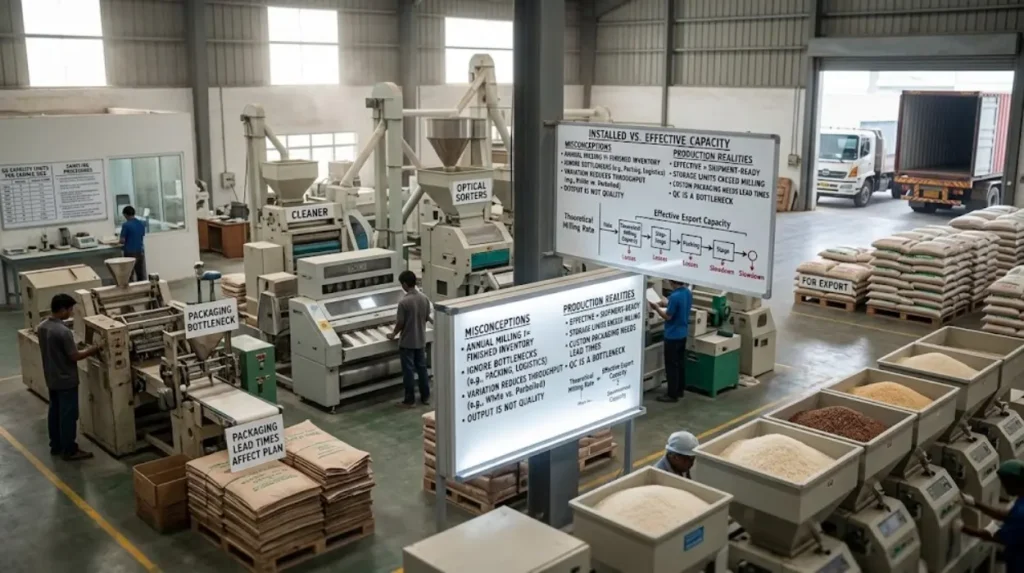
One common misconception is that annual capacity equals available inventory. It does not. A factory can have an annual processing figure while current raw-material inventory remains insufficient for a large order.
Another problem is ignoring bottlenecks. Milling can operate quickly while packing, sorting, warehousing, or container loading operates more slowly.
Product variation also affects throughput. White rice, steam rice, and parboiled products use different processing sequences. The same facility does not necessarily achieve the same daily output for every product.
Packaging creates another constraint. A large order requiring custom printed bags needs packaging materials before final packing can begin. Production planning therefore includes procurement lead times for packaging.
Quality control can also become a bottleneck if inspection resources do not scale with production. Every large production program still requires defined sampling, testing, release, and traceability procedures.
The most important distinction is between installed capacity and practical export capacity. Installed capacity describes what equipment can theoretically process. Practical export capacity describes what the complete operation can produce, verify, pack, store, and load while meeting the required specification and delivery schedule.
For large rice import programs, that distinction determines whether an exporter can support one large shipment or maintain a repeatable supply program.
Frequently Asked Questions
Why is production capacity important for large rice import programs?
Production capacity determines whether a rice exporter can supply the required volume consistently while maintaining agreed quality specifications, packaging standards, and shipment schedules.
What does rice production capacity mean?
Rice production capacity is the amount of rice an exporter can process, grade, pack, store, and prepare for shipment within a defined period while maintaining required specifications.
How is rice production capacity measured?
Capacity is commonly measured in metric tons per day, month, or year. Importers should also assess milling, sorting, packing, storage, and container-loading capacity separately.
Does high annual production capacity guarantee export reliability?
No. Annual capacity does not guarantee shipment reliability. Importers must also evaluate raw-material availability, practical processing capacity, quality controls, packaging resources, warehouse space, and loading schedules.
How does production capacity affect rice quality?
Adequate capacity allows exporters to maintain controlled processing, sorting, grading, sampling, testing, and packaging procedures as order volumes increase. This supports consistent quality across production lots.
What are the main components of rice production capacity?
Key components include paddy procurement, drying, milling, steaming or parboiling, sorting, grading, packing, finished-rice storage, quality control, labor, utilities, and container loading.
Why does storage capacity matter for large rice orders?
Storage capacity allows finished rice to remain available after processing and before container loading. Insufficient storage can create congestion and disrupt production and shipment schedules.
Which rice varieties require careful production-capacity planning?
1121 Basmati, Super Kernel, and 1509 Basmati require controlled production planning because each variety has specific grain, milling, grading, processing, and quality requirements.