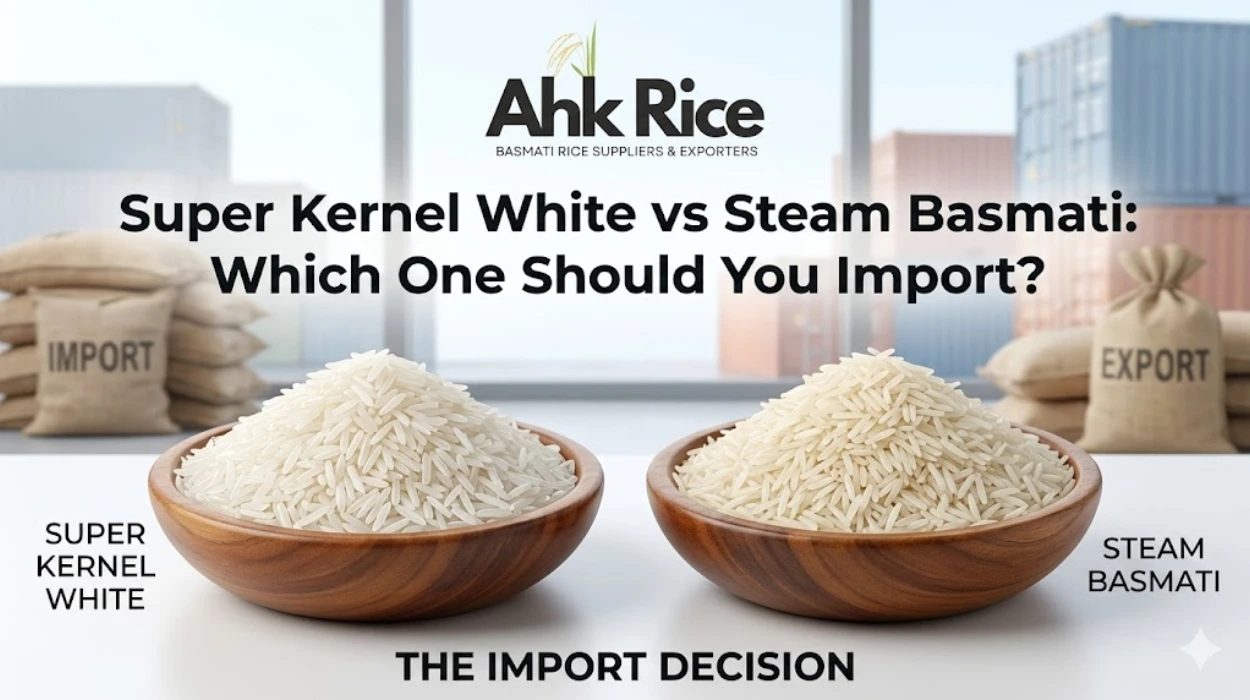
Super Kernel White vs Steam Basmati: Which One Should You Import?
Super Kernel White Basmati suits high-flavour, long-storage export markets, while Steam Basmati suits uniform cooking and modern retail demand. Here is why: processing differences in parboiling versus full polishing change aroma retention, grain elongation, and shelf-life stability across GCC and EU import conditions.
Super Kernel Basmati and Steam Basmati are both processed from long-grain basmati cultivated in Punjab, Pakistan. Exporters like AHK Rice cultivate, mill, dehusk, polish, grade, and dispatch both varieties for 15+ international markets.
Understanding these differences matters because importers choose rice based on cooking behavior, storage stability, and buyer expectations. For aroma science background, read this TOFU guide: Why Super Kernel Basmati Has a Naturally Strong Aroma.
For pricing and procurement strategy, see the BOFU analysis: Super Kernel Basmati Rice Price Per Ton for Importers.
What are the available solutions for importing Super Kernel White vs Steam Basmati?
Super Kernel White Basmati delivers high aroma intensity with soft grain texture, while Steam Basmati delivers stronger grain integrity, lower breakage, and higher cooking consistency for institutional buyers and packaged retail channels.
Super Kernel White and Steam Basmati represent two processing pathways applied to the same basmati genetic base. Both originate from harvested paddy cultivated in Punjab and Sindh regions of Pakistan.
Super Kernel White Basmati undergoes full milling and polishing. Steam Basmati undergoes parboiling before milling. This difference changes starch structure, elongation, and shelf stability.
Processing pathways comparison
Steam processing strengthens internal grain structure. White polishing increases aroma release but reduces structural hardness.
Specification comparison table (7 attributes)
| Attribute | Super Kernel White | Steam Basmati |
|---|---|---|
| Grain length | 7.4–7.6 mm | 7.35–7.5 mm |
| Aroma intensity | Very high | Medium-high |
| Cooking elongation | Up to 2.1× | Up to 2.3× |
| Breakage ratio | Low–medium | Very low |
| Color | Bright white | Creamy translucent |
| Shelf stability | 12–14 months | 16–18 months |
| Processing type | Fully milled & polished | Parboiled & steamed |
Super Kernel White prioritizes aroma release and premium dining appeal. Steam Basmati prioritizes structural stability and transport resilience.
With processing pathways defined, the next step is understanding how these approaches compare across export performance metrics.
How do Super Kernel White and Steam Basmati approaches compare?
Steam Basmati provides higher structural integrity and export stability, while Super Kernel White provides stronger aroma expression and premium dining value across Gulf foodservice markets and South Asian retail consumption.
The comparison depends on processing intensity and starch transformation. Steam processing gelatinizes starch before milling. White polishing removes bran completely after drying.
This difference affects cooking behavior in commercial kitchens and household consumption patterns.
Market region preference comparison
Gulf Cooperation Council (GCC): Steam Basmati dominates demand at 65–70% share due to catering stability (source: REAP export data, 2025).
United Kingdom and EU ethnic retail: Super Kernel White dominates premium shelves due to aroma preference and visual appeal.
Regional behavior insights
- GCC catering buyers prioritize bulk cooking consistency in hotels and restaurants.
- EU retail buyers prioritize fragrance, appearance, and branded packaging appeal.
- Iraqi and Saudi importers store rice in high-temperature warehouses. Steam performs better in such conditions.
- UK retail chains require uniform grain presentation for consumer packaging compliance.
Price per metric ton comparison
Super Kernel White: $1,050–$1,250 per MT depending on crop year and broken ratio.
Steam Basmati: $1,100–$1,300 per MT due to higher processing cost and yield stability.
Steam processing increases milling cost but reduces post-shipment losses. White rice commands higher retail margins due to aroma-driven pricing.
Shelf-life comparison under real conditions
Super Kernel White maintains quality for 12–14 months in controlled storage at 25°C. It degrades faster in humid Gulf warehouses.
Steam Basmati maintains quality for 16–18 months even at 35–40°C warehouse conditions. It resists moisture absorption due to parboiling stabilization.
For Iraqi catering importers storing rice without climate control, Steam Basmati provides lower risk of spoilage and breakage.
With comparison dynamics established, the next focus shifts to which method works best for specific import cases.
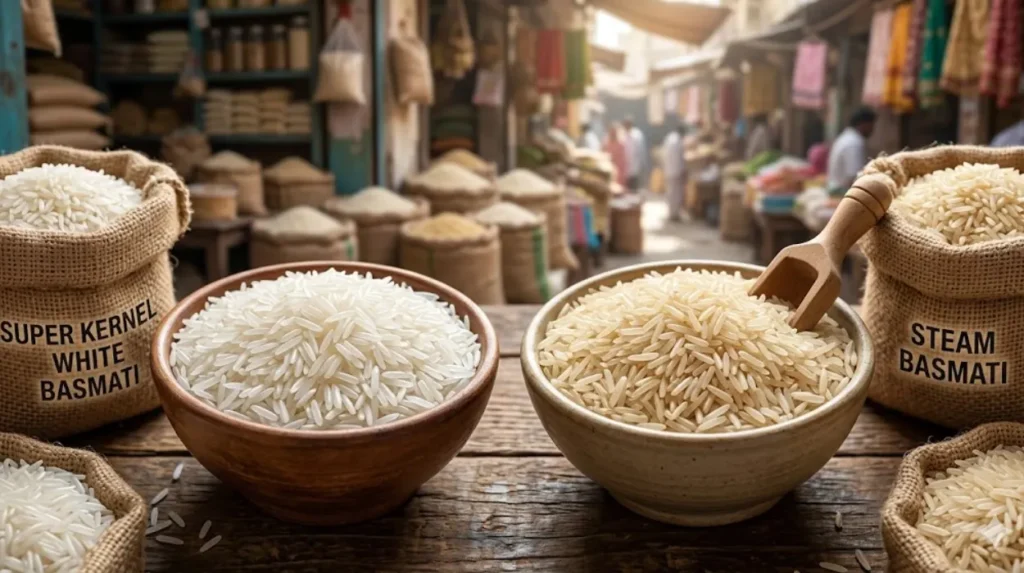
Which method works best for different import cases?
Steam Basmati works best for bulk catering, long logistics routes, and high-temperature storage markets, while Super Kernel White works best for premium retail, aroma-focused branding, and restaurant fine dining segmentation.
Import decision depends on buyer type, storage infrastructure, and end-consumption pattern. Both varieties serve distinct supply chain functions.
Use-case mapping
- Hospitality procurement → Select Steam Basmati for consistent cooking output in bulk kitchens
- Retail packaging brands → Select Super Kernel White for premium shelf differentiation
- Government tenders → Select Steam Basmati for low wastage and transport resilience
- Specialty ethnic stores → Select Super Kernel White for aroma-driven consumer demand
Performance in cooking environments
Steam Basmati produces firmer grains after boiling. It resists overcooking in high-volume kitchens. Super Kernel White produces softer texture with stronger fragrance release.
Steam rice holds structure in biryani preparation under long simmer cycles. White rice performs better in pilaf and light aromatic dishes.
Logistics resilience comparison
Steam Basmati survives long sea freight routes exceeding 30–45 days without quality loss. Super Kernel White requires stricter humidity control during shipping.
With use-case segmentation clarified, the next section evaluates strengths and weaknesses of each processing approach.
What are the pros and cons of each rice type?
Super Kernel White offers superior aroma and premium culinary positioning, while Steam Basmati offers superior durability, lower breakage, and higher export reliability across variable climate zones.
Each rice type serves different commercial objectives. Exporters evaluate them based on yield, customer satisfaction, and logistical risk.
Super Kernel White advantages
- Aroma enhancement → Releases stronger fragrance during cooking due to full polishing
- Visual appeal → Produces bright white grain preferred in retail packaging
- Market premium → Commands higher retail pricing in EU ethnic stores
Super Kernel White limitations
- Moisture sensitivity → Absorbs humidity faster in Gulf warehouses
- Lower stability → Breakage increases during long shipping cycles
- Shorter shelf life → Requires faster turnover in distribution chains
Steam Basmati advantages
- Structural strength → Maintains integrity during transport and cooking
- Storage stability → Performs well in high-temperature environments
- Reduced wastage → Lower broken percentage during milling and shipping
Steam Basmati limitations
- Lower aroma release → Slight reduction in fragrance intensity
- Higher processing cost → Requires parboiling infrastructure
- Longer processing cycle → Increases production lead time
With strengths and weaknesses clarified, the next step is understanding the decision factors that influence importer selection.
What decision factors should importers evaluate?
Importers should evaluate storage climate, buyer segment, logistics duration, price tolerance, and cooking application before selecting between Super Kernel White and Steam Basmati for bulk procurement.
Decision-making in basmati import depends on measurable supply chain constraints. Each factor directly influences profitability and customer satisfaction.
Decision framework table (5 rows)
| Factor | Super Kernel White | Steam Basmati |
|---|---|---|
| Storage climate | Controlled required | Heat resistant |
| Shipping distance | Short–medium routes | Long sea routes |
| Buyer segment | Premium retail | Institutional catering |
| Breakage risk | Moderate | Very low |
| Price sensitivity | Higher margin | Cost-efficient bulk |
Climate-driven decision logic
Hot and humid regions increase grain degradation risk. Steam Basmati reduces that risk due to parboiling starch stabilization.
Buyer segmentation logic
Retail consumers prioritize aroma perception. Institutional buyers prioritize consistency and yield per cooking batch.
Economic decision logic
Super Kernel White increases retail margins but requires tighter inventory control. Steam Basmati reduces wastage and improves bulk contract efficiency.
AHK Rice supports both sourcing models through cultivation, milling, grading, and export dispatch systems across Punjab production zones.
With decision factors established, the final step is summarizing the optimal import strategy.
Final import strategy: which one should you choose?
Steam Basmati is the optimal choice for large-scale, climate-sensitive, and institutional import contracts, while Super Kernel White is the optimal choice for premium retail branding and aroma-driven consumer markets.
Importers operating in GCC hospitality supply chains benefit from Steam Basmati due to storage resilience and consistent cooking behavior. Retail importers in Europe and niche ethnic markets benefit from Super Kernel White due to sensory appeal and branding strength.
AHK Rice integrates both varieties into export portfolios, ensuring grading, certification, and shipment alignment with destination market requirements.
Frequently Asked Questions
What is the main difference between Super Kernel White and Steam Basmati?
Super Kernel White is fully milled and polished, which enhances aroma and gives a premium white appearance. Steam Basmati is parboiled before milling, which strengthens the grain structure and improves cooking consistency.
Which rice type is better for long-distance import and shipping?
Steam Basmati is better for long-distance shipping because it has lower breakage and higher resistance to heat and humidity. It maintains quality better during long sea freight routes.
Which variety is preferred for premium retail markets?
Super Kernel White is preferred for premium retail markets, especially in Europe and ethnic grocery stores, because of its strong aroma, bright appearance, and high consumer appeal.
Which rice is more suitable for bulk catering and hospitality use?
Steam Basmati is more suitable for bulk catering and hospitality use because it cooks consistently in large volumes and remains stable during long cooking cycles in commercial kitchens.
Which option is more cost-effective for importers?
Steam Basmati is generally more cost-effective for large-scale importers due to lower wastage, reduced breakage, and better storage stability. However, Super Kernel White can offer higher retail margins in premium segments.