Why Should Michigan Buyers Review a Supplier’s Export History?
Michigan buyers should review a rice supplier’s export history because previous shipments provide evidence of product consistency, documentation accuracy, regulatory familiarity, packaging control, and delivery execution. For imported Pakistani Basmati rice, this history helps buyers distinguish operational capability from sales claims before entering a supply arrangement.
Export history means the documented record of a supplier’s previous international shipments. It includes destination countries, product varieties, shipment quantities, packaging formats, export documents, inspection records, customer requirements, and shipment outcomes. A useful history covers multiple transactions rather than one completed order.
For a Michigan importer, distributor, wholesaler, restaurant supplier, or ethnic-food retailer, the assessment starts with the supplier’s experience exporting food products into regulated markets. The United States applies the same basic food safety requirements to imported and domestically produced foods. Imported food also requires compliance with FDA import procedures and Prior Notice requirements.
What is export history in the Pakistani Basmati rice trade?
Export history is a supplier’s documented record of international rice shipments, showing what varieties were shipped, where they went, how they were documented, and whether specifications remained consistent across completed commercial transactions.
A Pakistani Basmati rice exporter operates within a chain that starts in agricultural production and ends with international delivery. Pakistan’s major Basmati-producing areas are concentrated in Punjab, where rice cultivation supports varieties such as 1121 Basmati, Super Kernel Basmati, and 1509 Basmati.
The export history therefore needs to be evaluated at several levels.
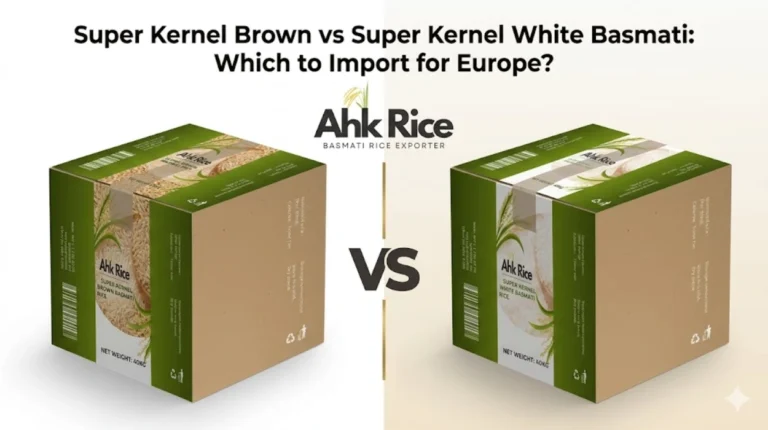
A buyer should identify the rice variety, grain length, broken percentage, moisture specification, milling type, packaging weight, and quantity supplied. Examples include 1121 Steam Basmati in 5 kg retail bags, Super Kernel White Rice in 25 kg bags, and 1509 Steam Basmati in 40 kg commercial sacks.
The buyer should also identify destination markets. Exporting rice to Saudi Arabia, the United Arab Emirates, the United Kingdom, or the United States exposes the supplier to different documentation, labeling, buyer specifications, logistics, and compliance requirements.
For Michigan buyers, previous U.S. shipments have particular value because they demonstrate familiarity with the American import environment.
How does a rice supplier build and demonstrate export experience?
A rice supplier builds export experience through repeated cycles of procurement, milling, quality inspection, packaging, documentation, container loading, customs processing, international transportation, and delivery while maintaining defined product specifications.
The process begins with paddy procurement. Paddy rice is received according to variety, moisture, maturity, and quality requirements. The raw material then moves through cleaning and pre-processing.
How is Pakistani Basmati rice processed before export?
The first stage is cleaning. Foreign material, dust, stones, straw, and other unwanted material are removed.
The second stage is dehusking. The outer husk is separated from the rice kernel.
The third stage is paddy separation. Paddy that retains its husk is separated from brown rice and returned for additional processing.
The fourth stage is whitening and polishing. The bran layers are removed according to the required milling specification.
The fifth stage is grading. Rice passes through equipment that separates kernels according to length, thickness, broken percentage, and other physical specifications.
The sixth stage is sorting. Optical sorting systems identify and remove discolored or defective kernels.
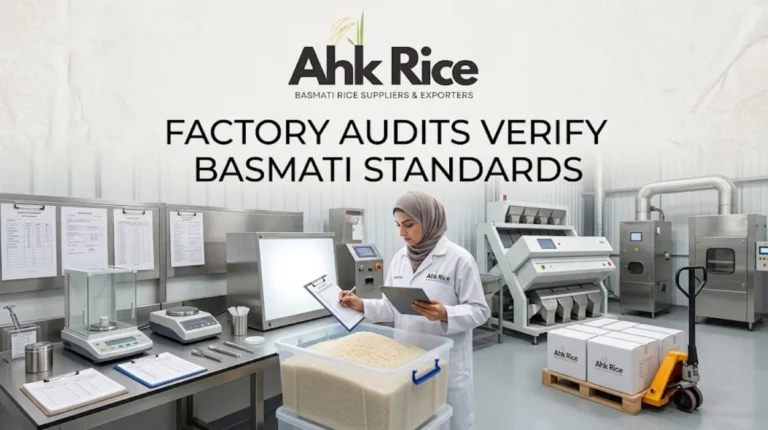
The seventh stage is quality inspection. Samples are checked against the agreed specification. Common parameters include moisture, broken kernels, foreign matter, damaged grains, grain length, chalkiness, and purity.
The eighth stage is packaging. The exporter packs the rice into the agreed retail, food-service, wholesale, or private-label format.
The ninth stage is container loading. Finished bags are loaded according to the agreed quantity, container configuration, packaging condition, and shipment documentation.
A supplier with repeated export activity has operational records across these stages. That makes export history a practical indicator of process maturity.
Which components should Michigan buyers examine in an export history?
Michigan buyers should examine destination markets, shipment frequency, product specifications, quantities, documentation, packaging, quality records, regulatory experience, logistics performance, and corrective-action history because these components reveal how consistently an exporter manages international supply requirements.
The first component is destination experience. Previous shipments to the United States provide stronger evidence for a Michigan buyer than exports limited to unrelated markets.
The second component is product experience. A supplier exporting 1121 Basmati should demonstrate actual experience with 1121 specifications rather than relying on general rice-export experience.
The third component is shipment volume. A history containing several container-scale shipments demonstrates experience with commercial quantities. Examples include 1-container, 5-container, and recurring monthly programs.
The fourth component is specification control. Buyers should compare previous specifications with the specification required for their own program.
The fifth component is documentation control. Export transactions require commercial invoices, packing lists, transport documents, certificates, and other documents applicable to the product and destination.
The sixth component is food-safety verification. U.S. food importers subject to the Foreign Supplier Verification Program, or FSVP, must evaluate foreign suppliers and establish appropriate verification activities. FDA identifies supplier performance, food-safety history, hazard analysis, verification activities, and corrective actions as important elements of this process.
The seventh component is traceability. A supplier should be able to connect finished rice to production and shipment records.
The eighth component is logistics performance. Buyers should examine whether previous shipments followed agreed production, loading, documentation, and transportation schedules.
Why does export history reduce supply chain risk?
Export history reduces supply chain risk by replacing assumptions with transaction evidence. Repeated shipments show whether a supplier can maintain specifications, prepare documents, meet loading schedules, respond to quality issues, and operate within international food-import requirements.
International supply chains contain several independent risk points. A rice order can fail through inconsistent raw material, milling variation, incorrect packaging, documentation errors, delayed production, container problems, or import compliance issues.
Export history helps a buyer investigate these points before placing a commercial order.
For example, a supplier with previous U.S. shipments has already operated within a framework involving FDA requirements, U.S. customs procedures, transportation documentation, and destination-specific compliance. This does not automatically establish compliance for a new shipment, but it provides evidence of previous operational exposure.
FDA states that FSVP applies to covered food importers and requires an FSVP for each food and foreign supplier, unless an exemption or modified requirement applies. Verification activities can include sampling and testing, records review, and audits based on the risk evaluation.
Export experience therefore supports the buyer’s supplier-evaluation process rather than replacing it.
For a detailed explanation of how previous international activity translates into lower operational exposure, the buyer can also review:
How export experience reduces international supply chain risks.
Which benefits does export history provide to Michigan buyers?
A verified export history gives Michigan buyers stronger supplier-evaluation evidence, clearer expectations for product consistency, better documentation visibility, lower communication risk, and a practical basis for comparing suppliers before signing recurring international rice supply agreements.
The first benefit is specification confidence. Previous shipments demonstrate whether the exporter has handled the required variety and grade.
The second benefit is documentation confidence. Repeated international shipments require coordinated commercial and regulatory records.
The third benefit is regulatory familiarity. A supplier that has exported food into the United States has experience operating within the U.S. import environment.
The fourth benefit is logistics visibility. Shipment history provides evidence of how the exporter manages production completion, container loading, and international transportation.
The fifth benefit is quality-control assessment. Buyers can review laboratory reports, inspection records, product specifications, and corrective-action records where available.
The sixth benefit is supplier comparison. Two exporters can offer the same nominal rice variety while having very different levels of documented international experience.
The seventh benefit is contract planning. Historical shipment volumes help buyers determine whether a supplier has experience handling one-time purchases, recurring container programs, or larger annual requirements.
Which export-history use cases matter most in Michigan?
Export history matters most when Michigan buyers compare new suppliers, establish recurring rice programs, introduce private-label products, purchase multiple containers, or source imported Basmati rice for distribution across retail, wholesale, restaurant, and food-service channels.
A new supplier evaluation uses export history to verify whether an exporter has completed comparable international transactions.
A recurring supply program requires stronger evidence because repeated shipments must maintain the same variety, grade, packaging, and quality parameters.
A private-label program requires packaging and documentation control in addition to rice-quality consistency. The supplier must reproduce the approved packaging specification across subsequent production runs.
A food-service program focuses heavily on cooking performance, grain appearance, broken percentage, packaging durability, and repeatability.
A wholesale distribution program requires commercial quantities and reliable shipment scheduling.
A retail program adds consumer-facing packaging, labeling, weight declarations, and product presentation requirements.
For imported plant products, requirements also depend on the commodity and country of origin. USDA APHIS directs importers to its Agricultural Commodity Import Requirements database for applicable plant and plant-product requirements.
This makes destination-specific experience useful, but buyers still need to verify the requirements applying to each shipment.
Which certifications and documents should be connected to export history?
Certifications and shipment documents should support the supplier’s operational record rather than stand alone. Buyers should connect food-safety certifications, laboratory reports, facility records, commercial documents, and applicable regulatory paperwork to the specific product and shipment program.
Certification requirements depend on the buyer, product, facility, destination, and applicable regulation. A certification logo alone does not prove that a specific shipment satisfies every contractual or regulatory requirement.
For U.S. food imports, the importer remains responsible for applicable FDA requirements. FDA identifies food facility registration, Prior Notice, and FSVP among the major areas relevant to importing food into the United States.
Relevant supplier records can include:
- Food-safety management certifications such as HACCP- or ISO 22000-based systems where applicable
- Third-party audit reports where required by the buyer
- Laboratory analysis for moisture, microbiological parameters, pesticides, contaminants, or other contractual requirements
- Certificate of Analysis records
- Commercial invoice and packing list
- Bill of lading
- Certificate of origin
- Product specification sheet
- Packaging and labeling specifications
- Inspection or quality-control records
- Applicable phytosanitary or other agricultural documentation when required by the commodity and import rules
CBP and USDA APHIS coordinate agricultural import enforcement at U.S. ports, and APHIS states that required certificates and permits depend on the regulated product.
The correct approach is to match each document to the specific shipment, product, and destination requirement.
What are the common misconceptions about supplier export history?
Export history does not mean a supplier is automatically suitable. Ten years in business, a large shipment count, or exports to 15 countries do not replace product testing, supplier verification, specification review, documentation checks, or regulatory assessment.
One misconception is that years in business equal export capability. A company can operate for many years while having limited experience with a specific product or destination.
Another misconception is that exporting to many countries guarantees U.S. compliance. U.S. requirements remain specific to the imported food and importer responsibilities.
A third misconception is that certification alone proves product quality. Certification addresses defined systems or requirements. It does not eliminate the need to verify the contracted rice specification.
A fourth misconception is that one successful shipment proves consistency. Recurring programs require evidence across multiple production and shipment cycles.
A fifth misconception is that export volume is more important than relevance. Ten large shipments of another commodity provide less useful evidence than several completed shipments of the same Basmati variety and packaging format.
A sixth misconception is that supplier history replaces FSVP. It does not. Covered U.S. importers must establish and follow the applicable FSVP requirements for imported food and foreign suppliers.
How should a Michigan buyer evaluate a supplier’s export history?
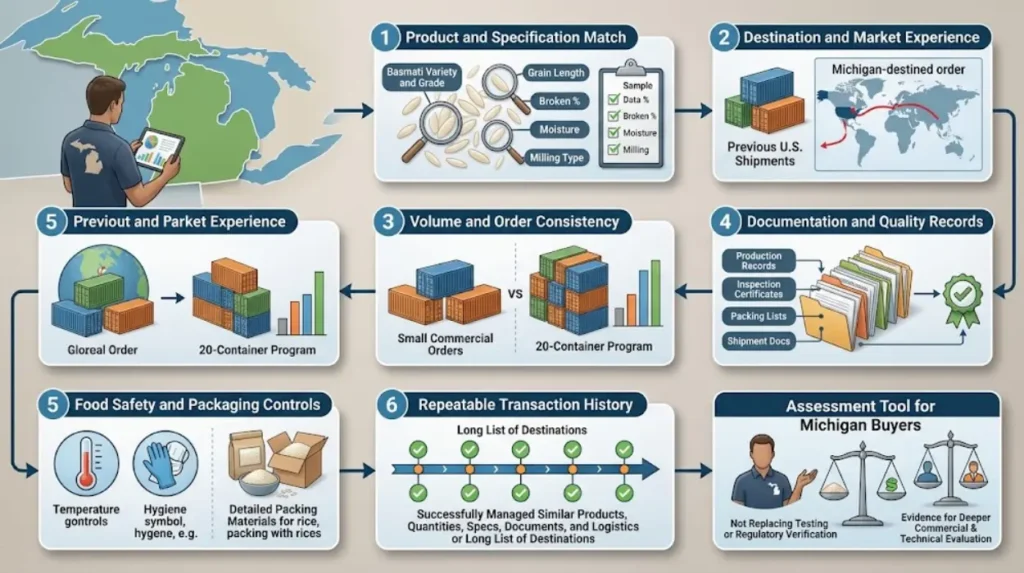
A Michigan buyer should evaluate export history by matching previous shipments against the intended product, destination, volume, specification, documentation, food-safety controls, packaging, and delivery requirements rather than judging experience from company age or shipment counts alone.
Start with the product. Confirm the exact Basmati variety and grade.
Next, review destination history. Give greater weight to previous U.S. shipments when the intended market is Michigan.
Then compare shipment quantities. A supplier experienced with 20-container programs provides different operational evidence from a supplier experienced only with small commercial orders.
Review specifications next. Compare grain length, broken percentage, moisture, purity, milling type, packaging, and other contractual parameters.
Examine documentation and quality records. Check whether the supplier maintains organized records that connect production, inspection, packing, and shipment.
Finally, assess consistency across transactions. A strong export history is not simply a long list of destinations. It is a repeatable record showing that the supplier managed similar products, quantities, specifications, documents, and logistics successfully.
For Michigan buyers, this approach turns export history into a practical supplier-assessment tool. It does not replace testing or regulatory verification. It gives the buyer evidence for deciding which suppliers deserve deeper commercial and technical evaluation.
Frequently Asked Questions
Why should Michigan buyers review a rice supplier’s export history?
Michigan buyers should review export history to verify a supplier’s experience with international shipments, product specifications, documentation, quality control, and logistics before placing commercial orders.
What does a rice supplier’s export history include?
Export history includes previous destinations, rice varieties, shipment quantities, packaging formats, quality records, export documents, certifications, and shipment performance.
Why is U.S. export experience important for Michigan rice buyers?
Previous U.S. export experience shows that a supplier has operated within the American food-import environment and understands applicable documentation, regulatory, and logistics requirements.
Does export history guarantee rice quality?
No. Export history provides evidence of operational experience, but buyers still need to verify product specifications, laboratory results, certifications, samples, and contractual quality requirements.
Which Pakistani Basmati rice varieties can Michigan buyers source?
Michigan buyers can source varieties such as 1121 Basmati, Super Kernel Basmati, and 1509 Basmati, depending on the required grain length, milling type, cooking characteristics, and commercial specification.
What documents should Michigan buyers request from a rice supplier?
Buyers can request product specifications, Certificate of Analysis records, commercial invoices, packing lists, certificates of origin, bills of lading, inspection records, applicable agricultural certificates, and food-safety documentation.