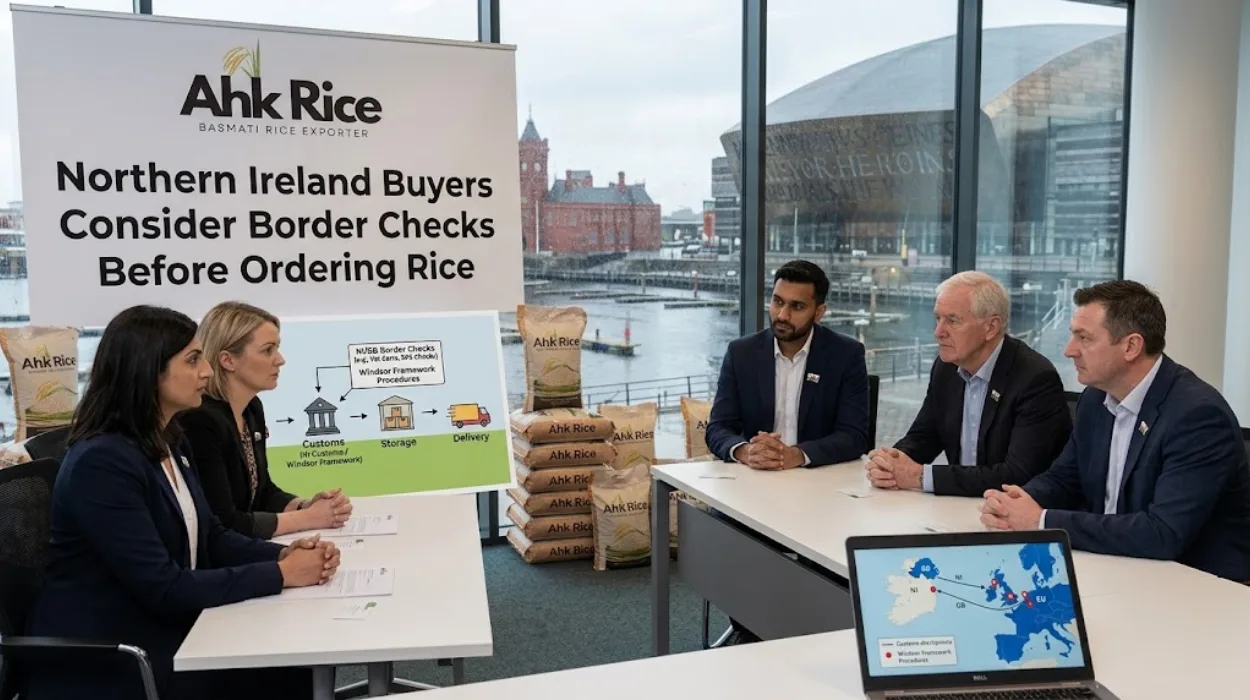
Why Do Northern Ireland Buyers Consider Border Checks Before Ordering Rice?
Northern Ireland rice buyers consider border checks because imported rice from Pakistan enters a market where EU food-safety rules continue to apply, and Pakistan-origin rice is subject to specific official controls for contaminants. Here is why: Northern Ireland remains aligned with EU food law, while rice from Pakistan is listed for controls covering aflatoxins and ochratoxin A.
What Are Border Checks for Rice Entering Northern Ireland?
Border checks verify the identity, documentation, food-safety status, origin, and compliance of a rice consignment before it enters Northern Ireland. For Pakistan-origin rice, controls focus particularly on food-safety risks identified under EU import-control rules.
Border checks are official controls applied to imported food. They protect consumers and confirm that imported products meet the rules governing the Northern Ireland market. Northern Ireland follows EU food law under the Windsor Framework.
Rice is a cereal and a food of non-animal origin. UK guidance states that rice imported from third countries must meet equivalent food-hygiene requirements to domestically produced cereals. Rice normally does not require a general health certificate for ordinary cereal imports.
Pakistan-origin rice has an additional consideration. EU Regulation 2019/1793 lists rice from Pakistan for increased official controls covering aflatoxins and ochratoxin A. The current regulation specifies a 10% identity and physical check frequency for the listed rice category.
This distinction matters to buyers. A normal food import requirement is different from a commodity-specific control. The importer must identify the exact rice classification, origin, route, and applicable control before shipment.
A buyer ordering Pakistani Basmati rice therefore evaluates border compliance alongside grain quality, packaging, price, and shipping arrangements.
With the border-check definition established, the next question is how a rice shipment moves through this control system.
How Does the Northern Ireland Rice Import Process Work?
The process starts with commodity classification and documentation, continues through pre-notification and official inspection where required, and ends with release, rejection, or another authority-directed outcome based on compliance.
How Is the Rice Classified?
Rice classification identifies the commodity by its physical and processing characteristics. UK tariff guidance distinguishes paddy, husked, semi-milled, wholly milled, and broken rice. Long-grain rice also has specific classification criteria.
Basmati is a long-grain aromatic rice. UK guidance identifies Kernel Basmati as a Pakistani Basmati variety and recognises Basmati as slender, fragrant, and non-glutinous.
The classification affects customs treatment and documentation. A buyer therefore needs the correct commodity code before arranging the shipment.
What Happens Before Arrival?
Pre-arrival preparation connects the importer, exporter, carrier, customs representative, and competent authorities. Required documentation depends on the commodity and control category.
Documents can include commercial invoices, packing information, transport documents, laboratory evidence, certificates, and import-control records. High-risk food consignments use specific procedures involving official control documentation.
Northern Ireland has designated Points of Entry for agri-food controls. These include Belfast Port, Larne Harbour, Warrenpoint Port, and Foyle Port.
What Happens During Inspection?
Officials can inspect documentation, identify the consignment, examine the product, and arrange sampling or laboratory analysis under the applicable control regime.
Pakistan-origin rice receives particular attention because EU legislation identifies aflatoxins and ochratoxin A as contaminants requiring increased controls. EU legislation also records the food-safety basis for increased controls on rice from Pakistan.
The buyer therefore needs the shipment specification and test evidence to match the physical cargo.
With the process established, the next question is which components buyers need to control before ordering.
What Are the Key Components of a Border-Ready Rice Shipment?
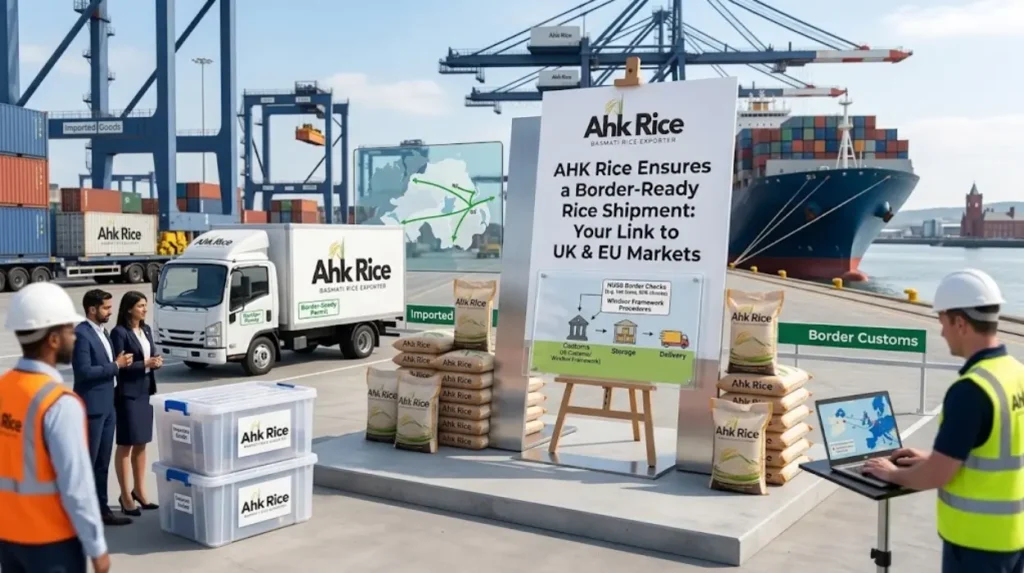
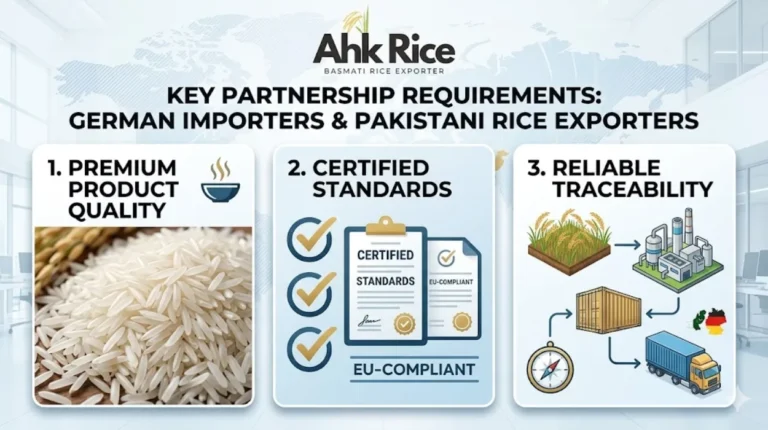
A border-ready rice shipment combines correct classification, accurate origin details, compliant packaging, traceable documentation, suitable laboratory evidence, and a product specification that matches the physical cargo presented for inspection.
What Product Details Matter?
Product details include rice variety, processing type, grain condition, packaging format, net weight, country of origin, and commodity code.
Common Pakistani Basmati varieties include 1121, Super Kernel, and 1509. Processing forms include white milled rice, parboiled rice, and other commercially defined grades.
The exporter should keep product descriptions consistent across invoices, packing lists, labels, specifications, and certificates.
What Quality Evidence Matters?
Quality evidence supports compliance with food-safety requirements. Laboratory testing can examine contaminants and residues relevant to the applicable import rules.
For Pakistani rice, aflatoxins and ochratoxin A are particularly important under the EU control framework. Pesticide residues also form part of the wider food-safety assessment applied to imported food.
A UK rice-industry submission also describes testing of rice from Pakistan for mycotoxins, agrochemical residues, and, in some cases, heavy metals.
Which Certifications Apply?
Certification depends on the exact commodity and control category. High-risk food products can require official certification, laboratory reports, and CHED-D procedures. Ordinary cereal imports do not automatically require a general health certificate.
Organic rice has additional certification requirements because organic status requires recognised organic conformity controls. A buyer should therefore separate food-safety certificates, laboratory reports, organic certification, and customs documents rather than treating them as one document type.
With the shipment components defined, the next question is why this preparation matters commercially.
What Benefits Do Border Checks Provide to Northern Ireland Rice Buyers?
Border checks provide documented assurance that imported rice meets applicable food-safety requirements, while pre-shipment preparation reduces documentation mismatches, testing problems, cargo delays, and uncertainty over the shipment’s regulatory status.
How Do Checks Support Food Safety?
Food-safety controls examine risks that buyers cannot reliably identify through appearance alone. A clean-looking rice grain does not prove that contaminant levels comply with legal limits.
Laboratory testing provides measurable evidence. This matters particularly for Pakistan-origin rice because EU controls specifically address aflatoxins and ochratoxin A.
How Do Checks Support Traceability?
Traceability connects the finished rice to the responsible food businesses and supply-chain records. UK food law requires food businesses to maintain records identifying suppliers and businesses receiving their products.
Traceability therefore links the rice variety, lot, origin, exporter, importer, packaging, and distribution records.
How Do Checks Improve Purchasing Decisions?
Border requirements influence purchasing decisions before a container is loaded. A buyer can request the product specification, testing evidence, packaging details, and relevant certificates before confirming the order.
This approach moves compliance work from the arrival stage to the procurement stage.
With the benefits established, the next question is where Northern Ireland buyers apply this knowledge.
Where Do Northern Ireland Buyers Use Border-Check Planning?
Northern Ireland buyers use border-check planning for direct imports from Pakistan, supplier selection, container procurement, retail packaging, food-service supply, and shipments routed through Great Britain before reaching Northern Ireland.
How Does Direct Pakistan-to-Northern Ireland Importing Differ?
A direct Pakistan-to-Northern Ireland shipment enters Northern Ireland from a non-EU third country. Northern Ireland applies EU food law to food placed on its market.
The buyer therefore considers the applicable EU import-control regime, the designated entry point, customs requirements, and the documentation accompanying the rice.
How Does a GB Route Change the Planning?
A Great Britain route creates a different regulatory movement. Goods moving from Great Britain to Northern Ireland operate under Windsor Framework arrangements.
The UK Government is also negotiating a UK-EU SPS agreement. Its intended implementation date is mid-2027, subject to negotiations. Current arrangements therefore remain relevant for buyers ordering rice today.
Buyers should not apply future SPS arrangements to current shipments. The exact future requirements remain subject to implementation.
Which Business Uses Need More Preparation?
Retailers need accurate product descriptions and compliant consumer information. Food-service distributors need consistent lot traceability and commercial documentation. Wholesalers need documentation that supports onward distribution.
A buyer importing multiple rice grades also needs separate product specifications for each grade. Mixing 1121, Super Kernel, and 1509 descriptions within one document creates avoidable classification and traceability problems.
With these use cases defined, the final issue is understanding the most common misconceptions.
What Common Problems and Misconceptions Affect Rice Imports?
The main misconceptions involve assuming every rice shipment needs the same certificate, treating customs clearance as food-safety clearance, ignoring Pakistan-specific controls, and assuming future UK-EU SPS changes already apply to current Northern Ireland shipments.
Does Every Rice Shipment Need a Health Certificate?
No. UK cereal guidance states that rice imports normally do not require a general health certificate. Specific high-risk controls create different requirements for listed products and origins.
The correct approach is to identify the commodity and control category first.
Does Customs Clearance Mean Food Compliance?
No. Customs procedures and food-safety controls address different requirements. A shipment can have correct commercial customs information while still requiring food-control documentation or inspection.
Importers therefore need both customs and food-compliance planning.
Are Pakistan Rice Controls Only About Pesticides?
No. Current EU rules identify aflatoxins and ochratoxin A for Pakistan-origin rice. Current GB restrictions also list Pakistan rice for pesticide residues, aflatoxins, and ochratoxin A, although that GB guidance applies to England and Wales.
Northern Ireland buyers should therefore use the applicable NI and EU rules rather than copying a GB checklist without checking the route.
Do Future SPS Rules Already Apply?
No. The proposed UK-EU SPS agreement is intended to take effect in mid-2027, subject to negotiations. Current Windsor Framework and EU-aligned requirements remain relevant until the new arrangements take effect.
For a practical explanation of how authorities review imported food at entry points, the next-stage resource should explain how imported food shipments are reviewed at UK entry points.
What Should Buyers Check Before Ordering Pakistani Rice?
Buyers should confirm the rice classification, country of origin, applicable import controls, testing requirements, documentation, packaging details, entry route, and responsible importer before approving a Pakistani rice shipment for Northern Ireland.
A practical procurement review starts with the product. Confirm the variety, processing grade, pack size, origin, and commodity code.
The second review covers food safety. Confirm applicable contaminant controls and obtain suitable laboratory evidence before dispatch.
The third review covers documentation. Match the invoice, packing list, transport documents, certificates, test reports, product specification, and labels.
The fourth review covers logistics. Confirm the intended Point of Entry and the party responsible for import formalities.
The fifth review covers regulatory timing. Current Northern Ireland rules apply to current shipments. The proposed SPS agreement is a future change and is not yet the current import regime.
Border checks therefore belong in the purchasing decision before the rice is loaded. They are not simply an issue for the port or customs broker after dispatch.
What Questions Do Buyers Commonly Ask About Northern Ireland Rice Imports?
Does Pakistani Basmati rice face border controls in Northern Ireland?
Yes. Pakistan-origin rice is subject to EU increased official controls for aflatoxins and ochratoxin A, with the current regulation specifying a 10% identity and physical check frequency.
Which Pakistani Basmati varieties can buyers specify?
Common commercial varieties include 1121, Super Kernel, and 1509. Buyers should state the exact variety and processing type in the purchase specification.
Does every rice shipment require a CHED-D?
No. CHED-D applies to food and feed of non-animal origin within the relevant official-control framework. The requirement depends on the commodity and control category.
Which contaminants matter for Pakistani rice?
Aflatoxins and ochratoxin A are specifically controlled for Pakistan-origin rice under EU Regulation 2019/1793. Pesticide-residue requirements also apply within the broader food-safety framework.