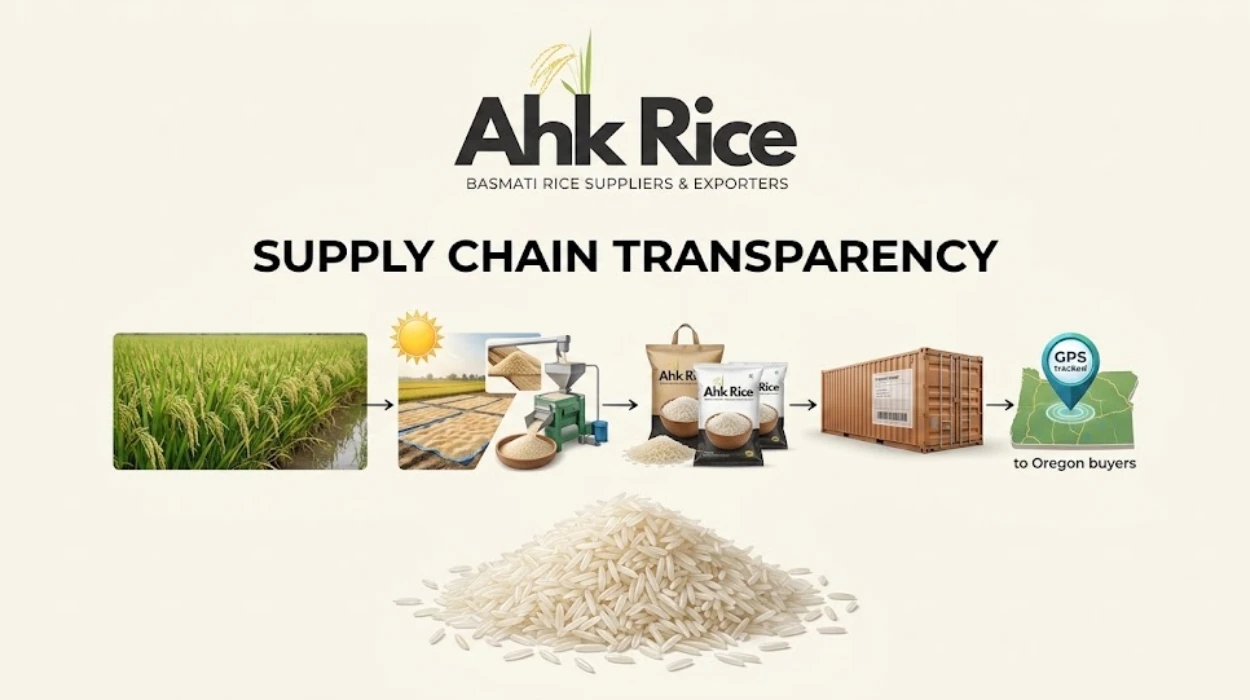
AHK Rice Provides Supply Chain Transparency for Oregon Buyers
Oregon rice buyers should choose an exporter that makes product specifications, quality records, processing status, documents, container movement, and delivery milestones visible before shipment, because supply chain transparency reduces procurement uncertainty and gives importers evidence for quality, compliance, inventory, and supplier-performance decisions.
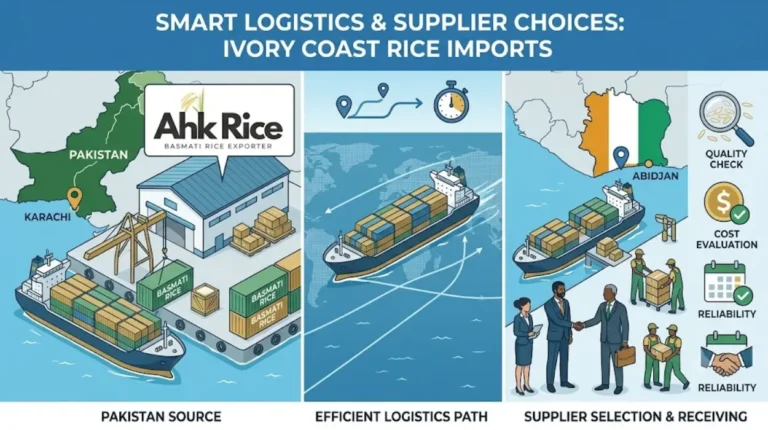
Oregon importers sourcing Pakistani Basmati rice face a longer Pacific Northwest logistics corridor than buyers using some other U.S. gateways. That makes visibility commercially important. A buyer needs to know not only what rice was ordered, but what was produced, tested, packed, shipped, and expected to arrive.
For a deeper explanation of why this matters, see:
Why supply chain visibility matters for rice importers. The principle is straightforward: every physical shipment should have a corresponding information trail. A purchase order should connect with a product specification, batch, inspection record, packing list, container, vessel, customs documentation, and delivery confirmation.
In 2026, this is also a regulatory consideration. FDA states that imported food must meet the same applicable legal requirements as domestically produced food. U.S. food importers remain responsible for safety, sanitary production, compliant labeling, facility registration requirements, and Prior Notice.
What is the best solution for supply chain transparency for Oregon buyers?
The strongest solution is an order-level visibility process connecting rice specifications, batch identification, quality testing, processing, packaging, export documents, container details, vessel milestones, customs status, and final delivery so Oregon buyers can make decisions using one consistent shipment record.
For Oregon buyers, transparency should begin before the purchase order is finalized. The exporter should confirm the rice variety, grade, grain specifications, moisture requirement, broken percentage, purity requirement, packaging, quantity, crop requirement, and destination before production is authorized.
The next stage is production visibility. A buyer should be able to associate the approved specification with the processing batch. This becomes important when several grades are being processed simultaneously. It reduces the risk of a specification being agreed commercially but interpreted differently during production.
AHK Rice approaches export supply through integrated processing and documentation. Its facility in Punjab manages stages including paddy procurement, cleaning, dehusking, paddy separation, whitening, polishing, grading, and length sorting.
Quality records should then connect the finished rice to the same order reference. Typical commercial checks can include moisture, broken grains, foreign matter, grain appearance, purity, and other buyer-agreed specifications. Where required, third-party inspection can provide an additional verification layer.
For an Oregon importer, transparency should continue after loading. Container number, booking reference, vessel, ETD, transshipment point, ETA, destination port, customs progress, and inland delivery should remain connected to the same order.
This is the difference between simply receiving shipping updates and operating a transparent supply chain.
Why choose the USA supply service for Oregon rice procurement?
The USA supply service is appropriate for Oregon buyers because it combines Pakistani Basmati sourcing with product processing, grading, packaging, quality control, export documentation, and shipment coordination, allowing buyers to manage product and logistics requirements through one export relationship.
AHK Rice supplies Pakistani Basmati rice to the U.S. market, including 1121, Super Kernel, and 1509 varieties. Its USA export program is designed around bulk supply and buyer-specific product requirements rather than a single standardized specification.
Explore AHK Rice USA supply for U.S. buyers
For an Oregon distributor, restaurant supplier, wholesaler, or private-label buyer, this structure can reduce coordination between separate milling, packaging, inspection, and export providers. The commercial advantage is accountability. If a specification changes, the change should be reflected in processing, quality verification, packing, and shipping records.
AHK Rice also states that its export operation provides customized packaging, full export documentation support, third-party inspection options, and direct communication with international buyers.
The U.S. compliance environment makes this documentation discipline valuable. FDA’s current import framework requires food importers to meet applicable requirements, while FSVP places verification responsibilities on the U.S. importer. On August 20, 2026, FDA’s Import Alert 99-41 continued to emphasize detention risks for food imported by parties that do not comply with FSVP requirements.
Therefore, an Oregon buyer should evaluate an exporter on more than price. The exporter should demonstrate specification control, documentation capability, product traceability, inspection support, shipment communication, and experience serving the U.S. market.
How many shipping days should Oregon buyers expect from Pakistan?
Oregon buyers should plan around approximately 36–61 days for ocean movement on current Pakistan-to-Pacific Northwest routing indicators, depending on port, carrier, transshipment, and service; final inland delivery, customs, terminal handling, and scheduling require additional contingency beyond ocean transit.
Current 2026 routing data demonstrates why Oregon buyers should avoid using one generic U.S. transit estimate. Published route information shows a fastest Karachi-to-Tacoma container route of about 36 days and a Karachi-to-Seattle route of about 38 days, while other current FCL options can be materially longer.
A current public freight-rate listing also shows approximately 61 days for one Karachi-to-Seattle 40-foot high-cube FCL option and approximately 50 days from Port Qasim to Seattle. These are schedule indicators, not guaranteed delivery commitments.
For Oregon procurement, the practical planning framework is:
| Oregon logistics stage | Planning consideration |
|---|---|
| Pakistan factory preparation | Confirm specification, production, inspection, packing and documents before loading |
| Karachi/Port Qasim departure | Verify booking, ETD, container and vessel information |
| Ocean transit | Approximately 36–61 days on current published Pacific Northwest options |
| Seattle/Tacoma handling | Allow time for discharge, examination, customs and terminal processes |
| Oregon inland delivery | Add trucking and receiving time according to destination warehouse |
| Final inventory receipt | Confirm quantity, packaging, condition and documents against the purchase order |
Port choice also affects visibility. Oregon buyers may use Pacific Northwest gateways and arrange inland transportation into Oregon. FDA identifies Portland among Oregon’s import ports and maintains an Oregon import office covering relevant entry activity.
The decision should therefore be based on the actual booking rather than an assumed transit number. Before approving a purchase order, the buyer should request the planned origin port, destination port, vessel, ETD, ETA, transshipment points, and inland delivery arrangement.
What does the complete rice sample process cost for Oregon buyers?
A practical Oregon sample process starts with product selection and specification confirmation, followed by sample preparation, courier dispatch, buyer testing, commercial approval, and purchase-order conversion; the rice sample itself may be supplied without charge while courier, laboratory, inspection, and document costs remain transaction-specific.
Sampling should happen before a commercial container is approved. The buyer first provides the desired variety, grade, packaging concept, quantity, destination, and technical specification. The exporter then identifies the closest available production specification.
AHK Rice product information states that samples of up to 20 kg can be provided free of rice charge for certain USA products, while the buyer pays the related shipping cost.
A complete Oregon sample workflow can be structured as follows:
| Sample stage | Cost treatment | Buyer decision |
| Rice sample up to 20 kg | Product may be free under stated sample terms | Confirm requested grade |
| International courier | Buyer-paid, quote-specific | Approve delivery cost |
| Buyer laboratory testing | Buyer-paid if independently tested | Verify specification |
| Third-party inspection | Optional; quote-specific | Add when required |
| Commercial approval | No separate standard sample fee stated | Approve specification |
| Bulk order | Quoted according to product and Incoterm | Issue purchase order |
Courier cost should not be presented as a fixed 2026 figure because it varies by sample weight, dimensions, courier account, service level, customs treatment, and Oregon delivery address. A responsible exporter should quote the actual courier charge instead of embedding an artificial universal sample price.
The buyer can also request independent laboratory testing when the procurement program requires it. The laboratory report should identify the tested sample and parameters clearly. If third-party inspection is required, the inspection scope should be agreed before the commercial shipment.
This process creates a stronger purchasing record. The approved sample becomes the physical reference for the bulk specification, while the purchase order defines the commercial requirements.
What results can Oregon buyers expect from transparent rice supply?
Transparent rice procurement should produce clearer specification control, earlier detection of shipment exceptions, stronger documentation readiness, better inventory planning, easier supplier evaluation, and fewer communication gaps because each commercial milestone is connected to identifiable product and logistics information.
The first result is specification consistency. An Oregon buyer can compare the approved specification with production and inspection records before the container departs. That reduces the chance of discovering a product mismatch only after arrival.
The second result is better shipment planning. If the vessel schedule changes, the buyer can update warehouse planning instead of waiting for the original ETA to pass. Pacific Northwest transit variability makes this especially useful for Oregon inventory programs.
The third result is stronger compliance preparation. FDA requires imported food to meet applicable U.S. requirements, and Prior Notice must be provided before covered food shipments are imported.
The fourth result is measurable supplier performance. Buyers can record whether production was completed on time, whether documents were ready, whether the shipment departed as planned, and whether the final quantity and specification matched the purchase order.
The fifth result is better exception management. A delayed laboratory report is different from a vessel delay. A missing document is different from a port congestion issue. Transparent records allow the buyer to assign the correct response to each problem.
AHK Rice’s U.S. supply operation connects processing, quality control, packaging, documentation, and shipping coordination. Its broader export network covers the USA and more than 15 international markets.
Pakistan also remains a significant rice-export origin. USDA’s April 2026 Pakistan Grain and Feed Annual forecasts 2026/27 rice production at approximately 9.8 million metric tons and exports at about 5.0 million metric tons, following projected 2025/26 exports of 4.7 million metric tons.
For Oregon buyers, the commercial implication is clear: supply availability matters, but controlled execution matters just as much.
How should Oregon buyers decide whether AHK Rice is the right supplier?
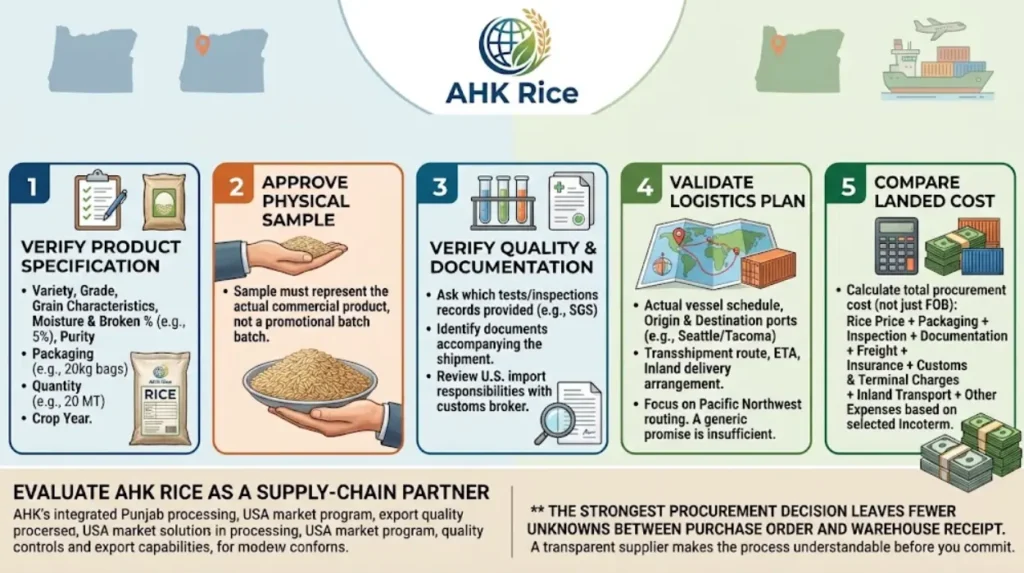
Oregon buyers should approve AHK Rice when its proposed specification, sample, quality controls, documentation process, shipping plan, communication structure, and commercial terms meet the buyer’s requirements; the final decision should compare total procurement risk and landed cost rather than FOB price alone.
The decision can be made through five checks.
First, verify the product specification. The variety, grade, grain characteristics, moisture, broken percentage, purity, packaging, quantity, and crop requirements should be written clearly.
Second, approve the physical sample. The sample should represent the commercial specification rather than being treated as a separate promotional product.
Third, verify quality and documentation. Ask which testing and inspection records will be provided and which documents will accompany the shipment. U.S. import responsibilities should be reviewed with the buyer’s customs broker and compliance team.
Fourth, validate the logistics plan. Oregon buyers should request the actual vessel schedule, origin port, destination gateway, transshipment route, ETA, and inland delivery arrangement. Current Pacific Northwest routing can vary significantly, so a generic transit promise is not sufficient.
Fifth, compare landed cost. The calculation should include rice price, packaging, inspection, documentation, freight, insurance where applicable, customs-related charges, terminal costs, inland transportation, and other destination expenses according to the selected Incoterm.
AHK Rice should therefore be evaluated as a supply-chain partner rather than simply a rice seller. Its integrated Punjab processing operation, USA market program, quality controls, packaging options, and export documentation capabilities provide the infrastructure Oregon buyers need to build a controlled procurement process.
For buyers who want to compare supplier performance and shipment-monitoring practices in more detail, see:
How international rice orders can be monitored effectively.
The strongest procurement decision is the one that leaves fewer unknowns between purchase order and warehouse receipt. A transparent supplier should make the product, process, documents, shipment, and delivery status understandable before the buyer commits to the next container.
Oregon buyers can start by submitting their required variety, grade, quantity, packaging, destination, Incoterm, and target delivery schedule through the AHK Rice request-a-quote process.
Frequently Asked Questions
How does AHK Rice provide supply chain transparency for Oregon buyers?
AHK Rice connects product specifications, processing, quality checks, packaging, export documentation, container details, vessel schedules, and delivery milestones so Oregon buyers can track the order from production through arrival.
What Pakistani Basmati rice varieties can Oregon buyers source from AHK Rice?
Oregon buyers can source Pakistani Basmati rice varieties including 1121, Super Kernel, and 1509, with specifications, grades, packaging, and quantities adjusted according to the commercial requirement.
How long does rice shipping from Pakistan to Oregon take?
Ocean transit to Pacific Northwest gateways can vary by carrier, routing, transshipment, and port. Published 2026 routing indicators show roughly 36–61 days on some Pakistan-to-Pacific Northwest services, excluding additional customs and inland delivery time.
What information should Oregon buyers receive before shipment?
Buyers should receive the approved product specification, production or inspection information, packing details, commercial and shipping documents, container number, vessel information, ETD, ETA, destination port, and relevant delivery updates.
Does AHK Rice provide rice samples to Oregon buyers?
AHK Rice may provide product samples under its stated USA sample terms. Sample quantity, rice cost, courier charges, and any testing or inspection expenses should be confirmed before dispatch.
Who pays for rice sample shipping to Oregon?
Sample courier charges are generally buyer-paid and depend on sample weight, dimensions, courier service, destination, and applicable shipping requirements. The exact cost should be quoted for the Oregon delivery address.
Can Oregon buyers request third-party rice inspection?
Yes. Buyers can request third-party inspection when required by their procurement policy, contract, customer, or compliance process. The inspection scope and associated cost should be agreed before shipment.
What quality specifications should Oregon rice importers confirm?
Importers should confirm variety, grade, grain length, moisture, broken percentage, purity, foreign matter, appearance, packaging, quantity, and any additional laboratory or inspection requirements before approving the commercial order.
How does supply chain visibility reduce procurement risk?
Supply chain visibility allows buyers to identify specification, production, documentation, vessel, or delivery issues earlier. This gives Oregon importers more time to adjust inventory, logistics, customs, or receiving plans.