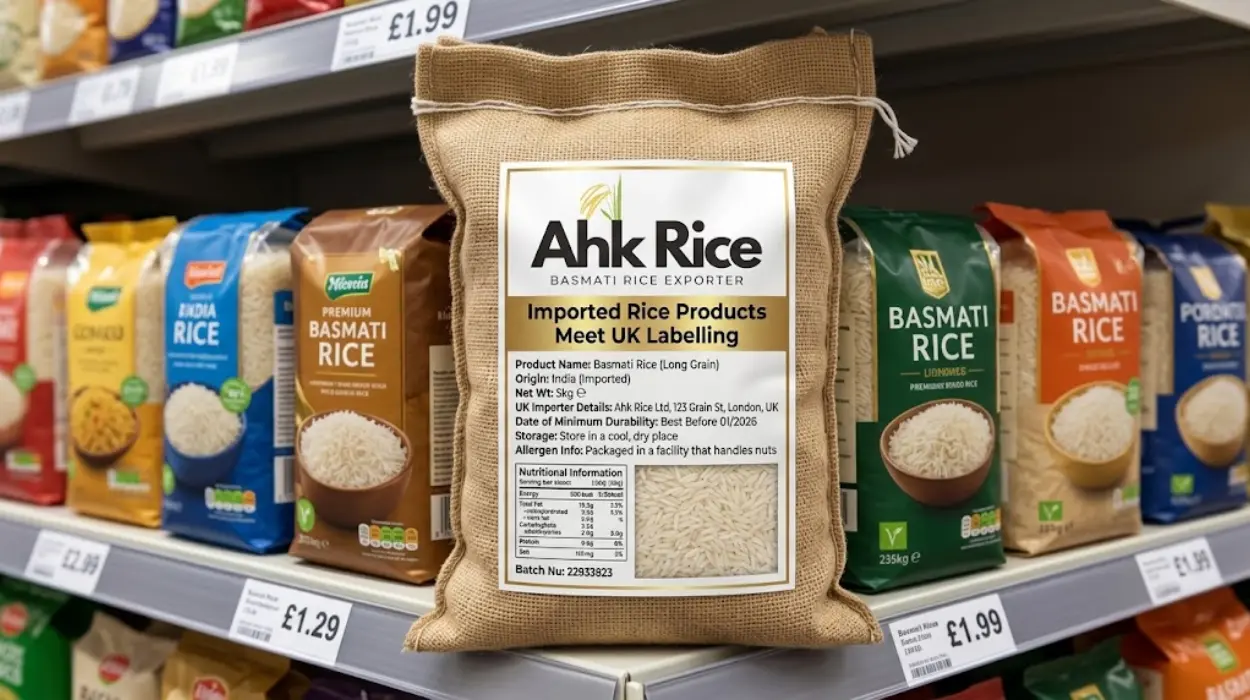
How Do Imported Rice Products Meet UK Labelling Expectations?
Imported rice products meet UK labelling expectations through accurate product descriptions, mandatory food information, traceable origin details, correct net quantity, date marking, storage instructions, and compliant packaging. The strongest approach is label-ready rice matched to the destination market before dispatch.
UK rice importers must treat labelling as part of product specification rather than a final artwork task. A label connects the rice variety, processing grade, origin, pack size, ingredients, nutrition, storage, and responsible food business operator. Buyers comparing sourcing models can also review how Pakistani Basmati is cultivated, processed, graded and exported before finalising UK requirements.
AHK Rice’s Pakistan rice export service provides processed Basmati varieties, custom packaging, and export documentation for international buyers. Its product range includes 1121, Super Kernel, and 1509 Basmati grades, allowing importers to align the physical product with the label declaration.
What are the available solutions for imported rice labelling?
Three practical solutions dominate UK rice trade: supplier-applied labels, importer-applied labels, and private-label production. Supplier-applied labels reduce handling, importer-applied labels increase flexibility, while private-label production provides the strongest control over product specifications, packaging, traceability, and retail presentation.
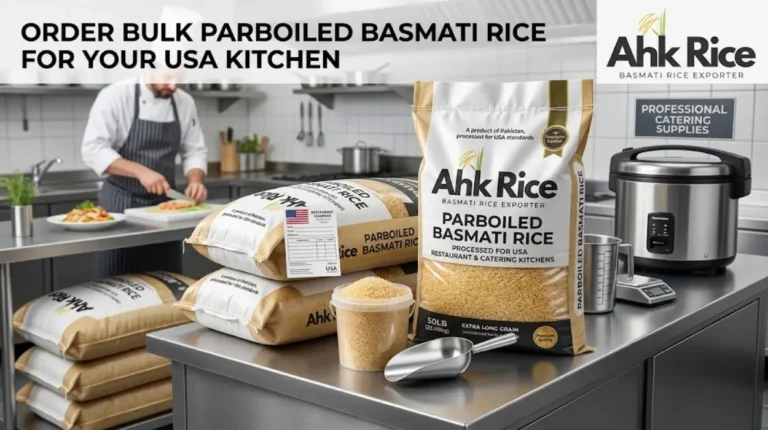
Supplier-applied labelling places the finished retail artwork onto the rice package before export. The exporter receives the buyer’s approved artwork and matches the label to the agreed variety, grade, origin, pack size, date coding, storage information, and importer details.
Importer-applied labelling keeps the rice specification separate from final retail artwork. The exporter supplies compliant bulk or plain retail packaging, while the UK importer applies the final label domestically. This model suits buyers managing several brands or changing promotional packaging.
Private-label production combines rice processing with custom packaging. The importer specifies the variety, processing grade, broken percentage, moisture target, pack size, artwork, and commercial positioning. The supplier then produces and packs the finished product against the approved specification.
UK rules require mandatory information to remain accurate, legible, visible, permanent, and understandable. Pre-packed food generally requires the name of the food, net quantity, date marking, ingredients where applicable, responsible business details, storage conditions, and relevant warnings.
Rice also requires attention to its description. Basmati is an aromatic long-grain rice category with specific recognised varieties and characteristics. UK guidance identifies Basmati as a distinct rice type, while the Rice Association’s Code of Practice establishes additional expectations for Basmati authenticity.
The solution therefore depends on how much control the importer wants over packaging and how close the supplier is to the final retail specification.
How do different imported rice labelling approaches compare?
Supplier-applied labels provide the simplest execution, importer-applied labels provide greater market flexibility, and private-label production provides the strongest specification control. The best method depends on volume, artwork changes, retailer requirements, traceability, and whether the importer sells one brand or multiple formats.
| Attribute | Supplier-Applied Label | Importer-Applied Label | Private-Label Production |
|---|---|---|---|
| Regulatory control | High with approved artwork | High after local application | Highest through specification control |
| Packaging flexibility | Medium | High | Very high |
| Artwork changes | Less flexible | Highly flexible | Flexible before production |
| Traceability | Supplier-controlled | Shared control | Fully specification-led |
| Minimum order impact | Usually higher | Potentially lower | Usually higher |
| Retail suitability | Strong | Strong | Very strong |
| Operational complexity | Low | Medium | Medium to high |
Supplier-applied labelling works efficiently for established products with stable packaging. The importer approves one artwork version, and the supplier reproduces it across repeated shipments.
Importer-applied labelling works better for distributors with multiple retail customers. One rice specification can support several final labels, reducing the need to manufacture separate export batches for every retailer.
Private-label production provides the deepest integration between product and packaging. The importer can select 1121 White, 1121 Steam, 1121 Golden Sella, Super Kernel, or 1509 and then build the retail specification around the chosen grade.
The comparison also reveals an important distinction. A compliant label does not compensate for an incorrect physical product. The rice itself must match the description, variety, processing method, and quality claims printed on the pack.
Basmati authenticity remains particularly important. In the FSA’s 2024/25 retail surveillance programme, 30 Basmati rice samples were tested and the compliance rate was 87%. Three samples exceeded the maximum 7% non-Basmati content under the Basmati Code of Practice.
This makes product verification a commercial requirement alongside label verification. The label and the rice must describe the same product.
Which method works best for England and Northern Ireland markets?
England retail markets generally favour flexible retail-ready specifications, while Northern Ireland requires additional attention to its distinct regulatory framework. England buyers can prioritise label simplicity, while Northern Ireland buyers must assess EU food-law requirements and Windsor Framework conditions.
What does England require from imported rice labels?

England operates within the Great Britain food labelling framework. Pre-packed rice must carry mandatory food information that is accurate, clearly visible, legible, and difficult to remove. Mandatory information includes the food name, net quantity, date marking, ingredients where required, storage instructions, and responsible business details.
Retail rice labels also need correct nutrition presentation where nutrition information is required. A standard pack can therefore contain the product name, ingredient statement, nutrition panel, net weight, best-before date, storage wording, cooking instructions, origin information where applicable, and UK food business address.
For England retail, 1121 White and 1121 Steam suit premium branded positioning because their long grain and aromatic characteristics support higher-value presentation. Super Kernel provides a traditional premium alternative, while 1509 supports value-oriented positioning.
Current UK retail pricing demonstrates the range. Tesco lists 10kg Basmati products around £1.90–£3.10 per kg, equivalent to approximately £1,900–£3,100 per MT at retail-equivalent pricing.
This figure is not an import cost. It includes retail economics and therefore should not be used as a supplier quotation. Pakistan FOB benchmarks provide a separate reference point, with indicative Basmati prices around US$1,135–US$1,205 per MT before destination freight and other landed costs.
What changes for Northern Ireland?
Northern Ireland requires closer regulatory coordination because EU food law continues to apply to food businesses operating there. The FSA states that EU Regulation 1169/2011 applies in Northern Ireland, while Great Britain uses the retained UK framework.
The Windsor Framework also affects retail movements between Great Britain and Northern Ireland. Certain retail goods require individual labelling under the Northern Ireland Retail Movement Scheme, with final-phase requirements applying from July 2025.
For Northern Ireland buyers, Super Kernel, 1121 Sella, and 1121 Golden Sella can suit retail and foodservice segments requiring durable grains and strong cooking performance. Golden Sella is parboiled, giving the kernel greater structural strength during handling and cooking.
Shelf-life specifications should be agreed contractually rather than assumed from the processing name. Commercial Basmati specifications commonly provide 24 months from production or manufacture under cool, dry storage, with some UK specifications requiring at least 12 months remaining on delivery.
| Market region | Common commercial grade fit | Indicative price benchmark | Typical stated shelf life |
|---|---|---|---|
| England retail | 1121 White, 1121 Steam, Super Kernel | £1,900–£3,100/MT retail-equivalent | Up to 24 months |
| Northern Ireland retail/foodservice | 1121 Sella, Golden Sella, Super Kernel | £1,900–£3,100/MT UK-market benchmark | Up to 24 months |
The price ranges above are market benchmarks rather than region-specific import quotations. The final landed price changes with FOB value, freight, insurance, customs costs, packaging, order volume, and retailer margin.
With the regional differences established, the next decision concerns which product and packaging method best fits each buyer.
What are the pros and cons of each imported rice labelling solution?
Supplier-applied labelling offers speed and consistency but reduces late-stage flexibility. Importer-applied labelling provides control but adds handling. Private-label production creates stronger brand differentiation but requires tighter specification approval and larger production coordination.
Supplier-applied labelling has a clear operational advantage. The finished pack leaves the exporting facility ready for distribution. The importer avoids relabelling labour and reduces the risk of applying different labels to identical products.
Its limitation is artwork rigidity. A change in retailer address, pack size, nutritional panel, or product description may require a new production run. This becomes inefficient for buyers with frequent packaging changes.
Importer-applied labelling offers the opposite advantage. The buyer can adjust artwork closer to the retail launch. This approach works well for distributors supplying several stores with different branding requirements.
Its disadvantage is additional operational responsibility. The importer must control label application, batch matching, date coding, and traceability. A mismatch between rice and label creates a compliance problem.
Private-label production provides the strongest commercial integration. A retailer can specify 1121 Steam, request a particular broken percentage, select a 5kg or 10kg pack, approve the artwork, and receive a unified finished product.
The drawback is greater coordination. The buyer must approve samples, specifications, packaging materials, artwork, and production quantities before dispatch. Errors discovered after production can create significant rework.
The best solution therefore depends on operational scale rather than simply choosing the cheapest packaging method.
What decision factors should UK rice importers evaluate?
UK importers should evaluate legal compliance, product authenticity, grade suitability, packaging control, shelf life, landed cost, traceability, and retailer requirements before approving an imported rice specification. These factors determine whether a shipment remains commercially usable after arrival.
Five-row decision framework
| Decision factor | Question to ask | Preferred solution |
|---|---|---|
| Label ownership | Who controls final artwork? | Private-label for maximum control |
| Product authenticity | Can variety and Basmati claims be verified? | Tested, traceable supply |
| Market destination | Is the product for England or Northern Ireland? | Destination-specific artwork |
| Shelf life | How much life remains at delivery? | Minimum agreed contractual threshold |
| Landed cost | Does the price work after freight and retail margin? | Compare FOB, landed, and retail benchmarks |
Label ownership determines who manages compliance risk. Retailers seeking one permanent design can use supplier-applied packaging. Distributors managing several customers benefit from importer-applied labels.
Product authenticity requires stronger attention for Basmati. The FSA’s recent surveillance found three of 30 tested Basmati samples exceeding the 7% non-Basmati tolerance. Specific variety claims also require accurate composition.
Market destination determines the applicable labelling framework. England follows the Great Britain system, while Northern Ireland operates under EU food-law provisions relevant to food information.
Shelf life affects warehouse turnover and retailer acceptance. A specification offering 24 months from production can provide useful commercial flexibility, but the importer should define minimum remaining shelf life at delivery.
Landed cost provides the most useful commercial comparison. FOB Pakistan pricing can look attractive before freight, packaging, insurance, customs, warehousing, and distribution are added. Retail-equivalent UK pricing shows the available market value but does not represent importer margin.
A final specification should therefore combine product, packaging, regulatory, and commercial requirements into one approved document.
How should an importer prepare label-ready Basmati rice?
Importers should approve the rice specification first, validate the label second, verify packaging third, and complete shipment documentation last. This sequence prevents artwork from describing a product that differs from the inspected, packed, and dispatched rice.
Product specification
Define the variety, processing grade, grain length, broken percentage, moisture level, foreign matter limit, crop information, packaging material, and pack size.
Label specification
Confirm the food name, ingredient declaration, net quantity, date marking, storage conditions, cooking instructions, nutrition information where required, origin statement where applicable, and responsible UK food business details.
Authenticity verification
Verify that Basmati claims match the physical rice. The Basmati Code of Practice provides a maximum 7% non-Basmati tolerance for products described as Basmati rice.
Packaging approval
Approve the final artwork against the physical packaging dimensions. Mandatory information must remain readable and must not become obscured by folds, seals, graphics, or other packaging elements. UK guidance specifies a minimum 1.2mm x-height for mandatory information, with a 0.9mm exception for smaller packs.
Shipment verification
Match the final packaging, batch identification, commercial documents, and product specification before loading. This creates a consistent chain from mill to UK importer and reduces discrepancies during receiving checks.
This workflow converts labelling from a design task into a controlled product specification process.
What is the best overall approach for UK imported rice?
The best overall approach is label-ready rice produced against an approved UK specification, with verified Basmati authenticity, destination-specific packaging, defined shelf life, accurate net quantity, and complete importer information before shipment leaves Pakistan.
For England retail, supplier-applied private-label packaging provides a strong balance between speed and control. It allows the importer to receive finished retail packs without sacrificing specification oversight.
For Northern Ireland, buyers should build destination requirements into the specification before production. EU food-law considerations and Windsor Framework conditions make early compliance review more efficient than correcting labels after dispatch.
AHK Rice can support this model through Pakistani Basmati varieties, end-to-end processing, custom packaging, and export preparation. The important commercial principle remains the same: the physical rice, packaging, label, documentation, and destination requirements must describe one consistent product.
UK labelling expectations therefore reward specification discipline rather than last-minute label design. Importers that approve product and packaging together reduce compliance risk, improve retailer acceptance, and create a more predictable import process.
Frequently Asked Questions
What information must imported rice labels show in the UK?
Pre-packed rice generally needs the food name, net quantity, date marking, ingredients where applicable, responsible food business details, storage conditions, and relevant warnings or instructions. Mandatory information must remain clear, legible, visible, and accurate.
Does imported Basmati rice need a country of origin statement?
Origin information is required where specific rules apply or where omission could mislead consumers. Basmati authenticity and origin claims also require careful control because UK industry standards address the use of the Basmati description and country-of-origin claims.
What is the usual shelf life of imported Basmati rice?
Commercial specifications commonly state 24 months under suitable cool and dry storage. Importers should also specify a minimum remaining shelf life at delivery, with some UK specifications requiring 12 months remaining.
Is Northern Ireland different from England for rice labelling?
Yes. England follows the Great Britain food-labelling framework, while EU food law continues to apply to Northern Ireland for relevant food information requirements. The Windsor Framework also introduces additional retail movement and labelling considerations.
What is the best Basmati grade for England retail?
1121 White and 1121 Steam suit premium retail positioning, while Super Kernel provides another established premium option. The correct grade depends on target price, cooking profile, consumer expectations, packaging size, and retailer positioning.
How can importers reduce rice labelling errors?
Importers should approve the physical rice specification and final artwork together. They should then verify variety, processing grade, net quantity, nutrition information, dates, importer details, storage instructions, packaging, and shipment documents before dispatch.