Why Are Export Licenses Essential for International Rice Procurement?
Export licenses and related trade registrations establish whether a rice supplier is legally authorized to sell, document, and move rice across international borders. For buyers, these records connect the supplier, commodity, customs declaration, certificates, and destination-country import requirements into one traceable procurement process.
International rice procurement involves more than purchasing milled grain from a processor. The transaction connects a producing country with an importing country through customs, food-safety, plant-health, banking, logistics, and commercial documentation. A licensed or properly registered exporter operates within this regulatory chain.
For Pakistani rice, this framework is especially relevant because Pakistan exports major Basmati varieties such as 1121, Super Kernel, and 1509. These varieties are grown mainly in Punjab, where fertile alluvial soils, irrigation, climate, and traditional rice-growing practices support aromatic long-grain production.
The term “export license” also requires precision. Pakistan does not use one universal document called a “rice export license” for every shipment. Exporters require appropriate business and customs registration, while individual consignments require documents such as export declarations, phytosanitary certificates, certificates of origin, invoices, packing lists, and destination-specific certificates. FBR confirms that commercial exporters use the WeBOC customs system after registration, while the Pakistan Single Window supports electronic regulatory processing.
What is an export license in international rice procurement?
An export license is regulatory authorization or registration that establishes an exporter’s legal ability to conduct international trade, while shipment certificates prove that the specific rice consignment satisfies customs, plant-health, food-safety, origin, and destination-market requirements.
In practical procurement, buyers should distinguish between exporter authorization and shipment certification.
Exporter authorization identifies the business. It establishes the entity behind the transaction and connects it with taxation, customs, banking, and trade records.
Shipment certification identifies the cargo. It describes what was exported, where it originated, how it was processed, and which regulatory conditions it satisfies.
In Pakistan, customs access is connected to Federal Board of Revenue registration and WeBOC. FBR identifies commercial exporters as a recognized trader category and requires registration information such as the National Tax Number, sales-tax information where applicable, business details, banking information, and other supporting records.
The Pakistan Single Window provides another important part of the process. Its Department of Plant Protection module allows traders and customs agents to process phytosanitary export certificates electronically. The export certificate request is generated through the Single Declaration process when the relevant commodity requirements apply.
Therefore, an international buyer should not treat a scanned “license” as the complete compliance record. The correct evaluation covers the exporter’s registration and the documents attached to the actual shipment.
How does licensed rice export work from Pakistan?
A compliant rice export begins with exporter registration, continues through product preparation and regulatory inspection, and ends with customs clearance supported by accurate commercial, origin, phytosanitary, transport, and destination-market documentation.
The process follows a connected sequence.
1. Exporter registration
The business establishes its legal and tax identity and obtains the customs access required for international trade. FBR’s WeBOC system provides electronic customs clearance for import and export transactions.
2. Rice procurement and processing
Paddy is received from rice-growing areas and processed through cleaning, dehusking, separation, milling, grading, polishing when specified, sorting, and packing.
For Basmati rice, processing must preserve the contracted identity and specification. A commercial specification can include variety, grain length, broken percentage, moisture, foreign matter, damaged grains, milling type, packaging format, and net weight.
3. Quality inspection
The processed rice is checked against the purchase specification. Inspection can include physical examination, laboratory analysis, weight verification, packaging checks, and sampling.
Food-safety testing depends on the destination and buyer requirements. Typical parameters include pesticide residues, aflatoxins, moisture, heavy metals, microbiological criteria where applicable, and foreign matter.
4. Phytosanitary certification
The Department of Plant Protection handles Pakistan’s phytosanitary export certification process. Its stated procedure requires exporters to satisfy the importing country’s phytosanitary conditions before inspection, sampling, treatment when required, and certificate issuance.
The documentation can include an importing-country permit or notification, commercial invoice, packing list, treatment certificate where applicable, container information, and other prescribed documents.
5. Customs declaration
The exporter or authorized customs agent submits the required declaration and supporting documentation through the applicable customs system.
The declared information must correspond with the physical shipment. Differences in HS classification, quantity, value, consignee information, packaging, or origin create documentation discrepancies.
6. Shipment and document transfer
After customs clearance, the cargo moves through the agreed logistics route. The commercial invoice, packing list, bill of lading, certificate of origin, phytosanitary certificate, inspection reports, and other required records form the documentary package used by the buyer and destination authorities.
What are the key components of a compliant rice export program?
A compliant rice export program combines exporter registration, customs authorization, product identification, quality controls, phytosanitary certification, origin evidence, commercial documents, transport records, and destination-country requirements into one traceable shipment file.
The main components are interconnected.
Exporter registration identifies the legal trading entity and provides access to customs procedures.
Customs documentation identifies the commodity, quantity, value, tariff classification, exporter, importer, and shipment route.
Commercial documents establish the commercial terms. Examples include the commercial invoice, packing list, purchase contract, and bill of lading.
Certificate of origin establishes where the rice originated. Pakistan’s Trade Development Authority provides electronic certificates of origin, with electronic issuance introduced in September 2024.
Phytosanitary certificate confirms compliance with plant-health requirements where the importing market requires it. Pakistan’s Department of Plant Protection follows ISPM 12 for phytosanitary certificates.
Treatment or fumigation records document required pest-control treatment when prescribed by the destination market.
Laboratory and quality reports provide measurable evidence for specifications such as moisture, purity, broken grains, pesticide residues, and contaminants.
Food-safety certifications can include systems such as HACCP, ISO 22000, BRCGS, or other buyer-recognized schemes. These are certifications rather than export licenses. Their applicability depends on the supplier, facility, buyer, and destination-market requirements.
Which certifications apply to international rice exports?
The applicable certification depends on the destination, product classification, contractual specification, and regulatory requirement; phytosanitary, origin, food-safety, laboratory, treatment, and authenticity documents serve different purposes and should not be treated as interchangeable.
A Pakistani rice exporter supplying different markets can encounter different documentation requirements.
Phytosanitary certification
Plant-health authorities issue phytosanitary certificates when the importing country requires them. Pakistan’s Department of Plant Protection states that certification follows the importing country’s phytosanitary requirements.
Certificate of origin
A certificate of origin establishes the declared country of origin. It becomes important when customs authorities, tariff programs, trade agreements, or buyers require origin evidence.
Food-safety certification
HACCP, ISO 22000, and BRCGS are examples of food-safety management or certification frameworks. They demonstrate structured controls at relevant stages of food production and handling.
Laboratory certificates
Laboratory reports document measurable product characteristics. Examples include pesticide-residue analysis, aflatoxin testing, moisture testing, microbiological analysis, and heavy-metal testing.
Basmati authenticity documentation
The European Union has specific arrangements concerning Basmati rice from India and Pakistan. The European Commission identifies authenticity certificates issued by competent authorities in India and Pakistan under Regulations (EU) 2023/2835 and 2023/2834.
Destination-specific documents
The importing country determines its own entry requirements. For example, U.S. agricultural import requirements depend on the commodity and country of origin, and USDA APHIS directs importers to its Agricultural Commodity Import Requirements database for commodity-specific rules.
Why are export licenses important for international buyers?
Export authorization reduces legal uncertainty by showing that the supplier operates within the exporting country’s trade system and can connect commercial shipments with customs declarations, regulatory certificates, traceability records, and destination-country compliance requirements.
The first benefit is supplier legitimacy. A registered exporter has an identifiable legal and customs presence.
The second is document traceability. Shipment records can be matched against the exporter, container, commodity, quantity, and destination.
The third is customs compliance. Export documentation gives customs authorities the information required to assess and release the cargo.
The fourth is plant-health compliance. Phytosanitary procedures address pest and disease risks associated with regulated plant products.
The fifth is food-safety control. Testing and certification provide measurable evidence instead of relying only on commercial statements.
The sixth is contract control. A documented export process gives buyers a stronger basis for comparing the contracted specification with the shipped product.
These controls become more important when procurement involves recurring container shipments rather than one small transaction.
Which rice markets rely on export documentation?
International rice markets rely on documentation because import authorities apply country-specific customs, food-safety, plant-health, tariff, origin, and labeling rules that determine whether a shipment can legally enter commercial distribution.
Major Pakistani rice destinations include markets across the Middle East, North America, Europe, Africa, and Asia.
Saudi Arabia and the United Arab Emirates require importers to meet their national food and customs controls. European markets operate under EU-wide rules, including controls for food safety and specific rice documentation.
The United States applies its own regulatory framework. FDA’s Foreign Supplier Verification Program places verification responsibilities on covered U.S. food importers, while USDA APHIS controls applicable plant-health requirements.
The EU also maintains specific controls for certain rice consignments from Pakistan and India. EU rules have included increased official controls for certain hazards in rice from these origins, demonstrating why destination-specific compliance remains part of procurement planning.
For buyers comparing suppliers, this means an exporter’s ability to provide correct documentation is a procurement criterion, not an administrative afterthought.
What are the main problems and misconceptions about export licenses?
The most common misconception is that one export license guarantees unrestricted international shipment; actual compliance depends on exporter registration, product requirements, certificates, customs rules, and the specific import conditions imposed by the destination country.
One misconception is that a business registration replaces shipment certification. It does not. The exporter can be properly registered while a specific shipment still requires phytosanitary or other regulatory documents.
Another misconception is that a phytosanitary certificate proves food quality. It does not. Its primary purpose concerns plant-health requirements.
A third misconception is that ISO certification is an export license. It is not. ISO 22000, for example, relates to food-safety management systems rather than customs authorization.
A fourth misconception is that the same document package works for every market. Import requirements vary by commodity and origin. USDA explicitly states that U.S. plant-product requirements depend on the specific commodity and country of origin.
A fifth misconception is that customs clearance in Pakistan guarantees entry abroad. Export clearance and import clearance are separate regulatory events.
A sixth misconception is that electronic documentation removes compliance responsibility. Pakistan’s Single Window digitizes several regulatory processes, but exporters still have to provide accurate information and required supporting documents.
How should buyers evaluate an exporter’s licensing and documentation?
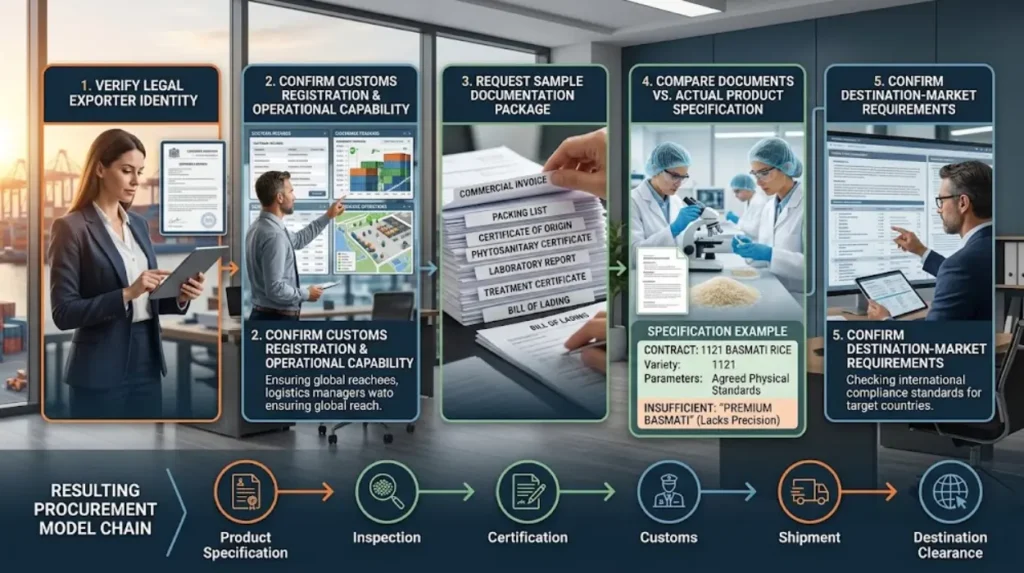
Buyers should verify the exporter’s legal identity, customs registration, shipment certificates, product specifications, testing records, origin documents, and destination-market compliance before approving recurring rice procurement programs.
A practical verification sequence starts with the exporter’s legal business identity.
The buyer then checks whether the exporter has the customs registration and operational capability needed to make commercial exports.
Next, the buyer should request a sample documentation package. This can include a commercial invoice, packing list, certificate of origin, phytosanitary certificate where applicable, laboratory report, treatment certificate where applicable, and bill of lading from a completed shipment.
The buyer should compare these documents against the actual product specification.
For example, a contract for 1121 Basmati should identify the variety and agreed physical parameters. A shipment described only as “premium Basmati” lacks the precision required for systematic procurement.
The buyer should also confirm destination-market requirements before finalizing the contract. This step prevents the common error of treating export-country compliance as equivalent to import-country compliance.
The resulting procurement model connects legal exporter identity → product specification → inspection → certification → customs → shipment → destination clearance.
That chain explains why export licensing and registration are essential to international rice procurement. They provide the regulatory foundation, while shipment-specific certificates and destination-market controls complete the compliance structure. For buyers evaluating the next stage, understanding:
How licensed exporters improve supply chain reliability provides the natural consideration-stage continuation.
Frequently Asked Questions
What is an export license for international rice procurement?
An export license or required exporter registration confirms that a rice supplier is legally authorized to conduct international trade. Shipment-specific documents then verify the cargo.
Why are export licenses important when buying rice internationally?
Export authorization helps buyers verify supplier legitimacy, customs compliance, documentation, and the legal movement of rice from the exporting country to the destination market.
What documents are required to export rice from Pakistan?
Common documents include a commercial invoice, packing list, customs declaration, certificate of origin, phytosanitary certificate where required, bill of lading, and applicable laboratory or treatment certificates.
Is a phytosanitary certificate the same as an export license?
No. A phytosanitary certificate confirms compliance with plant-health requirements for a specific shipment. Export registration or authorization establishes the exporter’s legal trading status.
Which certifications apply to Pakistani Basmati rice exports?
Requirements depend on the destination. Common documents and certifications include phytosanitary certificates, certificates of origin, laboratory reports, HACCP, ISO 22000, BRCGS, and Basmati authenticity documentation where applicable.
Do all countries require the same rice export documents?
No. Import requirements differ by country, commodity, origin, food-safety rules, customs procedures, plant-health controls, labeling requirements, and applicable trade arrangements.