Buy Licensed Pakistani Basmati Rice for North Carolina Distribution
For North Carolina distributors, the best solution is to buy Pakistani Basmati rice from an exporter that can demonstrate legal export capability, consistent product specifications, complete documentation, and a shipment process aligned with U.S. food-import requirements. A licensed supplier reduces the risk that a container is delayed because of incomplete export documentation, missing certificates, inconsistent product specifications, or weak coordination between the exporter, carrier, customs broker, and importer.
Before selecting a supplier, buyers should understand:
Why export licenses are essential for international rice procurement. Licensing alone does not guarantee product quality, but it is an important part of supplier qualification because commercial rice exports require coordinated customs, plant-protection, food-safety, origin, and shipping documentation.
For North Carolina distribution, the purchasing decision should therefore be based on four factors: verified Pakistani origin, the contracted Basmati specification, documented export compliance, and a realistic delivery schedule. AHK Rice approaches the transaction as an export supply program rather than simply a rice sale, allowing the buyer to evaluate the product, documents, packing, shipping route, and landed-cost assumptions before placing a recurring order.
What is the best solution for buying licensed Pakistani Basmati rice in North Carolina?
The strongest solution is a specification-controlled import program combining an established Pakistani exporter, approved Basmati grade, pre-shipment inspection, compliant export documentation, U.S. importer verification, and a planned ocean route into an East Coast port serving North Carolina.
North Carolina distributors should first define the exact product required. A typical specification can include 1121 Basmati, Super Kernel Basmati, or 1509 Basmati, together with whether the rice is white, steam, or parboiled, the required grain length, moisture range, broken percentage, crop year, packaging format, and private-label requirements.
This prevents a common procurement problem: comparing two suppliers only by price when their specifications are not equivalent. A lower quoted price may reflect shorter grain, higher broken percentage, different processing, weaker packaging, or different delivery terms.
The second step is supplier verification. AHK Rice should be assessed against the same criteria used for any serious Pakistani rice exporter: export documentation capability, product consistency, processing controls, packaging capacity, inspection procedures, shipment history, and ability to repeat the contracted specification.
For U.S. imports, the buyer should also identify the responsible FSVP importer. FDA states that the U.S. owner or consignee is generally responsible for FSVP requirements when importing food, including verifying that the foreign supplier and food meet applicable U.S. safety requirements.
The result is a procurement structure where the rice specification and regulatory requirements are established before production instead of being discovered when the container reaches the United States.
Why choose the USA service for North Carolina distribution?
The USA service is appropriate when North Carolina buyers need coordinated Pakistani rice sourcing, product preparation, export documentation, packaging, and ocean logistics rather than purchasing an unverified commodity shipment from an overseas supplier.
AHK Rice can position the transaction around the buyer’s required grade, packaging, quantity, and destination. The USA rice export service is the relevant conversion point when the buyer needs Pakistani Basmati prepared for commercial distribution in the United States.
The commercial advantage is specification control. A distributor can establish the required grain type before the purchase order is finalized and then use the same specification for repeat shipments. This matters when rice is sold through grocery distribution, ethnic-food wholesalers, foodservice channels, or private-label programs.
For Basmati rice, origin documentation is also important. Pakistan’s official Basmati specification documentation identifies geographical-area requirements and provides for authenticity certification through the Trading Corporation of Pakistan for exported Basmati rice.
The export process also increasingly relies on digital government workflows. Pakistan Single Window allows traders to submit export-certificate requests electronically through the relevant modules, while the Department of Plant Protection uses the system for phytosanitary export-certificate processing.
For a North Carolina distributor, this creates a clearer documentation chain from Pakistani processing and inspection through port departure and U.S. entry.
How many shipping days should North Carolina distributors allow?
North Carolina buyers should budget roughly 40–55 days from cargo readiness to practical inland delivery as a planning range, while actual timing depends on the selected U.S. port, vessel schedule, transshipment, customs clearance, and final trucking distance.
There is no single fixed Pakistan-to-North-Carolina transit time because North Carolina is an inland destination from the perspective of ocean freight. The container normally moves from Karachi to an East Coast gateway and then continues by truck or rail.
For example, current carrier schedules show Asia-to-U.S. East Coast services with published transit times of approximately 33 days to New York, 36 days to Norfolk, 38 days to Savannah, 40 days to Jacksonville, and 41 days to Charleston on one 2026 service network. These figures are ocean transit indicators, not guaranteed door-to-door delivery times.
For a North Carolina distributor, Norfolk, Charleston, Savannah, or another suitable gateway may therefore be considered depending on the final warehouse location, carrier availability, inland freight, and customs arrangements.
A practical planning framework is:
| Shipping stage | Planning allowance |
|---|---|
| Production and final packing | 7–15 days |
| Export documentation and cargo preparation | 2–5 days |
| Port handling and vessel loading | 3–7 days |
| Ocean transit | 33–41+ days |
| U.S. clearance and release | 2–7 days |
| Inland delivery to North Carolina | 1–3 days |
These are planning allowances rather than contractual transit guarantees. AHK Rice should confirm the actual sailing schedule, cargo-ready date, port, Incoterm, and estimated arrival date before the purchase order is committed.
What sample process should North Carolina buyers use before ordering?
A controlled sample process should verify the exact commercial specification before bulk production: buyer brief, sample selection, courier shipment, laboratory or quality checks, approval, purchase order, production confirmation, pre-shipment inspection, and final document review.
A practical sample program can begin with a buyer specification sheet. The buyer identifies the rice variety, processing type, grain-length requirement, moisture target, broken percentage, packaging, quantity, destination, and intended sales channel.
AHK Rice can then prepare representative samples from the proposed commercial grade. The buyer should inspect appearance, aroma, grain uniformity, broken grains, cooking performance, elongation, texture, and packaging suitability.
For budgeting purposes, a small international sample program can be planned around approximately US$100–250 for courier delivery, depending on weight and destination, plus approximately US$100–300 for independent laboratory or specialized testing where testing is required. Local handling, sample preparation, and documentation can add approximately US$25–100. These are budgetary allowances, not fixed AHK Rice charges, because courier, laboratory, destination, and test-panel costs vary.
A sample approval should not automatically approve an entire production lot. The purchase order should repeat the approved specification and identify measurable tolerances.
The next stage is pre-shipment verification. Depending on the contract, this may include quantity confirmation, packaging inspection, visual quality inspection, moisture measurement, broken-grain assessment, and review of export documentation.
The documentation chain should also be checked before loading. Pakistan’s digital export systems support electronic submission and processing of relevant certificates, while plant-protection requirements can include phytosanitary documentation depending on the product and destination requirements.
For the U.S. side, the importer and customs broker should verify the required FDA entry information, Prior Notice, labeling, and FSVP responsibilities. FDA states that imported human foods must comply with applicable safety and labeling requirements, and Prior Notice is required before food is offered for import.
This process converts a sample from a marketing exercise into a procurement-control mechanism.
What results can North Carolina distributors expect?
A properly controlled Pakistani Basmati rice program should produce more predictable product specifications, fewer documentation surprises, clearer landed-cost planning, stronger inventory scheduling, and better repeatability across containers and purchase cycles.
The most important result is specification consistency. A distributor selling a particular Basmati grade needs the next shipment to perform similarly to the approved sample. Otherwise, customer complaints can occur even when the shipment technically arrives on time.
The second result is better inventory planning. If the buyer knows that ocean transit can take approximately five to six weeks or longer depending on the route and delays, purchase orders can be placed before warehouse inventory reaches a critical level.
The third result is stronger import compliance. FDA’s current enforcement environment makes supplier verification particularly important. FDA’s July 2026 Import Alert 99-41 specifically addresses food imported by importers that do not comply with FSVP requirements.
This means North Carolina distributors should not treat supplier documentation as an administrative afterthought. It is part of commercial risk management.
AHK Rice can also support a repeat-order model in which the same grade, packing configuration, documentation workflow, and shipping route are used as the baseline for subsequent shipments.
What factors determine the price of Pakistani Basmati rice delivered to North Carolina?
The final North Carolina cost depends on rice grade, crop and processing specification, order quantity, packaging, inspection, Incoterm, ocean freight, insurance, U.S. port charges, customs-related costs, inland transportation, and any required compliance services.
The rice itself is only one part of the landed cost. A buyer comparing FOB prices should separately calculate the logistics and destination costs before deciding which supplier is cheaper.
A useful commercial model is:
Landed cost = rice value + export packing + origin charges + ocean freight + insurance + destination charges + customs/brokerage + inland transportation + applicable duties or taxes.
The grade has a major impact. Extra-long Basmati, steam processing, stronger packaging, lower broken percentage, tighter grain specifications, and private-label presentation can increase the unit price.
Quantity also matters. A full-container order can distribute fixed logistics costs over a larger volume more efficiently than small shipments. Packaging has a similar effect because customized printed bags require additional preparation and minimum-order considerations.
Freight should be quoted against the actual cargo-ready date. Published freight rates can change quickly, and freight platforms explicitly note that base rates are subject to change according to cargo-ready conditions.
For this reason, a serious North Carolina buyer should request a complete commercial quotation rather than using an old per-ton freight assumption.
How should buyers compare AHK Rice with another licensed exporter?
Compare suppliers against the same specification, documentation requirements, inspection process, shipment schedule, packaging standard, payment terms, and delivered-cost assumptions; the lowest headline rice price is not necessarily the lowest procurement cost.
A useful decision model is:
| Decision factor | What to verify | Preferred outcome |
| Product specification | Grade, grain length, broken percentage, moisture | Written specification |
| Export compliance | Certificates and export documentation | Complete document set |
| Sample approval | Physical and cooking performance | Written approval |
| Logistics | Port, vessel, transit, inland delivery | Defined schedule |
| Commercial cost | Product plus logistics and destination costs | Comparable landed-cost basis |
This approach also reflects the broader principle covered in the comparison-focused discussion of how licensed exporters improve supply-chain reliability: licensing matters because it supports a wider operational system, not because a license by itself guarantees perfect delivery.
AHK Rice should therefore be evaluated on the complete transaction. A distributor should ask whether the supplier can reproduce the approved sample, maintain the agreed packing, prepare documents accurately, coordinate loading, and communicate shipment milestones.
That evidence is more useful than a generic claim of being an exporter.
How can a North Carolina distributor get started?
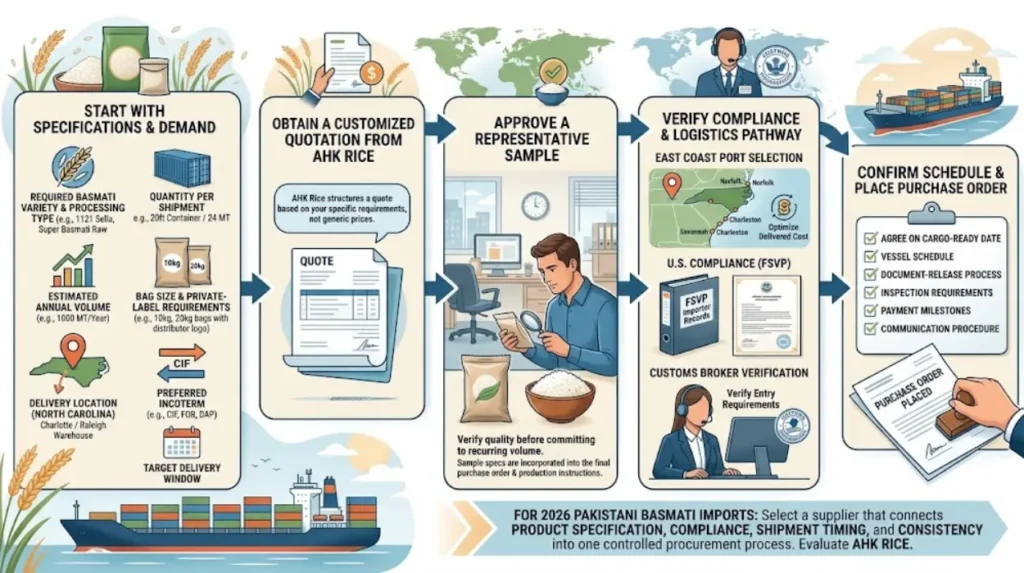
Start with the exact rice specification and annual volume, approve a representative sample, verify the export and U.S. compliance pathway, obtain a shipment-specific quotation, confirm the shipping schedule, and then place the purchase order against documented commercial terms.
The first information to provide should include the required Basmati variety, processing type, estimated quantity per shipment, annual demand, bag size, private-label requirements, delivery location in North Carolina, preferred Incoterm, and target delivery window.
AHK Rice can then structure the quotation around those requirements instead of providing a generic rice price.
The buyer should request the sample before committing to recurring volume. Once the sample is approved, the same specification should be incorporated into the purchase order and production instructions.
The next decision is logistics. Select the most suitable East Coast port based on the North Carolina warehouse location and compare the complete delivered cost. The buyer’s customs broker should simultaneously confirm entry requirements, while the FSVP importer should maintain the required supplier-verification records. FDA requires covered importers to develop, maintain, and follow an FSVP for each applicable food and foreign supplier relationship.
Finally, agree on the cargo-ready date, vessel schedule, document-release process, inspection requirements, payment milestones, and communication procedure.
For distributors planning recurring Pakistani Basmati imports in 2026, the correct decision is not simply to find the cheapest rice. It is to select a supplier capable of connecting product specification, export compliance, shipment timing, and repeat-order consistency into one controlled procurement process. AHK Rice can be evaluated on that basis before the first commercial container is committed.
To obtain a shipment-specific quotation for Pakistani Basmati rice delivered through a suitable route for North Carolina distribution, request a quote.
Frequently Asked Questions
Is Pakistani Basmati rice suitable for distribution in North Carolina?
Yes. Pakistani Basmati rice can be imported for commercial distribution in North Carolina when the product, foreign supplier, importer, labeling, documentation, and applicable U.S. food-import requirements are properly managed.
Which Pakistani Basmati rice varieties can North Carolina distributors buy?
Common commercial options include 1121 Basmati, Super Kernel Basmati, and 1509 Basmati. Buyers can specify white, steam, or parboiled processing according to their target retail, wholesale, or foodservice market.
Why should North Carolina buyers choose a licensed Pakistani rice exporter?
A licensed exporter provides a stronger basis for verifying export capability, documentation, product specifications, and shipment procedures. Licensing should still be evaluated alongside quality controls, export history, inspection, and supply capacity.
What documents are required to import Pakistani Basmati rice into the USA?
Requirements can vary by shipment and product, but commercial imports may involve invoices, packing lists, shipping documents, certificates of origin, applicable phytosanitary documentation, and U.S. food-import documentation. The U.S. importer should confirm requirements with its customs broker and compliance professionals.
What is FSVP for Pakistani rice imports?
The Foreign Supplier Verification Program (FSVP) requires covered U.S. importers to verify that foreign suppliers and imported foods meet applicable U.S. food-safety requirements. The importer should establish and maintain the required FSVP records for the applicable supplier and food.
How long does Pakistani Basmati rice take to reach North Carolina?
A practical planning range is approximately 40–55 days from cargo readiness to inland delivery, although actual timing depends on production, port handling, ocean transit, customs clearance, vessel schedules, and transportation from the U.S. port to the North Carolina warehouse.