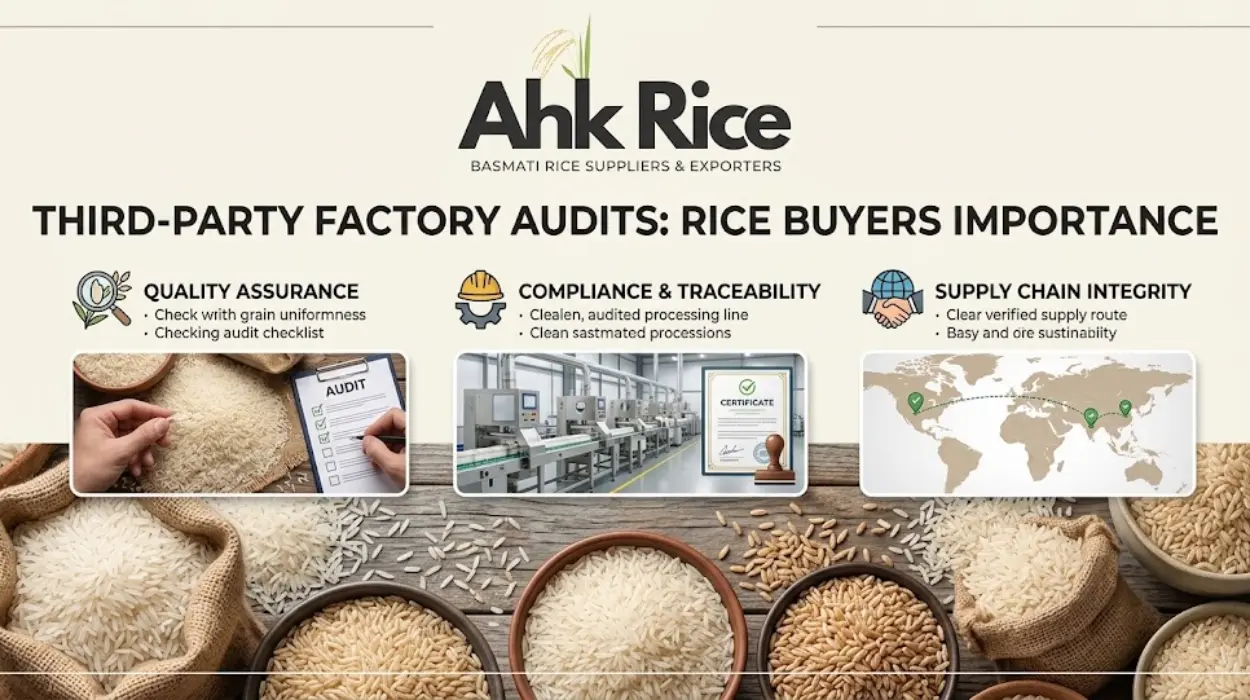
Why Are Third-Party Factory Audits Important for Rice Buyers?
Third-party factory audits are important for rice buyers because they provide independent evidence that a processing facility follows defined food safety, hygiene, quality, traceability, storage, and production controls. A buyer can use an audit to verify actual factory practices instead of relying only on supplier statements, certificates, photographs, or product samples.
For Basmati rice procurement, the audit examines the facility behind the product. This includes raw paddy receiving, laboratory testing, milling, grading, polishing, sorting, parboiling where applicable, packaging, storage, pest control, sanitation, traceability, and dispatch. These controls directly affect grain purity, moisture, broken percentage, foreign matter, appearance, cooking performance, and shelf stability.
A third-party audit is different from a product inspection. An inspection evaluates a specific shipment, lot, container, or sample. A factory audit evaluates the systems and physical processes that repeatedly produce those shipments. This distinction is important when a buyer plans recurring imports rather than a single purchase.
What is a third-party factory audit for rice buyers?
A third-party factory audit is an independent assessment of a rice-processing facility against defined requirements for food safety, quality, hygiene, traceability, production, storage, documentation, and operational control before commercial sourcing decisions.
A third-party auditor is an organization or auditor independent of the rice buyer and rice processor. The auditor reviews objective evidence and factory conditions against a predetermined audit scope.
The scope defines what the auditor examines. A Basmati rice audit can cover the milling line, sorting equipment, packing area, warehouse, laboratory, sanitation program, pest-control system, supplier controls, traceability records, and quality documentation.
The audit also checks whether documented procedures match actual operations. A factory can have a written cleaning procedure, but the auditor verifies whether workers follow it, whether cleaning records exist, and whether corrective actions are completed.
For a Pakistani Basmati rice exporter such as AHK Rice, the relevant production environment includes varieties such as 1121 Basmati, Super Kernel, and 1509. Each variety requires controlled specifications for attributes such as grain length, moisture, broken grains, damaged grains, foreign matter, and milling quality.
A third-party audit does not automatically guarantee that every shipment meets a buyer’s specification. It establishes evidence about the factory’s systems and controls. Shipment-specific testing and inspection remain separate quality-control activities.
How does a third-party factory audit work?
A third-party factory audit works through defined scope, document review, physical inspection, employee interviews, process observation, record verification, evidence collection, nonconformity classification, corrective action, and final reporting against specified requirements.
The process normally begins when the buyer defines the product, destination market, factory, audit standard, and required controls. A Basmati rice buyer should identify the exact product specification before the auditor visits the facility.
The auditor then reviews documentation. Examples include food safety plans, HACCP records, laboratory results, calibration records, sanitation schedules, pest-control reports, supplier approvals, traceability procedures, training records, production records, and corrective-action reports.
The physical assessment follows. The auditor walks through the factory from receiving to dispatch. The sequence matters because cross-contamination, product mixing, poor material flow, and weak traceability often become visible during process observation.
The auditor examines equipment and operating conditions. Examples include moisture meters, weighing systems, metal detectors, optical sorters, elevators, conveyors, packing machines, storage racks, and laboratory equipment.
Employees are also interviewed. Their answers show whether procedures are understood beyond the quality department. A worker responsible for cleaning, sampling, sorting, or packing should understand the applicable instructions and records.
The auditor then compares evidence against the audit criteria. Findings are recorded as conformities, observations, or nonconformities according to the applicable audit scheme.
The factory receives an audit report. Where corrective actions are required, the facility submits evidence showing how the root cause was addressed. This creates a documented improvement cycle rather than a one-time factory visit.
Which factory controls should rice buyers verify?
Rice buyers should verify raw-material control, processing, sorting, laboratory testing, sanitation, pest management, personnel hygiene, packaging, warehouse conditions, traceability, equipment calibration, documentation, and corrective-action systems during a factory audit.
Raw paddy and supplier controls
The factory should identify approved raw-material suppliers and define acceptance criteria. Incoming paddy records should connect the received material with a supplier, lot, date, quantity, and inspection result.
The buyer should examine controls for moisture, varietal identity, foreign matter, damaged grains, immature grains, and other applicable characteristics.
Milling and processing controls
The milling process removes husk and separates rice components through controlled mechanical operations. Paddy passes through stages such as cleaning, dehusking, separation, whitening or milling, grading, sorting, and polishing.
Parboiled Basmati products follow additional processes. These include soaking, steaming, drying, and subsequent milling. Process parameters require documented control because thermal treatment affects grain characteristics and cooking behavior.
Optical sorting and physical quality
Optical sorting systems identify and remove grains that differ in color or appearance from the target specification. The auditor checks equipment operation, maintenance, settings, rejected-product handling, and verification records.
Mechanical grading separates grains by dimensions. Buyers should verify that the factory measures grain length and broken percentage according to its product specification and applicable testing method.
Laboratory controls
The laboratory provides objective measurements for product release and process verification. Relevant tests include moisture, broken grains, foreign matter, grain dimensions, damaged grains, and other parameters required by the buyer or destination market.
Laboratory instruments require calibration or verification at defined intervals. ISO/IEC 17025 is the international standard associated with competence requirements for testing and calibration laboratories. Its use becomes relevant when laboratory competence is part of the buyer’s assurance program.
Hygiene and sanitation
Auditors inspect floors, walls, ceilings, drains, equipment surfaces, production zones, employee hygiene facilities, cleaning tools, and sanitation records.
The objective is to identify conditions that create food-safety or contamination risks. Examples include standing water, damaged surfaces, uncontrolled waste, poor cleaning practices, or inadequate separation between production and non-production areas.
Pest control
Rice warehouses and processing areas require documented pest-management controls. The auditor checks pest-control maps, inspection records, monitoring devices, contractor records, corrective actions, and evidence of pest activity.
Packaging and warehouse controls
Packaging materials should be controlled to prevent contamination and preserve product integrity. The auditor checks packaging specifications, storage conditions, labeling controls, coding, finished-goods identification, and packing records.
Warehouse controls include stock identification, lot separation, palletization, ventilation, cleanliness, pest management, and first-in-first-out or other defined stock-rotation systems.
Traceability and recall
Traceability connects finished rice to processing and raw-material records. A buyer should verify whether the factory can trace a finished lot backward to its raw material and forward to its dispatch documentation.
A practical audit test is a mock traceability exercise. The auditor selects one finished lot and asks the factory to produce the related production, laboratory, packaging, storage, and dispatch records.
Which certifications and standards apply to audited rice factories?
Applicable certifications and standards include HACCP-based food safety systems, ISO 22000, FSSC 22000, BRCGS Food Safety, GMP-based controls, Halal certification, and destination-specific regulatory requirements, depending on product, buyer, and market.
HACCP, or Hazard Analysis and Critical Control Point, is a preventive food-safety methodology that identifies hazards and establishes controls at relevant process points.
ISO 22000:2018 specifies requirements for a food safety management system across the food chain. ISO states that the 2018 edition remains current in 2026, with the 2024 climate-action amendment published and a replacement standard under development.
FSSC 22000 combines ISO 22000 with sector-specific prerequisite programs and additional requirements. In 2026, FSSC has published Version 7 of its certification scheme. Licensed certification bodies audit organizations against the scheme requirements.
BRCGS Food Safety Issue 9 remains a major food-safety standard for food manufacturing, processing, and packing. BRCGS states that Issue 9 covers product safety, integrity, legality, quality, risk assessment, and good manufacturing practices. Its revision process continued in 2026.
GMP, or Good Manufacturing Practice, refers to controlled manufacturing and hygiene practices that support safe and consistent food production. GMP requirements often form part of broader food-safety systems.
Halal certification is relevant when the destination buyer or market requires documented Halal status. The exact certification authority and requirements depend on the importing market.
A phytosanitary certificate is different from a factory certification. It concerns the plant-health status of an exported consignment and should not be treated as evidence that an entire factory operates under a certified food-safety management system.
What are the main benefits of third-party factory audits?
Third-party audits reduce information gaps by giving rice buyers independent evidence about factory conditions, process controls, documentation, traceability, food safety, quality management, production capability, and corrective-action performance before commercial procurement.
The first benefit is supplier verification. A buyer can compare the factory’s documented procedures with actual production conditions.
The second benefit is process visibility. A sample only represents the tested material. An audit examines the production environment that repeatedly creates the material.
The third benefit is risk identification. Problems involving sanitation, pest control, calibration, storage, documentation, or traceability can be identified before they become shipment-level problems.
The fourth benefit is specification control. A buyer can verify whether the factory measures and records the attributes defined in the commercial specification.
The fifth benefit is traceability. Strong records help identify the affected lot when a quality issue occurs.
The sixth benefit is corrective-action verification. A professional audit does not stop at identifying a problem. It establishes evidence requirements for correction and closure.
The seventh benefit is procurement consistency. Buyers importing repeated containers can use audit findings as one part of supplier qualification and periodic review.
Where are third-party factory audits used in Basmati rice procurement?
Third-party factory audits are used for supplier qualification, annual supplier reviews, private-label programs, large-volume contracts, retailer requirements, foodservice sourcing, new-market entry, and procurement programs requiring documented production controls.
A distributor importing several containers per month can use an audit to evaluate whether the factory has systems capable of supporting recurring orders.
A private-label buyer can audit packaging, labeling, traceability, product specifications, and production controls before approving a factory for branded production.
A restaurant or foodservice importer can examine cooking-related specifications, grain consistency, packaging integrity, warehouse controls, and lot traceability.
Retail buyers often require structured food-safety evidence because a product failure affects multiple stores and consumer-facing brands.
Third-party audits are also useful when buyers change suppliers. The audit creates a comparable evidence base for evaluating factories before switching production.
The same principle applies to Pakistani Basmati rice exported to markets in the Middle East, North America, Europe, Africa, and other regions. The exact requirements depend on the destination country’s regulations, buyer specifications, product category, and certification program.
What common misconceptions should rice buyers avoid?
A factory audit does not replace shipment inspection, laboratory testing, certification verification, or regulatory compliance; it evaluates factory systems and practices, while each additional control addresses a different part of supply-chain risk.
One misconception is that a certificate equals a factory audit. Certification audits and buyer-requested third-party audits can have different scopes, criteria, frequencies, and objectives.
Another misconception is that an audit guarantees every shipment. It does not. A factory can operate under an effective management system while an individual shipment still requires sampling and testing.
A third misconception is that a clean factory automatically produces specification-compliant rice. Hygiene and product quality are related but distinct. Grain length, broken percentage, moisture, purity, varietal identity, and cooking characteristics require product-specific controls.
Another misconception is that photographs prove factory compliance. Photographs show selected conditions at selected times. An audit evaluates physical conditions together with records, interviews, procedures, and operational evidence.
A final misconception is that the cheapest supplier has the lowest procurement risk. Purchase price does not measure documentation accuracy, quality consistency, corrective-action performance, traceability, or process control.
For buyers evaluating Pakistani Basmati suppliers, a factory audit should therefore sit within a wider supplier-qualification system. That system should combine factory assessment, certification verification, product sampling, laboratory analysis, specification approval, shipment inspection, documentation review, and ongoing performance monitoring.
How should rice buyers interpret an audit report?
Rice buyers should interpret an audit report by examining its scope, audit date, facility identity, standard, findings, severity, corrective actions, closure evidence, and limitations instead of treating the final audit score as the only supplier qualification measure.
The audit date is important because factory conditions change. A report from several years ago provides less current evidence than a recent assessment.
The facility identity also matters. A certificate or audit report should identify the actual production site used for the buyer’s rice program.
The audit scope should match the intended activity. A report covering storage alone does not establish control over milling and packing.
Findings deserve detailed review. A buyer should examine the underlying evidence rather than relying only on a numerical score or pass/fail outcome.
Corrective actions provide another important signal. Repeated findings indicate weaknesses in the management system. Closed findings with documented root-cause analysis show how the factory responds to identified problems.
A strong supplier assessment therefore connects audit evidence with product samples, laboratory results, shipment records, certifications, and commercial performance.
Why should factory audits be part of a rice buyer’s supplier-qualification process?
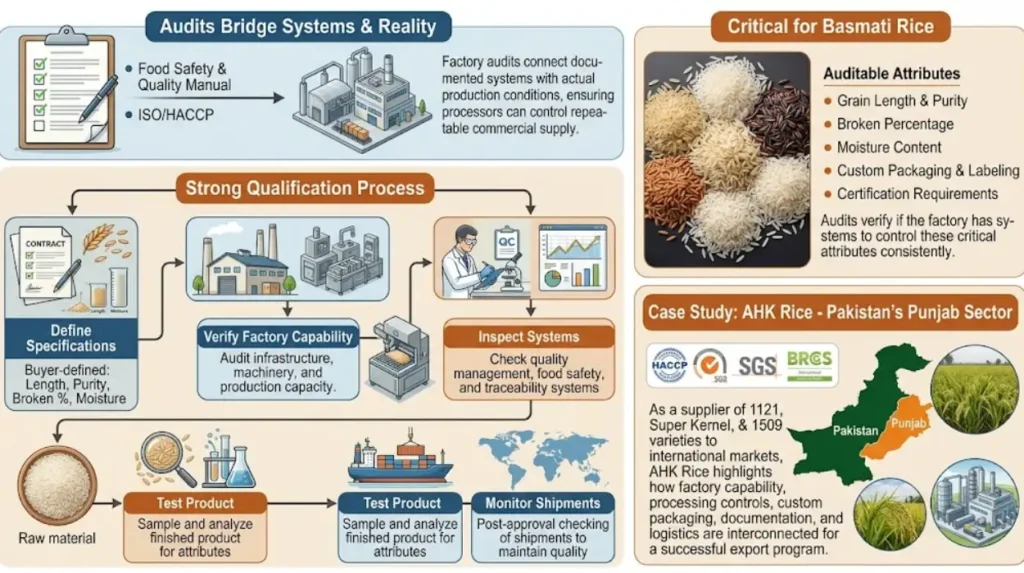
Factory audits should form one layer of supplier qualification because they connect documented food-safety and quality systems with actual production conditions, helping buyers evaluate whether a rice processor can control repeatable commercial supply.
The strongest qualification process follows the product from raw material to finished container. Buyers define specifications first, verify factory capability second, inspect systems third, test product fourth, and monitor shipments after approval.
This approach is especially relevant for Basmati rice because commercial specifications involve multiple measurable attributes. A buyer can require defined grain length, broken percentage, moisture range, purity, packaging format, labeling, and certification requirements.
The audit then verifies whether the factory has the infrastructure and systems to control those attributes consistently.
AHK Rice operates within Pakistan’s Basmati rice-processing sector in Punjab and supplies 1121, Super Kernel, and 1509 varieties to international markets. Its product and export context illustrates why factory capability, processing controls, custom packaging, documentation, and logistics need to be considered as connected parts of an export program.
The next stage is to examine how an audit verifies the specific processing controls behind Basmati rice production. For that consideration-stage analysis, buyers can review:
How factory audits verify Basmati rice processing standards
Frequently Asked Questions
What is a third-party factory audit for rice buyers?
A third-party factory audit is an independent assessment of a rice-processing facility’s food safety, hygiene, quality, traceability, production, storage, and documentation controls.
Why are factory audits important for Basmati rice buyers?
Factory audits help buyers verify that documented procedures match actual processing practices. They provide evidence about how consistently a facility controls Basmati rice quality and food safety.
What does a third-party rice factory audit check?
An audit can check raw-material controls, milling, grading, optical sorting, laboratory testing, sanitation, pest control, packaging, warehouse management, traceability, equipment calibration, employee hygiene, and corrective actions.
Does a factory audit guarantee rice quality?
No. A factory audit evaluates production systems and operating conditions. Buyers still need product sampling, laboratory testing, specification approval, and shipment inspection to verify individual consignments.
Which certifications apply to Basmati rice processing factories?
Relevant certifications and standards include HACCP-based systems, ISO 22000, FSSC 22000, BRCGS Food Safety, GMP controls, and Halal certification, depending on the buyer, product, and destination market.
How does a factory audit verify rice traceability?
The auditor reviews records connecting raw materials, production lots, laboratory tests, packaging, storage, and dispatch. A traceability exercise can test whether a finished lot can be traced through these records.
What is the difference between a factory audit and shipment inspection?
A factory audit evaluates the facility’s systems and processes. A shipment inspection evaluates a specific lot, container, or consignment against defined product and loading requirements.
How often should rice factories be audited?
Audit frequency depends on the buyer’s supplier-risk program, certification requirements, destination market, previous findings, and commercial volume. High-volume or higher-risk programs generally require more frequent verification.