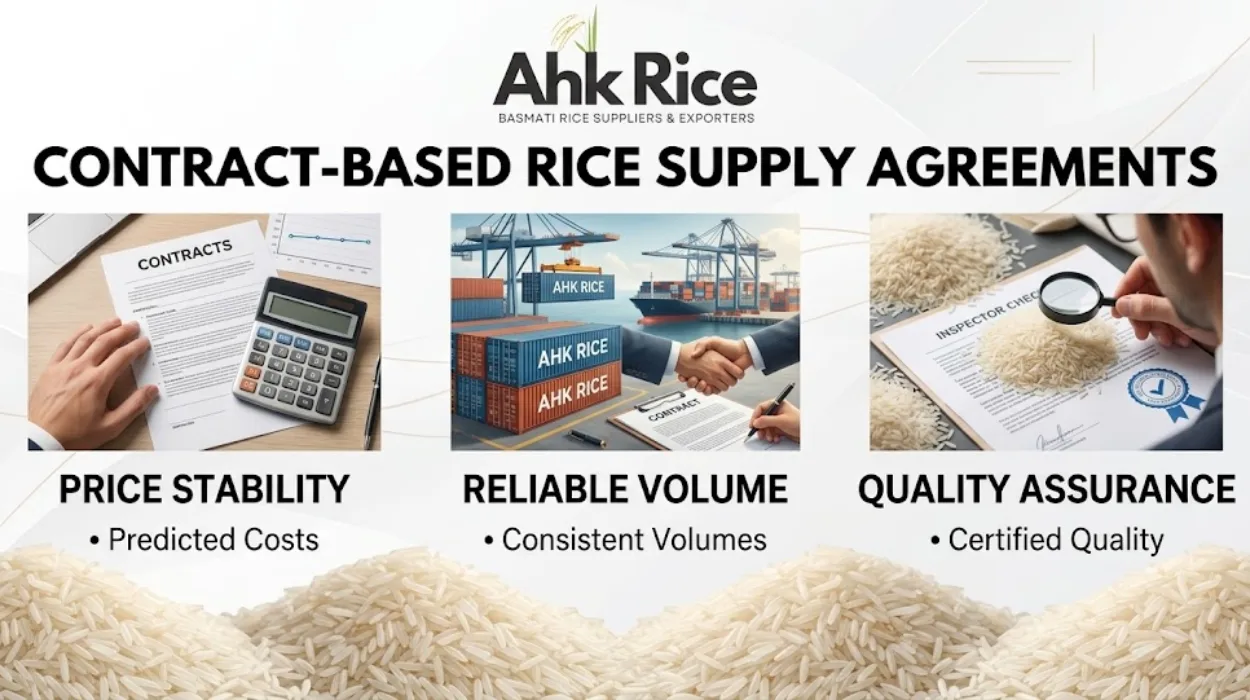
Why Do Importers Prefer Contract-Based Rice Supply Agreements?
Importers prefer contract-based rice supply agreements because a written contract converts repeated rice purchasing into a defined supply program. It establishes the product specification, quantity, price method, shipment schedule, quality requirements, documentation, payment terms, and responsibilities of both parties.
A rice supply agreement is a commercial contract between a buyer and supplier covering the purchase and delivery of rice during a defined period. The agreement can cover 1 shipment, 12 monthly shipments, or a yearly volume divided into scheduled deliveries.
The model is important because rice is an agricultural commodity. Supply depends on harvest timing, milling capacity, inventory, export demand, freight availability, and market prices. In 2026, USDA forecasts Pakistan’s 2026/27 rice production at 9.8 million metric tons and exports at 5.0 million metric tons, compared with projected 4.7 million metric tons of exports in 2025/26.
For an importer, a contract therefore does more than document a purchase. It connects expected demand with physical supply, quality control, shipment planning, and commercial risk.
What Is a Contract-Based Rice Supply Agreement?
A contract-based rice supply agreement is a written purchasing arrangement that fixes or defines rice specifications, volumes, delivery periods, prices, quality controls, payment terms, and responsibilities before repeated shipments occur.
A spot purchase normally addresses one immediate transaction. A contract-based program establishes rules for multiple transactions over a defined period.
For example, a distributor can contract for 1,200 metric tons of Pakistani Basmati rice for 12 months. The agreement can divide that volume into 100 metric tons per month, with shipment dates confirmed through individual purchase orders.
The contract identifies the buyer, which is the importing company responsible for purchasing and receiving the rice. It identifies the supplier, which is the exporter, processor, miller, or trading company responsible for supplying the contracted specification.
It also identifies the product specification. This describes what the buyer is actually purchasing rather than relying only on a commercial name such as Basmati rice.
A specification can include:
- Rice variety, such as 1121 Basmati, Super Kernel, or 1509.
- Processing type, such as white, steam, or parboiled rice.
- Grain length and appearance.
- Broken-grain percentage.
- Moisture percentage.
- Foreign matter tolerance.
- Damaged or discolored grain limits.
- Milling degree.
- Crop year or allowable crop range.
- Packaging material and pack size.
- Private-label printing requirements.
The agreement can also define Incoterms, which allocate transportation responsibilities, costs, and risk between the buyer and seller.
How Does a Contract-Based Rice Supply Agreement Work?
A contract-based rice supply agreement begins with demand planning, followed by specification approval, commercial negotiation, contract signing, production allocation, inspection, shipment scheduling, documentation, delivery, and performance review against agreed terms.
The first stage is demand planning. The importer estimates how much rice customers will consume during the contract period.
For example, a wholesaler expecting to sell 600 metric tons during a year can divide demand into monthly or quarterly requirements. The buyer then defines safety stock separately from contracted consumption.
The second stage is specification development. The buyer establishes measurable product requirements before discussing price.
The third stage is supplier qualification. The importer checks processing capability, quality systems, export documentation, production capacity, and previous shipment performance.
The fourth stage is commercial negotiation. The parties establish the price or pricing formula, minimum order quantity, payment method, shipment frequency, destination, and delivery terms.
The fifth stage is contract execution. Both parties sign the agreement and create purchase orders or shipment schedules under the master contract.
The sixth stage is production allocation. The supplier reserves paddy, milling capacity, packaging materials, processing time, inspection capacity, and container space according to the agreed schedule.
The seventh stage is quality verification. Inspection can occur before loading and can include laboratory testing, physical inspection, weight verification, packaging checks, and comparison against the approved specification.
The eighth stage is export documentation. Documents can include the commercial invoice, packing list, certificate of origin, phytosanitary documentation where applicable, bill of lading, inspection certificates, and destination-specific compliance records.
The final stage is delivery and reconciliation. The importer compares received quantity, quality, documentation, timing, and invoiced cost against the contract.
This sequence creates an auditable procurement process instead of treating every shipment as an independent negotiation.
What Are the Key Components of a Rice Supply Agreement?
The key components are product specifications, contracted volume, delivery schedule, pricing mechanism, quality standards, inspection procedure, packaging, payment terms, logistics responsibilities, documentation, claims procedure, and contract-performance rules.
Product specification
The specification defines the exact rice being purchased. This prevents the word “Basmati” from becoming the only quality reference.
Commercial rice categories include white rice, steam rice, and parboiled rice. Basmati contracts also distinguish varieties such as 1121, Super Kernel, and 1509.
Grades are normally established through measurable attributes rather than a universal global grading system. A contract can specify grain length, broken percentage, moisture, purity, damaged grains, chalkiness, foreign matter, and milling quality.
Volume and shipment schedule
The contract states the total quantity and shipment frequency.
For example, 1,200 metric tons can be scheduled as twelve 100-metric-ton deliveries. Another agreement can use quarterly shipments of 300 metric tons.
This structure allows procurement teams to compare contracted supply with warehouse inventory and forecast demand.
Pricing mechanism
Contracts use different pricing structures. A fixed price establishes the price for a defined quantity and period. A formula-based price connects the contract to an agreed market reference, quality premium, freight component, or adjustment mechanism.
The contract must define when the price is fixed. It must also define which costs are included.
This matters because global rice prices can change during a contract period. USDA reported in June 2026 that Pakistani long-grain export quotes had increased to $380 per metric ton for the reference product tracked in its global rice market analysis.
That figure is a market reference, not a universal Basmati contract price. Basmati prices depend on variety, processing, quality, packaging, destination, and commercial terms.
Quality and inspection
Quality clauses establish acceptable tolerances and the method used to determine compliance.
Inspection terms should identify the sampling method, testing laboratory or inspection body, testing point, acceptance criteria, and procedure for rejected or disputed cargo.
Packaging
Packaging clauses specify bag size, material, labeling, palletization, markings, and private-label requirements.
Examples include 5 kg retail bags, 10 kg foodservice packs, 25 kg wholesale bags, and 50 kg commercial sacks.
Payment and logistics
Payment terms define when funds are transferred and which documents trigger payment.
Logistics clauses define the shipment point, destination, freight responsibility, insurance responsibility where applicable, container requirements, and delivery window.
Claims and remedies
A strong agreement explains what happens when a shipment fails specification or arrives late.
The clause can define notification periods, independent inspection, replacement quantity, credit notes, price adjustments, or other agreed remedies.
What Benefits Do Importers Get From Contract-Based Rice Purchasing?
Contract-based purchasing gives importers planned supply, measurable quality, predictable procurement procedures, clearer costs, scheduled shipments, stronger inventory planning, and defined remedies when product or delivery performance fails agreed commercial requirements.
The first benefit is supply planning. A buyer knows the quantity covered by the agreement instead of repeatedly searching for replacement cargo.
The second benefit is specification consistency. Every shipment is measured against the same documented requirements.
This is particularly important for foodservice and private-label programs. A restaurant group using Basmati rice needs consistent grain appearance, cooking behavior, aroma, and yield across multiple deliveries.
The third benefit is inventory control. Contracted shipment dates allow procurement teams to calculate expected arrivals against warehouse stock.
The fourth benefit is budget planning. A fixed-price agreement provides stronger cost visibility. A formula-based agreement provides a defined method for managing price changes.
The fifth benefit is operational efficiency. Procurement teams do not need to renegotiate every commercial and technical requirement from zero for each shipment.
The sixth benefit is accountability. Quality specifications, delivery windows, and documentation requirements become measurable contractual obligations.
The seventh benefit is relationship continuity. Repeated orders create a performance record covering shipment accuracy, quality results, documentation, claims, and delivery reliability.
Long-term contracts also connect purchasing with wider inventory strategy. Importers evaluating this relationship can examine:
How long-term supply contracts improve procurement stability before designing a multi-shipment procurement program.
Where Are Contract-Based Rice Supply Agreements Used?
Contract-based rice agreements are used by food distributors, supermarket suppliers, restaurant groups, food manufacturers, wholesalers, private-label brands, institutional buyers, and importers that require repeated quantities under consistent commercial specifications.
Food distributors
Distributors use contracts when they serve multiple downstream customers with predictable consumption.
For example, a distributor supplying 20 restaurants can consolidate expected demand into a single import program.
Retail and private-label buyers
Retailers use supply agreements to maintain consistent packaging, product specifications, and replenishment schedules.
A private-label program can define the rice variety, grain specifications, bag design, labeling requirements, and annual volume in one framework.
Restaurants and foodservice groups
Large restaurant groups need consistent cooking performance. A contract can establish one specification across multiple locations.
This reduces the risk of changing rice characteristics between purchasing cycles.
Food manufacturers
Manufacturers use rice as an ingredient in products such as ready meals, frozen foods, rice mixes, and processed foods. Their contracts focus heavily on functional specifications, quantity, delivery timing, and consistency.
International importers
Importers serving regional markets use contracts to coordinate overseas production with ocean freight, customs clearance, warehouse capacity, and customer orders.
Pakistan remains a major rice-exporting origin. USDA’s April 2026 Pakistan Grain and Feed Annual forecast 5.0 million metric tons of Pakistani rice exports for 2026/27.
Rice import markets span the Middle East, Africa, Europe, North America, and Asia. Contract structures differ by destination because labeling, food-safety documentation, import procedures, packaging rules, and buyer specifications differ between markets.
What Certifications and Documents Matter in Contract-Based Rice Supply?
Certification and documentation requirements depend on the destination market, buyer specification, and product claim; common controls include food-safety certification, phytosanitary documentation, certificate of origin, laboratory analysis, traceability records, and compliant commercial documents.
A food-safety certification demonstrates that a facility operates under a recognized food-safety management system. Common schemes in international food trade include HACCP-based systems, ISO 22000, BRCGS, and FSSC 22000.
A phytosanitary certificate is an official plant-health document issued when required by the importing country’s regulations.
A certificate of origin identifies the country in which the goods qualify as originating under applicable rules.
A certificate of analysis records laboratory results against specified parameters. Rice contracts can use it to document moisture, broken grains, foreign matter, or other agreed tests.
A traceability record connects the finished shipment with relevant production, processing, packaging, and shipment information.
Certification does not replace the product specification. A supplier can hold a recognized food-safety certificate while a shipment still has to meet the buyer’s separate grain, moisture, purity, packaging, and labeling requirements.
What Problems and Misconceptions Affect Rice Supply Contracts?
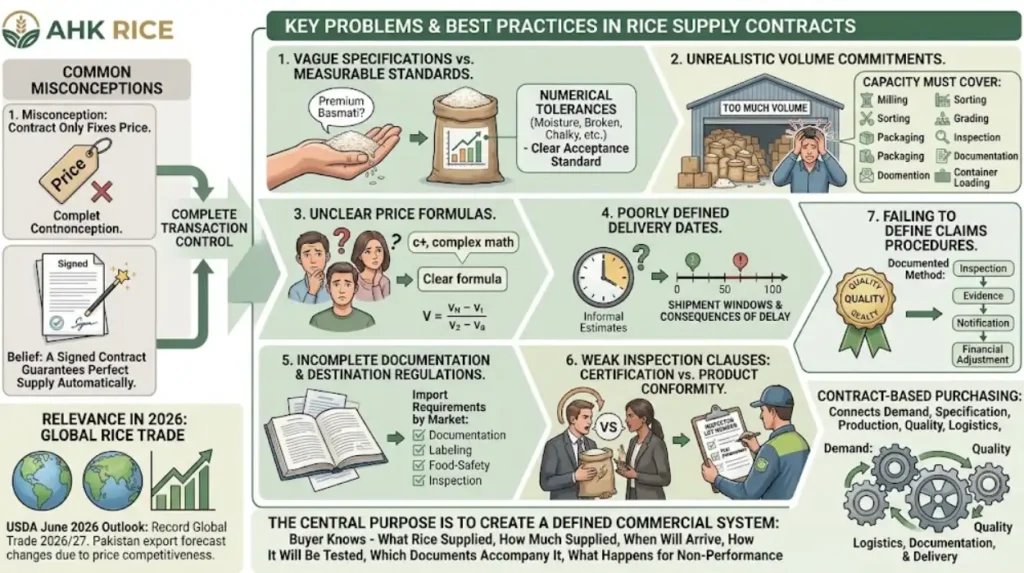
The main problems are vague specifications, unrealistic volume commitments, unclear price formulas, weak inspection clauses, poorly defined delivery dates, incomplete documentation requirements, and the mistaken belief that a signed contract guarantees perfect supply automatically.
One common misconception is that a contract only fixes price. A useful agreement controls the complete transaction structure.
Another problem is using broad terms such as “premium Basmati” without numerical tolerances. A measurable specification creates a clear acceptance standard.
A third problem is contracting more volume than the supplier can reliably process. Capacity must cover milling, sorting, grading, packaging, inspection, documentation, and container loading, not only paddy availability.
A fourth problem is treating shipment dates as informal estimates. A contract should define shipment windows and the consequences of delay.
A fifth problem is ignoring destination regulations. Import requirements differ by market. The buyer must establish documentation, labeling, food-safety, and inspection requirements before contract execution.
A sixth problem is confusing certification with product conformity. Certification evaluates a management system or defined process. Product inspection evaluates whether the shipment meets its agreed specification.
A seventh problem is failing to define claims procedures. When a shipment does not conform, both parties need a documented method for inspection, evidence, notification, resolution, and financial adjustment.
Contract-based purchasing therefore works best when the agreement connects demand, specification, production, quality, logistics, documentation, and delivery into one measurable framework.
In 2026, this approach is especially relevant to international rice procurement because global rice trade remains large while individual exporting origins face changes in supply, prices, and export competitiveness. USDA’s June 2026 global outlook reported record global rice trade for 2026/27 and noted changes to Pakistan’s export forecast because of price competitiveness.
The central purpose of a rice supply contract is not simply to secure a lower purchase price. It is to create a defined commercial system in which the buyer knows what rice will be supplied, how much will be supplied, when it will arrive, how it will be tested, which documents will accompany it, and what happens when performance falls outside the agreed specification.
Frequently Asked Questions
Why do importers prefer contract-based rice supply agreements?
Importers prefer contract-based rice supply agreements because they provide defined product specifications, volumes, shipment schedules, pricing methods, quality standards, payment terms, and delivery responsibilities.
What is a contract-based rice supply agreement?
A contract-based rice supply agreement is a written commercial arrangement between a rice buyer and supplier that establishes the terms for one or multiple rice shipments during a specified period.
What should a rice supply contract include?
A rice supply contract should include rice variety, grade, processing type, quantity, quality tolerances, packaging, price, payment terms, Incoterms, shipment schedule, inspection procedures, documentation, and claims procedures.
How do rice supply contracts improve procurement planning?
Rice supply contracts improve procurement planning by establishing expected quantities and shipment dates in advance. Importers can match contracted deliveries with customer demand, warehouse capacity, safety stock, and replenishment requirements.
Do rice supply contracts guarantee a fixed price?
A rice supply contract can use a fixed price, but it does not have to. Buyers and suppliers can also agree on a pricing formula linked to defined market references, quality premiums, freight costs, or adjustment mechanisms.
How do contracts ensure consistent rice quality?
Contracts ensure quality consistency by defining measurable specifications such as grain length, broken percentage, moisture, foreign matter, damaged grains, milling quality, processing type, and packaging requirements.