Partner with AHK Rice for Ohio Basmati Rice Import Programs
Ohio importers sourcing Pakistani Basmati rice should prioritize a supplier that can control product specifications, documentation, sampling, production, and ocean logistics as one coordinated export program. For a commercial import program, the objective is not simply to obtain the lowest FOB price. It is to secure repeatable quality, predictable shipment execution, compliant documentation, and a landed cost that protects distributor or foodservice margins.
Before approving a supplier, buyers should understand:
Why documented export performance matters. Our guide on:
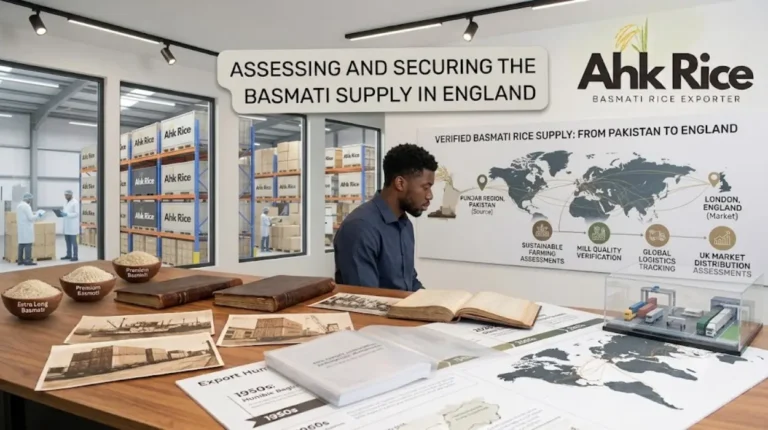
Why export history influences rice supplier selection decisions explains how shipment history, destination experience, documentation, repeat orders, and corrective-action records help distinguish an experienced exporter from a supplier that only competes on price. For Ohio buyers, that evaluation becomes more important because the shipment must move from Pakistan through a U.S. port before reaching an inland warehouse or distribution center.
AHK Rice supplies Pakistani Basmati varieties including 1121, Super Kernel, and 1509 for international buyers. The company operates from Bucheki, Nankana Sahib, Punjab, and manages processing, grading, sorting, packaging, inspection, and export documentation as part of its supply process.
What is the best solution for Ohio Basmati rice import programs?
The best solution is a specification-driven supply program combining approved rice grades, physical samples, documented testing, controlled production, compliant export paperwork, scheduled container loading, and a freight plan designed around the Ohio buyer’s final delivery requirements.
Ohio distributors should begin with the specification rather than the supplier name. Define the required variety, processing grade, grain length, moisture target, broken percentage, packaging, quantity, Incoterm, destination port, and intended sales channel. This creates a measurable purchase specification that can be checked before production and again before loading.
For example, a distributor serving ethnic supermarkets may select 1121 Basmati because of its long grain and premium cooking presentation. A foodservice buyer may instead prioritize consistent cooking performance, low breakage, and cost per serving. A private-label retailer may require a specific bag size, artwork, barcode, nutritional panel, and pallet configuration.
AHK Rice can support different product specifications and packaging requirements. Its USA export program lists 1121, Super Kernel, and 1509 Basmati options, with specifications tailored to U.S. wholesale and distribution requirements.
The buyer should also evaluate the complete procurement process. This includes sample approval, laboratory verification where required, production scheduling, packaging, inspection, container loading, export clearance, vessel departure, U.S. entry procedures, and inland transportation.
The U.S. importer remains responsible for complying with applicable food-import requirements. FDA states that imported food must meet U.S. legal requirements, and facilities involved in producing, storing, or handling food must meet applicable registration requirements. Prior Notice is also part of the U.S. import process.
Why choose USA service support from AHK Rice?
AHK Rice is suitable for Ohio sourcing when buyers need Pakistani Basmati varieties, controlled processing, customized packaging, export documentation support, pre-shipment quality checks, and coordinated ocean logistics from Pakistan toward U.S. ports.
The commercial advantage is centralized execution. Instead of separating milling, quality control, packaging, documentation, and export coordination among different parties, AHK Rice manages the principal export stages through its Pakistan operation.
AHK Rice has operated since 2019 and states that it supplies international buyers across multiple markets, including the USA. Its processing workflow covers paddy procurement, cleaning, de-husking, whitening or polishing, grading, length sorting, and export preparation.
For an Ohio importer, this matters because product consistency must survive the entire procurement cycle. The specification approved during sampling should be the same specification loaded into the container. Grain length, moisture, broken percentage, purity, appearance, and packaging should therefore be treated as commercial control points rather than informal quality claims.
AHK Rice also provides private-label and customized packaging options. This can be important for Ohio distributors selling under their own brand or supplying regional supermarket and restaurant networks.
The buyer should still conduct its own supplier verification. Request current certificates, product specifications, inspection documentation, sample results, packing details, and export references before approving a recurring program. A supplier’s ability to provide documents consistently is itself an important indicator of operational maturity.
The broader evaluation framework should include export history, quality consistency, documentation accuracy, capacity, shipment reliability, and destination-market experience. These are the same commercial factors buyers should compare when evaluating rice exporters before committing to long-term supply.
What shipping time should Ohio importers expect?
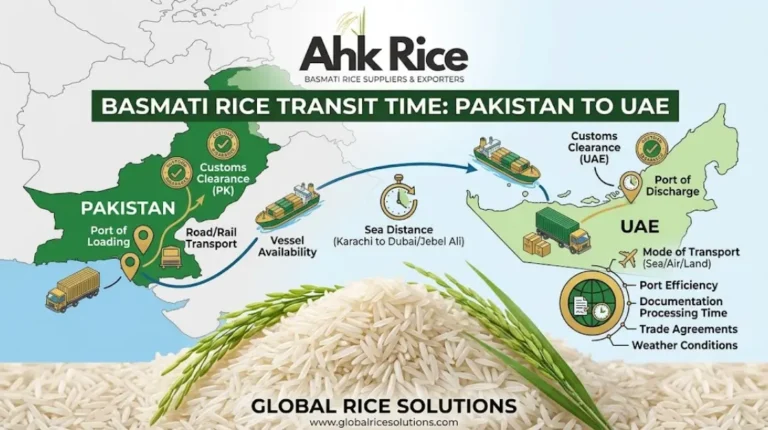
Ohio-bound Pakistani Basmati rice normally requires ocean transit to a U.S. gateway followed by inland transportation to Ohio; current 2026 lane data shows roughly 23–34 days port-to-port on major East Coast routes before customs and inland delivery.
For Ohio, the practical routing decision is usually based on the final landed-cost calculation rather than geographic distance alone. East Coast gateways can provide a logical starting point for an Ohio distribution program, followed by rail or truck movement to the buyer’s warehouse.
Current 2026 freight data provides useful planning benchmarks. Port Qasim to New York is currently shown at approximately 23–33 days for standard FCL service, while Karachi to New York is listed at about 27 days on another current lane quotation. Port Qasim to Baltimore is shown at approximately 27–34 days.
These figures are ocean transit estimates, not guaranteed Ohio delivery times. Production, container availability, port handling, customs release, inland transportation, weather, transshipment, and seasonal congestion can extend the total cycle.
A practical Ohio planning model is therefore:
| Stage | Indicative planning time |
|---|---|
| Order confirmation and specification approval | 1–2 days |
| Sample approval, if required | 3–10+ days |
| Production and packing | 7–10 days |
| Export clearance and loading | 2–5 days |
| Ocean transit to U.S. East Coast | 23–34 days |
| U.S. customs and terminal release | Variable |
| Inland movement to Ohio | Variable |
AHK Rice states that its production scheduling for certain USA Basmati programs can take approximately 7–10 days after approval, depending on order volume.
Ohio buyers should therefore avoid promising customers a delivery date based only on the vessel transit number. A better procurement schedule includes production time, port cutoff, ocean transit, customs clearance, and inland delivery as separate milestones.
What does the full rice sample process cost?
A professional sample process should verify the exact commercial grade before container production; the buyer normally evaluates physical samples, cooking performance, specifications, laboratory results when required, packaging, and commercial terms before approving the first shipment.
The first step is to send a detailed specification request. The buyer should identify the desired variety, processing method, grain length, moisture range, broken percentage, packaging format, quantity, and destination.
AHK Rice can then identify the closest available grade and prepare a representative sample. Its USA product information states that samples of up to 20 kg can be provided, while the buyer covers courier and phytosanitary certificate costs.
A typical sample evaluation should include visual inspection, grain-length measurement, broken-grain assessment, moisture verification, cooking evaluation, aroma assessment, and packaging review. If the buyer has an independent laboratory requirement, laboratory testing should be added before commercial approval.
A realistic planning budget for a U.S. sample program can be structured as follows:
| Sample cost component | Indicative budget |
| Rice sample | Often free subject to supplier policy |
| International courier | USD 40–120+ |
| Phytosanitary/sample documentation | Variable |
| Independent laboratory testing | USD 100–300+ |
| Custom sample packaging | Variable |
| Total planning allowance | Approximately USD 140–450+ |
These are planning allowances, not fixed AHK Rice charges. Courier destination, sample weight, testing scope, certification requirements, and packaging can change the actual amount.
After approval, the buyer should retain the approved sample and specification sheet as the reference standard for the commercial shipment. This reduces ambiguity if quality questions arise after arrival.
What pricing factors determine the Ohio landed cost?
Ohio landed cost depends on rice grade, crop and market conditions, quantity, packaging, inspection, export documentation, ocean freight, insurance where applicable, U.S. port charges, customs-related costs, and inland transportation from the gateway to Ohio.
FOB pricing should therefore not be treated as the final procurement cost. A low FOB offer can become less competitive if it carries higher freight, packaging, inspection, or inland delivery expenses.
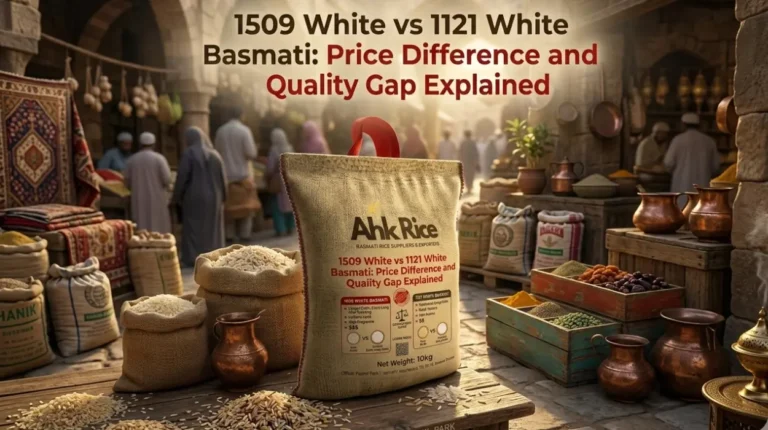
Rice grade is one of the largest variables. Premium 1121 specifications generally command a different price from 1509 or Super Kernel grades because grain characteristics, processing requirements, demand, and availability differ.
Packaging also affects cost. A 50 kg commercial bag, 25 kg distributor bag, and private-label retail package require different materials, printing, labor, and handling. Smaller retail units can increase packaging cost per metric ton but may provide greater value for branded distribution.
Freight is another major variable. Current 2026 public lane data shows approximately USD 5,252–5,691 for a standard 40-foot FCL from Port Qasim to New York and approximately USD 6,316–6,873 for Port Qasim to Baltimore in the cited quotations. These figures are market indications and can change with the cargo-ready date, carrier, equipment, surcharge structure, and booking conditions.
A buyer should request a quotation showing the Incoterm clearly. FOB, CFR, CIF, and other structures transfer different costs and responsibilities between seller and buyer. Comparing two quotations is meaningful only when the commercial basis is identical.
AHK Rice can quote according to the buyer’s selected product, packing, quantity, destination port, and Incoterm. AHK Rice’s USA export page specifically provides these fields as part of its quotation process.
What results can Ohio importers expect?
A properly managed Ohio import program can provide more consistent product specifications, better purchasing predictability, fewer documentation errors, stronger inventory planning, clearer landed-cost control, and a scalable basis for repeat container procurement.
The first measurable result is specification consistency. When the buyer approves a defined grade before production, the supplier has a clear commercial target. This reduces the risk of receiving a shipment that technically contains the right rice variety but does not match the buyer’s required grade.
The second result is improved supply planning. A distributor can build purchase cycles around production lead time and current ocean schedules instead of ordering only when inventory becomes critical.
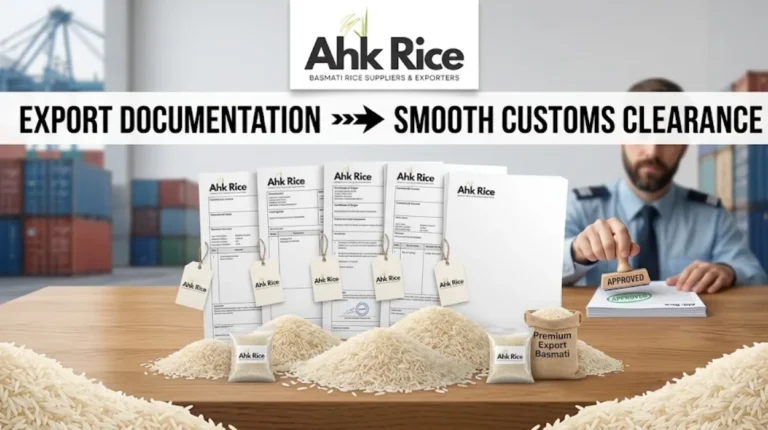
The third result is stronger documentation control. Pakistan’s Single Window system supports electronic export declarations and regulatory certificate processes. Exporters can submit relevant information through a single digital interface rather than repeatedly submitting the same data to different agencies.
For U.S. buyers, compliance remains a shared commercial responsibility. FDA’s FSVP requirements place obligations on covered importers to verify that foreign suppliers and imported food meet applicable U.S. safety requirements.
AHK Rice can support the export-documentation side of the transaction, but the Ohio importer should coordinate its own customs broker, FSVP responsibilities, labeling review, and other U.S. compliance requirements.
How can Ohio importers get started with AHK Rice?
Start with a written product specification, request a representative sample, verify quality and compliance documents, compare the landed-cost structure, confirm production capacity, approve packaging, and establish a shipment schedule before placing the first commercial container order.
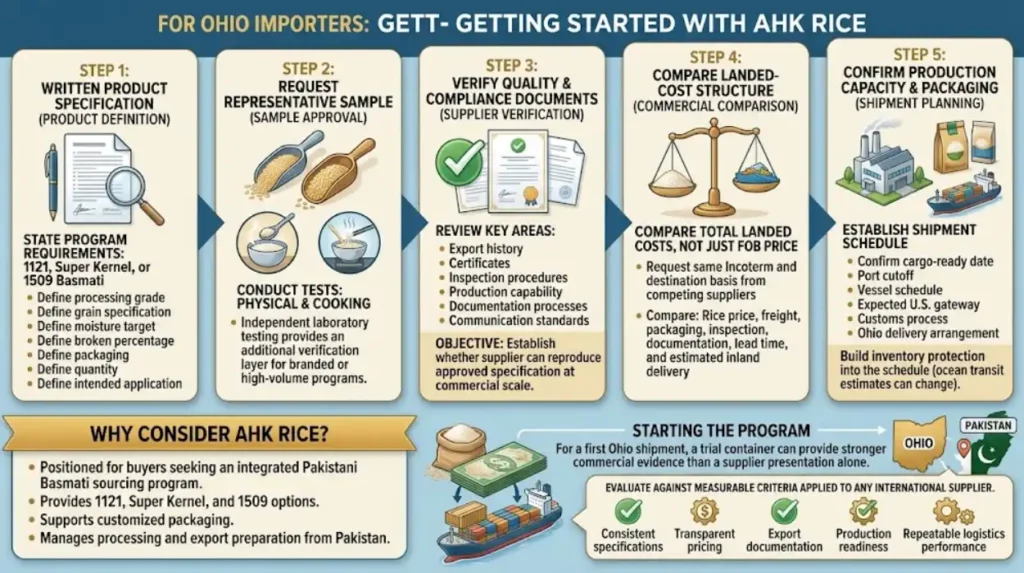
The first step is product definition. State whether the program requires 1121, Super Kernel, or 1509 Basmati. Then define the processing grade, grain specification, moisture target, broken percentage, packaging, quantity, and intended application.
The second step is sample approval. Conduct both physical and cooking tests. For branded or high-volume programs, independent laboratory testing can provide an additional verification layer.
The third step is supplier verification. Review export history, certificates, inspection procedures, production capability, documentation processes, and communication standards. The objective is to establish whether the supplier can reproduce the approved specification at commercial scale.
The fourth step is commercial comparison. Request the same Incoterm and destination basis from competing suppliers. Compare rice price, freight, packaging, inspection, documentation, lead time, and estimated inland delivery instead of comparing FOB price alone.
The fifth step is shipment planning. Confirm the cargo-ready date, port cutoff, vessel schedule, expected U.S. gateway, customs process, and Ohio delivery arrangement. Build inventory protection into the schedule because ocean transit estimates can change.
AHK Rice is positioned for buyers seeking an integrated Pakistani Basmati sourcing program. AHK Rice provides 1121, Super Kernel, and 1509 options, supports customized packaging, and manages processing and export preparation from Pakistan.
For a first Ohio shipment, a trial container can provide stronger commercial evidence than a supplier presentation alone. The buyer can measure arrival quality, documentation accuracy, delivery performance, packaging condition, and customer response before scaling the program.
AHK Rice should be evaluated against the same measurable criteria applied to any international supplier. The advantage comes when the supplier can demonstrate consistent specifications, transparent pricing, export documentation, production readiness, and repeatable logistics performance.
Ohio importers ready to define their rice grade, quantity, packaging, destination, and Incoterm can request a commercial rice quotation.
Frequently Asked Questions
What Basmati rice varieties does AHK Rice supply to Ohio importers?
AHK Rice supplies Pakistani Basmati rice varieties including 1121, Super Kernel, and 1509. Buyers can select specifications based on retail, foodservice, wholesale, or private-label requirements.
How long does it take to ship Basmati rice from Pakistan to Ohio?
Ocean transit from Pakistan to U.S. East Coast ports can take approximately 23–34 days, depending on the port, carrier, routing, and vessel schedule. Additional time is required for customs clearance and inland transportation to Ohio.
What is the minimum order quantity for Ohio Basmati rice imports?
The commercial order quantity depends on the selected rice variety, packaging, buyer requirements, and shipping arrangement. Container-based orders are generally more practical for international bulk procurement.
Can Ohio importers request rice samples before ordering?
Yes. Buyers can request representative rice samples before approving a commercial shipment. The sample should be evaluated for grain length, appearance, broken percentage, moisture, cooking performance, aroma, and other agreed specifications.
How much does a Basmati rice sample cost?
Sample costs vary according to weight, courier destination, documentation, phytosanitary requirements, and laboratory testing. Buyers should request a current sample quotation because courier and testing charges can change.
What factors affect the landed cost of Pakistani Basmati rice in Ohio?
Landed cost depends on rice grade, quantity, packaging, processing, inspection, documentation, Incoterm, ocean freight, insurance where applicable, U.S. port charges, customs-related costs, and inland transportation to Ohio.