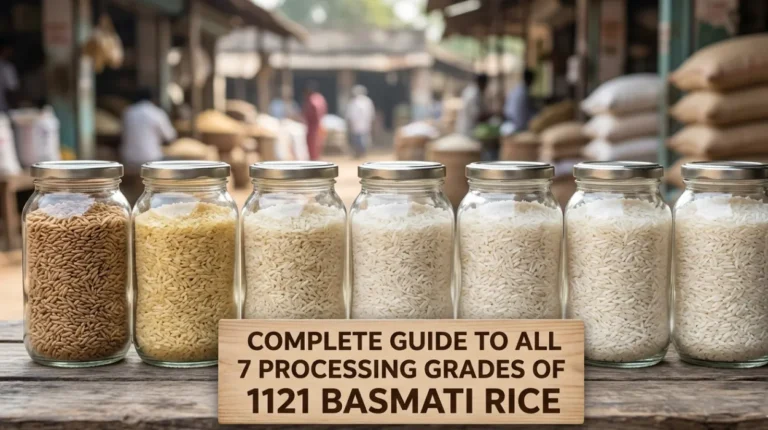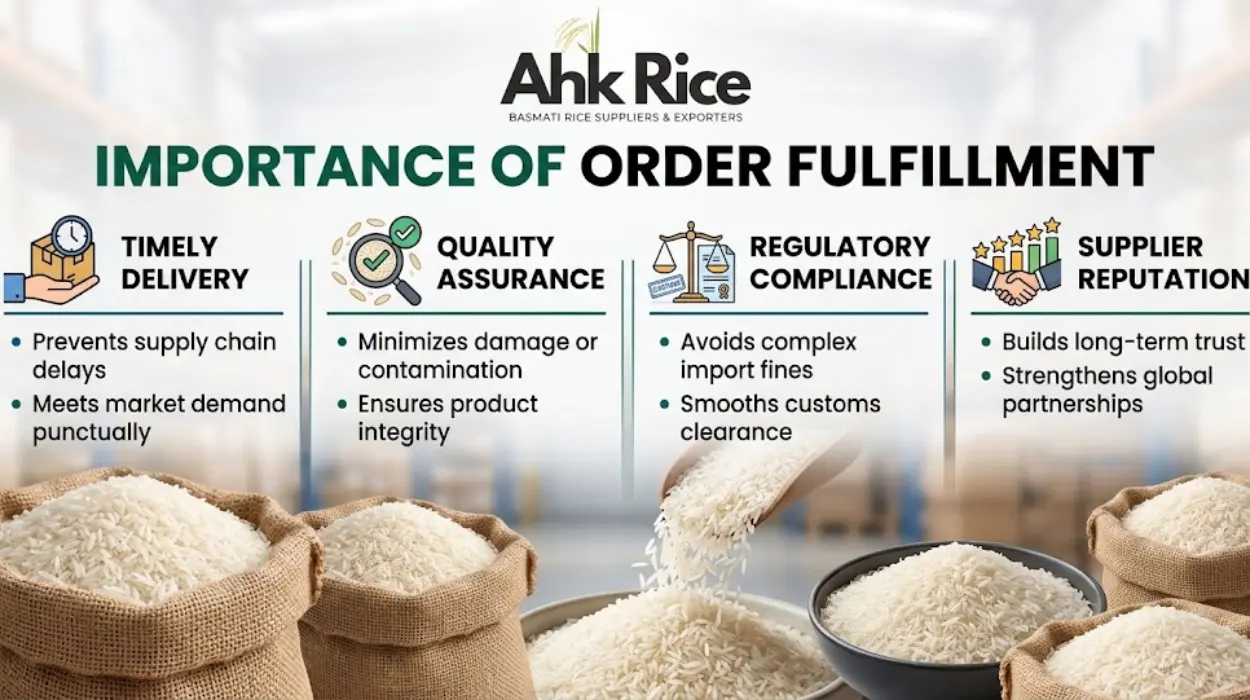
Why Is Order Fulfillment Performance Important in Rice Imports?
Order fulfillment performance in rice imports measures how consistently a supplier delivers the correct rice, quantity, packaging, documents, quality, and shipment timing stated in a purchase order. It connects production, processing, inspection, export documentation, freight coordination, customs clearance, and delivery into one measurable supply process.
For an importer, fulfillment performance is not limited to whether a container leaves the origin port. A shipment that contains the wrong grade, misses its loading window, has incomplete documents, or arrives with quality outside the agreed specification is an incomplete fulfillment. Reliable fulfillment therefore protects inventory planning, customer commitments, production schedules, and landed-cost calculations.
This issue has greater importance in the 2026 rice market. USDA forecasts Pakistan’s 2026/27 rice production at 9.8 million metric tons and exports at 5.0 million metric tons, compared with projected 2025/26 exports of 4.7 million tons. The United States also has record projected 2026/27 all-rice imports of 49.8 million hundredweight, showing the scale and importance of international rice supply.
What Is Order Fulfillment Performance in Rice Imports?
Order fulfillment performance is the supplier’s ability to execute every purchase-order requirement accurately and on schedule, from rice specification and quantity through processing, packaging, documentation, shipment, customs coordination, and final delivery. It is measured against defined commercial and quality requirements.
A rice import order begins with a purchase specification. The specification identifies the rice variety, grade, grain length, processing type, moisture limit, broken percentage, foreign matter tolerance, packaging format, bag weight, quantity, and shipment requirements.
For example, an importer purchasing 1121 Steam Basmati rice does not simply require “Basmati rice.” The order identifies the exact product, quality parameters, packing configuration, quantity, and delivery conditions.
Fulfillment performance compares the actual shipment with those requirements. A supplier that ships 5 containers when the order requires 6 has a quantity-performance problem. A supplier that ships 1121 White instead of 1121 Steam has a product-performance problem. A shipment with missing certificates has a documentation-performance problem.
The result is normally assessed through measurable indicators such as:
- Order accuracy
- On-time shipment rate
- Quantity accuracy
- Quality conformity
- Documentation accuracy
- Packaging conformity
- Shipment completeness
- Delivery lead time
- Claim frequency
- Response time for discrepancies
These indicators turn the broad concept of reliability into operational data.
How Does Rice Import Order Fulfillment Work?
Rice import fulfillment works through a sequence of specification confirmation, paddy sourcing, milling, processing, grading, quality inspection, packaging, documentation, container loading, export clearance, ocean transportation, import clearance, and final delivery. Each stage affects the final order result.
1. Purchase order confirmation
The supplier first confirms the commercial order and technical specification. The buyer and supplier establish the product name, grade, quantity, packaging, shipment window, payment terms, inspection requirements, and required documents.
A clear purchase order prevents production teams from working from incomplete information.
2. Paddy sourcing and production planning
The exporter allocates suitable paddy against the required rice specification. Pakistani Basmati production is concentrated mainly in Punjab, while Sindh also contributes substantially to Pakistan’s rice supply.
Production planning must match the required quantity. A supplier fulfilling a 100 MT order must allocate enough raw material and processing capacity to produce the required finished quantity without replacing the specified grade with another grade.
3. Milling and processing
Paddy passes through cleaning, dehusking, separation, whitening or polishing where specified, grading, sorting, and other processing stages.
Parboiled products such as Sella and Steam rice follow additional treatment stages before final milling and grading. The exact process depends on the product specification.
4. Sorting and grading
Mechanical and optical sorting removes unwanted material and separates grains according to defined characteristics.
Grading controls attributes such as broken grains, damaged grains, immature grains, foreign matter, and grain appearance. The purpose is to make the finished lot conform to the contracted specification.
5. Quality inspection
Quality control verifies the finished rice before shipment. Typical checks cover moisture, broken percentage, grain characteristics, purity, foreign material, infestation status, and packaging condition.
The exact inspection requirements depend on the destination, product, buyer specification, and applicable regulations.
6. Packaging
The rice is packed according to the purchase order. Examples include 5 kg, 10 kg, 20 kg, 25 kg, and 50 kg bags.
Packaging is part of fulfillment performance because incorrect bag weights or labels create inventory and retail problems even when the rice itself meets the required grade.
7. Export documentation
The exporter prepares the documents required for the transaction and destination. Examples include commercial invoices, packing lists, certificates of origin, inspection or analysis documents, phytosanitary documentation where applicable, and shipping documents.
Pakistan’s Pakistan Single Window provides an electronic interface for export declarations and document submission. Its export process requires trader or customs-agent registration and an active bank account with an Authorized Dealer.
8. Container loading and shipment
The finished rice is loaded into containers according to the approved loading plan. Container numbers, seal information, quantity, and shipping details are recorded.
The exporter then coordinates export clearance and handover to the carrier.
9. Import clearance and delivery
The importer or its customs broker completes destination-country clearance. The shipment then moves to a warehouse, distribution center, foodservice operation, manufacturer, or retailer.
In the United States, imported food must satisfy applicable U.S. requirements. FDA states that imported food must be safe, sanitary, properly labeled, and produced under compliant conditions. Food facilities subject to registration requirements must be registered, and prior notice is required for covered food imports.
What Are the Key Components of Rice Order Fulfillment Performance?
The key components are product accuracy, quantity accuracy, quality conformity, shipment timing, packaging accuracy, documentation completeness, logistics coordination, and delivery confirmation. These components form one fulfillment chain because a failure at any stage can prevent successful order completion.
Product accuracy
Product accuracy confirms that the rice delivered matches the ordered variety and processing type.
Examples include 1121 Basmati, Super Kernel, and 1509 Basmati, with further distinctions such as White, Steam, Sella, or Creamy Sella where specified.
Quantity accuracy
Quantity accuracy compares ordered and shipped quantities. A buyer ordering 200 MT requires the shipment to conform to the agreed quantity tolerance.
Quantity errors affect inventory planning, warehouse utilization, sales commitments, and landed cost per metric ton.
Quality conformity
Quality conformity confirms that the rice meets the agreed technical parameters.
A buyer can establish measurable tolerances for moisture, broken grains, grain length, purity, damaged grains, and other characteristics.
Shipment timing
Shipment timing measures whether the exporter completes production, container loading, and handover within the agreed shipment window.
For importers, timing affects stock coverage. A delayed container can create a gap between existing inventory and the next replenishment.
Documentation accuracy
Documentation accuracy confirms that product, quantity, consignee, container, origin, and regulatory information match across the required documents.
A mismatch between the commercial invoice and packing list creates unnecessary clearance work even when the physical shipment is correct.
Logistics coordination
Logistics coordination covers booking, container availability, port handover, shipping instructions, and tracking.
A supplier’s fulfillment record therefore includes operational communication, not only manufacturing performance.
What Benefits Does Strong Fulfillment Performance Provide?
Strong fulfillment performance gives rice importers more predictable inventory, fewer quality claims, better warehouse planning, lower disruption risk, cleaner customs processing, and more dependable customer service. It converts repeated rice purchases into a measurable and controlled replenishment process.
The first benefit is inventory predictability. Importers can schedule replenishment against expected shipment dates instead of reacting to uncertain supply.
The second benefit is quality consistency. Repeated orders based on defined specifications create a stable product profile. Restaurants, wholesalers, retailers, and food manufacturers can maintain consistent cooking results and product presentation.
The third benefit is better cost control. Delays create costs through storage changes, emergency purchases, missed sales, and production interruptions. Accurate fulfillment reduces these avoidable expenses.
The fourth benefit is document control. Complete and consistent documentation supports smoother customs processing.
The fifth benefit is customer service reliability. A distributor that receives the correct quantity on schedule can allocate stock to downstream customers with greater confidence.
The sixth benefit is supplier performance measurement. Historical fulfillment data gives buyers an objective basis for evaluating suppliers.
A buyer can calculate:
On-time shipment rate = on-time shipments ÷ total shipments × 100
For example, if 18 of 20 shipments leave within the agreed shipment window, the on-time shipment rate is 90%.
A similar calculation can measure order accuracy:
Order accuracy = orders completed without specification or quantity errors ÷ total orders × 100
These measurements create a factual supplier-performance record.
Where Is Order Fulfillment Performance Used in Rice Imports?
Order fulfillment performance is used wherever rice moves through recurring international procurement, including wholesale distribution, foodservice, retail, private-label packaging, food manufacturing, and institutional supply. Each application requires different specifications but depends on accurate execution.
Wholesale distribution
Wholesalers need predictable quantities because inventory moves through multiple customers. A late or incomplete shipment affects several downstream accounts.
Restaurants and foodservice
Restaurants depend on consistent rice characteristics. Grain length, cooking behavior, aroma, and appearance affect menu preparation.
Retail and private label
Retail programs require strict packaging, labeling, barcode, weight, and presentation controls. A packaging error can affect an entire retail shipment.
Food manufacturing
Manufacturers use rice as an input for prepared foods and other products. A supply interruption can affect production schedules.
Institutional purchasing
Institutional buyers often operate under scheduled procurement programs. Fulfillment performance supports planned deliveries and documented compliance.
What Certifications and Documents Affect Rice Fulfillment?
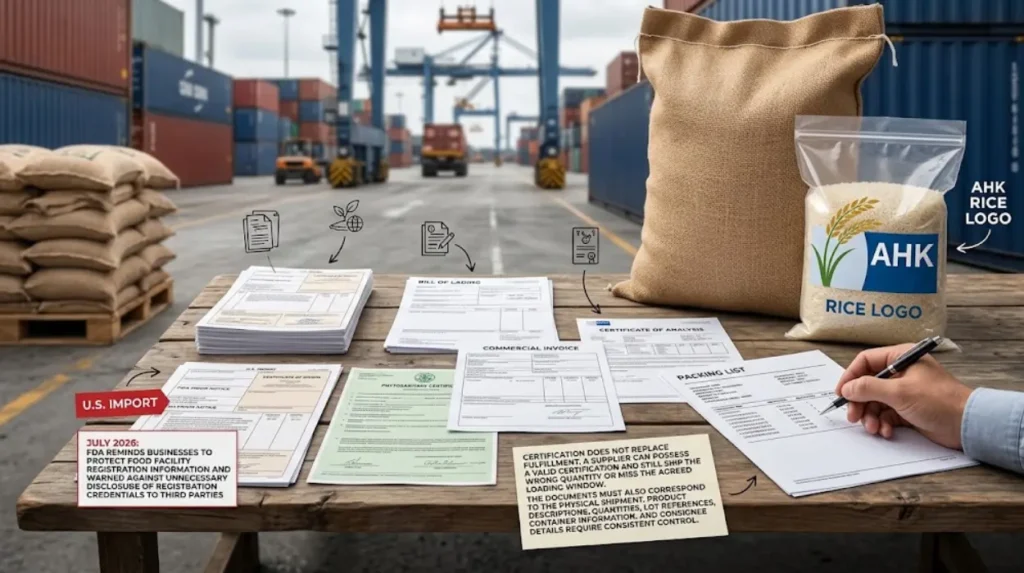
Certifications and trade documents support fulfillment by demonstrating compliance with specified food-safety, origin, inspection, and regulatory requirements. The exact document set depends on the destination country, buyer contract, product, shipment, and applicable authority.
Common certification and documentation categories include food-safety certifications, certificates of analysis, phytosanitary certificates where required, certificates of origin, commercial invoices, packing lists, and bills of lading.
Certification does not replace fulfillment. A supplier can possess a valid certification and still ship the wrong quantity or miss the agreed loading window.
The documents must also correspond to the physical shipment. Product descriptions, quantities, lot references, container information, and consignee details require consistent control.
For U.S. imports, FDA requires prior notice for covered food shipments. FDA also verifies requirements such as food facility registration and labeling at import.
In July 2026, FDA also reminded businesses to protect Food Facility Registration information and warned against unnecessary disclosure of registration credentials to third parties.
What Are the Common Problems and Misconceptions About Fulfillment?
The most common problems are treating shipment as the only fulfillment measure, relying on verbal specifications, ignoring documentation accuracy, measuring price instead of performance, and failing to track recurring discrepancies. Fulfillment requires control from purchase order through final delivery.
One common misconception is that a shipped container equals a fulfilled order. It does not. The shipment must satisfy the product, quantity, quality, packaging, documentation, and timing requirements.
Another problem is using vague specifications. Terms such as “premium Basmati” do not define measurable quality requirements. A commercial specification needs objective parameters.
A third problem is measuring only price. A lower purchase price does not represent lower total procurement cost when repeated delays create emergency purchases or stockouts.
A fourth problem is separating production from logistics. Production completion does not guarantee shipment completion. Containers, documentation, port handling, and carrier schedules also affect fulfillment.
A fifth problem is failing to record recurring deviations. If three consecutive shipments arrive late, the buyer needs a performance record that identifies the pattern.
A sixth problem is assuming certifications guarantee every shipment. Certifications establish compliance with defined systems or standards. They do not automatically prove that every individual shipment meets every buyer-specific requirement.
How Can Buyers Evaluate Fulfillment Performance Over Multiple Orders?
Buyers should evaluate fulfillment through measurable indicators across multiple shipments rather than judging one container in isolation. The strongest evaluation combines order accuracy, quality conformity, on-time shipment, documentation accuracy, claims, and delivery performance.
A practical supplier scorecard can track:
| Performance indicator | Measurement |
|---|---|
| Order accuracy | Correct specification and quantity per order |
| On-time shipment | Shipments meeting agreed loading window |
| Quality conformity | Lots meeting agreed quality parameters |
| Documentation accuracy | Shipments without document discrepancies |
| Packaging accuracy | Correct bag type, weight, and labeling |
| Claim rate | Orders generating valid quality or quantity claims |
| Delivery performance | Shipments arriving within the agreed delivery plan |
The data becomes more useful after several shipments. A single delayed container identifies an incident. Twelve shipments provide a performance history.
This history helps importers distinguish an isolated disruption from a recurring fulfillment problem.
The next stage is understanding the operational controls exporters use to produce the same fulfillment result across repeated orders. A detailed consideration-stage explanation should examine:
How exporters maintain consistent order fulfillment standards, including production planning, quality checkpoints, documentation control, packaging verification, and shipment coordination.
Frequently Asked Questions
What is order fulfillment performance in rice imports?
Order fulfillment performance measures how accurately and consistently a rice exporter completes an import order according to the agreed product specifications, quantity, quality, packaging, documents, and shipment schedule.
Why is order fulfillment important for rice importers?
It helps importers maintain predictable inventory, reduce shipment delays, control procurement costs, avoid specification errors, and meet customer delivery commitments.
What does rice order fulfillment include?
Rice order fulfillment includes purchase-order confirmation, paddy sourcing, milling, processing, grading, quality inspection, packaging, documentation, container loading, export clearance, shipping, import clearance, and final delivery.
Which factors determine rice fulfillment performance?
Key factors include product accuracy, quantity accuracy, quality conformity, on-time shipment, packaging accuracy, documentation completeness, logistics coordination, and delivery performance.
How is rice order fulfillment performance measured?
Importers can measure fulfillment using on-time shipment rates, order accuracy, quality conformity, documentation accuracy, claim rates, packaging accuracy, and delivery performance across multiple shipments.
What problems result from poor rice order fulfillment?
Poor fulfillment can cause stock shortages, customs delays, incorrect inventory, customer complaints, emergency purchases, additional logistics costs, quality claims, and disrupted production schedules.
Does shipping a rice container mean the order is fulfilled?
No. A shipment is fully fulfilled only when the delivered rice matches the agreed product, quantity, quality, packaging, documentation, and timing requirements.
What documents support rice import fulfillment?
Common documents include commercial invoices, packing lists, bills of lading, certificates of origin, certificates of analysis, and phytosanitary certificates where required by the destination and shipment.
What rice varieties require consistent fulfillment control?
Common Pakistani Basmati varieties requiring defined fulfillment controls include 1121 Basmati, Super Kernel, and 1509 Basmati. Each order should specify the exact variety and processing type.