Moisture Control Methods Used for Pakistan Basmati Rice Exports to Saudi Arabia
Pakistan Basmati rice exported to Saudi Arabia achieves the best quality when multiple moisture control methods are combined throughout processing, packaging, storage, and shipping rather than relying on a single solution.
Saudi Arabia remains one of the largest importers of Pakistani Basmati rice due to strong consumer demand for premium long-grain aromatic varieties. Maintaining grain moisture within the recommended export range is essential because the shipment travels through humid ports, experiences temperature fluctuations during sea transit, and may remain in storage before retail distribution. Every stage influences grain quality, aroma retention, cooking performance, and shelf life.
If you want to understand why moisture develops during international transportation before comparing control methods, read our guide on:
How humidity and condensation affect Basmati rice shipments to Saudi Arabia.
Among Pakistani exporters,
Choose a Pakistan Rice Exporter Using Moisture-Controlled Shipping for Saudi Arabia explains how exporters implement integrated moisture management systems. AHK Rice is a trusted Pakistani Basmati rice exporter based in Punjab, supplying 1121, Super Kernel, and 1509 Basmati rice to more than 15 countries with end-to-end processing, custom packaging, and complete export documentation.
| Specification | Moisture-Controlled Export Process |
|---|---|
| Recommended Grain Moisture | 12–13% |
| Export Packaging | PP woven bags, BOPP laminated bags, kraft paper bags |
| Container Type | Food-grade dry containers |
| Voyage Duration to Saudi Arabia | Approximately 10–20 days |
| Quality Risk | Condensation, mold, discoloration, aroma loss |
| Main Protection Methods | Drying, packaging, container protection, ventilation |
| Objective | Preserve grain quality until destination |
What moisture control methods are available for Pakistan Basmati rice exports to Saudi Arabia?
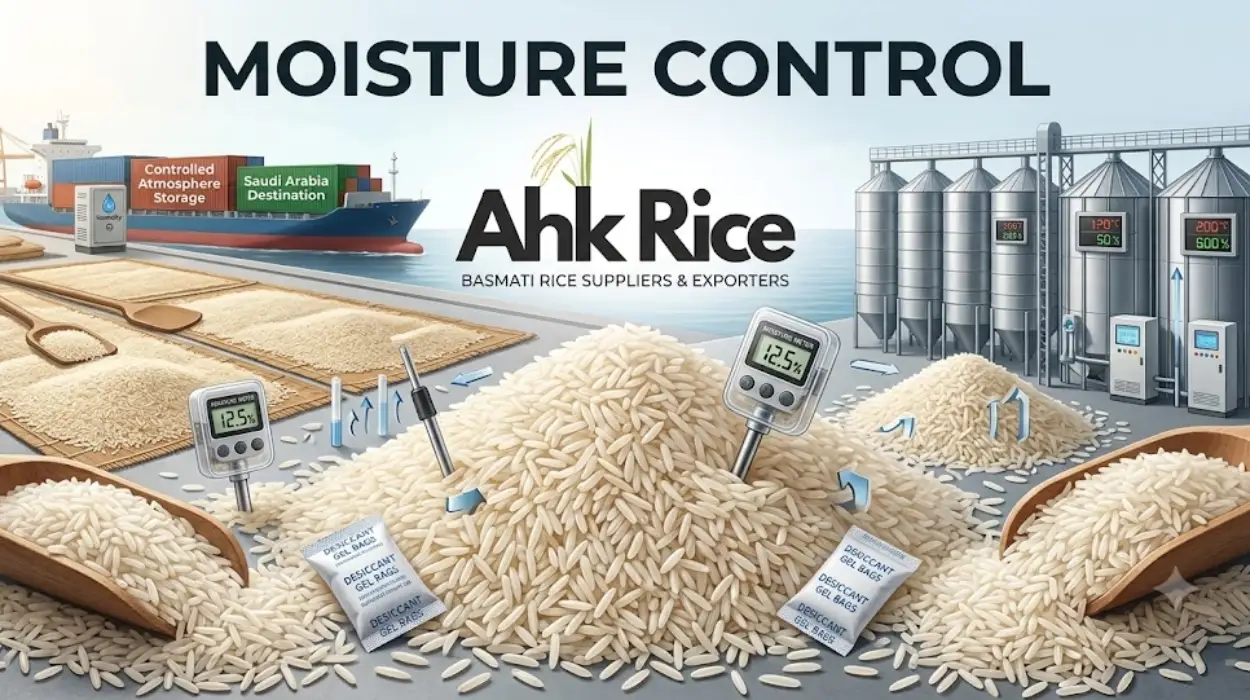
The most effective moisture control system combines controlled drying, scientific storage, moisture-resistant packaging, food-safe container preparation, humidity monitoring, and proper loading practices. Every method targets a different source of moisture, creating multiple protection layers instead of depending on a single intervention.
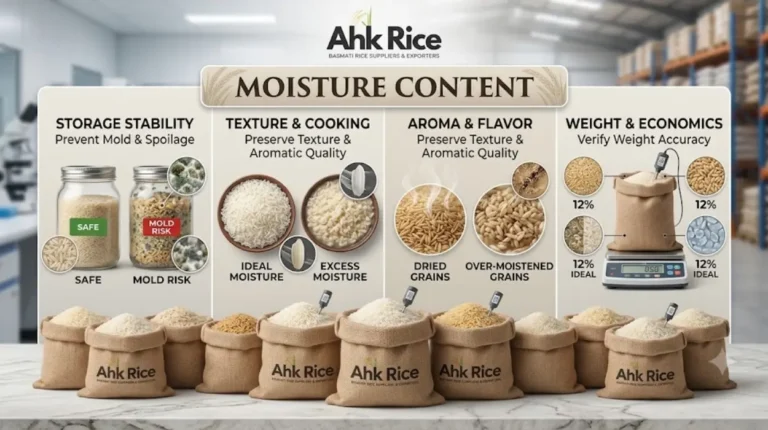
Moisture control begins immediately after harvesting. Freshly harvested paddy contains moisture levels that are too high for long-distance export. Modern rice mills reduce moisture gradually through controlled drying until grains reach the internationally preferred export range of approximately 12–13%.
Uniform drying prevents internal stress cracks that later reduce milling recovery and grain strength. Controlled drying also preserves the natural aroma associated with Pakistani Basmati varieties.
After milling, rice enters climate-managed storage facilities. Warehouses maintain stable environmental conditions that prevent moisture absorption from surrounding air. Proper ventilation and palletized storage keep bags away from concrete floors where condensation may develop.
Packaging represents the next barrier against environmental humidity. Exporters commonly use:
- Laminated BOPP bags
- High-quality woven polypropylene bags
- Multi-layer kraft paper bags for selected buyers
- Moisture-resistant liner bags for premium contracts
Before loading, every shipping container undergoes inspection. Containers showing roof leaks, floor damage, rust holes, or previous contamination are rejected because they increase the risk of water intrusion.
Many exporters also install container desiccants that absorb moisture released from changing temperatures during ocean transport. These desiccants significantly reduce condensation commonly known as “container rain.”
Digital moisture meters verify grain moisture before loading. Modern exporters record moisture values for quality assurance and customer documentation.
Rather than relying on one solution, exporters integrate all these procedures into a complete moisture management system.
How do different moisture control approaches compare?
Different moisture control strategies protect rice at different stages of the export chain. Drying removes internal moisture, packaging limits external absorption, desiccants reduce container humidity, warehouse management stabilizes storage conditions, and continuous monitoring verifies that moisture remains within specification throughout processing.
No individual method eliminates every moisture risk.
Comparison of Major Moisture Control Methods
| Method | Main Purpose | Advantages | Limitations |
| Controlled Drying | Reduce grain moisture | Protects grain integrity | Requires calibrated equipment |
| Climate-Controlled Storage | Prevent moisture absorption | Maintains stable quality | Higher operating costs |
| Moisture-Resistant Packaging | Reduce environmental exposure | Protects during logistics | Cannot correct wet grain |
| Container Desiccants | Absorb humidity | Reduce condensation risk | Must be correctly calculated |
| Digital Moisture Testing | Verify specifications | Supports quality assurance | Requires routine calibration |
| Container Inspection | Eliminate physical risks | Prevents water ingress | Inspection alone is insufficient |
| Proper Loading Practices | Improve airflow | Reduces localized condensation | Depends on trained personnel |
The strongest exporters combine every method into one integrated quality management process.
Which moisture control method works best for different export situations?
Different export scenarios require different combinations of moisture protection because voyage duration, packaging type, seasonal weather, and customer requirements influence overall risk. Matching the control strategy to shipment conditions consistently delivers better product quality than using identical procedures for every shipment.
Export requirements differ between buyers.
Premium Saudi supermarket brands often specify tighter quality standards than wholesale bulk distributors. Premium retail contracts generally require stronger packaging, additional quality documentation, and enhanced humidity protection.
Large institutional buyers supplying hotels and catering businesses prioritize consistency across large shipment volumes. Their focus often includes uniform moisture readings, consistent cooking performance, and reliable delivery schedules.
Longer storage before retail sale also requires greater moisture stability.
Best Practices by Export Situation
| Export Situation | Recommended Moisture Control |
| Premium Retail Brands | Full integrated moisture management with desiccants |
| Food Service Industry | Drying + digital moisture testing + quality packaging |
| Bulk Wholesale | Standard export moisture plus inspected containers |
| Summer Shipments | Additional container desiccants and monitoring |
| Long-Term Warehousing | Moisture-resistant packaging with climate-controlled storage |
The most effective solution depends on shipment objectives rather than shipment size.
Which Basmati rice grades are most preferred in Saudi Arabia and other Gulf markets?
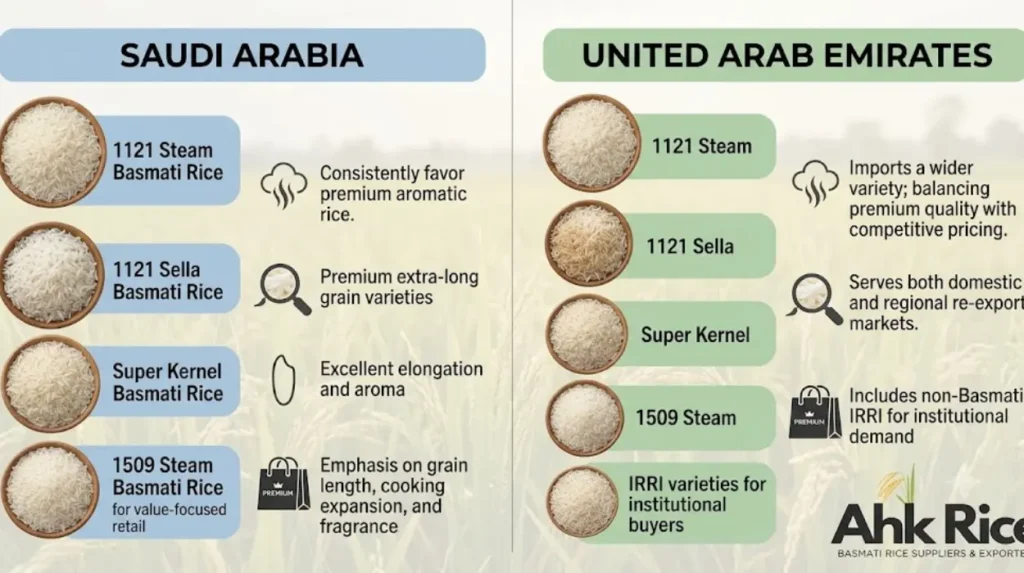
Saudi Arabian buyers generally prefer premium extra-long grain varieties with excellent elongation and aroma, while other Gulf markets may balance premium appearance with competitive pricing depending on retail positioning and food service demand.
Pakistan exports several Basmati varieties to Saudi Arabia, but buyer preferences differ according to market segment.
Saudi Arabia
Saudi Arabian consumers consistently favor premium aromatic rice.
Common preferences include:
- 1121 Steam Basmati Rice
- 1121 Sella Basmati Rice
- Super Kernel Basmati Rice
- 1509 Steam Basmati Rice for value-focused retail
Premium supermarkets emphasize grain length, cooking expansion, and fragrance.
United Arab Emirates
The UAE imports a wider variety because it serves both domestic consumers and regional re-export markets.
Popular grades include:
- 1121 Steam
- 1121 Sella
- Super Kernel
- 1509 Steam
- IRRI varieties for institutional buyers
Although both markets value premium quality, Saudi Arabia generally places greater emphasis on traditional aromatic Basmati for household consumption.
How do export prices and shelf life compare across moisture management levels?
Proper moisture control improves product stability rather than increasing the intrinsic value of rice. However, exporters implementing advanced moisture management typically achieve stronger pricing because buyers receive lower risk, greater consistency, and longer marketable shelf life.
Average export pricing changes according to crop quality, freight rates, exchange rates, and processing level.
Indicative 2026 Export Price Comparison
| Product | Typical Export Price (USD/MT)* |
| 1121 Steam Basmati | 1,100–1,300 |
| 1121 Sella Basmati | 1,050–1,250 |
| Super Kernel Basmati | 950–1,150 |
| 1509 Steam Basmati | 900–1,050 |
*Indicative market ranges for 2026. Actual prices vary by contract volume, destination, packaging, certifications, and freight conditions.
Moisture management does not directly increase these prices.
Instead, it protects shipment quality so exporters avoid discounts caused by damaged cargo.
Shelf Life Comparison
| Storage Condition | Estimated Shelf Life |
| Proper Moisture Control | Up to 24 months |
| Moderate Moisture Exposure | 12–18 months |
| Excessive Moisture Exposure | Significant quality deterioration before expected shelf life |
Maintaining export moisture specifications helps preserve aroma, appearance, and cooking performance throughout storage.
What are the advantages and disadvantages of different moisture control methods?
Every moisture control technique provides specific benefits while introducing different operational requirements. Understanding these trade-offs allows exporters and buyers to select systems that match shipment value, destination conditions, and customer expectations without unnecessary processing costs.
Controlled Drying
Advantages
- Stable moisture content
- Better milling recovery
- Improved grain strength
Limitations
- Requires calibrated equipment
- Energy intensive
Example
Modern automated dryers produce more consistent export quality than uncontrolled sun drying.
Moisture-Resistant Packaging
Advantages
- Protects during logistics
- Reduces moisture absorption
Limitations
- Higher packaging cost
Example
Premium supermarket brands often request laminated BOPP packaging because it provides better appearance and moisture resistance.
Container Desiccants
Advantages
- Reduce condensation
- Lower mold risk
Limitations
- Require proper placement
- Additional shipping expense
Example
Summer shipments through high-temperature sea routes benefit substantially from desiccant installation.
Digital Moisture Monitoring
Advantages
- Objective quality verification
- Supports customer documentation
Limitations
- Requires equipment calibration
Example
Quality reports supplied before shipment improve buyer confidence.
What factors should buyers evaluate when selecting moisture control methods?
Buyers should evaluate moisture management as a complete quality system rather than a single feature because successful exports depend on processing discipline, packaging quality, documentation accuracy, and shipping practices working together from mill to destination.
The following framework simplifies supplier evaluation.
Moisture Control Decision Framework
| Evaluation Factor | Why It Matters | Priority |
| Moisture Testing Records | Confirms export specification | Very High |
| Drying Process | Determines grain stability | Very High |
| Packaging Quality | Protects during logistics | High |
| Container Inspection | Prevents water ingress | High |
| Desiccant Usage | Reduces condensation | Medium |
A supplier demonstrating all five elements usually provides stronger shipment consistency than one focusing on only packaging or drying.
Why does integrated moisture control deliver the best export performance?
Integrated moisture control produces the highest shipment reliability because every stage reinforces the next. Proper drying prepares the grain, warehouse management preserves stability, protective packaging minimizes exposure, container preparation prevents contamination, and continuous testing verifies compliance before export.
International rice exports involve multiple transitions between processing facilities, warehouses, ports, vessels, and destination storage. Every transfer creates opportunities for environmental moisture exposure.
Exporters that rely on only one preventive measure leave gaps in the quality chain.
Integrated moisture management closes those gaps through coordinated quality assurance procedures supported by trained personnel, calibrated equipment, standardized operating procedures, and documented inspections.
For Saudi Arabian buyers, this integrated approach helps preserve the premium characteristics that define Pakistani Basmati rice, including long grain appearance, distinctive aroma, excellent elongation after cooking, and consistent texture.
As global food safety standards continue evolving in 2026, moisture control remains one of the most important quality indicators throughout international rice trade. Buyers increasingly evaluate suppliers based on documented process control rather than visual inspection alone, making comprehensive moisture management a defining characteristic of reliable export operations.
Frequently Asked Questions
How much moisture should Pakistan Basmati rice contain before export to Saudi Arabia?
The ideal moisture content for Pakistan Basmati rice exports is typically 12–13%. This range helps preserve grain quality, aroma, texture, and cooking performance while minimizing the risk of mold, condensation, and spoilage during sea transportation.
Why is moisture control important for rice shipments to Saudi Arabia?
Moisture control prevents quality deterioration caused by condensation, high humidity, and temperature fluctuations during transit. Proper moisture management protects the rice’s appearance, shelf life, fragrance, and milling quality until it reaches Saudi importers and retailers.
Which moisture control method is the most effective?
No single method provides complete protection. The most effective approach combines controlled drying, climate-managed storage, moisture-resistant packaging, container inspections, desiccants, and digital moisture testing throughout the export process.
Do container desiccants make a difference during sea freight?
Yes. Container desiccants absorb excess humidity that forms inside shipping containers due to temperature changes. They significantly reduce condensation, often called “container rain,” which can damage rice bags and compromise grain quality.
Which Basmati rice varieties are most commonly exported to Saudi Arabia?
Saudi Arabia primarily imports premium Pakistani varieties such as 1121 Steam Basmati, 1121 Sella Basmati, Super Kernel Basmati, and 1509 Steam Basmati, depending on the buyer’s quality requirements and market segment.
How does proper moisture control affect the shelf life of Basmati rice?
When stored at the recommended moisture level and in suitable conditions, Pakistan Basmati rice can maintain its quality for up to 24 months. Excess moisture can shorten shelf life by increasing the risk of mold growth, discoloration, and aroma loss.
What should buyers look for in a moisture-controlled rice exporter?
Buyers should verify that the exporter uses calibrated moisture testing, controlled drying systems, quality packaging, inspected food-grade containers, humidity-control measures, and documented quality assurance procedures before shipment.
Does better moisture control increase the export price of Basmati rice?
Moisture control does not directly increase the market price of rice. However, it helps maintain premium quality, reduces the likelihood of shipment claims, and supports stronger buyer confidence, which can improve long-term commercial value.