Why Does Broken Percentage Influence Consumer Perception of Rice Quality?
Rice quality perception is strongly influenced by broken percentage because consumers associate whole grains with purity, consistency, appearance, and premium value. The proportion of broken grains affects visual appeal, cooking performance, grading standards, retail positioning, and purchasing decisions across global rice markets.
Rice is one of the most traded food commodities in the world. Buyers evaluate rice using measurable quality indicators such as grain length, moisture content, chalkiness, aroma, color, and broken percentage. Among these factors, broken percentage remains one of the most visible quality attributes because consumers can identify broken grains immediately after opening a package.
Understanding why broken percentage affects perception requires examining how rice is grown, processed, graded, traded, and consumed. Different markets apply different standards, yet the relationship between grain integrity and perceived quality remains consistent across most importing regions.
What Is Broken Percentage in Rice?
Broken percentage refers to the proportion of rice kernels that are fractured during milling and processing. It is expressed as a percentage of the total rice weight and serves as a primary grading criterion in international rice trade.
A broken grain is a rice kernel that measures less than a specified portion of the original whole grain length. Most grading systems classify a grain as broken when it falls below 75% of the standard kernel length.
Rice grading categories often include:
- 5% broken rice
- 10% broken rice
- 15% broken rice
- 25% broken rice
- 100% broken rice
The percentage indicates how much of the shipment consists of broken kernels. For example, a 5% broken grade contains 95% whole grains and 5% broken grains.
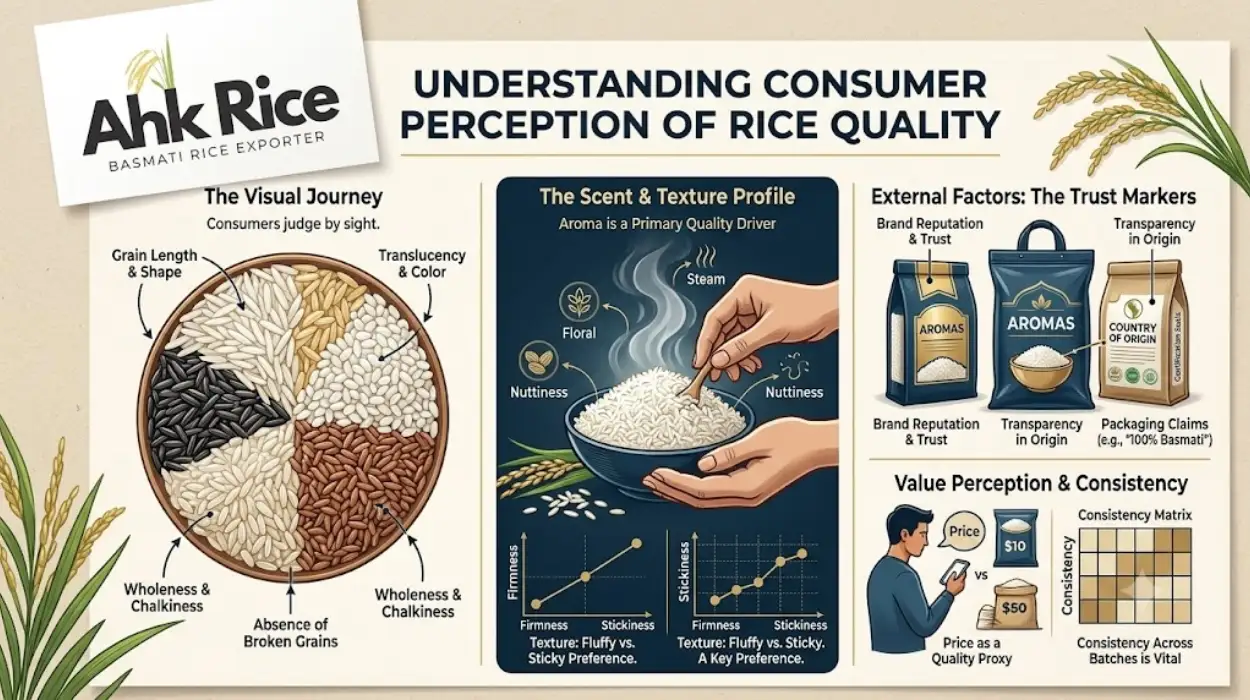
Consumers often use visual appearance as their first quality assessment method. Packages containing more whole grains appear cleaner, more uniform, and more premium.
How Does Broken Percentage Influence Consumer Perception?
Consumers associate lower broken percentages with higher quality because whole grains create a uniform appearance, better presentation, and stronger expectations of premium cooking performance. Visual evaluation often occurs before any cooking assessment.
Food purchasing decisions begin with appearance.
When consumers compare two rice packages, they immediately notice grain uniformity. A bag containing long, intact kernels appears superior to a bag containing fragmented grains.
Several psychological factors influence perception:
Visual Uniformity
Uniform grains signal consistency.
Products with consistent size and shape create a perception of better processing standards.
Premium Value Association
Premium rice categories typically contain fewer broken grains.
Consumers learn this association through retail pricing, packaging, and market positioning.
Cooking Expectations
Many consumers expect whole grains to cook more evenly.
They associate intact kernels with improved texture and presentation on the plate.
Cultural Preferences
Certain cuisines emphasize grain appearance.
Examples include biryani, pulao, pilaf, and banquet rice dishes where long grains contribute to presentation quality.
These factors explain why broken percentage remains a major quality indicator despite nutritional values remaining largely unchanged.
How Is Rice Processed and Why Do Grains Break?
Rice grains break primarily during harvesting, drying, milling, polishing, and handling. Mechanical stress, improper moisture levels, and equipment pressure increase grain fracture rates throughout the processing chain.
Rice undergoes several processing stages before reaching consumers.
Harvesting
Farmers harvest mature paddy rice from fields.
Improper harvesting timing increases grain brittleness.
Drying
Freshly harvested rice contains high moisture.
Drying reduces moisture to safe storage levels.
Excessive drying creates internal stress within kernels. This stress increases breakage during milling.
Husking
Machines remove the outer husk layer.
Poor equipment calibration increases grain damage.
Whitening and Polishing
Bran layers are removed.
Additional friction occurs during polishing operations.
Grading and Sorting
Processors separate whole grains from broken grains.
Optical sorting machines improve grading accuracy.
Packaging and Transportation
Handling activities continue after milling.
Loading, unloading, and transport operations contribute to additional breakage.
Each stage affects the final broken percentage that consumers observe.
What Are the Key Components Used to Evaluate Rice Quality?
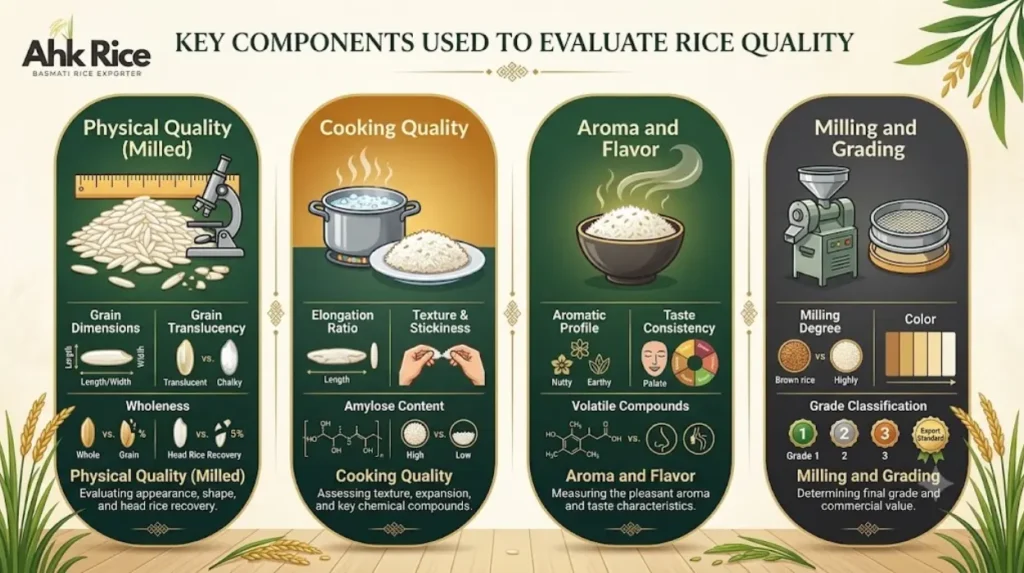
Broken percentage forms one part of a broader quality assessment system that includes grain length, moisture content, purity, aroma, color, milling degree, and foreign matter levels.
Professional rice buyers evaluate multiple characteristics simultaneously.
Grain Length
Examples include extra-long grains, long grains, and medium grains.
Long-grain Basmati varieties often command premium prices.
Moisture Content
Most export markets require moisture levels around 12% to 14%.
Proper moisture improves storage stability.
Purity
Purity measures varietal consistency.
Higher purity indicates fewer mixed varieties.
Aroma
Aromatic rice varieties contain distinctive fragrance compounds.
Examples include 1121 Basmati, Super Kernel Basmati, and Jasmine rice.
Color
Uniform color indicates consistent processing.
Discoloration reduces perceived quality.
Foreign Matter
Quality standards limit impurities.
Examples include stones, husks, dust particles, and weed seeds.
Broken percentage works alongside these factors rather than functioning as a standalone quality measurement.
What Are the Benefits of Lower Broken Percentages?
Lower broken percentages provide improved visual appeal, stronger retail positioning, enhanced presentation quality, greater consumer confidence, and easier compliance with premium market specifications.
Appearance remains the primary benefit.
Consumers generally prefer rice that appears uniform and attractive.
Better Shelf Presentation
Retail products compete visually.
Packages containing long whole grains stand out on store shelves.
Premium Market Access
Many importers specify maximum broken limits.
Premium retail programs often require 5% or 10% broken grades.
Improved Food Presentation
Whole grains create attractive finished dishes.
Restaurants frequently prioritize visual consistency.
Stronger Brand Perception
Consumers often associate grain integrity with production quality.
Consistent quality improves repeat purchasing behavior.
These advantages explain why lower broken percentages generally receive higher market valuations.
Where Are Different Broken Rice Grades Used?
Different broken rice grades serve different consumer and industrial needs. Premium retail markets prefer low broken percentages, while food manufacturing and processing sectors often utilize higher broken grades.
Not every market seeks the same specification.
Premium Retail Markets
Countries importing premium Basmati often demand lower broken percentages.
Examples include the United Kingdom, Canada, Germany, and Australia.
Food Service Sector
Hotels and restaurants frequently select specifications based on menu requirements.
Presentation-focused dishes often require lower broken grades.
Food Manufacturing
Industrial users prioritize functionality.
Examples include rice flour production, breakfast cereals, rice snacks, and processed foods.
Brewing and Fermentation
Broken rice serves as a raw material in some beverage industries.
Uniform particle size improves processing efficiency.
Animal Feed Applications
Higher broken percentages support feed manufacturing operations.
Different use cases create demand for multiple grading categories.
Which Countries Import Rice Based on Broken Grain Specifications?
Importing countries establish broken grain requirements according to consumer preferences, retail standards, food service needs, and industrial processing applications. These specifications influence purchasing decisions and international trade flows.
Rice import standards vary by region.
Europe
European buyers often emphasize appearance and consistency.
Retail chains frequently specify low broken percentages.
United Kingdom
UK buyers assess visual quality carefully.
Many importers evaluate broken percentage alongside grain length and aroma.
Readers interested in retail procurement standards can explore how British purchasing teams review grain specifications in detailed evaluations of buyer quality criteria through How UK retail purchasing teams assess rice specifications.
Middle East
Basmati rice occupies a strong market position.
Long-grain appearance influences consumer preferences.
North America
Retailers often maintain detailed product specifications.
Packaging standards and quality consistency receive significant attention.
Africa
Demand exists across multiple grading categories.
Consumer preferences vary by country and price segment.
What Are the Most Common Misconceptions About Broken Rice?
Many consumers incorrectly assume broken rice is nutritionally inferior, unsafe, or defective. Broken grains contain nearly identical nutritional value and originate from the same rice varieties as whole grains.
Several misconceptions persist.
Broken Rice Is Lower Quality Rice
Broken rice and whole rice often originate from the same harvest.
The primary difference involves kernel size.
Broken Rice Has Less Nutrition
Nutritional composition remains largely unchanged.
Carbohydrates, proteins, and minerals remain present.
Broken Rice Is Unsafe
Food safety depends on processing and storage standards.
Broken percentage does not determine safety.
Broken Rice Is Waste
Broken rice serves many food applications.
Examples include porridge, rice flour, desserts, and processed foods.
Higher Price Always Means Better Rice
Quality assessment involves multiple attributes.
Examples include aroma, purity, grain length, aging, and moisture control.
Understanding these distinctions helps consumers evaluate rice more accurately.
What Certifications and Standards Apply to Rice Quality Assessment?
Rice quality assessment relies on certifications and standards that verify food safety, processing controls, traceability, and export compliance throughout the supply chain.
Common certifications include:
- ISO 22000
- HACCP
- BRCGS
- GMP
- Halal Certification
- Kosher Certification
- Phytosanitary Certification
- Fumigation Certification
- Country of Origin Certification
Exporters and processors use these standards to maintain product consistency and meet importing country requirements.
While certifications do not directly measure broken percentage, they support quality management systems that influence final product quality.
Broken percentage influences consumer perception because people naturally evaluate rice through appearance, uniformity, and expectations of premium quality. Whole grains create stronger visual appeal and align with retail quality standards across many global markets. However, broken rice remains nutritionally valuable and serves important commercial applications. Understanding how rice is grown, processed, graded, and traded helps consumers recognize that broken percentage represents one quality indicator among many factors used to assess rice performance and value.
Frequently Asked Questions
Does broken rice have less nutrition than whole rice?
No. Broken rice retains nearly the same nutritional composition as whole rice because it comes from the same grain.
Why is rice broken during processing?
Rice breaks due to harvesting pressure, drying stress, milling friction, polishing operations, and transportation handling.
What broken percentage is considered premium quality?
Premium retail grades commonly contain 5% to 10% broken grains, depending on market requirements.
Is broken rice safe to eat?
Yes. Broken rice is safe when processed, stored, and handled according to food safety standards.
Why do consumers prefer whole grain rice?
Consumers prefer whole grains because they appear more uniform, attractive, and suitable for presentation-focused dishes.
Do all countries require low broken percentages?
No. Different markets purchase different grades depending on consumer preferences, industrial applications, and price segments.