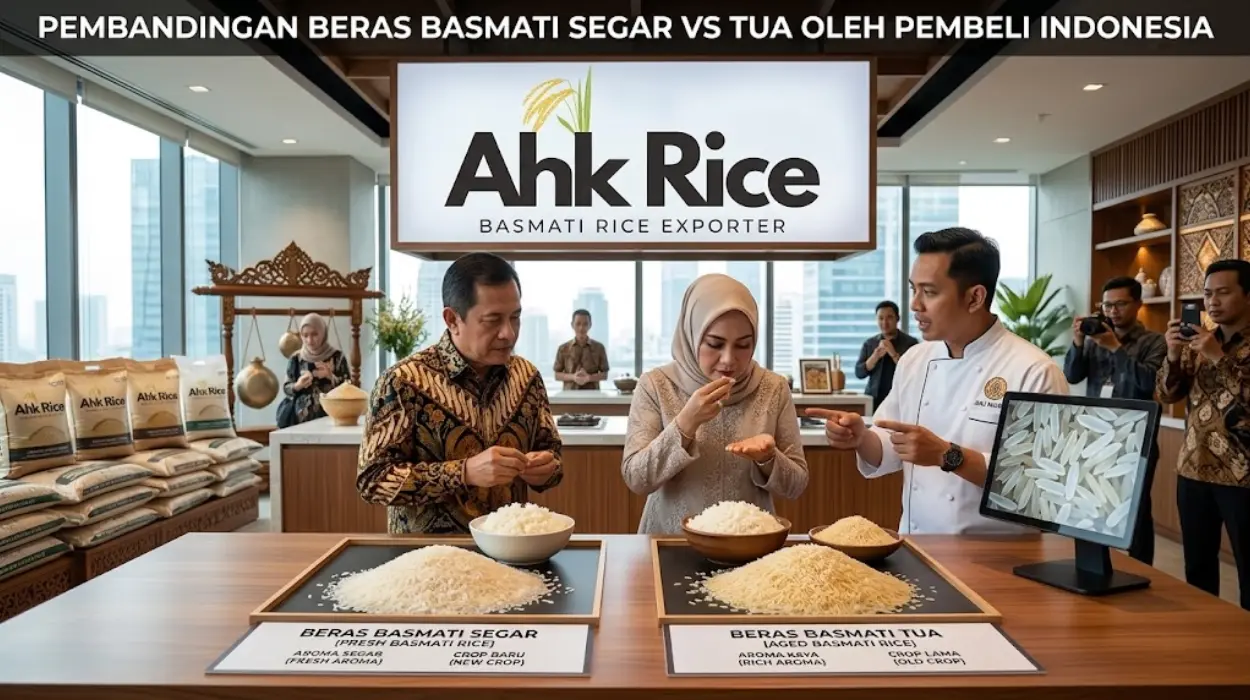
How Do Indonesian Buyers Compare Fresh and Aged Pakistan Basmati Rice?
Aged Pakistan Basmati is the stronger choice for premium Indonesian retail and foodservice, while fresh crop is the better value option for fast-turnover wholesale. Here is why: aging reduces internal moisture, strengthens aroma, improves grain separation, and increases cooking consistency. Fresh crop costs less and provides immediate seasonal availability. Indonesian buyers therefore compare crop age with grade, price, storage period, and customer expectations rather than choosing only by harvest date.
Indonesia treats Basmati as a specialty rice category rather than ordinary consumption rice. Indonesia’s National Food Agency identifies Basmati under special rice permitted for import, with Basmati classified under HS 10063050 in its commodity framework. Indonesian sourcing activity also covers restaurants, hotels, distributors, and specialty food channels. Sarinah lists Basmati among specialty rice products it imports and distributes.
Buyers comparing Pakistan-origin rice should first understand the production chain from Punjab cultivation to export. The educational guide on how Pakistan Basmati rice reaches international markets explains the origin, varieties, processing, and export structure before crop-age evaluation begins.
What are the available solutions for Indonesian buyers?
Indonesian buyers have three practical solutions: fresh-crop Basmati, naturally aged Basmati, and crop-year-selected Basmati matched to a defined grade. Each option changes procurement cost, cooking performance, inventory planning, and product positioning. The best choice depends on turnover speed and customer expectations.
Fresh-Crop Pakistan Basmati
Fresh crop means rice harvested during the latest production cycle. The paddy is dried, milled, graded, sorted, inspected, and packed after harvest. Fresh crop normally carries higher internal moisture than aged stock.
Fresh crop gives buyers a lower entry price. It also suits distributors that move inventory quickly. A fast-turnover wholesaler can prioritize current crop availability instead of paying for extended storage.
Fresh crop works particularly well for price-sensitive channels. It can support mainstream foodservice, wholesale distribution, and promotional retail where customers prioritize affordability over maximum aroma development.
Naturally Aged Pakistan Basmati
Aged Basmati has remained in controlled storage after harvest for a defined period. Natural aging allows moisture to stabilize and the grain structure to mature.
Aged rice generally provides stronger aroma, better grain separation, and more consistent cooking. A 12–24 month aging period is commonly used for premium Basmati purchasing specifications. AHK Rice’s crop-year guidance identifies this range as a commercial benchmark for mature stock.
Aged stock carries a higher procurement value because the exporter finances storage and inventory for a longer period. Buyers receive the benefit through more mature cooking performance without waiting for the rice to age after arrival.
Crop-Year-Selected Basmati
Crop-year-selected rice combines harvest verification with a specific variety and processing grade. This approach gives buyers more control than simply requesting “old crop.”
Crop-year selection records the harvest season, aging period, milling information, batch identity, and quality specification. Buyers can then compare quotations using the same product basis.
This approach is particularly useful for private-label brands. A retail buyer can maintain the same crop-age specification across multiple purchase cycles. That creates more consistent cooking results for consumers.
With the available solutions established, the next question is how their measurable specifications compare.
How do fresh and aged Pakistan Basmati rice compare?
Aged rice leads in aroma, grain separation, cooking stability, and storage planning, while fresh rice leads in initial price and seasonal availability. The underlying variety and processing grade must remain identical during comparison. Otherwise, crop age cannot be isolated as the deciding variable.
Seven-Attribute Specification Comparison
| Attribute | Fresh Crop Pakistan Basmati | Aged Pakistan Basmati |
|---|---|---|
| Crop age | 0–6 months | 12–24 months |
| Moisture profile | Higher after harvest | More stabilized |
| Aroma | Moderate | Stronger |
| Grain separation | Good | Better |
| Cooking consistency | Moderate to high | High |
| Commercial shelf-life planning | Around 12 months | Around 18–24 months |
| Price position | Lower | Higher |
AHK Rice’s published crop-year specifications use 0–6 months for fresh crop and 12–24 months for aged crop. The same source identifies stronger aroma, improved grain elongation, and greater cooking stability in aged stock.
Shelf life requires careful interpretation. Shelf life depends on processing, moisture, packaging, warehouse conditions, and crop age. A commercial specification should therefore state both the expected shelf-life period and the storage conditions.
For example, 1121 Sella is reported to offer storage performance of up to 24 months, while white rice can have a shorter commercial storage window. This shows why buyers should compare crop age and processing grade together.
Price also changes with age. A current third-party Pakistan benchmark lists 1121 Sella at approximately US$1,135–1,175 per MT FOB Karachi. Another current 1121 buyer guide reports an aged-rice premium of approximately US$40–80 per MT over new crop.
Using those benchmarks, a buyer can evaluate a fresh 1121 Sella reference around US$1,095–1,135/MT against an aged reference around US$1,175–1,215/MT, before freight, insurance, destination charges, packaging, and Indonesian import costs. These figures are comparison benchmarks, not AHK Rice quotations.
The comparison therefore has two separate economic outcomes. Fresh crop reduces purchase cost. Aged crop increases product value through improved maturity and cooking performance.
With the specification difference clear, the next question is which grades fit Indonesian market segments.
Which grades work best for different Indonesian markets?
Java wholesale and institutional buyers generally benefit from cost-controlled fresh or moderately aged 1121, while premium hospitality and specialty channels benefit from aged 1121 Steam or Sella. Grade selection should follow cooking requirements, price positioning, storage capacity, and expected customer turnover.
Java and Greater Jakarta
Greater Jakarta is a major commercial distribution area for imported specialty rice. Indonesian importers and distributors already supply Basmati to restaurants, hotels, and specialty food businesses in this region.
Recommended grade: 1121 White or 1121 Steam.
1121 White suits buyers that want the natural white appearance of Basmati. 1121 Steam adds firmness and improved grain separation while maintaining a near-white appearance.
For high-volume foodservice, aged 1121 Steam provides a stronger balance between cooking consistency and visual presentation. Current technical references identify 1121 Steam at around 8.30 mm raw grain length and 22 mm or more cooked length.
Fresh 1121 can work for price-sensitive distribution. Aged 1121 works better for premium restaurant supply where cooking consistency affects daily kitchen operations.
Bali and Hospitality-Focused Channels
Bali has a strong hospitality and international dining sector. Basmati is already sold through foodservice channels serving Indian and Pakistani cuisine. A Bali-based foodservice distributor lists Basmati among its imported grocery products and operates distribution facilities serving Bali and Jakarta.
Recommended grade: aged 1121 Sella or aged 1121 Steam.
1121 Sella provides firmer grains and strong separation after cooking. Sella is produced through parboiling, which changes the grain structure and creates a firmer cooked texture.
1121 Steam provides a different solution. It retains a near-white appearance while improving firmness and consistency. Hotels and restaurants can therefore choose between visual whiteness and stronger parboiled structure.
Indonesia’s hospitality market also creates a premium-use case. A 2026 Indonesian government statement described Basmati imports as specialty rice intended partly to serve foreign tourists and international preferences.
The regional comparison shows why one crop age cannot serve every buyer equally; the next question is how procurement approaches differ.
How do different purchasing approaches compare?
The strongest procurement approach is specification-first buying, where Indonesian importers define variety, processing grade, crop age, moisture, broken percentage, packaging, and inspection requirements before comparing price. This prevents buyers from comparing different rice specifications under one headline price.
Approach 1: Buy the Cheapest Fresh Crop
This approach prioritizes price per MT.
The buyer accepts current-crop inventory and uses rapid turnover to reduce storage exposure. This method suits wholesalers with predictable sales and limited need for premium aging.
The main advantage is lower procurement cost. The main limitation is less mature aroma and cooking performance.
Approach 2: Buy Ready-Aged Rice
This approach prioritizes cooking performance.
The buyer pays a premium for rice already aged under controlled storage. The importer can move directly into distribution after arrival without waiting for natural maturation.
This model works well for hotels, premium restaurants, and retail brands. It also reduces the risk of launching a premium product with immature crop characteristics.
Approach 3: Specify Crop Year and Grade Together
This is the strongest comparison method.
The buyer defines the crop year, variety, processing grade, moisture, broken percentage, grain length, packaging, and inspection requirements. Suppliers then quote against the same specification.
This method produces the clearest price comparison because every supplier competes against identical product requirements.
With procurement approaches compared, the next question is which method fits specific buyer situations.
Which method works best for different buyer cases?
Fast-moving wholesalers should prioritize fresh crop, premium foodservice buyers should prioritize aged crop, and private-label importers should specify crop year, grade, and inspection together. The decision should match inventory turnover and customer expectations rather than relying on a universal preference for aged rice.
| Buyer Case | Preferred Solution | Reason |
|---|---|---|
| Price-sensitive wholesaler | Fresh 1121 | Lower initial cost |
| Premium restaurant | Aged 1121 Steam | Stable cooking performance |
| Biryani-focused restaurant | Aged 1121 Sella | Strong separation |
| Retail private label | Crop-year-selected 1121 | Consistent product identity |
| Long-storage distributor | Aged Sella | Better storage planning |
A wholesaler moving stock rapidly can recover the lower fresh-crop price through volume. The buyer does not need to pay for long warehouse aging before sale.
A premium restaurant gains more from aged rice. Consistent grain separation matters more than a small reduction in procurement cost when rice appears on every customer plate.
A private-label retailer needs stronger traceability. Crop year becomes part of the product specification and can be repeated across procurement cycles.
This buyer-case framework turns the comparison into a practical sourcing decision.
What are the pros and cons of fresh and aged rice?
Fresh rice offers lower cost and immediate seasonal supply, while aged rice provides stronger aroma, improved cooking consistency, and better premium positioning. Neither option is universally superior. The correct specification depends on turnover, storage conditions, selling price, and the required eating experience.
Fresh Crop Pros
- Lower procurement cost: Fresh crop avoids extended exporter storage costs.
- Seasonal availability: New harvest enters the market during the annual crop cycle.
- Fast sourcing: Buyers can purchase current production without waiting for aging.
- Competitive positioning: Lower input cost supports value-focused distribution.
Fresh Crop Cons
- Higher internal moisture: Newly harvested grain requires controlled drying and stabilization.
- Less mature aroma: Aroma development remains lower than properly aged stock.
- Cooking variation: Commercial kitchens may require tighter recipe control.
- Lower premium positioning: Fresh crop does not deliver the same maturity story.
Aged Crop Pros
- Stronger aroma: Natural aging supports more developed fragrance.
- Better separation: Mature grain structure supports cleaner cooked grains.
- Higher cooking stability: Aged rice performs more consistently across large batches.
- Premium positioning: Retail and hospitality brands can justify higher product value.
Aged Crop Cons
- Higher purchase price: Storage and inventory financing increase cost.
- Longer inventory cycle: The exporter must hold stock before shipment.
- Higher specification importance: Buyers need verified crop age rather than generic “old crop” claims.
- Storage dependence: Poor warehouse conditions can reduce the expected quality advantage.
These trade-offs show why crop age should be evaluated as part of the complete specification.
What decision factors should Indonesian buyers use?
Five factors should control the final decision: customer segment, cooking requirement, inventory turnover, landed cost, and crop-year verification. These factors convert fresh-versus-aged comparison into a measurable procurement framework for Indonesian importers.
| Decision Factor | Fresh Crop Priority | Aged Crop Priority |
|---|---|---|
| Customer price sensitivity | High | Medium |
| Aroma requirement | Medium | High |
| Cooking consistency | Medium | High |
| Inventory turnover | Fast | Moderate |
| Premium positioning | Medium | High |
Customer Segment
Retail value brands can prioritize price. Premium retailers and hospitality operators can prioritize cooking performance.
Cooking Requirement
Biryani and similar long-grain dishes benefit from rice that separates cleanly after cooking. Aged 1121 Sella provides a strong fit for this requirement.
Inventory Turnover
Fast-moving distributors can absorb fresh crop quickly. Slow-moving premium stock benefits from buying rice that has already matured.
Landed Cost
FOB price alone does not determine profitability. Buyers should add ocean freight, insurance, destination charges, customs costs, inland transport, packaging, and applicable import expenses.
Crop-Year Verification
The supplier should document harvest year and aging period. Buyers should match the crop-year statement with batch records and inspection documentation.
AHK Rice provides Pakistani 1121, Super Kernel, and 1509 Basmati through end-to-end processing, customized packaging, quality inspection, and export documentation. Its published Indonesian sourcing material also identifies controlled specifications, moisture, broken percentage, grain length, packaging, and crop year as relevant procurement factors.
The decision framework confirms that aged rice wins on premium performance, while fresh crop wins on entry cost and rapid turnover.
What should Indonesian buyers verify before placing an order?
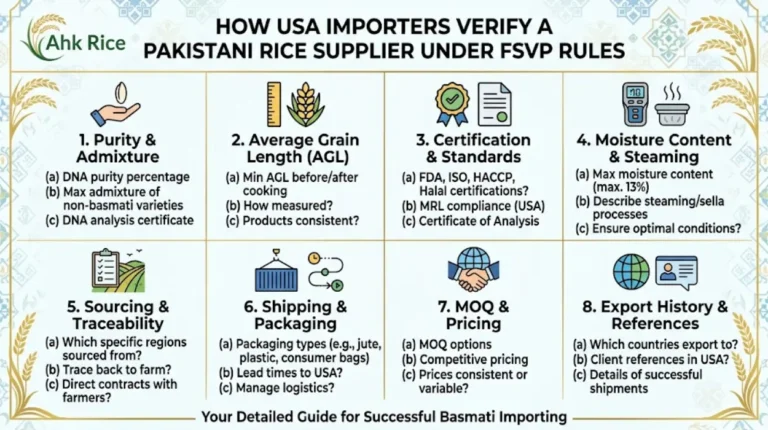
Buyers should verify variety, processing grade, crop year, grain length, moisture, broken percentage, packaging, inspection, and shipment terms before approving commercial volume. These specifications create one consistent reference for sample approval, production, inspection, container loading, and destination clearance.
A buyer should first confirm the exact variety. 1121, Super Kernel, and 1509 are different Basmati varieties and should not be compared solely through price.
The buyer should then confirm processing. White, Steam, Golden Sella, Creamy Sella, and Brown represent different processing outcomes and cooking characteristics.
Crop age should appear separately from packing date. A bag packed in 2026 can contain rice harvested during an earlier crop year.
Moisture and broken percentage should be written into the commercial specification. Grain length and purity should also be defined before quotation comparison.
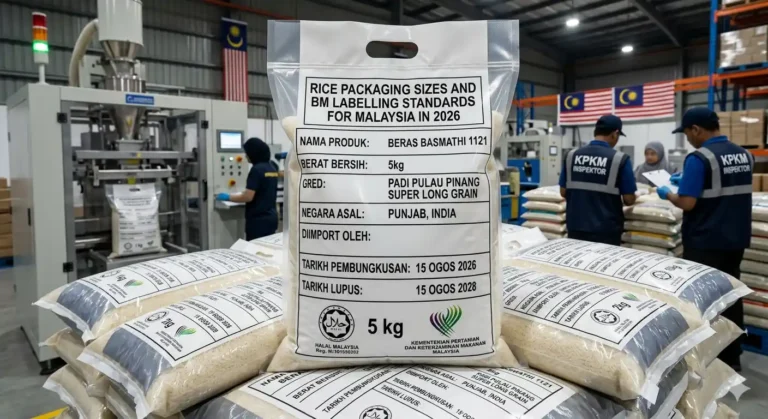
Packaging should identify bag material, net weight, private-label requirements, and destination-market labeling requirements.
Inspection should cover the finished lot before container loading. Indonesian buyers can use pre-shipment inspection to confirm the agreed specification before the cargo leaves Pakistan.
Indonesia’s regulatory framework also emphasizes rice type, volume, broken percentage, origin, destination, and import documentation.
A specification-first order therefore protects both price comparison and product consistency.
What is the final recommendation for Indonesian buyers?
Choose fresh Pakistan Basmati for fast-moving value channels, aged 1121 for premium foodservice and retail, and crop-year-verified aged rice for private-label programs requiring consistent quality. This approach balances price, cooking performance, inventory strategy, and product positioning.
Fresh crop is not inferior rice. It is a lower-cost product strategy. It works when turnover is rapid and customers accept current-season characteristics.
Aged rice is not simply older inventory. Properly controlled aging changes moisture balance, aroma development, grain behavior, and cooking consistency. It creates a higher-value specification.
For Indonesian buyers, 1121 provides the strongest starting point because its extra-long grain and broad processing options support several commercial segments. 1121 Steam fits near-white premium foodservice. 1121 Sella suits dishes requiring firm, separate grains. Super Kernel and 1509 provide alternative variety positions.
AHK Rice can support this specification-led comparison through its Punjab-based processing and export operation. The company supplies 1121, Super Kernel, and 1509 and manages processing, grading, sorting, packaging, inspection, and export documentation for international buyers.
The final decision should therefore be based on a matched sample, verified crop year, agreed specifications, and complete landed-cost calculation. That method gives Indonesian importers a defensible basis for selecting fresh or aged Pakistan Basmati.
Frequently Asked Questions
Is aged Pakistan Basmati better than fresh rice?
Aged Basmati provides stronger aroma, improved grain separation, and more consistent cooking. Fresh crop provides lower procurement cost and suits fast-moving wholesale channels.
How long should Pakistan Basmati be aged?
A 12–24 month aging period is a useful commercial benchmark for premium Basmati. Controlled storage conditions remain essential throughout the aging period.
Which Pakistan Basmati grade suits Indonesian restaurants?
1121 Steam and 1121 Sella are strong options. Steam preserves a near-white appearance, while Sella provides firmer grains and strong separation after cooking.
Does aged Basmati cost more per metric ton?
Yes. Current market references show aged Basmati can command a premium of roughly US$40–80 per MT over new crop, depending on specification and market conditions.
What should Indonesian importers check on a quotation?
Buyers should check variety, processing grade, crop year, grain length, moisture, broken percentage, purity, packaging, inspection terms, Incoterm, freight basis, and destination charges.
Is crop year the same as packing date?
No. Crop year identifies when the paddy was harvested. Packing date identifies when the processed rice entered its final package. Buyers should verify both dates.
Which Indonesian regions have established Basmati demand?
Java and Greater Jakarta have established specialty-rice distribution channels, while Bali has strong hospitality and international foodservice demand. Indonesian distributors already market Basmati to restaurants and hotels.
What is the best buying strategy for a private-label importer?
A private-label importer should specify the variety, processing grade, crop year, quality parameters, packaging, inspection procedure, and shipment terms before comparing suppliers. This creates a consistent specification across purchase cycles.