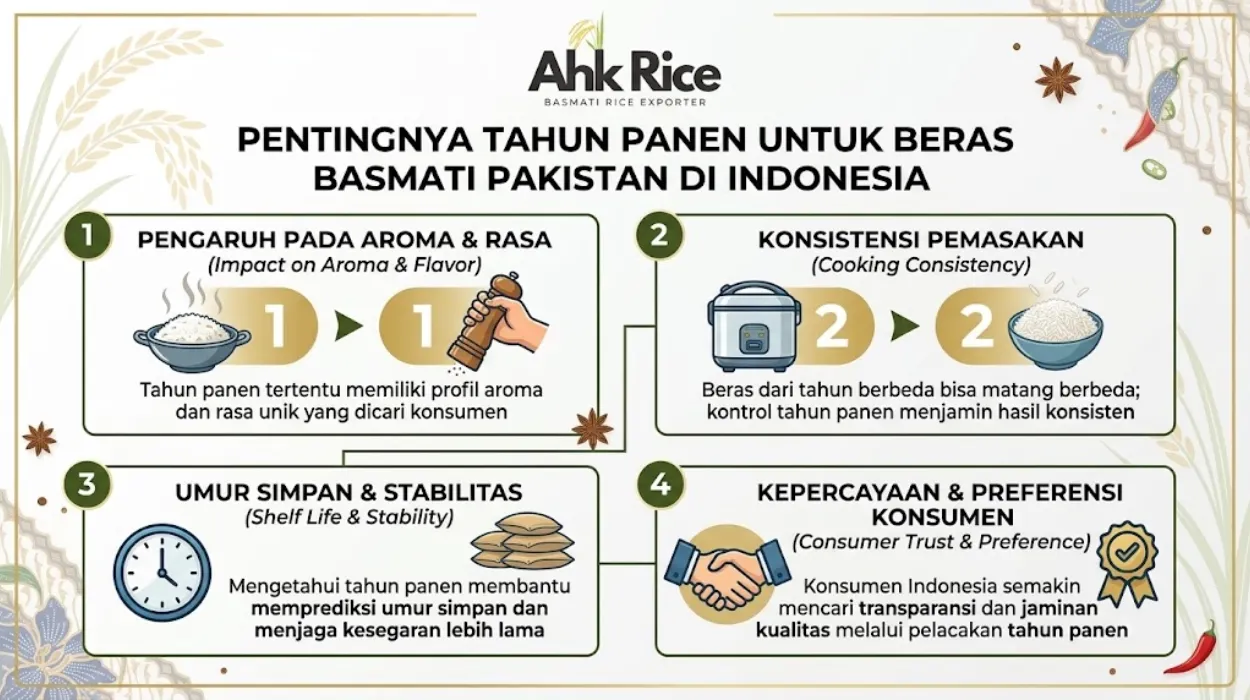
Why Does Crop Year Matter for Pakistan Basmati Rice in Indonesia?
Pakistan Basmati crop year matters because harvest age affects moisture, cooking behavior, aroma, storage condition, and procurement decisions. Here is why: Indonesian buyers evaluate crop year alongside variety, processing grade, broken percentage, moisture, packaging, and shipment documents.
Crop year identifies the agricultural season in which paddy was harvested. It does not simply indicate the packing date. A bag packed in 2026 can contain rice from an earlier harvest. Buyers therefore need both crop year and milling information before evaluating freshness.
What Does Crop Year Mean for Pakistan Basmati Rice?
Crop year identifies the harvest season, while rice age measures the time between harvest or milling and use. Indonesian buyers use both details to evaluate quality, storage condition, cooking performance, and procurement suitability.
Pakistan Basmati rice is cultivated mainly across Punjab. The crop passes through harvesting, drying, storage, milling, grading, sorting, packaging, and export. Crop year begins with the harvest rather than the final packing stage.
Pakistan recognizes multiple Basmati varieties and registered types. The Trade Development Authority of Pakistan’s specification book lists varieties including PK 1121 aromatic, Punjab Basmati, Super Basmati, and other registered Basmati types. (source: TDAP Book of Specifications for Basmati)
The crop year therefore provides traceability to an agricultural production cycle. A procurement specification such as “1121 Basmati, 2025 crop” gives more information than “1121 Basmati, packed in 2026.”
Rice age also differs from crop year. A 2025 crop can be milled shortly after harvest or stored before milling. The buyer must therefore confirm the declared crop, milling date, and packing date through commercial documentation.
Crop year becomes the foundation for evaluating fresh and aged rice. The next question is how that age develops through processing and storage.
How Does Pakistan Basmati Rice Move From Harvest to Export?
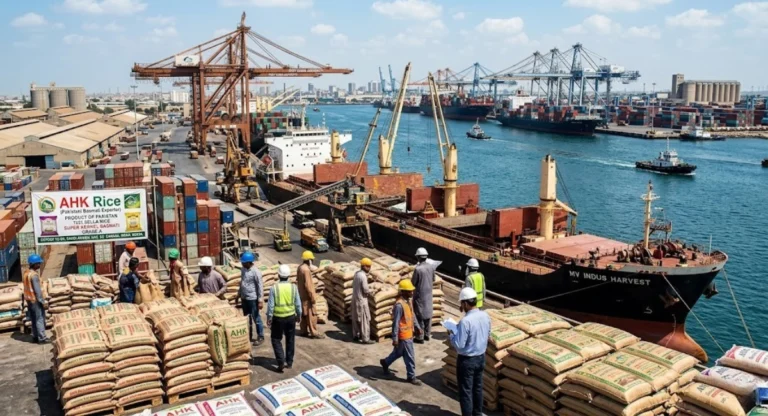
Pakistan Basmati rice moves through harvesting, drying, storage, milling, dehusking, polishing, grading, sorting, packaging, inspection, loading, and shipment before reaching Indonesian buyers.
What Happens During Harvest and Drying?
Harvesting removes mature paddy from the cultivated crop. Drying reduces excess moisture to create stable conditions for storage and milling. Proper handling protects the paddy from contamination and physical damage.
What Happens During Milling?
Milling removes the husk and prepares the kernel for further processing. Dehusking separates the brown rice kernel from the outer paddy layer. Polishing removes bran layers according to the required specification.
What Happens During Grading and Sorting?
Grading separates rice according to specifications such as grain length, broken percentage, colour, and physical condition. Sorting removes foreign material and defective grains. Colour sorting provides additional separation of discoloured kernels.
What Happens During Steam and Parboiled Processing?
Steam processing uses controlled steam treatment to produce firmer grains. Parboiling uses soaking, heating, and drying before milling. These processes create different cooking characteristics from conventional white rice.
Commercial Pakistani Basmati products commonly include white, steam, and parboiled forms. 1121 is available across these processing categories, while product availability varies by variety and supplier. (source: Pakistan rice product specifications)
Processing establishes the physical specification. Crop year establishes the agricultural origin and age context. Both details belong in a serious procurement specification.
Which Pakistan Basmati Grades Can Indonesian Buyers Evaluate?
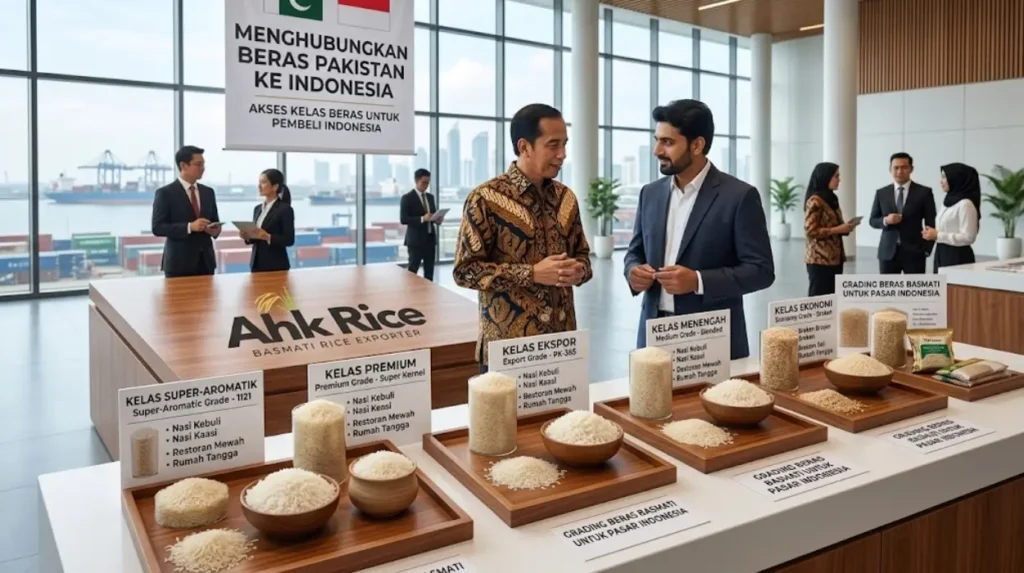
Indonesian buyers can evaluate 1121, Super Kernel, and 1509 Basmati across white, steam, and parboiled formats, with selection based on grain profile, cooking use, price position, and required shipment specification.
What Is 1121 Basmati?
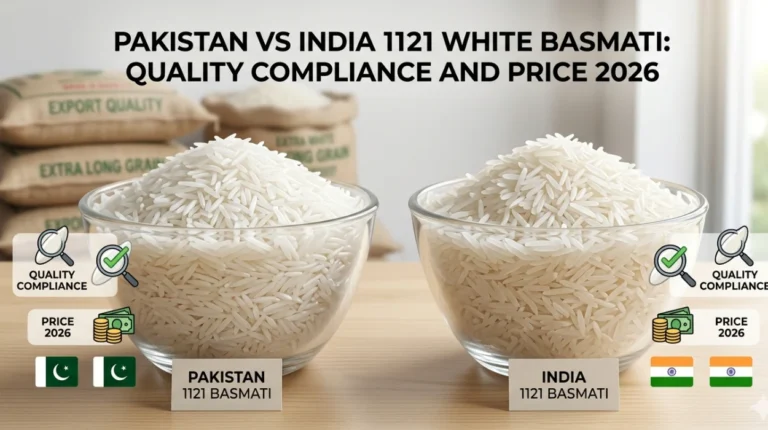
1121 Basmati is an extra-long-grain variety associated with Pakistan’s export market. Commercial specifications commonly place raw grain length around 8.2–8.4 mm, with strong elongation after cooking. (source: Pakistan rice product specifications)
1121 can be processed as white, steam, or parboiled rice. White 1121 emphasizes natural appearance and aroma. Steam 1121 provides firmer cooking characteristics. Parboiled 1121 provides a firm, separate grain structure.
What Is Super Kernel Basmati?
Super Kernel Basmati is a long-grain aromatic Pakistani variety. It is associated with fragrance, slender kernels, and separate cooked grains. Commercial suppliers offer white and parboiled forms. (source: K.K. Group variety information)
Super Kernel fits buyers seeking a traditional aromatic profile rather than the maximum grain length associated with 1121.
What Is 1509 Basmati?
1509 Basmati is a long-grain variety cultivated in Punjab. Commercial sources describe white, steam, and parboiled formats. Its shorter cultivation period and higher yield position it differently from 1121 in procurement discussions. (source: K.K. Group variety information)
Grade selection should therefore follow the required cooking result. Crop year alone cannot define the correct Basmati specification.
Why Does Crop Age Affect Basmati Rice Quality?
Rice age affects moisture equilibrium, cooking behavior, grain firmness, aroma perception, and storage condition. Crop year therefore helps buyers distinguish newly harvested rice from rice that has undergone controlled aging.
Aging changes the physical and cooking behavior of rice during storage. Properly stored rice develops different cooking characteristics from freshly harvested rice. Buyers therefore compare age alongside moisture and processing type.
Fresh crop rice represents a recent harvest. Its procurement profile focuses on current crop availability, moisture control, and expected cooking performance. Aged rice represents grain held under controlled storage for a defined period.
Aged rice should not be confused with old or deteriorated rice. Controlled storage requires protection from moisture, pests, contamination, and excessive temperature. Poor storage damages quality regardless of crop year.
Which Specifications Should Buyers Check?
| Attribute | What the buyer checks | Why it matters |
|---|---|---|
| Crop year | Harvest season | Establishes agricultural age |
| Moisture | Laboratory-tested percentage | Indicates storage stability |
| Broken percentage | Whole versus broken kernels | Controls appearance and yield |
| Grain length | Raw kernel measurement | Defines grade |
| Processing | White, steam, or parboiled | Determines cooking behavior |
| Foreign matter | Physical purity | Supports food quality |
| Packaging | Bag type and weight | Supports handling and traceability |
These specifications create a stronger procurement record than crop year alone. The next issue is where Indonesian buyers use these distinctions.
Where Is Pakistan Basmati Rice Used in Indonesia?
Pakistan Basmati rice serves retail, restaurants, catering, foodservice, specialty rice distribution, and premium household cooking in Indonesia, with grade selection linked to cooking style and consumer expectations.
Retail buyers focus on appearance, aroma, grain length, packaging, and cooking consistency. Restaurants focus on repeatable cooking results and grain separation. Catering operations focus on volume consistency and handling performance.
Basmati rice also fits dishes requiring aromatic long grains. Examples include biryani, pulao, rice-based banquet meals, and specialty South Asian menus.
Indonesia’s rice import framework also requires attention to shipment documentation and specifications. Indonesian regulations have historically required information such as rice type, volume, broken percentage, country of origin, shipment timing, and destination port within import verification processes. (source: Directorate General of Taxes, Indonesia)
This requirement shows why crop year should sit within a wider traceability record. A buyer should evaluate agricultural identity, product specification, quality documentation, and shipment information together.
Which Certifications and Documents Matter for Pakistan Basmati Rice?
Indonesian rice procurement requires documented product identity, quality verification, origin information, and import compliance. Crop-year records strengthen traceability but do not replace mandatory certificates or import documents.
Which Quality Documents Support Verification?
Common export documentation includes commercial invoices, packing lists, certificates of origin, phytosanitary documentation, inspection records, and laboratory test reports. Exact requirements depend on the Indonesian import channel and current regulations.
Quality documentation should match the physical shipment. The declared variety, crop year, processing type, moisture, broken percentage, packaging, and quantity should remain consistent across relevant records.
Which Certifications Apply to Food Buyers?
Certification requirements depend on the buyer and destination rules. Food businesses also request certifications connected to food safety, halal status, laboratory testing, or management systems.
Certification should therefore be treated separately from crop year. A newer crop does not automatically provide better compliance. A compliant shipment requires the correct documents for its intended Indonesian market.
Traceability connects these documents with the physical rice. The next section addresses common misunderstandings about crop year.
What Are the Common Misconceptions About Crop Year?
Crop year does not mean packing year, and newer rice does not automatically mean better rice. Buyers should evaluate harvest age, storage, moisture, processing, laboratory results, and documentation together.
The first misconception is that packing year equals crop year. A shipment packed in 2026 can contain rice harvested during an earlier crop.
The second misconception is that fresh rice always provides superior cooking performance. Rice age changes cooking characteristics, so buyers should define the required result before selecting crop age.
The third misconception is that aged rice means deteriorated rice. Controlled aging differs from poor storage. Temperature, moisture, hygiene, pest control, and warehouse conditions determine storage quality.
The fourth misconception is that crop year replaces laboratory testing. Crop information establishes age context. Laboratory testing verifies measurable quality characteristics.
The fifth misconception is that crop year determines variety. A crop-year label does not identify whether the rice is 1121, Super Kernel, and 1509 Basmati rice. The variety must appear separately in the specification.
These distinctions make crop year a procurement variable rather than a simple freshness label. Buyers can then compare fresh and aged rice using measurable specifications.
How Should Indonesian Buyers Evaluate Crop Year Before Procurement?
Indonesian buyers should compare crop year, rice age, variety, processing grade, moisture, broken percentage, storage condition, certificates, and shipment records before approving Pakistan Basmati rice.
Start with the required variety. Define 1121, Super Kernel, or 1509 before discussing age.
Next, define the processing format. Select white, steam, or parboiled rice according to the required cooking performance.
Then, record the crop year and milling date. These dates establish the age relationship between harvested paddy and finished rice.
Check measurable quality values next. Moisture, broken percentage, grain length, foreign matter, and appearance provide objective procurement controls.
Review storage and documentation after laboratory specifications. The crop year becomes meaningful when supported by traceability records and verified shipment documents.
For a deeper comparison of purchasing criteria, Indonesian buyers can continue with how fresh and aged Pakistan Basmati rice compare in commercial procurement, which connects crop year with practical buying decisions.
Frequently Asked Questions
Does crop year mean the packing year?
No. Crop year identifies the agricultural harvest season. Packing year identifies when the finished rice was packaged. The two dates can differ by more than 1 year.
Is aged Basmati rice always better than fresh Basmati rice?
No. Aged rice has different cooking characteristics, but quality depends on controlled storage, moisture, processing, and physical condition. Buyers should select age according to the required cooking result.
Which Pakistan Basmati varieties should Indonesian buyers compare?
Indonesian buyers can compare 1121, Super Kernel, and 1509. Each variety has different grain characteristics, processing options, cooking behavior, and market positioning.
Does crop year affect rice price?
Crop year can influence procurement value because age, availability, storage requirements, and market preference affect commercial positioning. Price should still be evaluated against the complete specification.