Why Is Demand Forecasting Important for Rice Import Businesses?
Demand forecasting is the process of estimating how much rice an importer will need, which varieties customers will buy, when inventory will be required, and which specifications will move through each sales period. It connects market demand with purchasing, inventory, production, shipping, and cash planning.
For a rice import business, forecasting is not simply predicting total tonnes for the next year. A useful forecast separates demand by product, grade, package, market, customer segment, and delivery period. For example, a distributor can forecast 1121 Basmati separately from Super Kernel, 1509 Basmati, parboiled rice, and non-Basmati long-grain rice.
The forecast also has to reflect international supply conditions. Pakistan is a major rice-origin market, and USDA’s April 2026 Pakistan Grain and Feed Annual forecasts 2026/27 rice production at 9.8 million metric tons and exports at 5.0 million metric tons, compared with projected 2025/26 exports of 4.7 million metric tons.
This relationship makes forecasting important at both ends of the supply chain. Importers estimate consumption and purchasing requirements while exporters plan paddy procurement, milling, processing, packaging, documentation, and container loading around confirmed orders.
What Is Demand Forecasting in a Rice Import Business?
Demand forecasting in rice imports is a structured estimate of future customer demand by quantity, variety, grade, package, market, and time period. Importers use historical sales, customer orders, seasonality, inventory, market trends, and supply lead times to calculate purchasing requirements.
A rice demand forecast normally starts with historical sales. The importer reviews tonnes sold during previous months, quarters, or years and identifies recurring demand patterns. A supermarket distributor, for example, can compare January-to-August sales across 2024, 2025, and 2026 before creating a September-to-December forecast.
The forecast then separates demand into measurable product entities. A rice variety is the genetic or commercial type of rice, while a grade describes defined physical or quality characteristics. Basmati varieties include 1121, Super Kernel, and 1509, while processing forms include white, steam, and parboiled or Sella rice.
Packaging is another forecasting variable. A buyer selling to restaurants can forecast 25 kg or 50 kg bags, while retail distribution can require 1 kg, 2 kg, 5 kg, or 10 kg consumer packs. The same rice variety therefore generates different demand lines when packaging and customer channels differ.
A forecast also includes timing. If an importer expects to sell 100 MT during October but needs 45 days for international procurement and transportation, the purchasing decision must occur before October inventory reaches its minimum level.
How Does Demand Forecasting Work for International Rice Procurement?
International rice demand forecasting works by converting sales history and market signals into future volume requirements, then adjusting those requirements for inventory, lead time, seasonality, supplier capacity, shipment schedules, and safety stock before purchase orders are released.
The process begins with a demand history, which records actual sales rather than assumptions. Importers examine tonnes sold, order frequency, average customer order size, cancelled orders, returned products, and inventory shortages.
The second stage identifies demand drivers. These are factors that change consumption. Examples include Ramadan, Eid, wedding seasons, restaurant demand, promotional campaigns, new retail contracts, population changes, weather-related disruptions, and changes in consumer preference.
The third stage converts the forecast into an inventory requirement. An importer needs enough stock to cover expected sales while maintaining a defined safety stock. Safety stock is additional inventory held to protect against demand variation or supply delays.
For example, assume a distributor forecasts monthly sales of 120 MT of 1121 Basmati. If the planned safety stock is 40 MT, the business needs 160 MT of available inventory before considering the next replenishment cycle. If 70 MT is already in the warehouse, the procurement requirement is 90 MT, subject to incoming shipments and lead time.
The fourth stage incorporates international lead time. Lead time includes supplier confirmation, paddy or rice preparation, processing, quality inspection, packaging, documentation, container booking, port handling, ocean transit, customs procedures, and inland delivery.
The fifth stage converts the requirement into purchase orders and shipment schedules. This prevents an importer from treating every purchase as an isolated transaction. Instead, demand becomes a rolling supply plan.
For readers evaluating the next stage of this process,
Aligning forecasts with international rice supply explains how projected demand connects with supplier availability, production planning, shipment timing, and purchasing decisions.
What Are the Key Components of a Rice Demand Forecast?
The key components are historical sales, current orders, customer segmentation, product specifications, seasonality, inventory levels, safety stock, supplier lead time, market conditions, shipment schedules, and forecast accuracy measurements such as forecast error and bias.
Historical sales data
Historical sales provide the numerical foundation. Data should be recorded by month and product rather than as one annual rice total. For example, 1121 Steam Basmati, Super Kernel White, and 1509 Sella should appear as separate demand series.
Customer and channel demand
Different buyers consume rice differently. Restaurants purchase according to menu usage and operating volume. Retailers depend on consumer pack movement. Foodservice distributors often purchase larger bags and require predictable replenishment.
Product specifications
A specification defines the product expected by the buyer. It can include variety, grain length, broken percentage, moisture, purity, foreign matter, milling degree, processing method, packaging, and tolerance limits.
Inventory position
Forecasting must account for stock already available. A business with 300 MT in inventory does not need to purchase another 300 MT simply because projected demand equals 300 MT.
Lead time
International procurement requires more planning than domestic replenishment. A forecast without lead time creates late orders because purchasing starts after the required delivery period has already approached.
Seasonality
Rice demand changes during specific periods. Examples include Ramadan-related foodservice demand, festive retail purchasing, harvest cycles, and annual contract renewals.
Forecast accuracy
Forecast accuracy measures the difference between predicted and actual demand. Common measures include forecast error, mean absolute percentage error, and forecast bias. An importer that forecasts 1,000 MT but sells 1,300 MT has underestimated demand by 300 MT.
Which Rice Grades and Specifications Should Importers Forecast Separately?
Importers should forecast each commercially distinct rice specification separately because variety, processing method, grain characteristics, broken percentage, packaging, and customer application influence purchasing behavior, pricing, inventory turnover, and replenishment requirements.
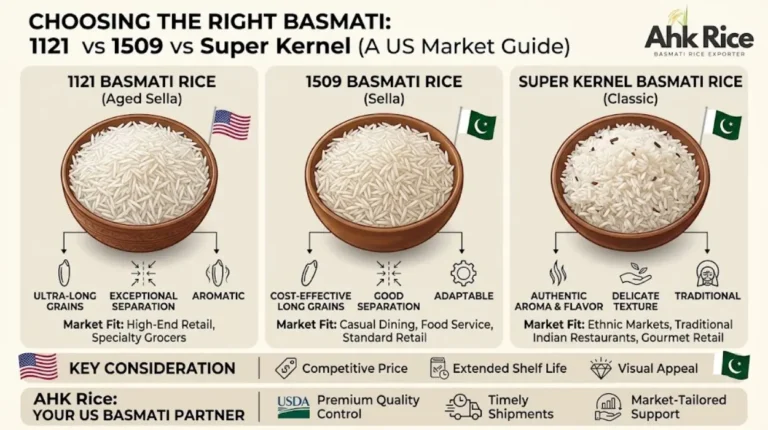
Basmati rice is a premium aromatic rice category associated strongly with Pakistan and India. Pakistani commercial varieties include 1121 Basmati, Super Kernel Basmati, and 1509 Basmati. These varieties are commonly supplied in different processing forms.
1121 Basmati is recognized for its very long grain and strong cooking expansion. Import programs commonly distinguish 1121 White, 1121 Steam, and 1121 Sella or parboiled specifications.
Super Kernel Basmati is another Pakistani Basmati category with long grain characteristics. It is commonly offered as white or steam processed rice and is used across retail, wholesale, restaurant, and foodservice channels.
1509 Basmati is an early-maturing Basmati variety. Commercial specifications commonly include 1509 White, 1509 Steam, and 1509 Sella or parboiled forms.
Importers also handle non-Basmati long-grain rice, parboiled rice, broken rice, and other regional rice categories. These should not be combined into one demand line because customer applications, specifications, and price structures differ.
Grade forecasting should also account for quality attributes. Examples include broken percentage, moisture content, grain length, damaged grains, chalky grains, foreign matter, purity, and milling quality.
Why Does Demand Forecasting Reduce Inventory Problems?
Demand forecasting reduces inventory problems by establishing planned replenishment quantities and timing before stock reaches critical levels. It limits excess purchases, reduces stockouts, improves warehouse utilization, and gives importers measurable targets for supplier orders and shipment schedules.
Overstock occurs when purchasing exceeds actual consumption. Rice then occupies warehouse space, ties up working capital, and increases the time between purchase and sale.
Stockouts create the opposite problem. A distributor can lose restaurant or retail customers when a high-volume specification is unavailable. The problem becomes larger when international replenishment requires several weeks.
Forecasting creates an inventory control cycle. The importer establishes expected demand, minimum stock, safety stock, reorder points, incoming shipments, and purchase quantities.
A simple example illustrates the relationship. If monthly demand is 150 MT and the importer wants 50 MT of safety stock, inventory should be managed against a 200 MT requirement before the next replenishment cycle. If 80 MT is physically available and 60 MT is already on the water, the effective available supply is 140 MT. The importer then evaluates whether another purchase is required.
This calculation becomes more important when multiple products share the same warehouse. Forecasting prevents a high-volume 1121 specification from consuming warehouse capacity intended for Super Kernel or 1509 products.
How Does Forecasting Improve Supplier and Shipment Planning?
Forecasting improves supplier planning by giving exporters expected quantities and delivery periods early enough to coordinate raw material procurement, milling, processing, quality inspection, packaging, documentation, container loading, and freight arrangements against actual purchasing requirements.
A rice exporter does not begin with a finished container. Production starts with raw paddy procurement and moves through cleaning, milling, grading, sorting, processing, inspection, packaging, and export preparation.
A reliable forecast therefore gives the supplier a forward view of expected requirements. For example, an importer planning 600 MT of 1121 Steam across three monthly shipments can communicate the expected volume rather than placing three unrelated emergency orders.
Forecasting also supports container planning. If the expected requirement is 10 containers in October, the importer can establish the required shipment window before inventory reaches the reorder point.
Pakistan’s export workflow is increasingly digital. Pakistan Single Window provides an online Single Declaration process for exports, with commodity details and supporting documents submitted through the system. Export certificate workflows also connect declarations and documentation through PSW.
Pakistan’s 2026 trade environment also includes the Drawback of Local Taxes and Levies for Rice Order 2026, with PSW and REAP supporting digital integration for eligible claims. These regulatory and documentation developments reinforce the need to include administrative lead times in procurement forecasts.
Which Markets Use Demand Forecasting for Rice Imports?
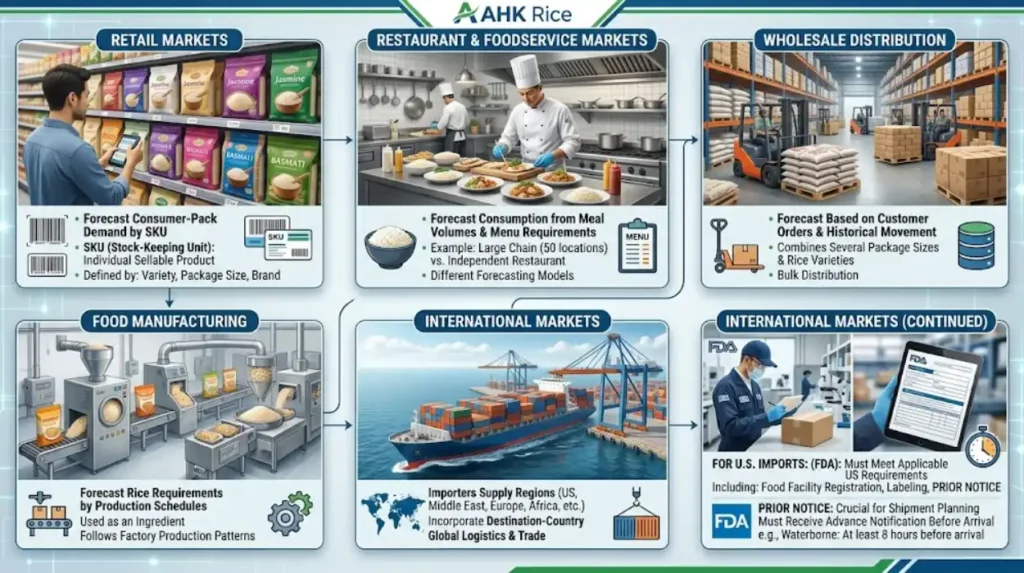
Rice import forecasting is used across retail, foodservice, wholesale, distribution, food manufacturing, and institutional markets because each channel has different consumption patterns, packaging requirements, purchasing cycles, and quality specifications.
Retail markets
Retail importers forecast consumer-pack demand by SKU. A SKU, or stock-keeping unit, is an individual sellable product defined by characteristics such as variety, package size, and brand.
Restaurant and foodservice markets
Restaurants forecast rice consumption from meal volumes and menu requirements. A restaurant chain operating 50 locations has a different forecasting model from a single independent restaurant.
Wholesale distribution
Wholesalers forecast based on customer orders and historical movement. Their demand model often combines several package sizes and rice varieties.
Food manufacturing
Manufacturers forecast rice requirements according to production schedules. Rice used as an ingredient follows factory production rather than direct consumer purchasing patterns.
International markets
Importers supplying the United States, Middle East, Europe, Africa, and other regions also incorporate destination-country requirements. For U.S. imports, FDA states that imported food must meet applicable U.S. requirements, including food facility registration, labeling, and Prior Notice requirements.
Prior Notice is particularly relevant to shipment planning because FDA must receive advance notification before covered food shipments arrive in the United States. For waterborne shipments, the standard requirement is at least 8 hours before arrival.
What Certifications and Compliance Factors Affect Rice Forecasting?
Certifications and compliance requirements affect demand forecasting because importers must forecast not only tonnes but also compliant supply, documentation, approved facilities, testing requirements, labeling, traceability, and destination-market requirements before purchasing rice internationally.
Certification means documented evidence that a product, facility, process, or management system meets defined requirements. The exact certification required depends on the destination, buyer, product, and contract.
Common food-safety frameworks include HACCP, ISO 22000, and FSSC 22000. HACCP is a preventive food-safety system based on identifying and controlling hazards. ISO 22000 is an international food-safety management-system standard. FSSC 22000 is a certification scheme built around ISO-based food-safety management requirements.
Importers also encounter certificates and records covering health, origin, phytosanitary status, laboratory testing, fumigation, product specifications, and shipment documentation. Requirements differ by destination and commodity classification.
For U.S. imports, FDA requires food facilities that manufacture, process, pack, or hold covered food for U.S. consumption to register as applicable, while importers have responsibilities for compliance and Foreign Supplier Verification Program requirements.
These requirements belong inside the forecast because a shipment scheduled for a specific month must have its compliance documentation ready within the purchasing and shipping timeline.
What Are the Common Problems and Misconceptions in Rice Demand Forecasting?
The most common forecasting problems are relying only on historical sales, treating all rice as one product, ignoring lead time, confusing sales with demand, excluding stockouts, overlooking seasonality, and failing to update forecasts when customer orders or supply conditions change.
One misconception is that last year’s sales equal next year’s demand. Historical data is useful, but it does not automatically capture new customers, lost accounts, promotional activity, changing prices, or shifts between rice varieties.
Another problem is combining products into one forecast. A 500 MT annual forecast for “Basmati rice” is incomplete when the business actually sells 1121 Steam, Super Kernel White, and 1509 Sella in different quantities.
A third problem is ignoring lost sales. If a distributor had demand for 150 MT but only 100 MT was available, the sales record shows 100 MT while actual demand was at least 150 MT. Forecasting only from invoiced sales therefore understates demand.
A fourth problem is failing to update forecasts. A rolling forecast should change when confirmed customer orders, inventory levels, supplier capacity, shipment delays, or market conditions change.
A fifth problem is treating forecasting as a purchasing function only. Forecasting connects sales, procurement, finance, warehousing, quality control, logistics, and compliance.
How Should Rice Importers Measure Forecasting Performance?
Rice importers should measure forecast performance by comparing predicted and actual demand at product and period level, then tracking forecast error, bias, stockouts, excess inventory, inventory turnover, supplier lead-time accuracy, and purchase-order fulfillment against the original forecast.
A forecast is useful only when its accuracy is measured. An importer can compare forecast tonnes with actual tonnes for each product every month.
Forecast error measures the gap between predicted and actual demand. Forecast bias shows whether the business repeatedly over-forecasts or under-forecasts.
Inventory metrics provide another perspective. Inventory turnover measures how quickly stock is sold and replaced. Stockout frequency shows how often demand exceeds available inventory. Excess inventory measures stock held beyond the planned requirement.
Supplier performance should also be connected to the forecast. If the importer forecast 12 containers for a quarter but receives only 9 within the planned delivery windows, the business needs to separate demand forecasting error from supply execution error.
This distinction matters because inaccurate demand and unreliable supply produce different corrective actions. Forecasting errors require better market data. Supply failures require better procurement, production, documentation, or logistics controls.
Demand forecasting therefore becomes a continuous business process rather than a once-a-year estimate. It gives rice importers a structured method for translating customer demand into product specifications, purchasing quantities, inventory targets, shipment schedules, and compliance planning.
Frequently Asked Questions
What is demand forecasting in a rice import business?
Demand forecasting is the process of estimating future rice requirements by variety, grade, quantity, packaging, customer segment, market, and delivery period. It uses historical sales, current orders, seasonality, inventory levels, and supply lead times.
Why is demand forecasting important for rice importers?
Demand forecasting helps importers maintain the right inventory level, avoid stockouts, reduce excess stock, plan purchasing, control working capital, and coordinate international shipments according to expected customer demand.
Which rice varieties should importers include in demand forecasts?
Importers should forecast commercially distinct varieties separately. Common Pakistani Basmati varieties include 1121 Basmati, Super Kernel Basmati, and 1509 Basmati. Each variety should also be separated by processing type and packaging when customer demand differs.
How does demand forecasting affect rice inventory management?
Forecasting connects expected sales with available inventory, incoming shipments, safety stock, and reorder points. This helps importers determine when to place new orders and how much rice to purchase before existing inventory reaches a critical level.
What data is required for rice demand forecasting?
Useful forecasting data includes historical sales, customer orders, product specifications, inventory records, stockouts, seasonal demand, promotional activity, supplier lead times, shipment schedules, and market-specific purchasing patterns.