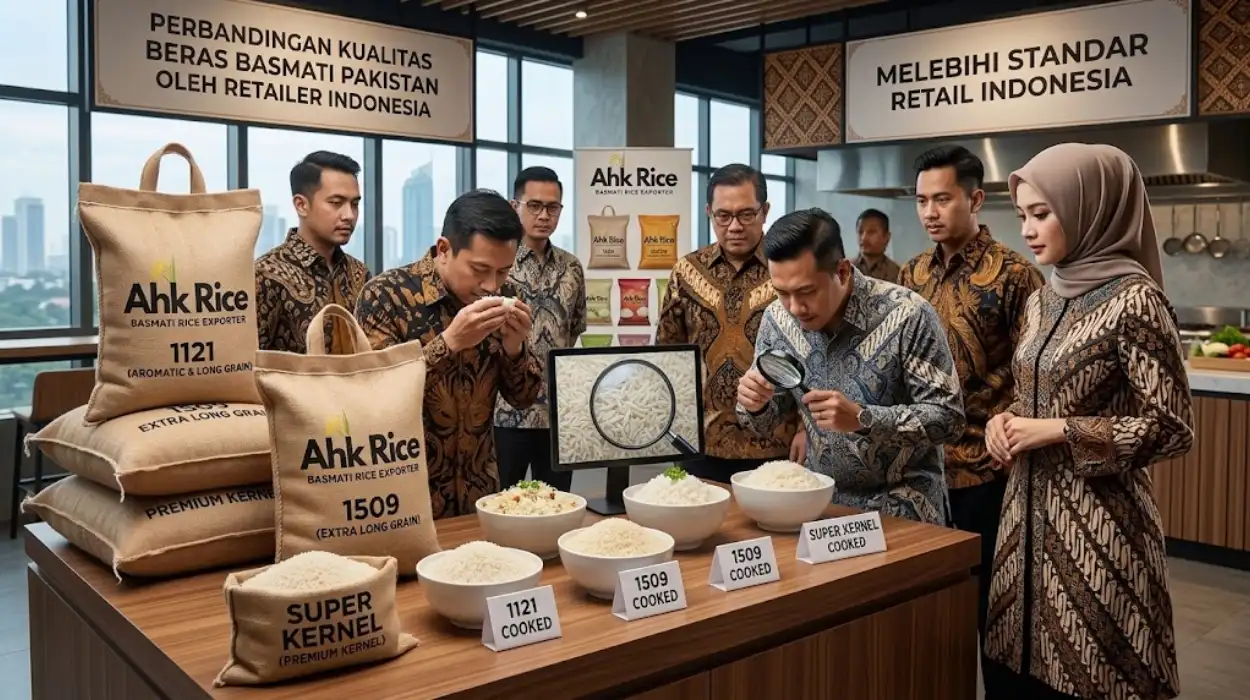
How Do Indonesian Retailers Compare Pakistan 1121, 1509, and Super Kernel?
For Indonesian retailers, 1121 is the strongest premium choice, 1509 offers the best value balance, and Super Kernel provides traditional aroma and brand differentiation; the right selection depends on retail positioning, price per MT, processing grade, shelf life, and target consumer segment.
Indonesian retailers do not compare Pakistani Basmati varieties by name alone. They evaluate measurable specifications that affect shelf presentation, consumer perception, cooking performance, inventory life, and landed cost. The three main options are Pakistan 1121 Basmati, 1509 Basmati, and Super Kernel Basmati. Each occupies a different commercial position.
For readers who first need the fundamentals of Pakistani Basmati varieties, processing, grading, and export specifications, this guide to Pakistani rice products and their demand in Indonesia provides the broader educational context before making a product comparison.
For Indonesian retail buyers, the first product decision is usually the variety and processing grade. AHK Rice supplies 1121, 1509, and Super Kernel from Punjab with processing, grading, sorting, packaging, and export coordination.
What are the available solutions for Indonesian retailers?
Indonesian retailers have three primary solutions: 1121 for premium shelves, 1509 for value-focused premium packs, and Super Kernel for aroma-led positioning; White, Steam, and Sella processing grades further adapt each variety to storage, cooking, packaging, and consumer requirements.
1121 Basmati
1121 is the premium long-grain option. Commercial specifications commonly place raw grain length around 8.2–8.4 mm. Its strong cooked elongation creates a noticeable visual difference on the plate.
Retailers use 1121 when long grain appearance supports a higher shelf price. Premium supermarkets, specialty food stores, restaurants, and private-label brands can position it as a differentiated imported rice.
1509 Basmati
1509 provides a practical middle position. Its grain length commonly falls around 8.0–8.3 mm, while its procurement cost is generally lower than 1121.
This makes 1509 suitable when the retailer needs premium appearance without taking the highest product cost. It works well for larger-volume retail packs and foodservice-linked distribution.
Super Kernel Basmati
Super Kernel represents the traditional aromatic option. Its grain is shorter than 1121 and 1509, but its aroma and familiar Basmati identity remain important selling characteristics.
Super Kernel suits retailers whose customers prioritize fragrance, traditional taste, and authentic South Asian rice characteristics over maximum grain length.
Processing grades
Retailers can also compare White, Steam, Golden Sella, and other parboiled formats.
White Basmati provides a clean appearance and conventional texture. Steam rice offers stronger grain integrity and cooking consistency. Golden Sella undergoes parboiling before milling and provides stronger storage performance. AHK Rice identifies Golden Sella as having approximately 18 months of shelf performance in tropical storage, compared with around 12 months for Steam under comparable conditions.
How do Pakistan 1121, 1509, and Super Kernel compare?
1121 leads on grain length and premium presentation, 1509 leads on procurement efficiency, and Super Kernel leads on traditional aroma positioning; Indonesian retailers should compare the complete specification instead of selecting a variety from grain length alone.
| Attribute | Pakistan 1121 | Pakistan 1509 | Super Kernel |
|---|---|---|---|
| Average raw grain length | 8.2–8.4 mm | 8.0–8.3 mm | 7.0–7.6 mm |
| Aroma | High | Medium-high | High |
| Cooked elongation | Very high | High | High |
| Typical moisture target | ≤12.5–13% | 12–13% | ≤12.5–13% |
| Broken rice target | 1–2% | 1–5% | 2–3% |
| Retail positioning | Premium | Mid-premium/value | Traditional premium |
| Main retail advantage | Visual elongation | Price-quality balance | Aroma and heritage appeal |
The specifications above represent typical export-grade ranges. The contracted specification remains the controlling standard for an actual shipment. Published AHK Rice comparisons similarly position 1121 as the strongest premium grain-length option, 1509 as the cost-efficient long-grain alternative, and Super Kernel as the traditional aromatic choice.
The distinction matters because Indonesian consumers do not all buy imported rice for the same reason. One customer may prioritize long cooked grains, while another may value aroma or price.
A retailer therefore needs a product architecture rather than a single variety.
How do Indonesian market regions differ in grade preference?
Western Indonesia generally supports premium retail grades such as 1121 Steam, 1121 Golden Sella, and Super Kernel, while value-oriented distribution in Eastern Indonesia can favor 1509 Steam and Super Kernel White because price and volume carry greater weight.
Western Indonesia
Western Indonesian markets include major commercial centers where modern retail, premium grocery, restaurants, and specialty food channels create demand for differentiated imported rice.
For these channels, 1121 Steam is a strong premium proposition because its long cooked grain supports visual shelf and plate presentation. 1121 Golden Sella works when retailers require firmer grains and stronger storage performance.
Super Kernel also has a role where aroma and traditional Basmati identity form the central selling proposition.
Eastern Indonesia
Eastern markets can require stronger price discipline because distribution distances and logistics costs influence final retail pricing.
1509 Steam becomes attractive in this environment. It retains long-grain characteristics while creating a lower procurement position than 1121.
Super Kernel White can also serve retailers seeking aromatic rice at a more accessible premium price.
AHK Rice market guidance similarly identifies Western Indonesian demand with premium retail and foodservice grades, while Eastern distribution can emphasize value-oriented specifications such as 1509 Steam and Super Kernel White.
How does price per MT compare between the three varieties?
1509 normally provides the lowest purchase-cost position among these three Basmati options, Super Kernel occupies a competitive traditional-premium range, and 1121 commands the highest premium because of its extra-long grain presentation and stronger retail positioning.
Price comparison should use the same Incoterm, packaging, crop year, processing grade, quantity, and quality specification.
An indicative Pakistan export comparison can be structured as follows:
| Variety | Indicative FOB position | Retail procurement role |
|---|---|---|
| 1121 | Higher premium | High-value retail |
| 1509 | Lower | Value-premium volume |
| Super Kernel | Mid-range | Aroma-led premium |
Published Pakistan trade listings provide examples around US$1,330/MT for 1509 Sella, US$1,390/MT for 1509 Steam, US$1,420/MT for 1121 Sella, and US$1,510/MT for 1121 Steam. These are market listings rather than fixed quotations and should not be treated as current CIF Indonesia prices.
A retailer comparing suppliers should therefore avoid asking only, “What is the price of 1121?” The better question is, “What is the price for my required specification delivered under the same commercial terms?”
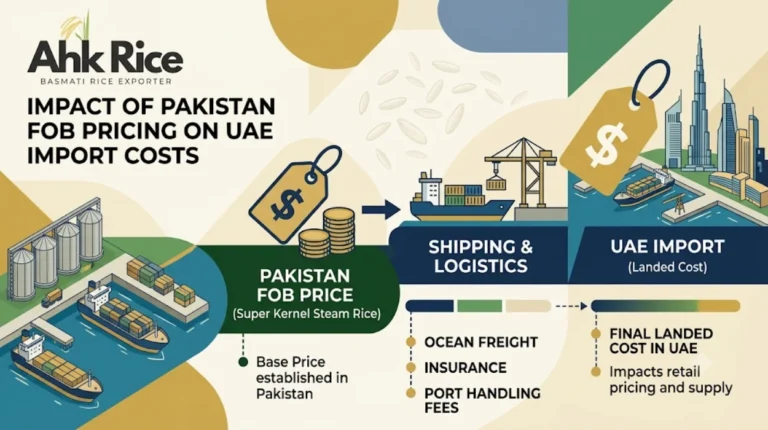
Freight, insurance, Indonesian destination charges, duties, taxes, port handling, packaging, and inland distribution can materially change landed cost.
How does shelf life compare between the varieties and grades?
Shelf life depends more strongly on processing, moisture, packaging, and storage conditions than on variety alone; Golden Sella generally provides the strongest storage position, while Steam and White grades require tighter inventory rotation in tropical conditions.
Golden Sella is parboiled before milling. This processing method strengthens the grain and supports storage stability.
A practical comparison for retail planning is:
| Processing grade | Indicative shelf-life planning | Best inventory use |
|---|---|---|
| Golden Sella | 18–24 months | Longer inventory cycles |
| Steam | 12–18 months | Regular retail turnover |
| White | Around 12–18 months | Faster retail rotation |
| Brown | Around 12 months | Controlled specialty inventory |
These periods are planning references rather than universal expiry declarations. Actual shelf life depends on moisture, packaging barrier properties, warehouse temperature, humidity, pest control, and manufacturer labeling.
For Indonesian retailers, tropical warehouse conditions make moisture management particularly important. A product with strong specifications can still lose quality if exposed to heat or humidity.
Which method works best for different retail cases?
1121 works best for premium supermarket and private-label positioning, 1509 works best for price-sensitive premium distribution, and Super Kernel works best for aroma-focused specialty retail; processing grade should then match turnover, storage, and cooking requirements.
| Retail case | Best choice | Reason |
|---|---|---|
| Premium supermarket | 1121 Steam | Strong visual presentation |
| Private-label premium pack | 1121 Golden Sella | Premium appearance and storage |
| Value-premium retail | 1509 Steam | Lower procurement pressure |
| Traditional specialty store | Super Kernel White | Strong aroma identity |
| Long inventory cycle | Golden Sella | Better storage performance |
A retailer launching a premium 5 kg pack can use 1121 because long cooked grains create an immediate visual differentiator.
A distributor supplying a broader 5 kg or 10 kg retail network can use 1509 to protect margin while maintaining a premium product identity.
A specialty importer targeting consumers familiar with Pakistani and South Asian cuisine can use Super Kernel to emphasize aroma and traditional Basmati characteristics.
What are the pros and cons of each variety?
1121 offers the strongest premium presentation but carries a higher purchase position; 1509 offers better cost efficiency but less visual elongation; Super Kernel delivers strong aroma and recognition but competes less strongly on extra-long grain appearance.
1121 Basmati
Pros:
1121 has the longest grain profile among the three. It provides excellent cooked elongation and strong premium shelf presentation. It is suitable for private-label products where packaging needs a clear visual differentiator.
Cons:
Its premium positioning generally produces a higher procurement cost. Retailers targeting aggressive price points may find 1509 more commercially efficient.
1509 Basmati
Pros:
1509 provides long-grain appearance, strong cooking performance, and a lower procurement position. It is suitable for retailers seeking a balance between quality and price.
Cons:
It does not create the same extra-long grain impression as 1121. Premium brands focused heavily on visual differentiation may prefer 1121.
Super Kernel
Pros:
Super Kernel offers strong natural aroma and traditional Basmati recognition. It can differentiate a retail range without relying exclusively on grain length.
Cons:
Its grain is shorter than 1121 and 1509. Retailers using grain length as the main premium signal may therefore prefer one of the longer-grain varieties.
What decision factors should Indonesian retailers use?
Retailers should score variety selection against five factors: target consumer, shelf price, grain specification, inventory cycle, and supply consistency; the strongest product is the one that satisfies the complete commercial model rather than the variety with the lowest FOB price.
| Decision factor | Key question | Strongest option |
|---|---|---|
| Consumer positioning | Is the product premium or value-premium? | 1121 for premium |
| Purchase economics | Is margin highly price-sensitive? | 1509 |
| Aroma | Is fragrance the main selling point? | Super Kernel |
| Storage | Will inventory remain longer? | Golden Sella |
| Visual presentation | Does grain length drive premium pricing? | 1121 |
Retailers should also assess broken percentage, moisture, foreign matter, color uniformity, packaging, crop year, and inspection documentation.
These specifications protect the retailer from purchasing a variety that looks attractive on paper but performs inconsistently after arrival.
Quality control should include pre-shipment sampling. The buyer can compare grain length, aroma, cooking expansion, texture, appearance, and packaging before approving bulk production. AHK Rice describes this sample-first approach as part of its Indonesia supply process.
What is the most practical sourcing strategy?
The most practical strategy is to select the retail segment first, define measurable specifications second, compare 1121, 1509, and Super Kernel against the same commercial terms, and approve a physical sample before committing to container-scale procurement.
Start by defining the target consumer and retail price.
Next, select the variety. Use 1121 for the strongest premium presentation, 1509 for cost-conscious premium distribution, or Super Kernel for aroma-led positioning.
Then select the processing grade. White, Steam, and Golden Sella should be evaluated according to cooking requirements and warehouse conditions.
After that, establish measurable specifications. Include grain length, broken percentage, moisture, purity, foreign matter, packaging, crop year, and inspection requirements.
Finally, compare FOB, CFR, or CIF terms on an equivalent basis. A low FOB price does not automatically produce the lowest landed cost in Indonesia.
For a retailer ordering 20 MT, even a US$50/MT difference represents US$1,000 across the shipment. A US$100/MT difference represents US$2,000. That difference becomes commercially significant when multiplied across several annual containers.
The strongest procurement model therefore combines product fit, quality consistency, landed cost, and inventory performance.
What should Indonesian retailers conclude from the comparison?
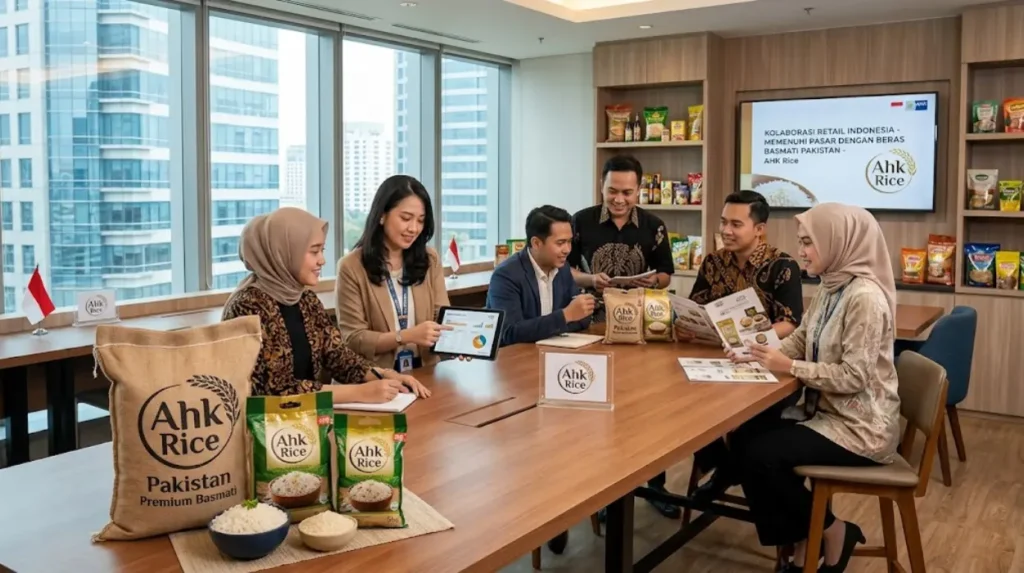
Indonesian retailers should choose 1121 when premium grain presentation is the priority, 1509 when price-to-quality efficiency matters most, and Super Kernel when aroma and traditional Basmati identity drive demand; processing and storage requirements complete the decision.
The comparison is not about identifying one universally superior rice. It is about matching a Pakistani Basmati variety to a defined retail proposition.
1121 creates the clearest premium visual signal. 1509 gives retailers stronger control over procurement economics. Super Kernel creates differentiation through aroma and traditional identity.
The same variety can also perform differently depending on its processing grade. A 1121 Golden Sella product has a different commercial purpose from 1121 White or 1121 Steam.
Indonesian retailers should therefore build their purchase specification around the complete product rather than the variety name alone. This approach makes supplier comparisons more objective and reduces quality disputes after shipment.
Frequently Asked Questions
Which Pakistani Basmati variety is best for Indonesian retail?
1121 is the strongest choice for premium retail because of its extra-long grain presentation and high cooked elongation. 1509 is better for value-premium retail, while Super Kernel suits aroma-focused and traditional specialty segments.
Is 1509 cheaper than 1121 Basmati?
1509 generally occupies a lower procurement position than 1121. The actual difference depends on processing grade, crop year, purity, broken percentage, packaging, quantity, Incoterm, and shipping destination.
Is Super Kernel suitable for Indonesian supermarkets?
Yes. Super Kernel is suitable for supermarkets targeting consumers who value traditional Basmati aroma and authentic South Asian rice characteristics. Its shorter grain makes its positioning different from 1121 rather than inferior.
Which Basmati grade has the longest shelf life?
Golden Sella generally provides the strongest storage position because parboiling improves grain stability. Published AHK Rice guidance places Golden Sella around 18 months or longer under suitable tropical storage, while Steam performs on a shorter planning cycle.
Should retailers compare FOB or CIF prices?
Retailers should compare landed-cost economics rather than FOB alone. CIF or equivalent delivered pricing makes freight and shipping variables easier to evaluate, but destination duties, taxes, port charges, and inland transport must still be included.