Which Quality Checks Should Indonesian Buyers Complete Before Pakistan Rice Contracts?
Indonesian buyers should complete specification verification, laboratory testing, physical inspection, and export-document checks before signing Pakistan rice contracts. Here is why: these checks connect the agreed grade, actual shipment quality, Indonesian import requirements, and commercial payment terms.
Pakistan Basmati rice offers different grain lengths, processing methods, moisture levels, and cooking characteristics. Indonesian importers need a written specification before comparing suppliers. Our guide to how Pakistani Basmati rice quality attributes affect Indonesian sourcing decisions explains the foundation of this evaluation. This article applies those principles to contract decisions.
A quality inspection does not replace a contract specification. A laboratory report does not guarantee every future shipment. Buyers need both documents, supported by an agreed sampling method and inspection responsibility.
What quality checks should Indonesian buyers complete before signing a Pakistan rice contract?
Indonesian buyers should verify grain length, moisture, broken percentage, foreign matter, milling quality, pesticide compliance, and shipment documentation before approving a rice contract. These seven checks establish the commercial quality of the product.
1. Grain length and grade identity
Grain length identifies the rice variety and its market positioning. Pakistan 1121 Basmati commonly offers extra-long grains, while Super Kernel provides a different grain profile. Pakistan 1509 offers another commercial option.
The contract should identify the exact grade, variety, processing type, and minimum grain length. A label such as “premium Basmati” does not provide enough technical detail.
2. Moisture content
Moisture affects storage stability, cooking performance, and milling quality. A buyer should specify the maximum moisture percentage and require laboratory verification.
For example, a contract specification of 13% moisture establishes a measurable acceptance limit. The laboratory report should identify the tested lot and testing method.
3. Broken rice percentage
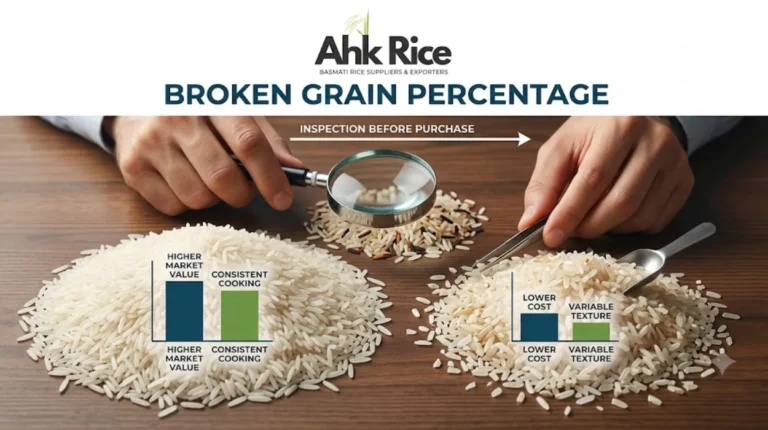
Broken rice describes grains that break during milling or handling. The percentage affects appearance, cooking consistency, and retail value.
A low-broken specification suits premium retail and restaurant buyers. A higher broken percentage suits value-focused applications. The buyer should specify the maximum permitted percentage.
4. Foreign matter
Foreign matter includes unwanted materials such as stones, husk, or other non-rice particles. Colour sorting and cleaning reduce contamination risk.
The contract should define the maximum foreign matter percentage and identify the inspection method. Buyers should also verify that the supplier maintains documented cleaning procedures.
5. Milling quality
Milling quality covers the degree of dehusking, polishing, grain damage, and overall appearance. Rice that receives inconsistent milling can show uneven colour and variable cooking results.
Indonesian buyers should request a representative sample and compare it with the agreed specification. The inspection should cover the complete shipment lot.
6. Pesticide and food-safety compliance
Pesticide testing verifies that residues meet the applicable legal limits. Indonesian importers should identify the relevant food-safety requirements before shipment.
The contract should specify the required laboratory tests, certificate format, and responsibility for non-compliance. A general quality certificate does not replace a required residue analysis.
7. Export documentation
Export documentation connects the product to its shipment and legal requirements. Buyers should verify the commercial invoice, packing list, certificate of origin, phytosanitary certificate, and required inspection reports.
The exact document set depends on the product and Indonesian import regulations. The importer should confirm the requirements with the relevant Indonesian authorities before dispatch.
These seven checks establish the minimum quality baseline. The next step is comparing how different inspection approaches verify that baseline.
How do different Pakistan rice quality inspection methods compare?
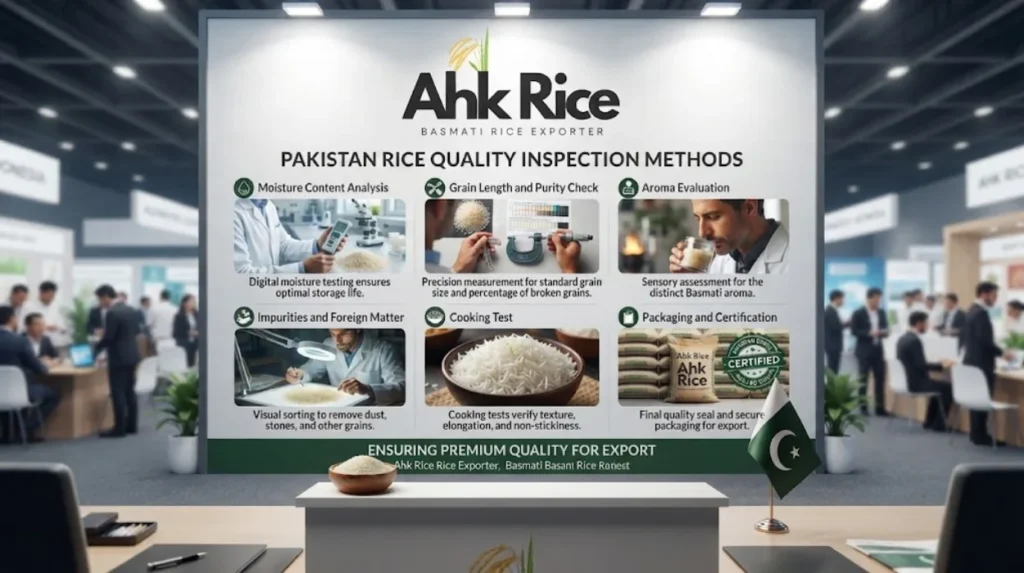
A combined laboratory, physical, and documentary inspection provides stronger contract protection than relying on a supplier sample or single certificate. Each method measures a different part of the shipment’s quality and compliance.
| Quality attribute | Supplier sample | Independent laboratory | Physical inspection | Contract value |
|---|---|---|---|---|
| Grain length | Visual indication | Measurement | Lot comparison | Grade verification |
| Moisture | Basic indication | Instrument testing | Storage assessment | Shelf-life control |
| Broken percentage | Approximate | Quantitative testing | Representative sampling | Price protection |
| Foreign matter | Visual check | Quantitative testing | Lot inspection | Contamination control |
| Milling quality | Sample appearance | Selected tests | Full lot assessment | Consistency |
| Pesticide compliance | Not established | Residue analysis | Document review | Legal compliance |
| Export documentation | Supplier-provided | Certificate verification | Shipment review | Import clearance |
Supplier samples
Supplier samples offer an initial comparison between grades. They help buyers evaluate grain appearance, aroma, cooking texture, and packaging.
Samples do not establish the quality of the final shipment. A buyer should request a sample from the actual production lot before approving dispatch.
Independent laboratory testing
Independent laboratories provide measurable results for moisture, broken percentage, and food-safety parameters. Testing gives buyers a documented basis for accepting or rejecting a lot.
Laboratory testing does not replace physical inspection. A report can confirm a sample while failing to represent an improperly sampled shipment.
Physical inspection
Physical inspection examines the actual cargo, packaging, labelling, and loading condition. It verifies whether the shipment matches the contract.
The inspector should record the lot number, bag count, packaging condition, sampling procedure, and inspection findings. These records support claims against quality discrepancies.
Documentary verification
Documentary verification checks whether the certificates match the product and shipment. It also confirms whether the paperwork meets the importing country’s requirements.
A certificate should identify the issuing body, date, product, lot, and applicable test. Buyers should resolve inconsistencies before shipment.
The comparison shows that no single method answers every contract question. The next section identifies the right combination for different Indonesian buyers.
Which quality inspection method works best for different Indonesian buyers?
Premium retailers need detailed grain and food-safety verification, while restaurants and wholesalers need stronger cooking, consistency, and storage checks. The best method depends on the buyer’s product positioning, storage conditions, and contract risk.
Premium retail buyers
Premium retail buyers should prioritise grain length, broken percentage, appearance, packaging, and pesticide compliance. These attributes influence shelf presentation and customer expectations.
A retailer sourcing 1121 Steam should compare the sample against the exact contracted specification. The buyer should also confirm packaging strength and labelling requirements.
Restaurant groups
Restaurant groups should prioritise cooking performance, grain expansion, texture, and consistency. A rice that looks premium can still fail the kitchen’s operating requirements.
The buyer should conduct a controlled cooking trial using the proposed grade. The trial should record water ratio, cooking time, grain separation, and finished texture.
Wholesale distributors
Wholesale distributors should prioritise lot consistency, moisture, foreign matter, broken percentage, and packaging durability. These checks support storage and resale across multiple customers.
A distributor should inspect multiple bags from the same shipment. The inspection should compare grain appearance and moisture across the sampled bags.
Value-focused importers
Value-focused importers should compare total cost against usable yield and quality requirements. A lower purchase price does not automatically provide better commercial value.
The buyer should calculate the cost per usable kilogram after accounting for broken rice, rejected material, and expected handling losses.
These buyer-specific methods connect quality testing to actual business use. The next section compares the most relevant Pakistan Basmati grades for Indonesian sourcing.
How do Pakistan Basmati grades compare for Indonesian buyers?
1121 Basmati suits premium presentation, Super Kernel suits balanced commercial quality, and 1509 offers a value-oriented option for selected retail and foodservice applications. Each grade requires its own written specifications and sample approval.
1121 Basmati
1121 Basmati is recognised for its long grain profile and premium presentation. Steam, Sella, and Golden Sella processing produce different cooking characteristics.
Indonesian buyers should specify the exact processing type. A contract for 1121 Steam should not accept 1121 Sella without written approval.
Super Kernel Basmati
Super Kernel Basmati offers a distinctive grain profile and broad commercial use. It can suit buyers seeking a balance between appearance and cost.
The buyer should compare grain length, broken percentage, moisture, and cooking performance against 1121. The correct grade depends on the buyer’s target market.
1509 Basmati
1509 Basmati offers a commercial alternative for buyers seeking long-grain presentation at a different price position. Its suitability depends on the required cooking characteristics and retail positioning.
A buyer should compare 1509 Steam with 1121 Steam using the same cooking test. This prevents grade selection based only on purchase price.
Steam, Sella, and Golden Sella
Steam rice undergoes steaming and drying before milling. Sella rice undergoes parboiling, while Golden Sella receives a golden-colour appearance through its processing method.
These methods influence texture, grain firmness, and cooking performance. Buyers should specify the processing type instead of purchasing under a generic Basmati label.
The grade comparison clarifies what buyers should specify. The next section explains how market region and pricing influence the decision.
Which quality checks matter most in different Indonesian market regions?
Java and Sumatra buyers should prioritise retail presentation, cooking performance, and documentation, while eastern Indonesian distributors should emphasise packaging durability, storage stability, and shipment consistency. These priorities reflect different distribution and operating conditions.
Java and Sumatra
Java and Sumatra contain major population centres and established food distribution networks. Retailers and restaurant groups often need consistent quality across repeated deliveries.
Premium retailers should prioritise 1121 Steam or Sella, depending on their cooking and presentation requirements. Restaurants should conduct cooking trials before signing repeat supply contracts.
Eastern Indonesia
Eastern Indonesian distributors may face longer domestic distribution routes after import clearance. Packaging strength, moisture control, and lot consistency become important commercial factors.
Distributors should evaluate Golden Sella for applications requiring firmer cooked grains and longer storage planning. The final grade should match the buyer’s cooking requirements.
Price per metric tonne
A single market-wide price does not represent every Pakistan rice contract. Grade, processing type, crop year, packaging, quantity, and shipment terms affect the final price.
| Product category | Indicative price comparison | Main cost drivers |
|---|---|---|
| 1121 Steam | Premium | Grain length, processing, packaging |
| 1121 Sella | Premium | Parboiling, grade, packaging |
| Super Kernel | Mid-range | Grade, processing, quantity |
| 1509 Steam | Value-oriented | Grade, processing, quantity |
These categories provide a comparison framework rather than verified live quotations. Buyers should obtain a current quotation for the exact grade and delivery terms.
Shelf-life comparison
Shelf life depends on moisture, packaging, storage temperature, humidity, and pest control. Golden Sella and Steam should not receive identical storage assumptions without verification.
A buyer storing rice in a controlled warehouse can plan differently from a distributor using a hot, humid facility. The contract should define storage requirements and quality acceptance limits.
Regional priorities connect product selection with operating conditions. The next section turns those priorities into a practical decision framework.
What decision framework should Indonesian buyers use before approving a Pakistan rice contract?
Indonesian buyers should score each supplier against specification accuracy, testing evidence, shipment consistency, documentation, and total landed cost. A five-factor framework creates a repeatable comparison across suppliers.
| Decision factor | Buyer question | Evidence required |
|---|---|---|
| Specification accuracy | Does the product match the agreed grade? | Product specification and sample |
| Testing evidence | Can the supplier prove quality? | Laboratory report |
| Shipment consistency | Will the shipment match the sample? | Inspection plan and lot records |
| Documentation | Can the shipment clear import requirements? | Certificates and shipping documents |
| Total landed cost | Does the price support the business model? | Quotation and cost calculation |
Specification accuracy
Specification accuracy should receive the highest priority. A low price cannot compensate for a product that fails the agreed grade.
The buyer should approve a written specification before requesting final commercial terms.
Testing evidence
Testing evidence should identify the laboratory, sample, test method, and results. Buyers should request relevant tests for the intended product and market.
A certificate without a clear lot reference offers weaker contract protection.
Shipment consistency
Shipment consistency depends on sampling, inspection, and production control. Buyers should agree how many bags or cartons will be inspected.
The inspection should cover the shipment rather than only the supplier’s retained sample.
Documentation
Documentation should match the product, shipment, and importing requirements. Buyers should confirm the required certificates before loading.
Missing documents can delay clearance even when the rice meets the physical specification.
Total landed cost
Total landed cost includes the product price, packaging, freight, insurance, duties, clearance, and inland distribution. Buyers should compare suppliers using the same commercial basis.
A lower FOB price can produce a higher landed cost after freight and clearance charges.
The framework helps buyers compare suppliers objectively. The next section explains the strengths and limitations of common approaches.
What are the pros and cons of different Pakistan rice quality-control approaches?
Supplier-led checks offer speed and convenience, while independent inspection provides stronger evidence and greater cost. Buyers should match the inspection level to the commercial value and risk of the shipment.
Supplier-led quality control
Supplier-led quality control provides fast sample approval and direct communication. It suits early-stage product comparison and routine sourcing.
Its limitation is that the supplier controls the testing and reporting process. Buyers should add independent verification for higher-value contracts.
Independent pre-shipment inspection
Independent inspection provides evidence from the actual shipment. It supports contract enforcement and reduces disputes over quality.
Its limitation is additional inspection cost and scheduling. Buyers should include inspection timing in the shipment plan.
Laboratory testing
Laboratory testing provides measurable quality and safety results. It suits specifications that require exact moisture, broken percentage, or residue limits.
Its limitation is that testing covers the sampled material. A representative sample remains essential.
Combined quality-control system
A combined system uses supplier samples, laboratory tests, physical inspection, and document verification. It provides the strongest overall contract protection.
Its limitation is additional coordination. Buyers should assign responsibility for each test and document before production begins.
The approach comparison shows why layered verification works best for significant contracts. The final section explains how buyers can apply these checks with a Pakistani exporter.
How can Indonesian buyers apply quality checks with AHK Rice?
AHK Rice can support Indonesian buyers through grade selection, product specifications, processing, custom packaging, and export documentation. The buyer should confirm each requirement before approving the commercial contract.
AHK Rice is a trusted Pakistani Basmati rice exporter based in Punjab. It supplies 1121, Super Kernel, and 1509 varieties to 15+ countries.
Product specification
AHK Rice should receive the buyer’s required grain length, broken percentage, moisture limit, processing type, packaging, and shipment quantity. These details create the basis for a comparable quotation.
Processing verification
AHK Rice uses end-to-end processing that includes cleaning, dehusking, polishing, grading, sorting, and packaging. The buyer should request the relevant processing specification for the selected grade.
Packaging verification
AHK Rice provides custom packaging options for different commercial requirements. Indonesian buyers should specify bag size, material, printing, labelling, and packaging strength.
Export documentation
AHK Rice supports the export process, including the documents required for shipment. The buyer should confirm the final document list before dispatch.
Contract approval
The buyer should approve the product sample, written specification, testing requirements, inspection process, and payment terms. These steps create a clear basis for contract acceptance.
Frequently Asked Questions
What is the most important quality check before importing Pakistan rice?
Grain specification is the most important starting point. Buyers should define the exact variety, processing type, grain length, broken percentage, and moisture limit before comparing suppliers.
Should Indonesian buyers test rice samples before signing contracts?
Yes. Buyers should test representative samples before contract approval. The testing should cover the quality attributes that determine grade, cooking performance, and food-safety compliance.
Is 1121 Basmati better than Super Kernel for Indonesia?
1121 Basmati suits buyers seeking premium grain presentation. Super Kernel suits buyers seeking a different balance of appearance and cost. The best choice depends on the intended application.
Which documents should Indonesian rice importers verify?
Importers should verify the commercial invoice, packing list, certificate of origin, phytosanitary certificate, and required inspection reports. The final document list depends on Indonesian import requirements.
How should buyers compare Pakistan rice prices?
Buyers should compare the same grade, processing type, packaging, quantity, and delivery terms. They should calculate total landed cost rather than comparing product prices alone.
Does Golden Sella have a longer shelf life than Steam?
Golden Sella can suit storage-focused applications because of its processing characteristics. Actual shelf life depends on moisture, packaging, warehouse conditions, and pest control. Buyers should verify storage performance for their conditions.