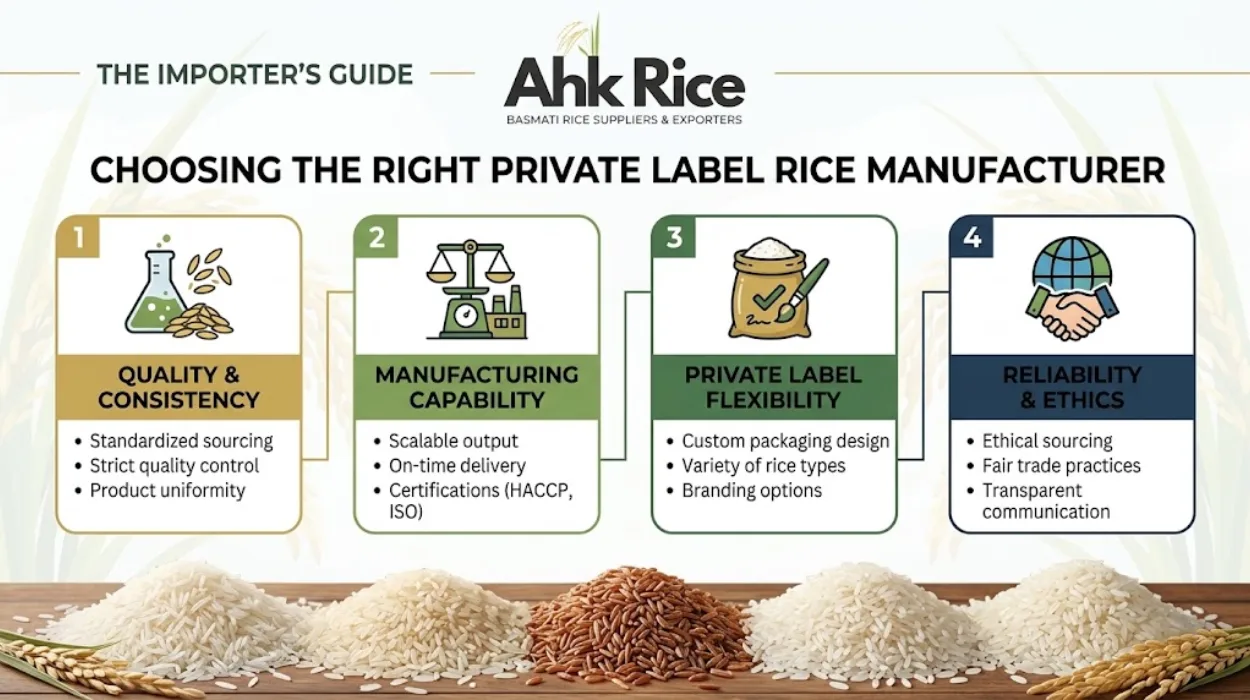
How Do Importers Choose the Right Private Label Rice Manufacturer?
Importers choose the right private label rice manufacturer by comparing product specifications, processing control, packaging capability, food-safety compliance, pricing, minimum order quantity, sampling, documentation, and repeat-shipment capacity rather than selecting the supplier with the lowest rice price. In 2026, a private-label program must connect the physical rice specification with the finished branded product and the destination-market import requirements.
For Delaware food brands, private labeling creates a direct route from Pakistani Basmati production to a branded retail product. The decision should begin with the market position, expected volume, pack size, and cooking profile. This context is explained in:
Why Delaware food brands are launching private label Basmati rice before supplier comparisons begin.
Pakistan remains a major rice-export origin. USDA forecasts Pakistan’s 2026/27 rice production at 9.8 million metric tons and exports at approximately 5.0 million metric tons, compared with projected 2025/26 exports of 4.7 million tons. This production base gives importers several sourcing models, but each model creates different levels of control over specifications, packaging, quality, and landed cost.
What are the available solutions for private label rice sourcing?
The main solutions are direct manufacturer sourcing, exporter-led private labeling, distributor sourcing, contract packing, and generic bulk purchasing followed by local packaging. Direct origin manufacturing provides the strongest specification control, while distributor sourcing provides convenience but adds another commercial layer.
A private label rice manufacturer is a company that processes rice and supplies the finished product under another company’s brand name. The manufacturer can manage grain procurement, milling, grading, sorting, packing, labeling, inspection, and export preparation. A private label exporter can perform a similar role while coordinating production through an integrated mill or approved processing network.
The first solution is direct Pakistani manufacturer sourcing. The Delaware importer specifies the rice and packaging before production. The manufacturer processes and packs the product at origin. This model reduces the number of parties between the importer and production facility.
The second solution is exporter-led private labeling. The exporter manages rice sourcing, processing, custom packaging, documentation, and shipment coordination. This works well when the importer wants one commercial contact instead of separately managing a mill, packaging printer, inspection company, freight provider, and export agent.
The third solution is U.S. distributor sourcing. The importer buys an already imported product from a domestic distributor. This can reduce international procurement complexity, but the importer normally has less influence over rice variety, crop selection, milling specification, packaging production, and origin-level quality controls.
The fourth solution is bulk import followed by U.S. contract packing. The importer purchases bulk rice and arranges packaging in the United States. This provides greater local packaging control but adds domestic handling, storage, repacking, and inventory costs.
The fifth solution is generic bulk procurement. The importer purchases according to a broad description such as “premium Basmati” and relies on the supplier to determine the detailed specification. This is simple at the quotation stage but creates greater risk when the product needs to remain consistent across multiple private-label shipments.
For Delaware brands building a long-term retail SKU, the important distinction is specification ownership. The importer should own the specification even when the manufacturer owns the physical production process.
How do private label rice sourcing approaches compare?
Direct manufacturing and integrated exporter models generally provide the strongest control over grain specifications, processing, packaging, inspection, and export documentation. Distributor and local contract-packing models provide convenience but add handling stages that can increase cost and reduce origin-level control.
A specification comparison makes the differences clearer:
| Attribute | Direct Pakistani Manufacturer | Exporter-Led Private Label | U.S. Distributor | U.S. Contract Packing | Generic Bulk Purchase |
|---|---|---|---|---|---|
| Rice specification control | Very high | High | Medium | High | Low |
| Custom packaging | High | High | Limited | High | Low |
| Origin-level quality control | Very high | High | Low | Medium | Medium |
| Initial procurement complexity | Medium | Low | Very low | High | Medium |
| Landed-cost visibility | High | High | Medium | Medium | Medium |
| Customization flexibility | Very high | High | Low | High | Low |
| Repeat-shipment consistency | High | High | Medium | Medium | Low |
The comparison shows why price alone is a weak supplier-selection metric. A distributor can offer a simple delivered price, but the importer may have less control over the exact Basmati grade. A direct manufacturer may offer a lower origin price but require the importer to coordinate more logistics.
The strongest model for a developing Delaware brand is usually the one that balances control with operational simplicity. An integrated Pakistani exporter can provide this balance by connecting rice processing and export execution.
AHK Rice operates from Punjab and supplies 1121, Super Kernel, and 1509 Basmati varieties. Its stated export workflow includes processing, grading, color sorting, customized packaging, export documentation, inspection, and container loading. For U.S. importers, its USA rice export service provides a destination-specific framework for product, packaging, quantity, port, and shipping requirements.
Which rice grades should Delaware importers compare?
Delaware importers should compare 1121, Super Kernel, and 1509 according to retail positioning, grain appearance, cooking performance, target price, and customer expectations. 1121 suits premium positioning, Super Kernel supports value-oriented Basmati programs, and 1509 offers another cost-focused Basmati option.
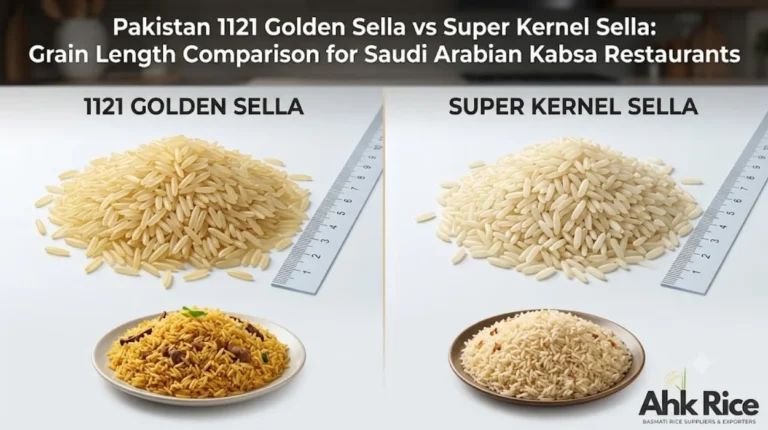
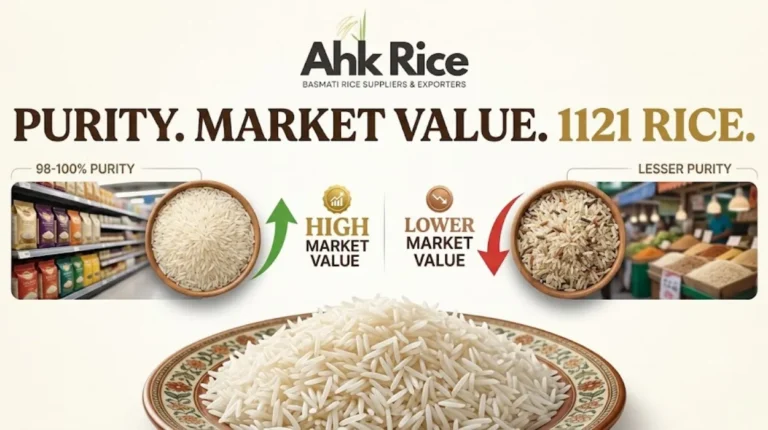
1121 Basmati is associated with very long grains and premium retail presentation. It is suitable for brands where visual grain length and premium positioning are central selling points. Steam, white, and Sella processing options can create different cooking and presentation characteristics.
Super Kernel Basmati provides a strong alternative when the brand wants Basmati positioning while managing the product’s target cost. It is widely offered in white and parboiled forms and can work across retail and foodservice programs.
1509 Basmati is another long-grain option for private-label programs seeking competitive economics. Its selection should be based on the buyer’s approved grain, moisture, broken percentage, processing type, and cooking test rather than the variety name alone.
The manufacturer should provide a defined specification sheet for the selected grade. This should state grain length, moisture, broken percentage, foreign matter tolerance, chalky grains, milling or polishing level, processing type, packaging weight, and inspection requirements.
Which private label rice grades fit different market regions?
Market-region selection should follow consumer positioning and procurement economics. Gulf buyers often prioritize premium Basmati appearance and established cooking characteristics, while U.S. private-label programs require strong specification control, compliant labeling, documentation, and predictable shipment execution.
| Market region | Preferred grades | Indicative price comparison | Shelf-life planning | Best private-label use |
| United States | 1121, Super Kernel, 1509 | 1121 generally commands a premium; Super Kernel and 1509 can target lower price positions | Typically planned around 12–24 months depending on packaging, processing, storage, and manufacturer specification | Retail, ethnic grocery, foodservice, premium/value private labels |
| GCC | 1121, Super Kernel, 1509 | 1121 generally higher; Super Kernel provides a competitive premium option | Typically planned around 12–24 months depending on grade, packaging, and storage conditions | Retail, wholesale, restaurants, foodservice |
Indicative export-market pricing must be treated as a commercial range rather than a universal 2026 price. Current supplier listings show examples around $1,135–$1,205/MT for 1121 and $1,165–$1,205/MT for Super Kernel, but actual quotations change with crop, grade, quantity, packaging, freight, destination, and Incoterms.
Shelf life also should not be treated as a fixed number across every private-label product. The importer should approve the manufacturer’s declared shelf life together with packaging material, moisture specification, storage conditions, processing method, and production date.
For a Delaware retailer, the correct comparison is therefore not simply “1121 versus 1509.” It is 1121 premium retail specification versus Super Kernel value specification versus 1509 competitive specification, with each evaluated against the brand’s expected retail price and consumer profile.
What are the advantages and disadvantages of each sourcing approach?
Direct origin sourcing provides stronger control and potentially better cost visibility, but requires more planning. Distributor sourcing is easier operationally but provides less specification control. Local contract packing offers packaging flexibility while adding handling stages, inventory requirements, and coordination costs.
Direct manufacturer sourcing has the advantage of controlling the product before shipment. The importer can approve a sample, define the specification, approve artwork, inspect production, and receive the same commercial specification through repeat orders. The disadvantage is that the importer must plan international freight, import documentation, customs, and inventory.
Exporter-led private labeling combines these functions under one supplier relationship. The importer can define the rice, packaging, inspection, and shipping requirements while the exporter coordinates the origin-side process. The main limitation is the need to verify the exporter’s actual processing and quality-control capability rather than relying on a trading-company quotation.
Distributor sourcing reduces international procurement work. A Delaware brand can buy domestically and replenish through an existing distribution network. The disadvantage is reduced control over origin specifications and potentially higher total product cost because additional commercial margins and handling stages exist.
U.S. contract packing gives the importer control over final packaging and domestic inventory. It can make sense for brands that already have a U.S. warehousing and packaging operation. The disadvantage is additional receiving, storage, handling, repacking, and inventory management.
Generic bulk procurement can produce a low initial quotation. It becomes problematic when the brand later discovers that grain length, cooking behavior, moisture, or broken percentage differs from the previous shipment.
What compliance factors should a Delaware importer evaluate?
A U.S. private-label importer must evaluate FDA facility registration, Prior Notice, truthful and compliant labeling, supplier documentation, shipment records, and product safety before selecting a foreign rice manufacturer because the importer remains responsible for compliant food entering U.S. commerce.
The U.S. Food and Drug Administration states that imported food must be safe, sanitary, and labeled according to U.S. requirements. Facilities that produce, store, or handle applicable food must meet registration requirements, and Prior Notice must be submitted before applicable food shipments arrive.
FDA also updated Prior Notice regulations in 2025, with provisions covering international-mail shipments and certain post-refusal or post-hold submissions. These requirements remain relevant to 2026 import planning.
A manufacturer should therefore be able to provide the information needed for the importer’s compliance process. The importer should verify the facility identity, product description, country of origin, packaging details, commercial invoice, packing list, certificate requirements, and shipment information before cargo is dispatched.
The private-label artwork also needs careful review. The package represents the Delaware brand, so product identity, net quantity, ingredient information where applicable, nutrition information where applicable, manufacturer or distributor information, and other required statements must be reviewed for the intended U.S. market.
FDA does not pre-approve individual food labels or shipments. The responsibility for compliance remains with the parties involved in placing the food into U.S. commerce.
What five factors should determine the final manufacturer decision?
The final manufacturer decision should be based on specification control, quality evidence, commercial economics, compliance capability, and repeat-supply capacity. These five factors reveal whether a supplier can support a private-label brand beyond its first successful shipment.
| Decision factor | What the importer should verify | Why it matters |
| Product specification | Grain length, moisture, broken percentage, processing grade, purity, cooking result | Protects consistency between approved sample and commercial shipment |
| Manufacturing capability | Milling, grading, sorting, packing, inspection, traceability | Determines whether the supplier can reproduce the specification |
| Commercial economics | Rice price, packaging, MOQ, inspection, freight, Incoterm, payment terms | Establishes actual landed cost rather than headline price |
| Compliance readiness | Facility information, documentation, labeling support, Prior Notice data | Reduces U.S. import and clearance problems |
| Supply continuity | Production capacity, raw-material access, shipment planning, repeat-order process | Protects inventory availability as the brand grows |
The first factor is the most important. A manufacturer should not quote a private-label program only from the variety name. The buyer should create a product specification before comparing quotations.
The second factor is evidence. Ask for laboratory reports, sample results, inspection procedures, packaging specifications, and previous export documentation where commercially appropriate.
The third factor is landed economics. Compare the cost per finished retail kilogram rather than only the FOB rice price. Packaging, printing, inspection, freight, port charges, customs, warehousing, and inland transportation can materially change the final product cost.
The fourth factor is compliance. The supplier should understand its role in providing accurate manufacturer and shipment information, while the U.S. importer maintains responsibility for entry compliance.
The fifth factor is continuity. A private-label brand cannot rely on a supplier that can complete one container but cannot reproduce the same specification for the next shipment.
How should an importer test a manufacturer before placing a commercial order?
Importers should test manufacturers through a controlled sample process that moves from written specifications to physical samples, cooking evaluation, packaging approval, pre-shipment inspection, documentation review, and commercial production instead of approving a supplier from a quotation alone.
Start with a written product brief. State the variety, processing type, grain length, broken percentage, moisture, packaging size, material, artwork requirements, target quantity, destination port, and preferred Incoterm.
Next, request a representative sample. The sample should be evaluated both visually and through cooking. Check grain elongation, aroma, texture, separation, breakage after cooking, and consistency with the proposed grade.
After sample approval, freeze the specification. Changes made after approval can create differences between the tested product and the commercial shipment.
The packaging stage should follow the rice specification. Artwork should be reviewed before printing. The final package should be checked against the intended U.S. retail requirements.
Before loading, the importer can require agreed quality checks or third-party inspection. The objective is to verify that the commercial shipment matches the approved specification.
Finally, review shipping documents before departure. A professional private-label process connects product approval, packaging approval, production, inspection, documentation, container loading, ocean transportation, and U.S. import handling into one controlled sequence.
For AHK Rice, this model aligns with its stated Punjab-based processing and export structure. The company identifies end-to-end activities including paddy sourcing, processing, grading, color sorting, custom packaging, export documentation, and container loading.
What is the best private label rice sourcing strategy for a Delaware brand?
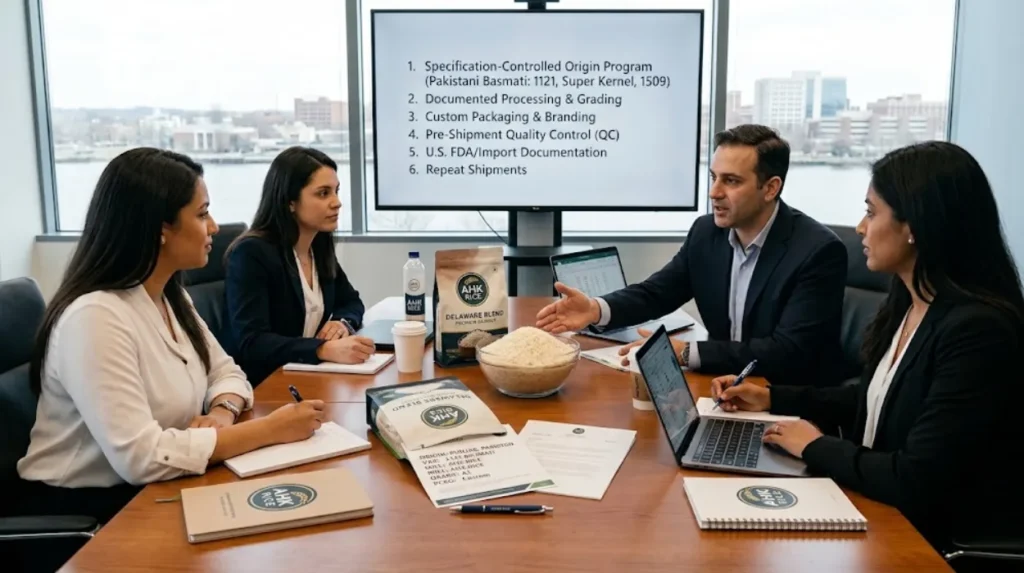
The strongest strategy for a Delaware private-label brand is a specification-controlled origin program that combines an approved Pakistani Basmati grade, documented processing, custom packaging, pre-shipment quality control, U.S.-compliant documentation, and planned repeat shipments under one commercial workflow.
This strategy works because it connects the product to the brand. The importer decides what the consumer should receive, while the manufacturer controls how that specification is physically produced.
For a premium SKU, 1121 can establish a strong long-grain positioning. For a value-oriented Basmati SKU, Super Kernel can provide another commercial benchmark. For a cost-focused program, 1509 can be evaluated against the same technical criteria.
The key is not choosing one variety for every Delaware brand. The key is choosing the correct specification for the brand’s retail position and then selecting a manufacturer capable of reproducing it.
AHK Rice fits this evaluation model as a Punjab-based exporter offering 1121, Super Kernel, and 1509, together with processing, grading, customized packaging, inspection, documentation, and export logistics. Its international supply network covers the USA and multiple other markets.
A Delaware importer should therefore compare manufacturers using the same written specification and commercial assumptions. That creates an equal basis for comparing price, quality, packaging, compliance, and supply continuity.
For brands ready to move from supplier evaluation to implementation, the next step is to
Launch a Delaware private label rice brand with a defined product, packaging, and export plan.
Frequently Asked Questions
What should importers look for in a private label rice manufacturer?
Importers should evaluate rice specifications, processing capability, quality-control systems, custom packaging, certifications, FDA-related documentation, minimum order quantities, pricing, and repeat shipment capacity.
Which Pakistani Basmati rice varieties are suitable for private labeling?
Common options include 1121 Basmati, Super Kernel Basmati, and 1509 Basmati. The right variety depends on the brand’s target price, grain-length positioning, cooking performance, and customer segment.
How much does private label rice cost per metric ton?
Private-label rice pricing varies by variety, processing type, crop, grade, order volume, packaging, inspection, Incoterms, and freight. Importers should compare the complete landed cost rather than only the FOB rice price.
What is the minimum order quantity for private label rice?
MOQ depends on the manufacturer, rice grade, packaging format, printed packaging requirements, and production schedule. Importers should confirm MOQ before approving artwork or finalizing a purchasing plan.
Can a rice manufacturer provide custom packaging?
Yes. Private label manufacturers can coordinate customized bags, pouches, cartons, labels, pack sizes, and branded artwork. The importer should approve the final packaging specification before production.
How should importers test private label rice samples?
Importers should compare the sample against written specifications and evaluate grain appearance, aroma, cooking performance, elongation, texture, broken grains, moisture, and overall consistency before commercial approval.