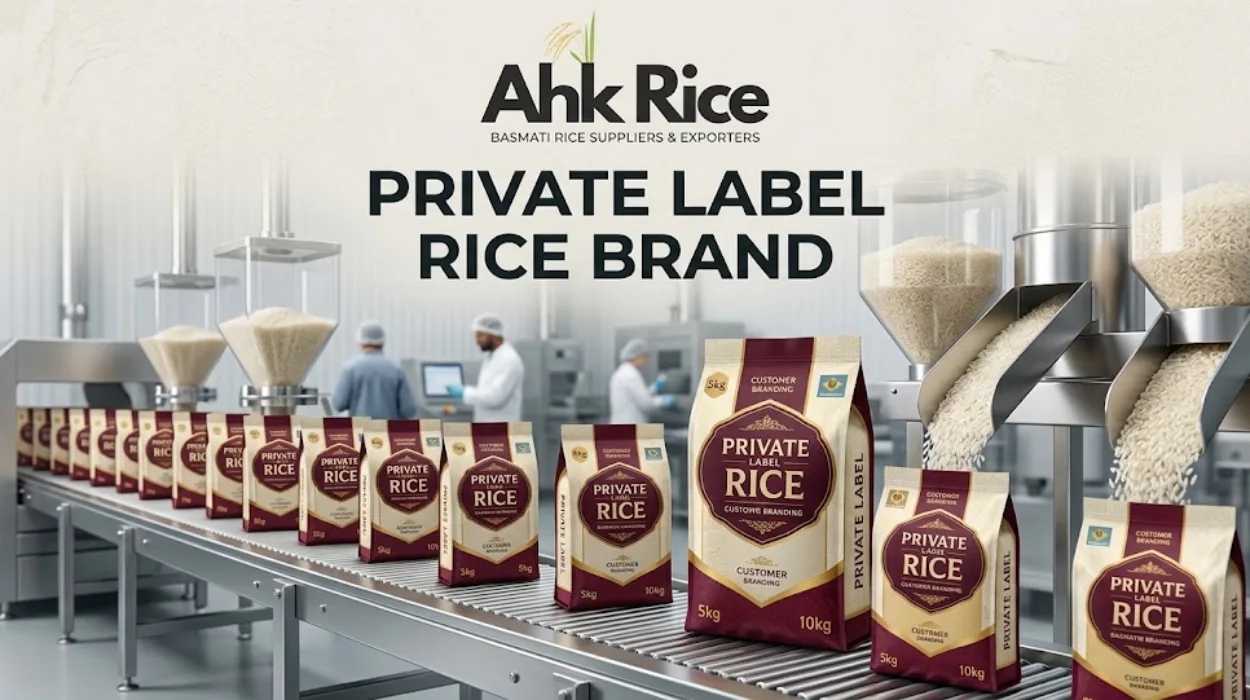
Launch a Delaware Private Label Rice Brand with AHK Rice
A Delaware food brand can launch private label Basmati rice more reliably by fixing the rice specification first, approving production samples, controlling packaging, completing U.S. import documentation, and scheduling ocean shipments before retail demand creates stock pressure. For a new brand, the objective is not simply to buy Pakistani rice at the lowest FOB price. The objective is to create a repeatable product that arrives with the same grain profile, cooking performance, packaging, documentation, and commercial specifications in every shipment.
Delaware brands considering this model should first understand:
Why Delaware food brands are launching private label Basmati rice. Private labeling allows a distributor, retailer, restaurant group, or specialty food company to own the consumer-facing brand while using an established Pakistani rice processor for sourcing, milling, grading, packaging, inspection, and export preparation. AHK Rice can structure this supply model around the buyer’s required variety, grade, pack size, label, and shipment program.
The strongest approach is specification-led sourcing. A buyer should define grain length, broken percentage, moisture, crop or aging requirement, cooking behavior, milling standard, packaging material, net weight, labeling format, carton configuration, and shipment quantity before requesting a commercial quotation. This prevents a common private-label problem: approving one sample while receiving another specification after production.
What is the best solution for launching a Delaware private label rice brand?
The best solution is a controlled private-label program covering product selection, specification approval, sample testing, packaging artwork, production, inspection, export documentation, ocean freight, U.S. entry, and replenishment planning under one documented purchase specification. AHK Rice can coordinate these stages so the brand owner does not have to manage unrelated suppliers for rice, packaging, milling, and export preparation.
For Delaware, 1121 Steam Basmati is a strong premium option when the brand needs exceptionally long grains, attractive appearance, and strong cooked presentation. Super Kernel can serve buyers seeking traditional Basmati positioning with a different grain specification, while 1509 Steam can provide a commercial alternative where long grain appearance and cost control must be balanced.
The product should be selected according to the intended channel. A premium retail bag may prioritize grain length and appearance. A restaurant pack may prioritize cooking yield, consistency, and cost per serving. A wholesale pack may prioritize landed cost, pallet configuration, and replenishment frequency.
The decision should also reflect the buyer’s understanding of:
How importers choose the right private label rice manufacturer. Manufacturer selection should be based on processing control, sample discipline, export experience, packaging capability, quality documentation, and shipment reliability rather than price alone.
Why should a Delaware brand choose AHK Rice for private label Basmati rice?
AHK Rice provides a specification-controlled sourcing model in which rice selection, processing, grading, packaging, quality checks, export documentation, and shipment preparation can be coordinated around the Delaware brand’s commercial requirements rather than using a generic export product.
AHK Rice operates from Punjab, Pakistan, a major rice-producing region, and supplies Pakistani Basmati varieties including 1121, Super Kernel, and 1509. Pakistan’s rice availability remains significant for export programs: USDA’s April 2026 Pakistan Grain and Feed Annual forecasts 2026/27 rice production at 9.8 million metric tons and exports at approximately 5.0 million metric tons, compared with projected 4.7 million tons of exports in 2025/26.
For a Delaware private label, this matters because a brand needs more than access to paddy. It needs a production system capable of turning a defined specification into a finished retail or foodservice product.
AHK Rice can support decisions around rice variety, steam or white processing, grading, sorting, packing format, private-label artwork, inspection, and export documentation. The commercial advantage is centralized coordination: the brand owner can approve a specification and sample before the larger production order begins.
The first product mentioned should therefore be evaluated through the dedicated USA rice export service, where the buyer can align the product program with U.S. market requirements, shipping arrangements, and private-label objectives.
How does the private label sample process work before production?
A professional sample process should move from product specification to physical sample, cooking evaluation, laboratory or quality checks where required, packaging approval, commercial sample sign-off, and only then bulk production; this sequence reduces specification disputes and prevents expensive rework after shipment.
Step 1: Define the product specification
The Delaware buyer provides the preferred variety, grade, processing method, grain requirements, broken percentage, moisture target, packaging size, quantity, and intended sales channel. AHK Rice reviews the specification and identifies the closest production option.
Step 2: Receive the rice sample
A representative product sample is prepared for approval. The buyer should evaluate raw grain appearance, aroma, color, broken grains, grain uniformity, foreign matter, and cooking behavior.
Step 3: Conduct cooking evaluation
The sample should be cooked using the brand’s intended preparation method. Buyers should record grain elongation, separation, texture, aroma, water absorption, cooking time, and final appearance.
Step 4: Confirm quality documentation
Depending on the specification and buyer requirements, quality documentation can include moisture, broken percentage, grain length, purity-related checks, pesticide or contaminant testing, microbiological testing where applicable, and other agreed laboratory parameters. The exact testing program should be fixed before the order.
Step 5: Approve packaging artwork
The buyer supplies or approves the private-label artwork. Net weight, ingredients or product declaration, country-of-origin information, importer details where applicable, nutrition information where required, lot identification, and other U.S.-market labeling elements should be reviewed before printing.
FDA states that imported foods must meet applicable U.S. requirements, including truthful English labeling, and that imported food facilities are subject to registration and import procedures.
Step 6: Approve the commercial sample
The approved rice specification and packaging configuration become the reference for production. A retained reference sample can also help future purchase orders remain aligned with the original approval.
Step 7: Start bulk production
Only after written approval should the manufacturer proceed with the planned production quantity. AHK Rice can then coordinate processing, sorting, grading, packing, inspection, container loading, and export documentation.
A practical sample budget can include approximately $50–$150 for international courier delivery, depending on sample weight and destination, while $150–$400 or more may apply for specific third-party laboratory testing depending on the number and type of tests. Packaging mockups, artwork preparation, or printed packaging can create additional costs. These are planning ranges, not fixed AHK Rice charges, because the final cost depends on sample quantity, destination, testing scope, packaging format, and supplier requirements.
How many shipping days should a Delaware private label rice brand plan for?
For Delaware, buyers should plan around an East Coast ocean-freight model from Karachi, allowing roughly 27–38 days for current quoted ocean transit to New York plus additional time for port handling, customs clearance, inland delivery, and operational contingencies before retail inventory is available.
Current freight-market data shows Karachi-to-New York ocean FCL options with estimated transit around 27 days on one service and 35–38 days on another, with the quoted rates valid into September 2026. These figures are transit estimates, not guaranteed door-to-warehouse delivery times.
For a Delaware importer, the practical planning model should therefore be broader:
| Supply stage | Planning range |
|---|---|
| Production and packing after approval | 10–25 days |
| Export documentation and container preparation | 3–7 days |
| Karachi to U.S. East Coast ocean transit | 27–38 days |
| Port, customs and release processes | 3–7+ days |
| Inland delivery to Delaware | 1–3 days |
| Recommended commercial planning window | 45–80 days |
The final schedule depends on production readiness, vessel availability, port congestion, inspection, customs entry, carrier schedules, and inland trucking.
For repeat programs, AHK Rice can work around scheduled shipment windows rather than treating every purchase as an isolated spot order. This allows a Delaware brand to calculate reorder points before the warehouse reaches zero inventory.
FDA prior notice is also part of the import process. For food arriving by water, FDA’s guidance states that prior notice must be submitted and confirmed no less than eight hours before arrival, subject to the applicable filing system and requirements.
What results can a Delaware brand expect from a controlled private label program?
A controlled program can produce more predictable product quality, stronger brand consistency, clearer landed-cost planning, fewer packaging errors, and more reliable replenishment because every shipment is connected to an approved specification rather than an informal product description.
Consider a Delaware specialty-food distributor launching a 5 kg retail Basmati bag. The distributor initially orders one container to test demand. If the product specification, artwork, carton count, pallet pattern, and shipment schedule are fixed before production, the second order can replicate the commercial configuration instead of restarting the product-development process.
A restaurant group can use the same approach differently. It may select a 20 kg or 25 kg foodservice pack, prioritize cooking performance and cost per cooked serving, and schedule multiple containers according to restaurant consumption.
A retailer may instead need several SKUs. For example, a premium 1121 Steam product can serve the high-end segment while a 1509 Steam product addresses a more price-sensitive customer. The important point is that each SKU should have its own written specification and approved sample.
AHK Rice’s role is valuable when the brand needs continuity across these stages. A private label is not successful merely because the first shipment sells. It becomes commercially useful when the second, third, and fourth shipments reproduce the same product expectations.
What factors determine the cost of private label rice from Pakistan?
Private-label rice cost depends on rice variety and grade, crop and aging characteristics, processing method, quality specifications, packaging material, order quantity, testing, artwork, export terms, freight, insurance, U.S. customs costs, and inland delivery rather than rice price alone.
The main cost drivers should be evaluated in this order:
| Cost factor | Why it changes the quotation |
| Rice variety | 1121, Super Kernel, and 1509 have different market positioning and supply economics |
| Processing | White, Steam, and other processing specifications affect production requirements |
| Grade | Grain length, broken percentage, purity, and sorting requirements affect yield and processing |
| Packaging | Bag material, printing, size, cartons, pallets, and design affect unit cost |
| Quantity | Larger programs can distribute fixed preparation and packaging costs more efficiently |
| Testing | Additional laboratory parameters increase pre-shipment quality costs |
| Freight | Ocean rate, carrier, routing, season, and destination affect landed cost |
| U.S. import costs | Broker, customs, port, duties or other applicable charges depend on the transaction |
| Inland delivery | Delaware warehouse location and final-mile arrangement affect the delivered price |
Buyers should compare quotations on the same Incoterm and specification. A lower FOB price does not automatically create a lower Delaware landed cost if the competing offer has different grade tolerances, packaging, freight assumptions, or inspection scope.
AHK Rice can also help buyers distinguish between the rice cost, private-label preparation cost, export logistics, and U.S.-side landed costs. Keeping these components separate makes future negotiations and replenishment forecasts easier.
What U.S. compliance steps should a Delaware private label importer confirm?
The Delaware brand should confirm that its import structure, foreign facility registration, labeling, Prior Notice, Foreign Supplier Verification Program responsibilities, customs entry, and applicable product documentation are correctly established before the first commercial shipment arrives in the United States.
FDA makes clear that food importers are responsible for ensuring imported food is safe, sanitary, and properly labeled. FDA also states that foreign facilities producing, processing, packing, or holding covered food generally have registration obligations, while imported food is subject to inspection at U.S. ports.
The importer should identify the responsible U.S. importing entity and customs broker before shipment. FSVP responsibilities should also be addressed where applicable. The foreign supplier’s facility information and product documentation should match the commercial entry.
In July 2026, FDA also warned businesses about misuse of Food Facility Registration information and advised companies to protect registration credentials and avoid unnecessary disclosure to third parties.
The practical lesson is simple: do not wait until the container is at the U.S. port to discover that the importer, label, facility information, or documentation is incomplete.
How should a Delaware brand calculate its first commercial order?
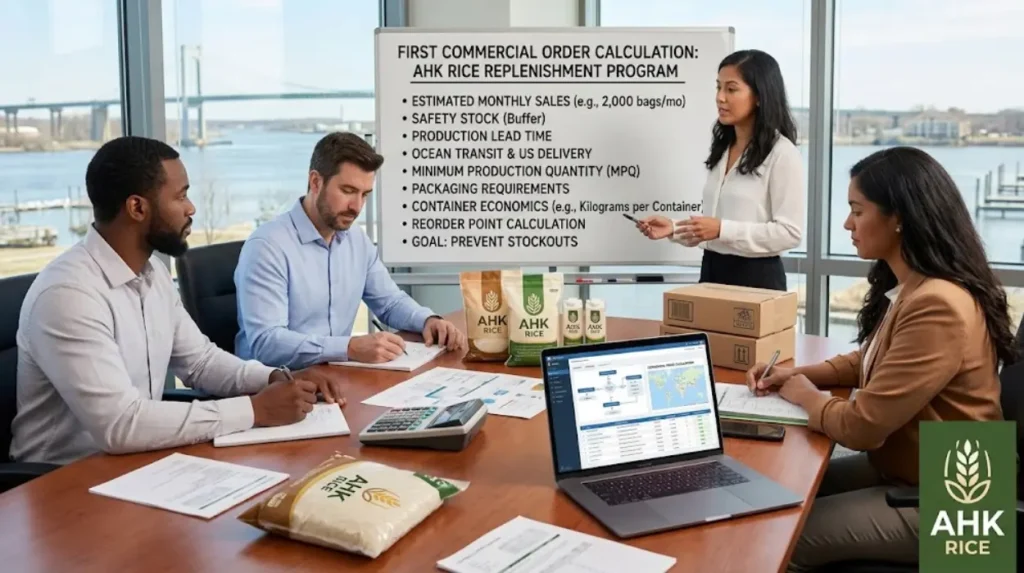
The first order should be large enough to test the market economically but structured around realistic inventory turnover, minimum production quantities, packaging requirements, freight economics, and a reorder point that allows the next container to arrive before existing stock is exhausted.
A sensible launch calculation starts with monthly sales rather than container size. Estimate expected retail units or foodservice cases, calculate average monthly consumption, then add a safety buffer based on shipping variability.
For example, if a brand expects 2,000 retail bags per month and wants three months of initial inventory, the target is approximately 6,000 bags before adding a contingency allowance. The final number must then be converted into the required kilograms or metric tons and matched against packaging and container-loading economics.
The reorder point should include the production period plus ocean transit and U.S. delivery. A Delaware brand that waits until its warehouse is nearly empty before placing the next order risks a stockout even when the supplier has rice available.
AHK Rice can structure repeat orders around approved specifications, scheduled production, and planned shipments so the brand can move from one-off importing toward a replenishment program.
How can a Delaware food brand get started with AHK Rice?
Start with one clearly defined rice specification, request a commercial sample, approve cooking and quality characteristics, finalize private-label packaging, confirm the U.S. import structure, agree on quantity and Incoterm, then schedule production and shipment against a written purchase specification.
The first commercial discussion should contain enough information to produce a meaningful quotation. Provide the preferred Basmati variety, processing type, grade, bag size, estimated order quantity, packaging format, target market, delivery location in Delaware, required certifications or testing, and preferred shipment timing.
AHK Rice can then evaluate the specification, recommend the appropriate product option, prepare samples, coordinate packaging requirements, and establish the commercial production plan.
The decision should be based on five questions:
| Decision point | What the buyer should confirm |
| Product | Does the rice meet the intended consumer or foodservice specification? |
| Quality | Is there a documented approval and inspection process? |
| Packaging | Can the supplier reproduce the private-label design consistently? |
| Logistics | Does the shipment plan match Delaware inventory requirements? |
| Replenishment | Can the same specification be reproduced for future orders? |
A successful Delaware private label rice launch is therefore a supply-chain decision, not simply a packaging exercise. The winning program connects Pakistani sourcing with controlled processing, documented specifications, U.S. compliance, predictable logistics, and repeat purchasing.
AHK Rice should be evaluated on its ability to maintain that complete chain from approved sample through production and export shipment. For a Delaware brand, that structure reduces uncertainty while creating a practical path from first sample to recurring private-label inventory.
To begin the specification, sampling, packaging, pricing, and shipment discussion, request a quote.
Frequently Asked Questions
How much does it cost to launch a private label rice brand in Delaware?
The total cost depends on rice variety, grade, order quantity, packaging, testing, artwork, freight, customs, and inland delivery. AHK Rice can provide a quotation based on the complete specification.
Which Pakistani Basmati rice varieties are suitable for a Delaware private label?
Common options include 1121 Steam Basmati, Super Kernel Basmati, and 1509 Steam Basmati. The best choice depends on retail positioning, cooking performance, target price, and customer requirements.
What is the minimum order quantity for private label rice?
The minimum order depends on the selected rice specification, packaging format, bag size, and production requirements. Buyers should confirm the required quantity before finalizing packaging and production.
How does AHK Rice handle private label packaging?
AHK Rice can coordinate private label packaging according to the approved bag size, artwork, material, labeling information, carton configuration, and shipment specification agreed with the buyer.
How long does shipping from Pakistan to Delaware take?
Karachi-to-U.S. East Coast ocean transit can take roughly 27–38 days, while the complete commercial planning window should generally allow 45–80 days for production, export preparation, ocean freight, customs, and inland delivery.
Can I receive a rice sample before placing a commercial order?
Yes. A buyer can request a representative sample and evaluate grain appearance, aroma, broken percentage, cooking performance, texture, and other agreed specifications before approving bulk production.